



Fara u kostela Povýšení svatého Kříže (Františkovy Lázně) Parish house
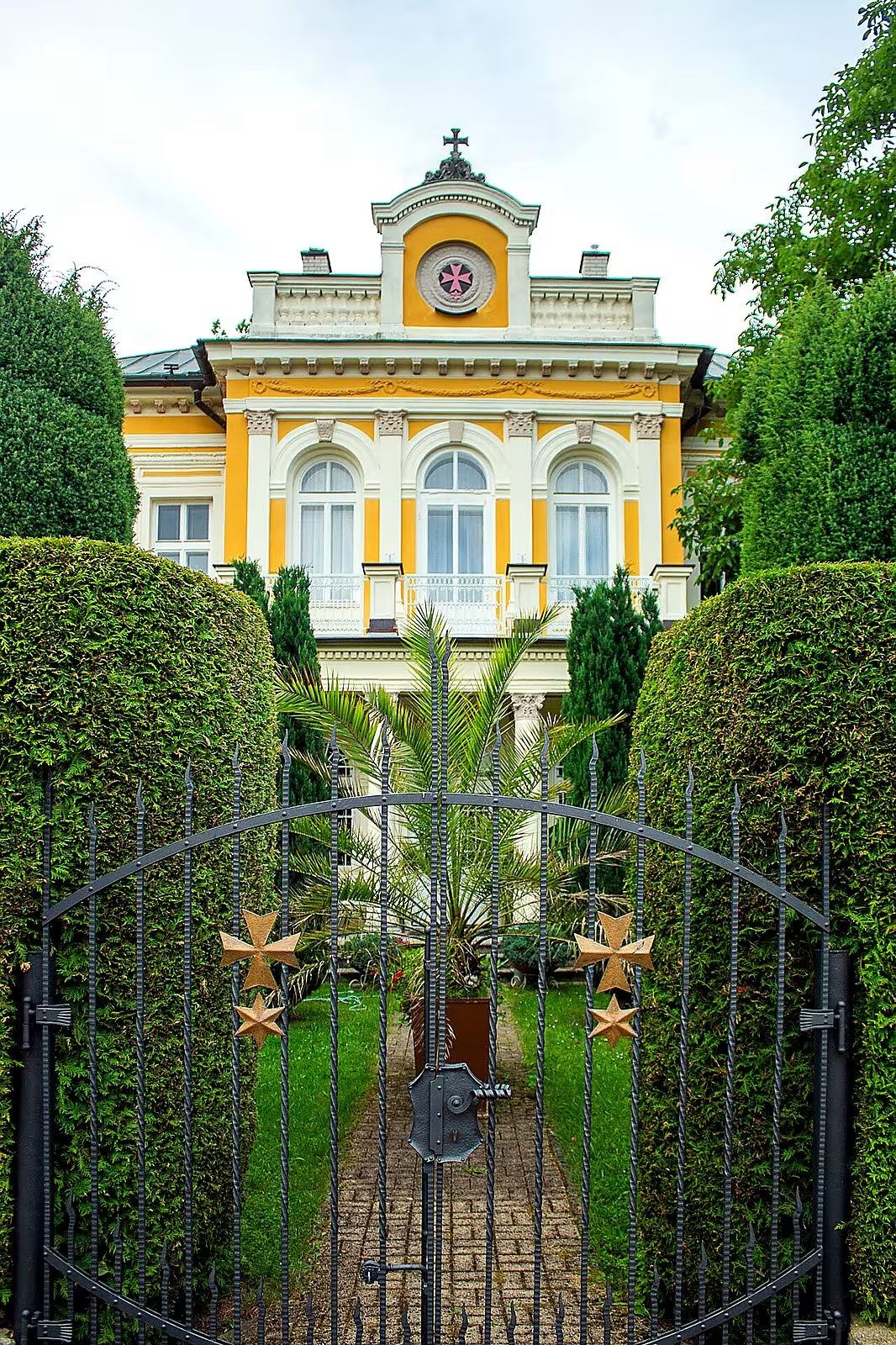
The parish near the Church of the Holy Cross in Františkova Lazne is a protected building from 1869. This object in the style of historical romanticism served as the seat of the vicar and is located near the church of the same name. It's part of the city conservation.
The construction of the rectory was called upon by the promotion of the village Františkovy Lázně to the city in 1865. In the meantime, he had managed the Artisan Order of Cruisers with a red star a local church that fell under the parish in the Upper Lomany. In 1868 it was decided to establish a new parish, which required the position of its own parish building. It was designed by architect Karl Wiedermann and built on the neighbouring grounds of the Empire Church a year later. The first priest became František Huspeka from the order of the cruisers.
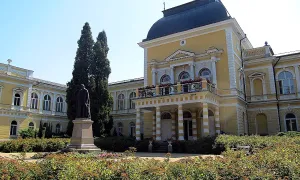
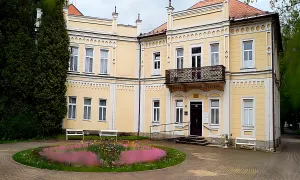
The building is built in the style of historical romanticism as a free-standing one-storey house with a rectangular plan and a saddle roof. The main facade is dominated by three-axis risalite, which on the ground floor forms a portician with columns of the Corinthians order and on the floor balcony with metal railing decorated with lace decoration. In the shield there is a sign of the order of cruisers with a red star.
The ground floor has flat bossages in the side parts and windows encapsulated by a semi-circle with stucco archives. There are barefoot pilasters in the corners, which go to pedestal pilasters on the floor. The windows on the first floor are rectangular and combined with stucco frames, post-docking fillings and mantelpiece. The medium risalite has windows with half-circular shambles between pilasters and a walled attachment.
The entrance to the building is from the side of the church. The small hall leads to a representative hall with a stone staircase, which serves as the main communication area. The main living room, the only room decorated with rich stucco decoration, is accessible from the hall towards the street. In the interior are preserved artistic and craft elements.
The building belongs to the Roman Catholic parish and is managed by the Order of Cruisers with a red star. Since 1992, the object has been officially protected.
The rectory represents an important architectural element of the historical core of the city and a demonstration of the nineteenth century. The preserved exteriors and interiors are evidence of the development of the spa cities at the time. We recommend visitors to look at the building in the context of the Church of the Holy Cross.
Historical milestones
- 1869
- construction of a parish building
- 1992
- the building is protected by monuments
Architectural development
The building was built in 1869 according to the Karl Wiedermann project in the style of historical romanticism. It is a one-storey house with a rectangular plan and a saddle roof. The facade is decorated with three-axis risalite with Corinthian columns and a balcony with a fine metal railing.
Historical events
1865 - promotion of Františkova Spa to the city; 1868 - Decision to create a new parish; 1869 - construction of a parish building; 1992 - declaration of a protected building.
Owners
Roman Catholic parish, managed by order of cruisers with a red star
Points of interest
The rectory was built in 1869. - It's a building in the style of historical romanticism. The architect of the rectory was Karol Wiedermann. - The first priest became František Huspeka from the order of the red star cruisers. - The rectory is part of the town conservation.
Guide
Show guide text
This text was created by artificial intelligence and has not been editorially reviewed. It may contain inaccuracies.
Welcome to Františkova Lazne, a place where healing springs with calm and spiritual reflections are bound from age. Right now, you're standing in front of one of the silent but prominent witnesses to the history of this city. In front of you is the parish building at the Holy Cross Church. Stop for a moment, take a breath and feel the atmosphere of this place. It's a place where day-to-day care meets the sanctity of the church office. When you look at this building, you don't just see an ordinary house, but the embodiment of the ambition and bloom that these baths experienced in the nineteenth century.
Let us now return together in time more than 150 years ago. Imagine 1869. It wasn't just an ordinary year for Františkovy Lázně. The village has just undergone a major change, has been promoted to a city, and with this new status came the need to create a new parish. The city grew, there were more visitors from different parts of Europe who came here to seek health and relief. With population growth and the importance of the city, it became necessary to create a dignified seat for the spiritual leader of the community. This year, in 1869, this rectory was built. It was not only a practical building for living, but it was to be a symbol of stability, faith and a new beginning for the whole parish.
Now pay attention to the very form of the building. If you look at her external appearance, you'll see traces of a style we call historical romanticism. This direction in architecture was very popular at the time because it returned to elements from the past but interpreted them with a new sensitivity and desire for beauty. The architect who designed this building was Karl Wiedermann. His intention was to create a space that would be harmonious and at the same time encourage respect. Look at the facade and see how this building is supplemented with the Church of the Holy Cross, located in the immediate vicinity. The rectory is not separated from the church by just a few steps, but it is connected to it by a deep sense. Together they form the spiritual center of the city, a place where people met in difficult times and in a time of joy.
When you look at the facade and the overall character of the building today, try to imagine what the pace of life was. The vicar served as the seat of the vicar, which meant that not only the priest's private life had taken place here, but people had been accepted, the parishioners' worries were addressed and festivities were planned. The first person to find his home in these walls and do his duty was František Huspeka. He wasn't just an ordinary priest, he was a member of the order of cruisers with a red star. This order has a long and noble tradition that is closely linked to care for the sick and the suffering. In the context of the spa town, where people came just to heal, the presence of a cruiser was very symbolic. So František Huspeka here did not only deal with religious rituals, but probably provided spiritual support to those who fought with diseases and sought hope of recovery.
Note that you are located in an area that is now part of the city conservation. This means that this building is not just an old house but a protected piece of culture to be preserved for future generations. The official recognition of its value came in 1992, when the rectory was declared a protected building. It is a recognition that Karl Wiedermann's proposal and history associated with František Huspeka are of lasting importance for the identity of Františkova Lazne.
You might find one interesting thing that carries the secrets of the time. Imagine the role the rectory played in 1869 when it was completed. At that time, the spa was a meeting point for various social classes. From the richest nobles to the simple people, everyone around the church and the rectory met. Fara was such a bridge between the spiritual world and the earthly world. It is fascinating to think how many secrets, prayers and wishes have been expressed in these walls over the past 150 years. Every stone of this building carries echoes of the voices of the people who sought comfort or counsel here.
Now, if you look at the building as a whole again, feel its calm. In today's rush world, this rectory acts as an island of stability. It is a reminder of a time when things were built in the light of eternity and when architecture should have expressed something more than functionality. The historical romanticism you see here encourages us to stop and think about our roots and what remains in our lives when time passes.
Now that you've come to know the story of this building, its architect Karl Wiedermann and the first vicar František Huspekou, I suggest you continue to explore the area. A few steps from you is the Church of the Holy Cross, which is inseparably linked to this parish. Take a moment of silence, walk around these historic buildings and see how history intersects with the present. Let yourself be guided by your curiosity and discover other hidden corners of this beautiful monument reservation.
Thank you for spending some time with us at the parish in Františkova Lazne. We hope this short trip to the past has helped you better understand the importance of this place. We wish you a pleasant rest of the day and many wonderful experiences while exploring our city. Goodbye.
Tips for visitors
Best time to visit the church parish The promotion of the Holy Cross in Františkova Lazne is a period of autumn when the atmosphere is calm and nature offers beautiful coloring. This time of the year also avoids sunny summer days, which may be disagreeable for some users.
When visiting the rectory, it is recommended to bring protective clothing, especially in colder months. It is also important to have a camera or mobile phone with you to capture the historical details of the building and surrounding greenery.
Photography of the rectory offers several attractive perspectives. The best light is usually in the early morning or evening when the sun illuminates the building from the side and highlights its architectural details. It is also recommended to photograph the Church of the Holy Cross, which is nearby.
In the vicinity of the parish you can visit the Church of the Holy Cross, which is a historical monument and offers a view of the urban landscape. For families with children it is advisable to explore parks nearby or visit local museums.
Frequently asked questions
Can the monument be visited?
This is a residential or farm building, not a museum with opening hours. Please view it from public space and respect the owners' privacy. We have no information about access to the interior.
Where is the monument?
Location: Františkovy Lázně. The map on this page shows the exact spot.
Why is the monument protected?
It is listed in the Central List of Cultural Monuments of the Czech Republic as a cultural monument (register no. 1000136864).
Businesses nearby
Do you run a restaurant, accommodation, shop, museum, rental, wellness or other visitor service near this monument? Show yourself directly to the people heading to it — this is how they will see you in the app and on the web:
Nearby
Kostel Povýšení svatého Kříže
Accommodation nearby
Themed route
Fara at the Church of the Holy Cross Type: Historical building, cultural monument. This building together with the church forms a unified architectural complex and offers a view of the traditional sacral building of the spa town. Visitors can enjoy a quiet atmosphere and details of the historical facade in the immediate vicinity of the main temple.
Church of the Holy Cross Type: Sacral monument, Baroque church. It is a dominant area that is closely linked to the parish building. The interior and exterior of this temple are an important part of the cultural heritage of Františkový Lazě and provide space for spiritual and aesthetic inspiration.
Tanks and immediate surroundings Type: Public space, historical installation. The space between the rectory and the church allows for a close-up tour and the capture of the relationship between these two buildings. This section of the route serves as a natural link between the points and allows you to relax and soak up the atmosphere of the historical centre.
Re-tour of the details of the Fara at the Church of the Holy Cross Type: Architectural study, photo stop. The final stop allows for more detailed examination of the facade and input elements of the rectory from a different perspective. In this way, the circle around this specific cultural unit shall be completed without the need to leave its immediate surroundings.
Seasonal recommendations
In spring, the surroundings of the rectory awaken to life and the garden around the church shines fresh greenery. The soft spring light highlights the facade details and creates a calm mood. We recommend to dress in several layers because the weather is variable. The visit in the morning will allow you to observe the awakening nature in peace.
The summer season brings bright sun and a full bloom of surrounding parks, which gives the place a joyous energy. Because of the spa season, there are more people, so it is best to come first thing in the morning to avoid the biggest crowds. Remember light summer clothes and sun protection during walks around the sights.
In autumn, the landscape around the rectory turns into gold and red tones, creating a nostalgic and quiet atmosphere. Morning fog gives the building a mysterious look. At this time it is advisable to choose waterproof shoes and a warm jacket. The number of visitors is falling, so you can enjoy peace and quiet.
In the winter, the rectory of the church is pristine and noble, especially if it is covered by a layer of snow. The atmosphere is cosy and quiet at advent time. It is necessary to wear warm winter clothes and warm shoes.
Visualizations and artistic views

The visualisations are generated by artificial intelligence and serve as inspiration.
Photos from the area
Real photos taken near the monument


Zdroj a licence jsou uvedeny u každého snímku.
Tips from visitors
No tips yet. Be the first!
Log in and add your tip.
Sources and literature
Photos: VitVit / CC BY-SA 4.0 — Wikimedia Commons. The author and licence also appear when you hover over the image.
Faktickým podkladem tohoto textu byl článek na Wikipedii, jehož autory jsou přispěvatelé Wikipedie. Článek je dostupný pod licencí CC BY-SA 4.0.
Location on the map
More monuments – Františkovy Lázně
Show all in the municipality
Příběhy a pověsti
Legendy, pověsti a příběhy spjaté s touto památkou
Fotografie návštěvníků
Zatím žádné fotografie. Buďte první, kdo přidá fotografii z návštěvy!
Log in a přidejte svou fotografii nebo hodnoťte.
Za ověřenou návštěvu v aplikaci získáte víc bodů — poznáme podle GPS, že jste na místě.
Reviews and comments