






Lázně II. / Císařské Swimming pool
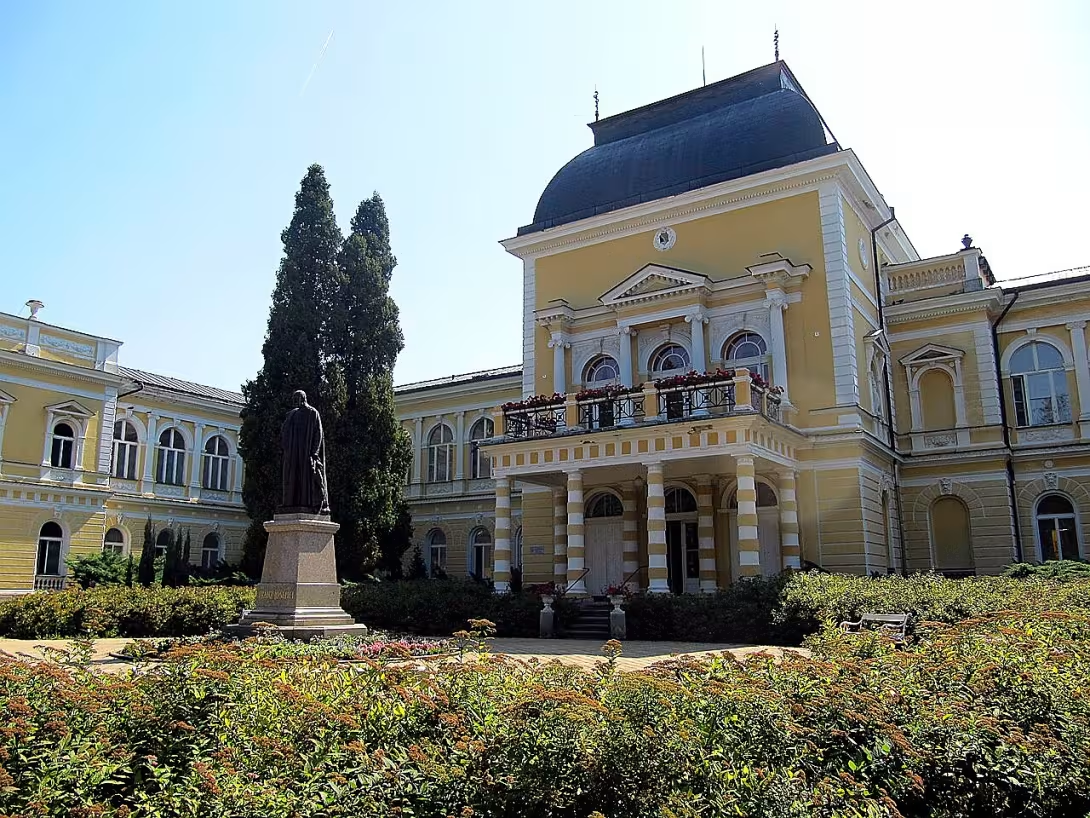
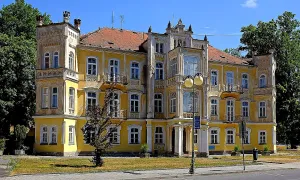
The Imperial Spa, originally known as Spa II (or Spa IV), is a neo-Renaissance building built in Františkova Lazne at No. 154. The project was developed by architects Karl Haberzettl and Gustav Wiedermann, with the construction being built by Petrograd banker and millionaire of Austrian-Hungarian origin Anton Singer. The building is characterized by a number of elements of a large urban scale, which contrasted the originally communal character of the spa site and dominated it.
The building had a private character from the beginning, but it failed financially and gradually changed owners. The decisive change came in 1903 when the city of Františkovy Lázně bought it. Since 1904 the city owned all four previously private spa areas. The original composition was inspired by the architecture next to the standing colonnade of the Salt and Lučí Spring, but with its own disposition: the side wings form an honest courtyard, with the building sensitively connected to the park areas with an open, castle character.
Architectural is a single-storey object with highlighted medium pavilion. The entrance is located in this very pavilion, который is covered with a massive Neck dome, thus gaining the character of a French neo-Renaissance. The facade is decorated with a balcony supported by four pairs of columns; above him is the sign of Františkova Spa. The entrance hall is decorated in Vienna's Neo-Renaissance style. Inside is a large hall with gallery, in side wings are located spa cabins. There was a circular swimming pool designed for water treatment in the rear tract.
Originally, the building was equipped with 120 spa cabins, a Prince's spa lounge, a large waiting room and a relaxation hall. Singer secured his own springs from Natalie's source and offered a massive arsenal of treatments: baths in mineral, carbonous and iron baths, salt and thermal treatments, electrotherapy, phototherapy, Roman-Irish and Russian steam baths, cold water treatments, massages, irigation and X-ray cabinet. In 1924, the spa was equipped with 90 vans for carbon and steel baths and 43 vans for saltwater baths. In the season, 50 to 80 thousand baths took place daily, more than any other spa complex.
The original Spa II was dangerously tilted over time and were demolished after World War II. The marking of Spa II was subsequently transferred to some Spa IV, i.e. the Imperial Spa. Today's building connects preserved historical interiors with the latest balnetics. It serves not only spa service, but also as a venue for concerts. The professional workplace provides traditional bacon bath according to the original recipe.
In front of the building there are monuments: a monument of working women from sculptor Karl Lidický, located in 1951 and a statue of emperor Franz Joseph I., which was moved here in 2004 from the interior of the main station in Prague.
Then and now
Drag the slider to compare how the landmark may have looked when it was built with the view today.
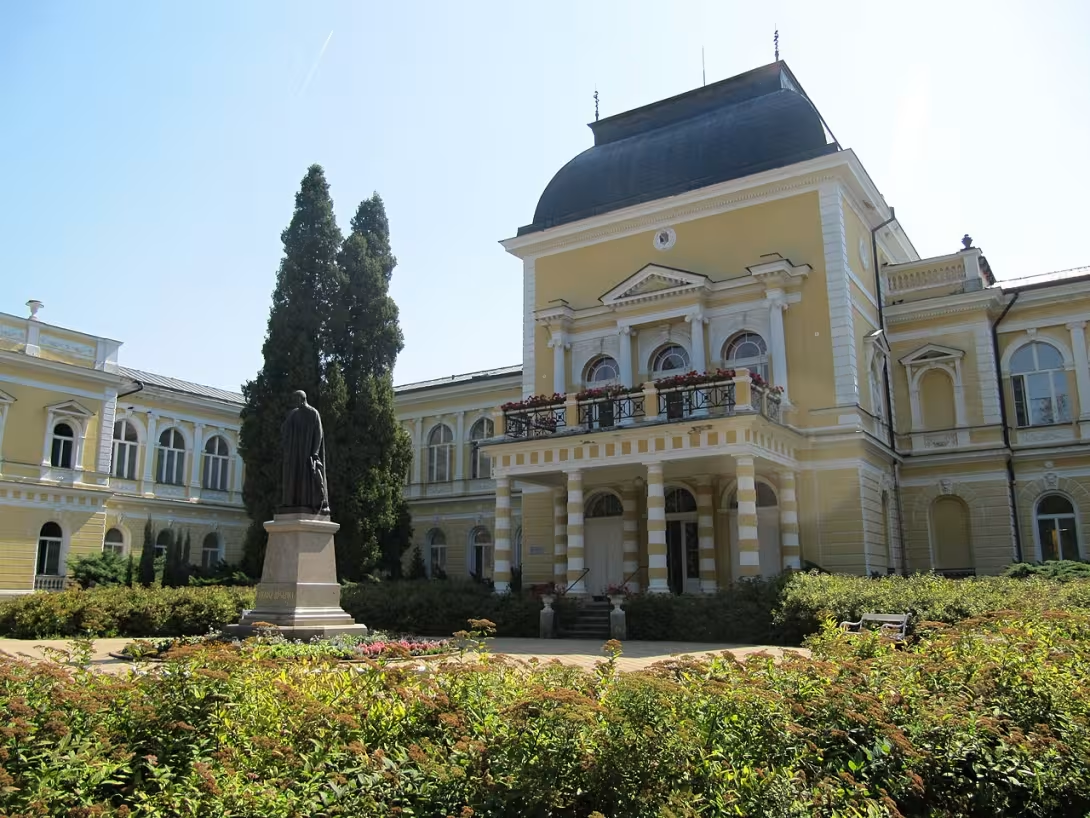

The historical appearance on the left is an AI-generated visualisation and serves as inspiration only.
Historical milestones
- 1878
- Beginning construction of the Imperial Spa.
- 1880
- Completion of construction.
- 1903
- Buying a spa city.
- 2004
- Location of statue of emperor Franz Joseph I. in front of the building.
Architectural development
It is a single-storey object with a highlighted medium pavilion and a necke dome in the style of French neo-Renaissance. The layout is inspired by the Colonnade of the Salt and the Lukeground Spring and creates an honest court. The interiors are decorated in Vienna's Neo-Renaissance style.
Historical events
1878- 1880: construction of the Imperial Spa; 1903: purchase of the spa by the city; 1951: location of the monument of working women.
Owners
Anton Singer (until 1903), city Františkovy Lázně (since 1904).
Points of interest
- The building is neo-Renaissance and its project was developed by architects Karl Haberzettl and Gustav Wiedermann. - The building was built by a Petrograd banker and millionaire Anton Singer. - 50 to 80 thousand baths took place daily in the season, which was more than in any other spa complex. - The entrance hall is decorated with Vienna's Neo-Renaissance style. - There is a monument of working women by Karl Lidický and a statue of emperor Franz Joseph I.
Guide
This guide is narrated by a synthetic voice generated by artificial intelligence.
Show guide text
This text was created by artificial intelligence and has not been editorially reviewed. It may contain inaccuracies.
Welcome to Františkova Spa. You are standing in front of one of the most important and beautiful building units this city has to offer. In front of your eyes is the monumental building of the Imperial Spa, whose presence in this space is so strong that it cannot be overlooked. Just by looking at its size and majesty, you can feel the weight of history in every stone and in every architectural detail. It is a place that carries the soul of old Europe, an era where the spa has become a symbol of the highest social status and unprecedented luxury. Feel the atmosphere of peace and nobility surrounding you while you look at this building triumph.
Let us now return together to the time when the foundations of this magnificent work were laid. To understand the importance of the building that you are currently facing, we need to move on to the end of the nineteenth century. It was 1878 when the construction started to be implemented, which was to change the face of the whole spa town. The main mover and visionary of this entire investment was not a local nobleman, but a Petrograd banker and a very successful millionaire Anton Singer. It was his ambition, his financial strength, and his desire to create something extraordinary that made it possible to create a complex that completely surpassed the spa world. Singer didn't just want an ordinary healing building; He wanted to create a monumental center to represent his success and the rise of the entire region. The construction lasted two years and was completed in 1880, which definitely established the golden age of the spa in Františkova Lazne. Later, in 1903, the spa took over the city, becoming a public treasure, but their original, spectacular character remained preserved for future generations.
Now pay attention to the architecture itself and to what you see right in front of you. This whole complex is the pinnacle of the Neo-Renaissance style. The project was developed by two recognized architects, Karl Haberzettl and Gustav Wiedermann, who put into their work a deep knowledge of classical rules and an effort for perfect harmony. If you look up now, you're going to see a massive Neck dome that dominates the whole neighborhood and gives the building its unmistakable and noble character. This dome acts as the crown of the entire building. Notice the central pavilion that forms the heart of the entire complex. The whole architecture of the building, with its emphasis on symmetry and monumentality, refers to the French style of neo-Renaissance. Feel the balance of the lines and the effort to express strength through architecture. At the time of its creation, the whole complex was equipped with the most modern technology known to mankind at the time to provide visitors with unprecedented comfort. It was a combination of artistic expression and the latest technological possibilities of its time.
When you look at this building, you might think what personalities were moving around. Besides the founder himself, Anton Singer, whose visionary spirit is felt in every detail of the building, there is also a figure that is directly visible. In front of the building is a statue of emperor Franz Joseph I. This monarch is a symbol of the era in which these spas were built and in which they experienced their greatest boom. The presence of his statue here is not random; It is a reminder of the time when Františkovy Lázně was the centre of the European social and political scene, a place where power and wealth met.
And now I'm going to introduce you to something that might really impress you and help you better understand the scale of this place. We often imagine the spa as quiet, quiet places to relax. But at the time of the greatest expansion of the Imperial Spa, it was rather a pulsating organism full of incredible activity. Did you know that during the season there were 50 to 80,000 baths every day? That's a number that's absolutely incredible. There was no other spa complex at the time. Imagine the constant movement, the mix of people from all over the world who were meeting here for treatment, but above all, for social life, for conversations in grandiose spaces and for the experience of luxury, which at the time was absolutely unique.
I hope that this brief insight into the past has helped you better understand the importance of the place you are facing. The Imperial Spa is not just a building of stone and mortar; are a monument to human ambition, wealth and the golden era of the spa. Continue to walk around this beautiful area, feel its atmosphere and be carried away by the beauty of Františková Lázna. Thank you for your attention and I wish you a pleasant continuation on your journey through history.
Tips for visitors
Best time to visit The Imperial Spa is autumn or spring when the weather is pleasant and parks around the spa complex offer beautiful green. This period also avoids many flying tourists, allowing you to enjoy peace and comfort.
Parking can be found in the vicinity of the spa, and we recommend checking the availability of the car parks online or at arrival. Public transport offers a comfortable connection with Františková Spa, specific options can be found in local search engines.
When visiting, it is advisable to bring sun protection clothes and shoes suitable for walking on the lawn, especially if you plan to explore the surrounding parks. Don't forget the water or some light food.
For photography it is best to wait for a sunny morning or evening when light is softer and shady. The most prominent photographic sites include the facade of the spa with water springs in the background and the park around the colonnades of the Salt and the Lukewarm spring.
In the vicinity of the Imperial Spa you can visit the Spa Park, where there are colonnades and monuments for working women. The park offers a beautiful opportunity for relaxation and walking in peace. For families with children it is advisable to consider visiting the park where children can play and enjoy the outdoor environment.
Frequently asked questions
Is Lázně II. / Císařské open to the public?
Yes, Spa II is generally open to the public, but it is recommended to inform us first about possible restrictions or events on the official website.
How do I get to the place by car / public transport?
Spa II can also be visited by car, but parking can be limited. By public transport it is possible to reach Františková Lázně and leave by bus or tram near the centre where the monument is located.
How much is the entrance fee and is it paid on the spot?
Admission fees are usually paid on the spot. Current prices and ticket purchase options can be found on the official site of the sights.
Is the tour suitable for children and seniors?
Yes, a tour Spa II is also accessible for children and seniors as it is safe and easy to navigate.
How long does the tour take?
Duration of visit Spa II depends on your interest in the details and number of other attractions you wish to visit. In general you can look forward to a short tour in 30 minutes.
What are the opening times and booking is required?
Opening hours Spa II can be variable, therefore it is recommended to check the current information on the official website. Reservation is not usually necessary.
What's interesting in the immediate vicinity?
In the vicinity of Lázna II. there is a monument of working women by Karel Lidický and a statue of emperor Franz Joseph I., which are an interesting addition to the sightseeing.
For kids
About 146 years ago, in the beautiful land of Františkova Spa, where every year people were filled with hope and desire for recovery, the construction of an extraordinary place began. It was a time when one could feel like a fairy tale, and the Imperial Spa, also known as Spa II, was its amazing proof. The buildings were raised up like witchcraft, attracting people from all sides of the world.
Businesses nearby
Do you run a restaurant, accommodation, shop, museum, rental, wellness or other visitor service near this monument? Show yourself directly to the people heading to it — this is how they will see you in the app and on the web:
Nearby
Spa park, colonnades of the Salt and Lučí spring and memorial of working women.
Accommodation nearby
Themed route
Thematic cruise route: Lázně II. / Císařské
1. Spa Park - Type: Park - Why it is worth a visit: The spa park is an ideal place for relaxing and walking, offering beautiful green spaces and comfortable pavement. It is the starting point of our trip where you can enjoy the quiet moments before visiting the main destination.
2. Colonnades of the Salt Spring - Type: Architectural element - Why is it worth a visit: The Colonnades of the Salt Spring are an important architectural work, which represents the time of the flowering of spa places. These are beautiful arched corridors, under which guests used to travel to their hospitals.
3.Lázně II. / Císařské - Type: Historical spa building - Why is it worth visiting: Spa II, also known as Imperial, is one of the oldest and most important spa facilities in Františkovy Lazne. The history of this place dates back to the 18th century, when the first healing springs were discovered here.
4. Colonnades of the Lukespring - Type: Architectural element - Why is it worth a visit: Like the Colonnades of the Salt Spring, these corridors are an example of spa architecture and used to serve for comfortable access to medical resources. It's a beautiful place to understand the history and importance of these baths.
5. Memorial to Working Women - Type: Memorial - Why it is worth a visit: This monument is dedicated to women who have contributed to the development and prosperity of spa places. It is a memory of the important figures of the history of Františkova Spa and their contribution to the community.
This route will guide you through parts that are not only beautiful but also rich in the history and culture of the spa city Františkovy Lázně.
Seasonal recommendations
In the spring Františkovy Lázně comes to life together with blooming vegetation in nearby gardens. The soft morning light beautifully highlights the details of historical architecture and the air is fresh. For visiting it is ideal to choose the morning hours when it is still quiet. We recommend layered clothing because even when the sun is shining, the morning temperatures may still be low.
The summer season brings the most exciting and lively atmosphere to the spa area. The sun hits the facades of buildings, creating ideal conditions for taking images. Due to its high attendance, we recommend arriving as early as possible in the morning to enjoy the peace in front of the main crowd. Remember light summer clothes and the necessary protection from sunlight.
Autumn moons offer melancholy beauty thanks to golden shades of leaves and morning fog that cover colonnades. The atmosphere is very soothing and nostalgic at this time. It is advisable to carry a waterproof jacket and comfortable shoes for walking on wet roads. The best time to observe the color change of nature is in the afternoon when the light is the hottest.
In winter, the spa becomes a quiet and fairy tale oasis, especially if the city covers the snow. Short day and evening lighting buildings create a very cozy mood. It is necessary to prepare for freezing temperatures, so choose a warm jacket, scarf and gloves. Before travelling, check the current opening hours, which may be shorter in this period than in other seasons.
Visualizations and artistic views


The visualisations are generated by artificial intelligence and serve as inspiration.
Photos from the area
Real photos taken near the monument


Zdroj a licence jsou uvedeny u každého snímku.
Tips from visitors
No tips yet. Be the first!
Log in and add your tip.
Sources and literature
Fotografie: Palickap / CC BY-SA 3.0 — Wikimedia Commons. The author and licence also appear when you hover over the image.
Faktickým podkladem tohoto textu byl článek na Wikipedii, jehož autory jsou přispěvatelé Wikipedie. Článek je dostupný pod licencí CC BY-SA 4.0.
Location on the map

Příběhy a pověsti
Legendy, pověsti a příběhy spjaté s touto památkou
Fotografie návštěvníků
Zatím žádné fotografie. Buďte první, kdo přidá fotografii z návštěvy!
Přihlaste se a přidejte svou fotografii nebo hodnoťte.
Za ověřenou návštěvu v aplikaci získáte víc bodů — poznáme podle GPS, že jste na místě.
Reviews and comments