






Hanička Museum building
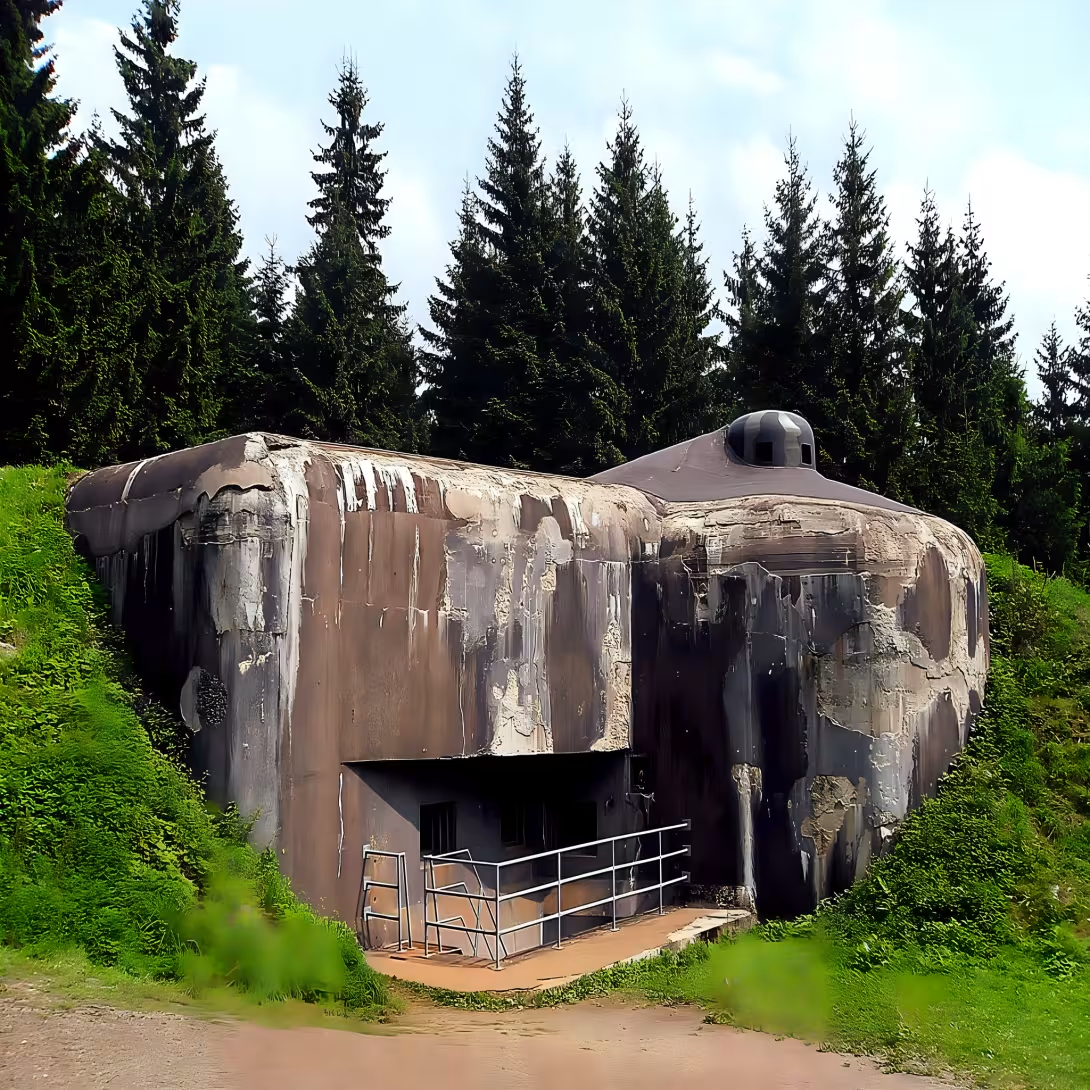
The fortress Hanička is a fortifications complex built in 1936-1938 near the village Rokytnice v Orlických horách as part of Czechoslovak fortification. This concrete structure was used to defend state borders and was later secretly converted into a nuclear shelter.
The emergence of the fort was a reaction to the growing tension in Europe before the outbreak of World War II. The construction contest was published by the Ministry of National Defence in 1936; won by Prague civil engineer Bedřich Hlava. The first building day was September 14, 1936. The initial entry amount was CZK 22 571 403.24; later it was increased by CZK 3 080 792.80 due to the artillery cabin. The entire building was completed on 30 September 1938.
The building is made of concrete and is located south of Anen Hill. The designer was the captain of Bedřich Kubec. The fortress consists of a system of six objects marked R- S 76, R- S 77, R- S 78, R- S 79, R- S 79a and R- S 80, supplemented by artillery observation R- S 91. The construction also included insulated infantry cabins R-S 75 and R- S 81. In the documents, the fort was marked with the letter H or the name of the Pan Field.
The construction was difficult; 18 officials and 584 workers worked on it on 30 April 1938. Work has claimed human sacrifice; in accidents, the workers Jan Tacl, Václav Spinar and František Franc died. Many other workers, including the gunman Jakub Mykysa and blacksmith Miroslav Bohumil, suffered various injuries during falls, material slides or detonation.
The crew of the fort was to form a unit established in May 1938, later renamed the VII. battalion of the border regiment 19. The total number of men was planned for 426, of which 27 officers and 9 Rotmasters. Major of infantry Jaroslav Mikuláš Novák was appointed commander of the fort. At the time of completion in September 1938, for example, the artillery captain Josef Škodík was the commander of the R- S 79 battery and the lieutenants Josef Chalupecký and František Urban as the commanders of the crew.
After World War II, the fortress was managed by the Czechoslovak army's rokytic crew. Until 1969, it served as a source of drinking water for the village of Rokytina. In the 1950s, Kovoskrit, without permission, plucked 7 out of 14 armor bells, which was considered vandalism. In the early 1970s, the fort was made available to the public, which allowed the filming of the film "Days of Betrayal" in 1972.
In 1975, the Federal Ministry of Interior of the CSSR closed the fort. Since the second half of the 1970s, there has been a secret reconstruction into a nuclear shelter. In 1940 there were tests of Röchling subcalibers.
The fortress Hanička is a unique witness to the fortifications of the 20th century and military architecture. Her visit makes it possible to understand the extent of the preparations for the war and the later arrangements for the Cold War.
Then and now
Drag the slider to compare how the landmark may have looked when it was built with the view today.
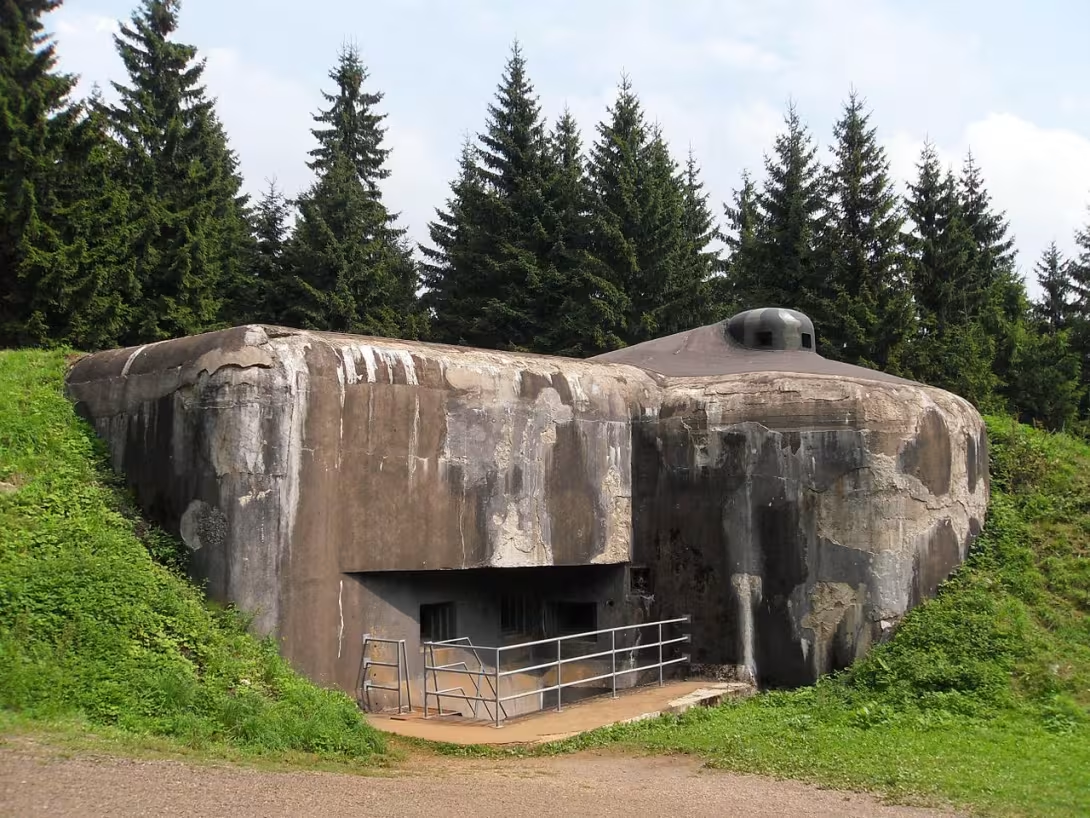
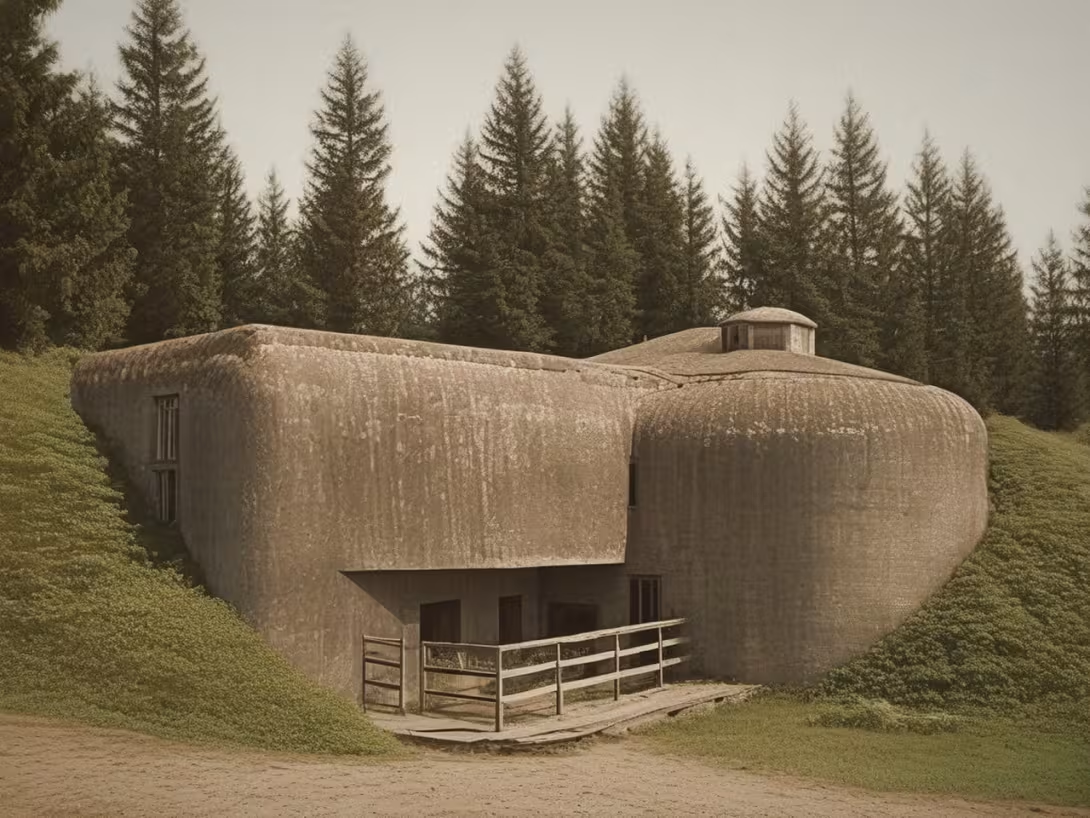
The historical appearance on the left is an AI-generated visualisation and serves as inspiration only.
Historical milestones
- 1936
- The assignment of construction to civil engineer Bedřich Hlav.
- 1937
- Completion of the concrete installation R-S 77 on 28 August.
- 1938
- Construction completion of the fort on 30 September.
Architectural development
The construction was carried out from concrete in 1936- 1938. The original project of five objects was later extended to six objects and one observatory. At a later stage, the space was modified for the purpose of the nuclear shelter.
Historical events
1936-1938: construction of a fortress; 1940: testing of Röchling subcalibers; since the 1970s: a secret reconstruction into an anti-nuclear shelter.
Points of interest
- The concrete building was later secretly converted into a bomb shelter. - In the documents, the fort was marked with the letter H or the name of the Pan Pole. - Until 1969 it served as a source of drinking water for the village of Rokytina. - In the 1950s, the Kovoskrit National Company broke out 7 of 14 armored bells without permission. - In 1972, there was a film of The Days of Betrayal.
Guide
Show guide text
This text was created by artificial intelligence and has not been editorially reviewed. It may contain inaccuracies.
Welcome to this monumental concrete structure that stands right in front of your eyes. You're standing at the Hanička fort. Feel the weight, the immobile force, and the impenetrability that protruding from the surrounding landscape south of Anen Hill. If you look around now, you'll see how this massive concrete unit collides with the nature of the Orlich Mountains. There is something both fascinating and freezing - the contrast force of the human work that was created to withstand the greatest possible strain. Feel this atmosphere of silence and strength that radiates from this place. This building is not just an ordinary building, it is a silent witness to a time when the fate of nations was decided in tension and fear.
Let us now return together in time and understand why this place was created. Imagine 1936. The atmosphere in Czechoslovakia was filled with uncertainty. Black clouds were being pulled over Europe, and the need to secure national borders was urgent. It was during this crucial period that the fortress Hanička was entered for implementation. The aim was to create a solid part of the Czechoslovak fortification system, which should serve as an impenetrable barrier for possible enemy penetration. Construction wasn't just an engineering task, it was a race against time, a race for the security of the state.
It all began in 1936 when the task was entrusted to civilian engineer Bedřich Hlav. We have to realize how much pressure it must have been for speed and precision. The first concrete work on the object R-S 77 began in August 1937 and shortly thereafter, until the end of September 1938, the whole fortress was completed. This speed of construction in such a challenging terrain is proof of the incredible use of the workers at the time and the precision of planning. Bedřich Hlava, a man whose name is inextricably connected to this place, had to solve not only the strength but also the functionality of the entire system in every detail.
Now pay attention to what you see right in front of you. Although at first glance it may seem to be one continuous building, in fact, this hardness is a complex system. It consists of a system of six objects and one artillery observatory. Feel the architecture through its purpose. Every concrete element, every line you see here, was designed with one goal: defense. It's not the architecture that's supposed to like the eye, it's the architecture that's supposed to survive. When you look at these massive shapes, you realize that every meter of concrete was rare at the time and its use here was completely strategic. This structure was designed to be part of a wider defense line to form an impenetrable castle that would stop the enemy from reaching the interior at all.
Now, if you think about the history of this place, you will encounter fascinating and mysterious aspects. This fortress has never lived just one life. In the then official documents Hanička was not always appointed directly. In order to preserve secrecy and security, this building was marked with the letter H, or the name of the Panská Pole was used for it. Imagine the tension when secret information was moving around such an important object and people knew they were near something that had to be hidden from the enemy's eyes.
But this mystery did not end at the end of World War II. In the second half of the 1970s, the Hanička fortress went through another completely unexpected transformation. It was secretly rebuilt into a bomb shelter. This means that the place that was meant to defend classical military aggression has become a haven in the event of a nuclear threat. This transformation gives the place another layer of depth and reminds us of how humanity's fears should have evolved over the decades. The border fortification has become a silent shell for survival in an atom era.
But there are also downsides to the history of this place, which may surprise you. Even this monumental structure was exposed not only to war threats, but also to human greed. In the 1950s, there was an incredible act that left a permanent scar on the fortress. In fact, the National Company Kovocrit, without any authorisation, has torn seven out of 14 armor elements. Imagine the incredible courage and insolence, when parts of such a strategic and state building were taken away from it to ensure its defence. This loss was crucial to the integrity of the fort and remains one of the most disturbing stories associated with this place.
Although the fortress acts as an isolated and impenetrable monolith, it was very close to the inhabitants of the area at some point. Until 1969, this building served as an important source of drinking water for the village of Rokytina. It is an interesting paradox - the place that was built for fighting and death has become a source of life for people living near it. This connection to local life also adds to the human dimension that we often seek behind this concrete.
Now that you've met the main lines of history of this place, I suggest you continue your search. Let yourself drift through the atmosphere of this place, perceive the contrast between the calm of the Orlich Mountains and the history that is engraved here in every piece of concrete. Explore other parts of this complex, look at the details, and try to imagine the feelings that people who once stood here had had to have, or those who secretly prepared for the worst-case scenarios. Thank you for choosing to make this journey with us. We wish you a pleasant and inspiring further discovery of this historical monument.
Tips for visitors
The best time to visit Hanicka is during spring or autumn, when the views of the Orlicka Mountains are brightest and the weather is most suitable for field movement. You can transport by car or use public transport to remember; Please check the current connection in the search engine.
For a pleasant experience take with you enough drinking water, small food and above all quality, solid footwear, which is necessary for moving in historical areas. Families with children can appreciate the historical importance of the construction, but it must be assumed that the terrain can be more challenging for the smallest.
If you're interested in photography, you'll find the best light to capture architecture in the morning or late afternoon hours. The most interesting views of concrete structures offer places with a view of the whole from surrounding heights.
As part of your trip to this area, you can visit Anen Hill, which is in close proximity and represents another interesting destination in the surroundings.
Businesses nearby
Do you run a restaurant, accommodation, shop, museum, rental, wellness or other visitor service near this monument? Show yourself directly to the people heading to it — this is how they will see you in the app and on the web:
Nearby
Anen Hill
Accommodation nearby
Themed route
Hanička (fortress) Type: Historical monument, fortress Why is it worth a visit: It is a significant medieval building in the village Rokytnice v Orlických horách, which offers a view of the history of the region. It is the main point of your trip route and the key cultural dominance of this location.
Anen Top Type: Natural location, view Why is worth a visit: Located in the immediate vicinity of the main destination and offers beautiful views of the surrounding countryside. It is an ideal place for a short walk and rest after a tour of the fortress, which complements the cultural experience of natural beauty.
Rokytnice v Orlických horách Type: Village, starting point Why is it worth a visit: This village forms a base for the whole trip and provides access to the two mentioned goals. It's a place where you can start or end the route and explore the local atmosphere in a quiet environment of the Orlich Mountains.
The route is designed to be clear and logical. You start in the village Rokytnice v Orlických horách, where you can make first impressions about the location. Then you go to the main destination, which is Hanička (fortress) . After a tour of this historical monument we recommend a short walk to Anen high , located nearby and allowing you to enjoy nature and views. The entire route is compact and focuses exclusively on specified locations, thus ensuring an authentic and unburdened experience from the region. In view of the limited number of authorised places, emphasis is placed on a deeper examination of these three points without having to travel to more remote parts of the region.
Seasonal recommendations
In spring nature wakes up around the hardness of Hanička and the surrounding forests begin to green. The light is soft and ideal for capturing details of the historical building in the morning haze. I recommend wearing layered clothes because morning temperatures can still be low. With lower attendance you will enjoy a quieter atmosphere than in the high season.
Summer months bring the longest days and full bloom of vegetation, which gives the monument a lively and colorful look. The sun shines the most, so it's good to have protection from heat and plenty of fluids. Due to the main summer season and larger crowds, I recommend arriving early in the morning so that you can see the memory without unnecessary haste and in a pleasant shade of trees.
Autumn season is characterized by golden tones of leaves and fog, which often drifts down from the mountains and creates a mysterious atmosphere. The light is deep at this time and the colors are very rich. For the visit it is necessary to prepare a waterproof and windproof jacket, because the weather is variable. It is the perfect time for those who seek peace and melancholy experiences.
In winter, the hardness is surrounded by snow and frost, highlighting its historical character in contrast to the white landscape. The atmosphere is quiet and lonely, which allows a deeper perception of history. It is necessary to take very warm clothes and shoes with good grip to move on a slippery surface. In advent time and during freezing days, count on shorter viewing time due to limited daylight.
Visualizations and artistic views


The visualisations are generated by artificial intelligence and serve as inspiration.
Photos from the area
Real photos taken near the monument


Zdroj a licence jsou uvedeny u každého snímku.
Tips from visitors
No tips yet. Be the first!
Log in and add your tip.
Sources and literature
Fotografie: User:Harold / CC BY-SA 3.0, rozlišení zvýšeno umělou inteligencí — Wikimedia Commons. The author and licence also appear when you hover over the image.
Faktickým podkladem tohoto textu byl článek na Wikipedii, jehož autory jsou přispěvatelé Wikipedie. Článek je dostupný pod licencí CC BY-SA 4.0.
Location on the map
More monuments – Rokytnice v Orlických horách
Show all in the municipality
Příběhy a pověsti
Legendy, pověsti a příběhy spjaté s touto památkou
Fotografie návštěvníků
Zatím žádné fotografie. Buďte první, kdo přidá fotografii z návštěvy!
Přihlaste se a přidejte svou fotografii nebo hodnoťte.
Za ověřenou návštěvu v aplikaci získáte víc bodů — poznáme podle GPS, že jste na místě.
Reviews and comments