






kostel svatého Jiří (Dolní Branná) Church
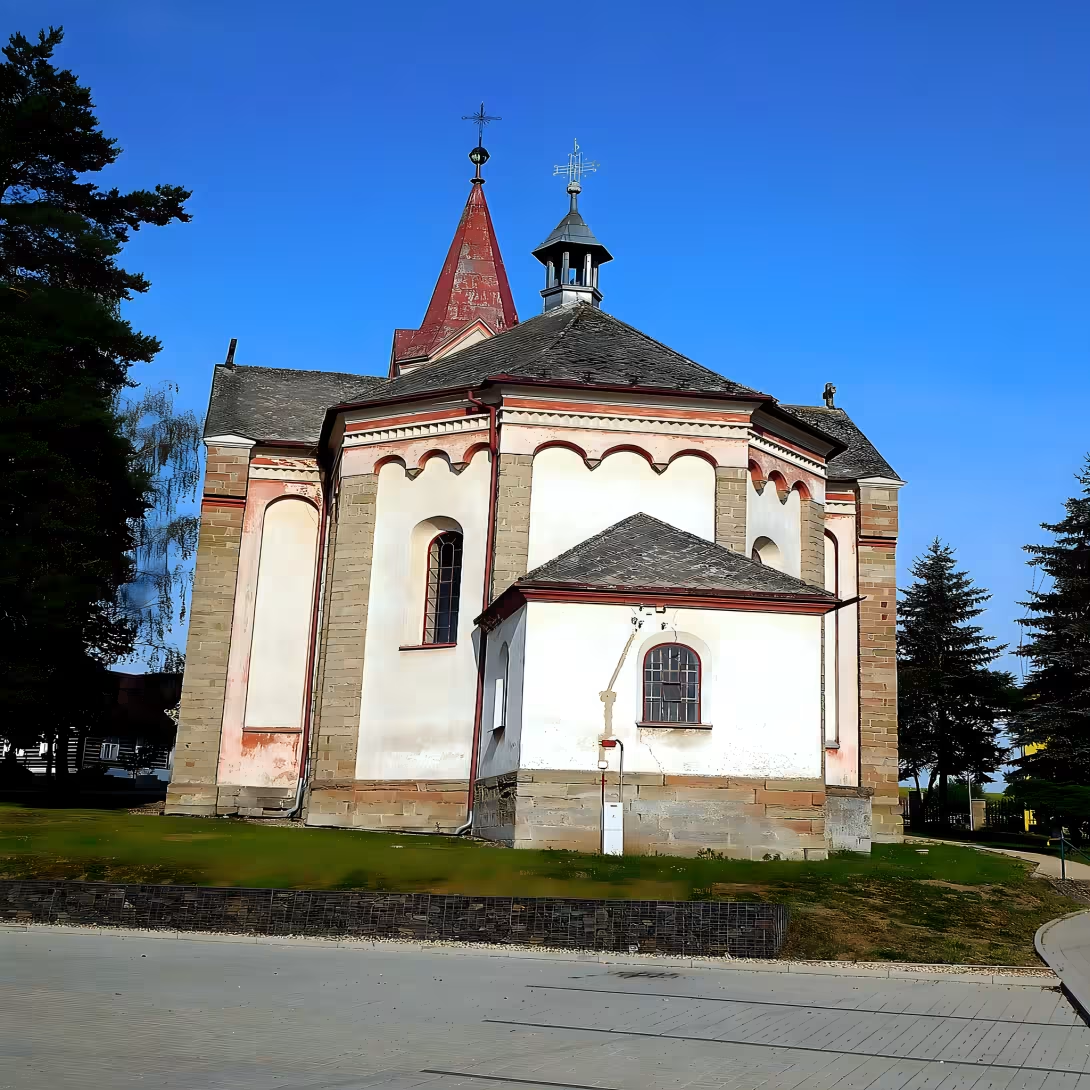
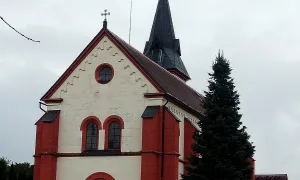
St. George's Church in Lower Branné is a Neo-Romanesque temple which became part of the list of protected cultural monuments of the Czech Republic. The seemingly common temple hides a richer story - it was built on the foundations of the original Gothic church and its layers extend back to the Middle Ages.
The beginnings of the church in Lower Branné date back to 1398, when Eusebia z Valdštejna built the first church of wood. But this building did not escape the disasters of the Hussite wars and was destroyed. Only in 1490 did the owner of the village Jiří z Valdštejna build a new stone church equipped with bell tower. This is how the building served for many years, but over time, especially in the nineteenth century, it no longer met the growing demands.
In 1857, it was decided on a major reconstruction. The foundation stone for the new construction was laid on 21 September 1857. The construction lasted three years and the consecration of the rebuilt church took place on 2 October 1860. The last big repair went through the church between 1969 and 1970.
It is an architectural church with a polygonal presbytery and transverse boat. The building is dominated by a prism tower on the west facade, ending with a facade with a Latin cross. The roof is a saddle-shaped, transverse ship closed with dental shields. Interesting is the solution of the plinth that balances the holiness of the terrain.
In the interior, a white marble plate with four children's characters and the figure of crucified Christ will attract attention. On the board there is a high Czech inscription from 1597, which remembers the dead bodies of the sons and daughters of Johann Bledina, the official of the graft estate. Another interesting element is the one-manual pneumatic organ with Barker lever, which was assembled by Josef Zený and Josef Kunt in 1926.
The only bell left in the church in 1499, weighing 260 kilograms. It is allegedly the second oldest dated bell in the Royal Hradec diocese. Like the silent testimony of centuries, it carries the story of the believers who were touched by the sounds of prayer.
Then and now
Drag the slider to compare how the landmark may have looked when it was built with the view today.
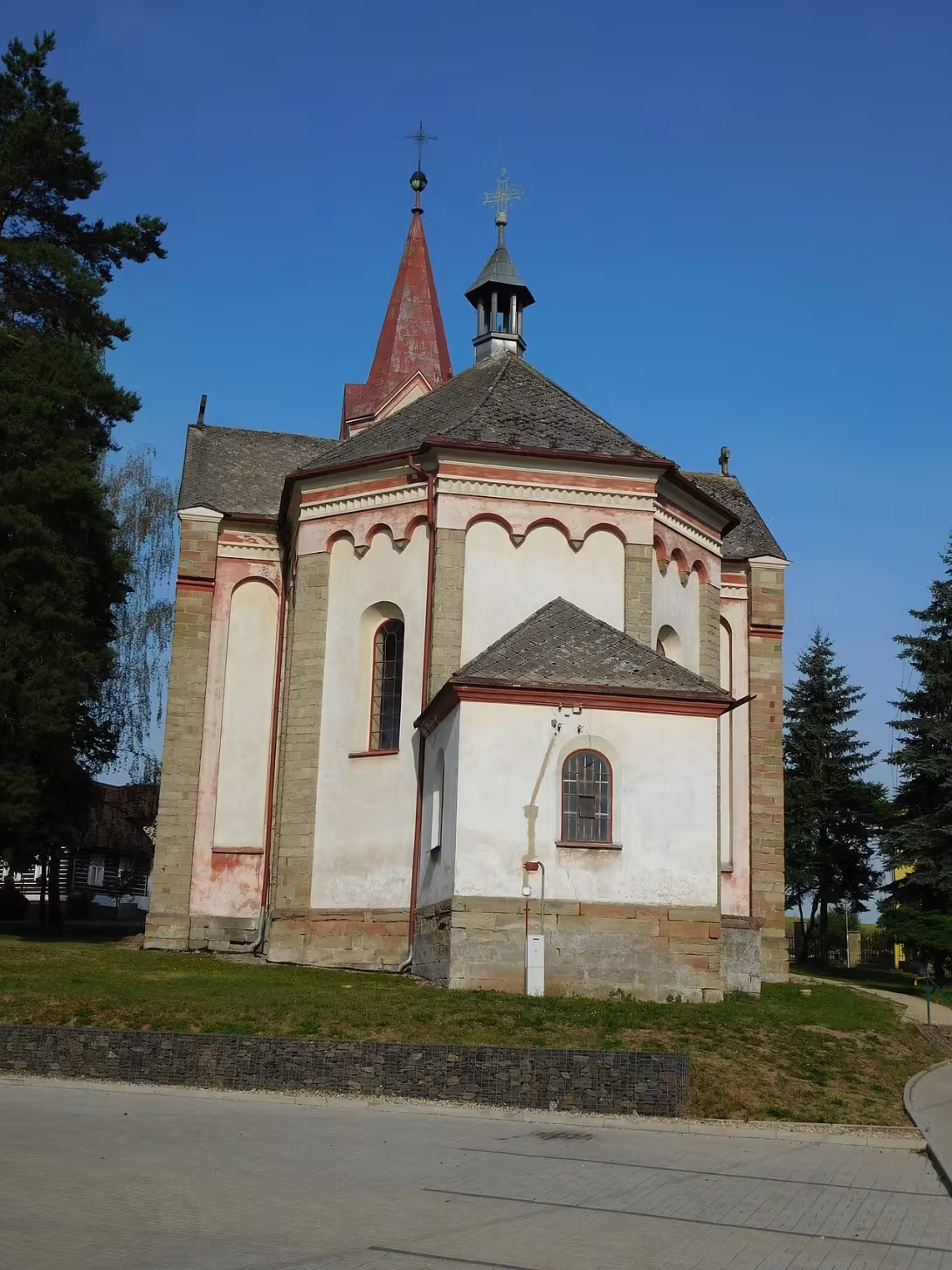
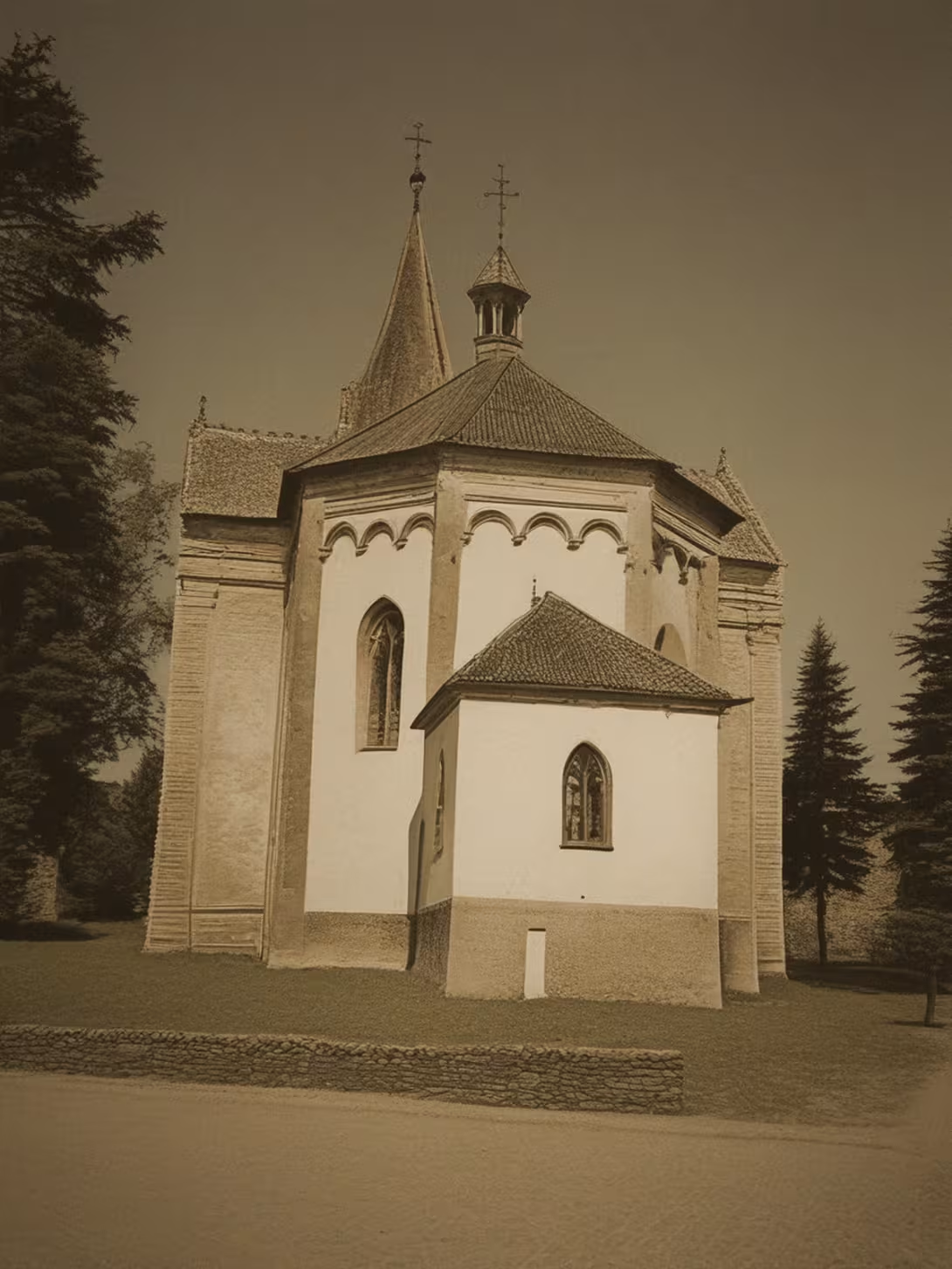
The historical appearance on the left is an AI-generated visualisation and serves as inspiration only.
Historical milestones
- 1398
- Eusebia z Valdštejna built the first wooden church.
- 1490
- Jiří z Valdštejna built a new stone church with bell tower.
- 1857
- The laying of the foundation stone for the reconstruction of the church.
- 1860
- The consecration of a rebuilt church.
Architectural development
Originally a wooden church from the end of the 14th century was destroyed during Hussite wars. The stone building from the end of the 15th century followed, which was essentially rebuilt in the pseudo-Romanesque style between 1857 and 1860.
Historical events
1398: construction of the first wooden church of Eusebii from Valdštejn; 1490: construction of the new stone church Jiří from Valdštejn; 1857-1860: rebuilding in a pseudo-Romanesque style.
Owners
parish
municipality
Points of interest
- St.
Guide
This guide is narrated by a synthetic voice generated by artificial intelligence.
Show guide text
This text was created by artificial intelligence and has not been editorially reviewed. It may contain inaccuracies.
Welcome to Lower Branné, in the quiet corner of the Royal Hradec Region, where time seems to be stopped for a while. You are standing in front of St. George's Church, a building that radiates peace and deep history with its presence in the landscape. Before we go into detail, I suggest you just stand there for a moment and perceive the overall impression. In front of you is a stone temple, which, with its silhouette, dominates the surroundings and reminds us how important the centre of the community has been for centuries. Feel the atmosphere of this place, the silence of the countryside and the sense of respect that radiates from the building.
Let us now return together in time to make it clear why this church looks just like this. The story of this place does not begin with the stones you see today, but with wood and faith in the late 14th century. It is 1398 and at this time Eusebia z Valdštejna had the first church built in this place. It was a simple wooden temple that served the locals as a sanctuary and a place of prayer. Imagine what this landscape looked like at that time, and what importance it meant to the people of that time to have a sacred space nearby.
But time passed, and the needs of the community grew, as did the ambitions of the families that managed the region. More than a hundred years later, in 1490, came the turn of Jiří z Valdštejna. It decided that the wooden structure was no longer sufficient and that something lasting had to be created instead. He therefore built a new stone church, which was supplemented by a bell tower. It was this Gothic building that formed the basic skeleton and spiritual center of the village for many generations. When you look at the building today, remember, under its present form, the foundations of this time still lie, connecting the present to the end of the Middle Ages.
Now pay attention to the architecture itself that you see before you. What you observe is a so-called pseudo-Romanesque building. This style tried in the nineteenth century to revive the elements of the Romanesque period, which gives the church some monumental and also a sense of stability. Note that this is a single-storey structure, which means that the main space is made up of one wide boat, which leads the view directly to the altar. If you look at the back of the church, you'll see a polygonal presbytery, a space designed for a priest and an altar, which ends with several walls forming a polygon. Another architectural element is the transverse ship, which provides the space dynamic and extends its internal availability.
Look up at the west facade now. The dominance of the entire building is the prism tower that rises above the surrounding area. It is precisely this element which gives the church its characteristic profile and which was visible from a distance already for travelers coming to Lower Branné. Note the purity of the lines and stone design that replaced the original Gothic shapes.
This transformation from the Gothic temple to the neo-Romanesque monument was not sudden, but was the result of careful planning. Let's stop at the crucial period of the mid-nineteenth century. In 1857, on 21 September, a foundation stone was laid for a large reconstruction. It was a period when the architecture sought inspiration in the past to express strength and tradition. The whole process lasted several years and culminated in October 2, 1860, when the rebuilt church was ceremonially consecrated.
This place is associated with the names of the personalities that gave him life. We have already mentioned the House of Valdstein, Eusebia and George, who laid the first stones of faith and stability. In a later period, during a major reconstruction, there was a trail of other men like Josef Ženatty and Josef Kunt. Although the names of particular architects remained forgotten at times, the work of these men is still present in every detail of stone masonry and in the harmony of the entire space.
Now that we're thinking about what's waiting for us inside, prepare to meet with historical artifacts. The interior of the church is not only empty space, but a real shredder monument. One of the rarest jewels here is the organ, whose tones were probably accompanied by generations of believers in their happiest and happiest moments. Another fascinating element is the ancient bell, which with its volume announced time, summoned people to prayer or warned against danger. The sound of the bell is in many ways the voice of history itself, which sounds throughout centuries.
You might find one interesting thing that gives this place special value. St. George's Church is not only a local goodbye, but an officially protected cultural monument of the Czech Republic. This means that the state recognises its unique value not only for Lower Branna, but for our entire culture. It is fascinating to realize that a building that is now so harmonious and perfect is actually a layering of different epoch. It's like a book where every chapter represents a different century and a different approach to architecture and belief. From the wooden church of 1398 to the stone goth to the neo-Romanesque precision of the nineteenth century.
While you're standing in front of this building, try to imagine all the people who stood in front of you. Kings, nobles of the Valdstejn family, local craftsmen and inhabitants of the village who sought answers to their questions in this space. Every stone you see carries a story of patience, craftsmanship and desire for immortality.
Now that you know the story of St. George's Church's inception and architecture, I suggest you take a good look at the surroundings. Feel the light reflected from the stone walls and the building inscribed in the sky above Lower Branna. If you have the chance, look inside and let the atmosphere of silence and history that the temple holds in you.
Thank you for spending time with us at this beautiful memorial. We hope that this short trip to history has helped you better understand what you see and that you are leaving with a sense of admiration for human work and perseverance. We wish you a pleasant continuation in discovering the beauty of the Royal Hradec Region. Goodbye.
Tips for visitors
The best time to visit St. George's Church in Lower Branné is during spring or autumn when the weather is mild and pleasant. This time of year offers ideal conditions for exploring architectural details of the church without excess heat in summer or winter cold.
Parking can be found near the church, but we recommend checking the actual availability of parking lots before visiting. In addition to the car, the place can also be reached by public transport; a specific connection should be checked in an online search engine or local information.
When visiting, it is recommended to bring protective clothing such as shoes and jackets, especially in colder months. It is also important to bring a camera to capture the architectural details of the church, which is illuminated best during early morning or late afternoon.
For families with children, the visit to St. George's Church in Lower Branné is suitable as it can serve as an opportunity to talk about history and architecture. Children can also be interested in exploring interiors and detailed stories about the construction history.
There are several interesting places around the church that can be visited during a weekend trip. Their examination can take about 30 minutes from the site and offers the possibility of extending the visit to other cultural experiences.
Frequently asked questions
Is kostel svatého Jiří (Dolní Branná) open to the public?
Yes, the church is open to the public and open daily from 9: 00 to 5: 00.
How do I get to the place by car / public transport?
Parking is possible in the parking lot near the church. If you want to get public transport, stop at the Lower Branné bus stop.
How much is the entrance fee and is it paid on the spot?
You pay at the register at the church.
Is the tour suitable for children and seniors?
Yes, the tour is suitable for families with children because there are interesting details in the decoration and children's games on the roof.
How long does the tour take?
The total length of the tour is approximately 30 minutes.
What are the opening times and booking is required?
The church is open daily from 9: 00 to 17: 00. Reservations are not required, but we recommend calling in advance at + 420 775 123 456.
What's interesting in the immediate vicinity?
In the immediate vicinity of the church there is a nature reserve with beautiful forests and river. You can take a nice walk or sit on a bench by the river.
For kids
Imagine going back to the past, a small town in a deep forest. This place is called Dolní Branná and it lies deep in the heart of the Jesenians. How would you like to discover the secret of this place? Then let's go back to the Middle Ages with us!
By that time, a beautiful Gothic building - St. George's Church - was built in this place. She looked like a rock that grew trees and bushes. The church was built out of stone and its roof was covered with onion-eating. Imagine what the church towers looked like when the sun wrapped on their shields.
Businesses nearby
Do you run a restaurant, accommodation, shop, museum, rental, wellness or other visitor service near this monument? Show yourself directly to the people heading to it — this is how they will see you in the app and on the web:
Nearby
surrounding landscape
nature reserves
Accommodation nearby
Themed route
1. St. George Church (church) - The main destination of the trip, which represents the centre of the tour. 2. Interior (interior) - Here you can admire architectural details and religious elements inside the building. 3. Church courtyard (courtyard) - Space directly at the temple, which offers a quiet environment for observing the monument from the outside.
Seasonal recommendations
Spring: In the spring period, St. George's church in Lower Branné is transformed into a magnificent still life of blooming nature. The sunny days illuminate the richly decorated interiors of the church, where the light hits the ceilings and altars in beautiful colour accents. Nature is awakening from the frost, and the surrounding forests and meadows are gaining living greenery. For a visit it is advisable to come in the early afternoon when the crowds are still mild, and to wear clothes suitable for a warm day with the possibility of a colder morning. This period offers ideal conditions for a view of the church in peace.
Summer: During the summer period Dolní Branná is full of life and heat, which attracts many visitors. The sun illuminates the walls of St. George's church in the best light, which increases its historical beauty. The views from surrounding hilly areas are stunning and nature offers countless flower fields. For the best experience it is recommended to visit the church early in the morning to avoid large crowds during the main summer season. Don't forget to wear protective sun clothes and water because the temperature can be considerable.
Autumn: In autumn days the church of St. George in Lower Brané gets melancholic beauty. November leaves add a colour palette to the surrounding region, while sunny and slightly cold weather offers ideal conditions for visiting. The atmosphere is calm and quiet, allowing a full experience of ancient architecture without excessive crowds. We recommend you take with you warmer clothes for a colder afternoon and use this mild period to explore historical sites.
Winter: Winter Dolní Branná offers unique experiences with St. George's Church as a centre of attention. The cold air and the possibility of snow decoration add magic to the visit when the sun's rays intersect with the cool atmosphere outside. Opening hours may be shorter due to winter conditions, so it is advisable to visit the church early in the morning. We recommend bringing warm clothes, including hat and gloves, to make the visit comfortable even in cold weather. This period is ideal for those looking for peaceful and intimate experiences in historical places.
Visualizations and artistic views


The visualisations are generated by artificial intelligence and serve as inspiration.
Photos from the area
Real photos taken near the monument


Zdroj a licence jsou uvedeny u každého snímku.
Atmosphere of the place
This atmospheric visualisation of the place and period was generated by artificial intelligence. It is not real footage of the location.
Tips from visitors
No tips yet. Be the first!
Log in and add your tip.
Sources and literature
Fotografie: JiriMatejicek / CC BY-SA 3.0, rozlišení zvýšeno umělou inteligencí — Wikimedia Commons. The author and licence also appear when you hover over the image.
Faktickým podkladem tohoto textu byl článek na Wikipedii, jehož autory jsou přispěvatelé Wikipedie. Článek je dostupný pod licencí CC BY-SA 4.0.
Location on the map

Příběhy a pověsti
Legendy, pověsti a příběhy spjaté s touto památkou
Fotografie návštěvníků
Zatím žádné fotografie. Buďte první, kdo přidá fotografii z návštěvy!
Přihlaste se a přidejte svou fotografii nebo hodnoťte.
Za ověřenou návštěvu v aplikaci získáte víc bodů — poznáme podle GPS, že jste na místě.
Reviews and comments