



židovský hřbitov v Rokytnici v Orlických horách Jewish cemetery
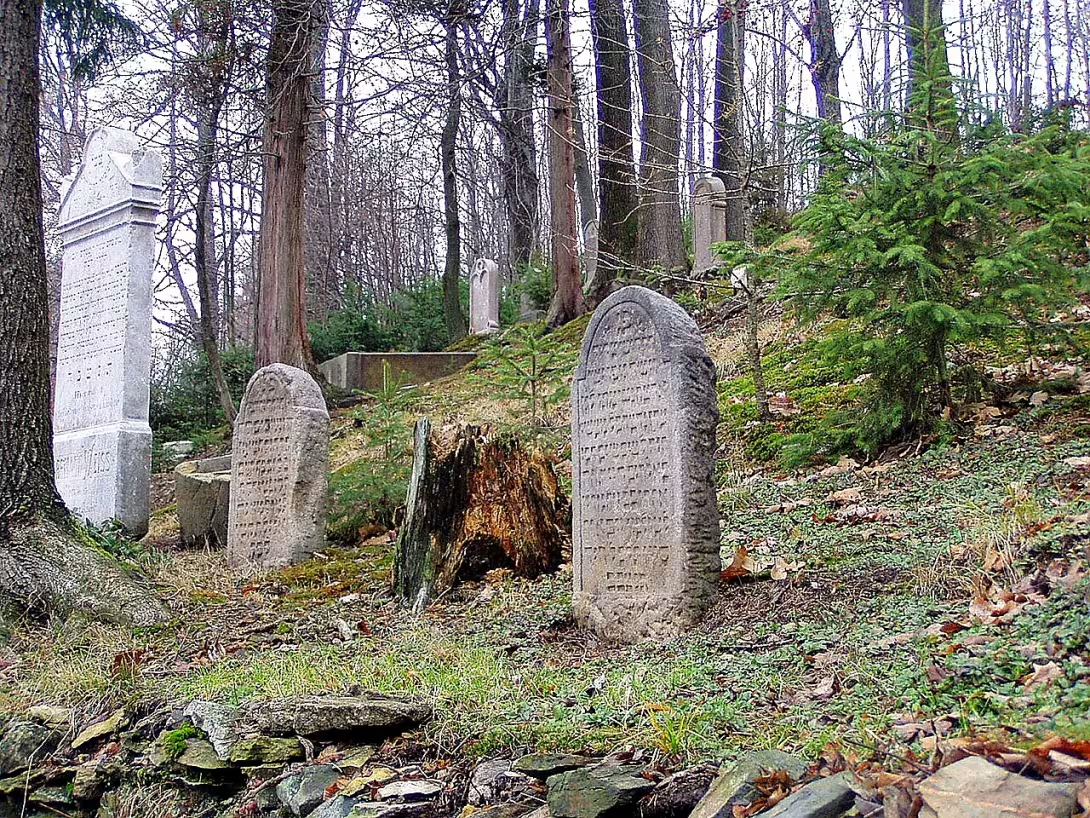
The Jewish cemetery in Rokytnice in the Orlicky Mountains is a Baroque monument founded in 1718. It is located in the eastern part of the city on the sloping grounds behind the Rokytenka stream. Since 1994, the area has been a protected cultural monument and represents an important witness to the history of the local Jewish community.
The burial ground was established in 1718 during the period of the high Baroque, when the Habsburgs ruled in the Czech lands. The local Jewish people then negotiated a permit for its establishment at the edge of the forest at Count Nostitz's. They chose the locality behind the Rokytenka stream, near the houses no. 108 and 109, at a sufficient distance from the then urban development.
From the original form of the complex until today only the torso of the western part of the wall has been preserved. The tombstones, referred to as the lubricant, dates from the mid-18th century to 1925, when the last funeral took place here. In total, less than two dozen of these tombstones were preserved on the ground.
During World War II, the cemetery passed through a period of massive devastation. Many stones were used at the time as building material, specifically as a tile of inner yards in the city centre. The local Jewish poet Moritz Reich, who lived between 1831 and 1857, excels among the persons buried here.
The area is currently open to the public. Despite considerable damage in the past, this place remains an important historical point Rokytnice v Orlických horách. The visit offers the opportunity to recall the fates of the local Jewish village and to see preserved fragments of tombstones in a quiet environment at the edge of the forest.
Then and now
Drag the slider to compare how the landmark may have looked when it was built with the view today.
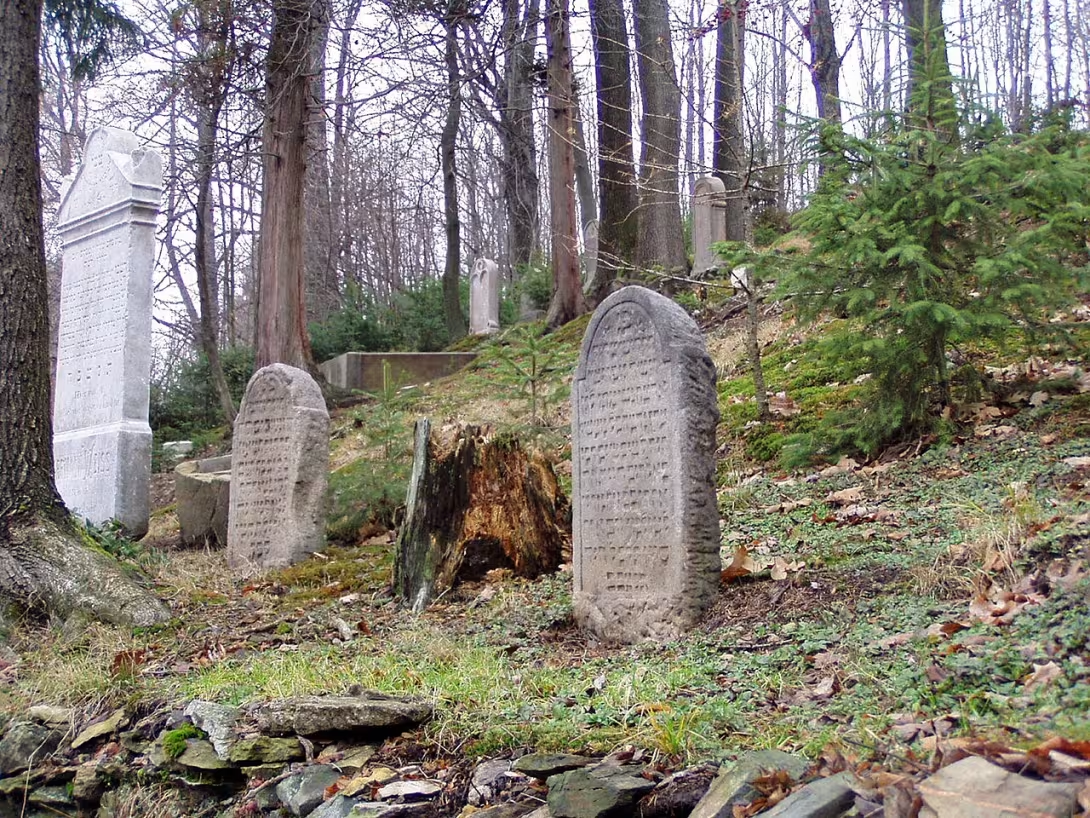

The historical appearance on the left is an AI-generated visualisation and serves as inspiration only.
Historical milestones
- 1718
- The establishment of a Jewish cemetery.
- 1925
- The date of the last preserved tombstone.
- 1994
- The cemetery became a protected cultural monument.
Architectural development
The cemetery was founded in the Baroque period on the edge of the forest. The original wall was largely destroyed, only the western part preserved. The tombstones of the Mazevot type dates from the mid-18th century to 1925.
Historical events
The foundation of the cemetery in 1718. Devastation of the premises during World War II. Declaration for cultural heritage in 1994.
Points of interest
- The cemetery is a baroque monument founded in 1718 on a narrow plot behind the Rokytenka stream. - The locals negotiated permission to set up a burial site on the edge of the forest at Count Nostitz's. - Only the western part of the fence wall and less than two dozen tombstones were preserved from the original site. - During World War II, the tombstones were used as building materials for the tile of the inner courtyard in the city centre. - A local Jewish poet Moritz Reich, who lived between 1831 and 1857, was buried in the cemetery.
Guide
Show guide text
This text was created by artificial intelligence and has not been editorially reviewed. It may contain inaccuracies.
Welcome to Rokytnice, Orlicka Mountains. You are standing right in front of a place that carries a quiet and deep testimony of the past, of the people who lived here centuries ago, working and finally leaving their trail in the country. There's a Jewish cemetery in front of you. The first thing you might feel is a strange calm and a slight slope. Feel this atmosphere of humility. You are located in the eastern part of the city, on a sloping plot that separates the Rokytenka stream from the other buildings. Stop for a moment, take a deep breath and listen to the noise of water in the stream. It was this sound that accompanied visitors to this place for centuries. Let us now return together in time more than 300 years ago. We write to each other for a year, seven hundred and eighteen. It was this year that this cemetery was founded. At that time, the question of the funeral home was not only a practical matter, but it was deeply linked to the law and social position. The establishment of such a site required the approval of the ruling nobleman. Local Jewish residents had to negotiate a space where they could bury their loved ones in dignity. They made a deal with the then influential Count Nostitz. It was thanks to his permission that this space could be created at the edge of the forest, in places that were perceived as diverted and silent at the time. Imagine the talks, the pleas, and finally the relief when the deal was made. This act created a baroque monument to serve generations and to be a safe addition to the memory of the dead. Now please take a look around. At first glance, you might wonder why the cemetery looks just like this and why it doesn't look as full as you might have known other historical burial sites. Note that there is not a dense forest of tombstones before you, but rather scattered stones. There are only less than two dozen tombstones preserved here today. Why are there so few? The answer is painful and linked to the darkest time of modern history. During World War II, this complex was destroyed. What happened here was not just the destruction of monuments, but an attempt to erase the identity of the entire community. Many tombstones were brutally ripped from the ground and used as ordinary building material for other buildings. Imagine the contrast where the sacred stone with the inscription and date became a mere stone in a wall. What you see today is just the remnants of a once richer and larger entity. Pay attention to the surroundings as well. If you look towards the west side, you'll see a torso wall. It's just a small fragment, the rest of the original circuit, which previously clearly separated the sacred space of the cemetery from the surrounding landscape. Even though this wall is now just a shadow of its former size, it still reminds us of the boundaries that existed in the past. Feel how this ruin mingles with the surrounding nature, and how it slowly wraps up time. Now, if you're going to walk slowly among those few preserved stones, try to notice the names. One of them is Moritz Reich. Names engraved in stone are not just inscriptions, they are the fates of the particular people who formed the community in Rokytnice. They were businessmen, craftsmen, fathers and sons. If you pay attention to the data, you'll see that the last preserved tombstone carries a thousand nine hundred twenty-five. This gives us a clear idea of the time when the cemetery was fulfilling its main function before the time of destruction and violent interruption of traditions came. Every stone left here today is a small victory over oblivion. He's a silent witness to the fact that, despite the destruction efforts, some of this history survived. What's interesting is how much this place is connected to the Orlich Mountains. The location behind the Rokytenkou stream and the proximity of the forest was not random. It was a place diverted, quiet, suitable for contemplation and prayer. Imagine how here in the Baroque times people were walking in black clothes, how quietly they remembered their loved ones and how they were surrounded by the same nature that you see today. It is fascinating that despite this great devastation, the cemetery managed to keep itself in our sights. In the year one thousand nine hundred ninety-four, the cemetery became a protected cultural monument. This means that the state has recognised its invaluable value, not only in terms of appearance, but above all in terms of history and human memory. This move meant that the rest of the campus would be taken care of and that it would become a place of reflection for everyone who comes here. Now I'm leaving you to walk quietly through the cemetery area at your own pace. Stop by the stones, feel the cold of the stone under your fingers and the silence that rules here. Let yourself be guided by your own feelings and think about how important it is to protect even the smallest remains of our common past. Even if you only see less than twenty stones and a piece of wall, the history of hundreds of people is present in this space. It's a place that teaches us humility before time and reminds us that memory is the only thing that can overcome even the greatest destruction. Before you leave, take another look at the slopes and listen to the Rokytenka stream. This landscape has witnessed everything that has happened here since the founding of the year seven hundred and eighteen to this moment. I hope this short trip to history has helped you to better understand the importance of this quiet corner in Rokytnice in the Orlické Mountains. Thank you for your attention and for the respect with which you have visited this place. I wish you the rest of the way and many other interesting discoveries in this beautiful area. Goodbye.
Tips for visitors
The best time to visit is late spring or autumn when vegetation is lower and the terrain of the cemetery is clearer. For photography, choose the morning hours when the sun lights up the tombstones from the east and highlights their historical details. In the surrounding area you can visit the city Rokytnice v Orlických horách itself, walk along the river Rokytenka or use the tourist route leading to the surrounding forests of the Orlické Mountains. For families with children, the visit is more suitable as a short stop during a trip to nature, due to the more demanding terrain of the cemetery we recommend caution and supervision of children.
Frequently asked questions
Can the monument be visited?
Cemeteries and graves are usually accessible; please respect the dignity of the place. We have not verified the opening hours of this cemetery. According to the heritage register the structure is in poor condition – do not enter it and take care nearby.
Where is the monument?
Location: Rokytnice v Orlických horách, Královéhradecký kraj. The map on this page shows the exact spot.
Why is the monument protected?
It is listed in the Central List of Cultural Monuments of the Czech Republic as a cultural monument (register no. 1000120044).
Businesses nearby
Do you run a restaurant, accommodation, shop, museum, rental, wellness or other visitor service near this monument? Show yourself directly to the people heading to it — this is how they will see you in the app and on the web:
Events nearby
Zdroj akcí: otevřená data měst a obcí ČR (Národní katalog otevřených dat) a kalendář akcí Národního památkového ústavu.
Nearby
Město Rokytnice v Orlických horách, řeka Rokytenka, okolní lesy Orlických hor.
Accommodation nearby
Themed route
1. City Rokytnice v Orlických horách (Village): The starting point of the road where you can get acquainted with the atmosphere of the place. 2. Jewish cemetery in Rokytnice in the Orlické Mountains (Monument): The main destination of the trip, which offers a view of old tombstones and quiet space for reflection. 3. River Rokytenka (Water flow): A pleasant walk along the water that leads through the countryside. 4. The surrounding forests of the Orlické Mountains (Nature): The final part of the route in deep forests for relaxation in nature.
Seasonal recommendations
Spring: In the spring nature awakens and among the old tombstones begins to grow first flowers. The light is soft, but due to the poor condition of the place the soil is very muddy and moist. I recommend a visit in the first spring, when the air is fresh and tourists are minimal. Put on tight shoes that won't let go of water.
Summer: In the summer months there is a strong sun and high grass can partially hide the place. The atmosphere is calm, but heat can be tiring. The best thing is to come right after sunrise to avoid the biggest crowds and burning heat. Prepare light clothes and protection against insects that can be present in lush vegetation.
Autumn: Autumn brings foggy times and golden colours to the mountains, which gives the cemetery a melancholy touch. The roads can be slippery because of moisture and leaves. An ideal visit in the afternoon is when the sun shines low. Dress with layers so that the cold wind doesn't enter your body.
Winter: Winter is very quiet and cold here, with tombstones covered with snow. The view is rough and rough, which matches the decaying state of the monument. Due to short days and frost, it is necessary to plan a visit around noon and to wear a very warm and waterproof jacket. Watch out for sudden weather changes and slippery surfaces.
Visualizations and artistic views


The visualisations are generated by artificial intelligence and serve as inspiration.
Photos from the area
Real photos taken near the monument


Zdroj a licence jsou uvedeny u každého snímku.
Tips from visitors
No tips yet. Be the first!
Log in and add your tip.
Sources and literature
Photos: Petr Hudousek / CC BY-SA 3.0 — Wikimedia Commons. The author and licence also appear when you hover over the image.
Faktickým podkladem tohoto textu byl článek na Wikipedii, jehož autory jsou přispěvatelé Wikipedie. Článek je dostupný pod licencí CC BY-SA 4.0.
Location on the map


Příběhy a pověsti
Legendy, pověsti a příběhy spjaté s touto památkou

Fotografie návštěvníků
Zatím žádné fotografie. Buďte první, kdo přidá fotografii z návštěvy!
Log in a přidejte svou fotografii nebo hodnoťte.
Za ověřenou návštěvu v aplikaci získáte víc bodů — poznáme podle GPS, že jste na místě.
Reviews and comments