



Haselburg Castle
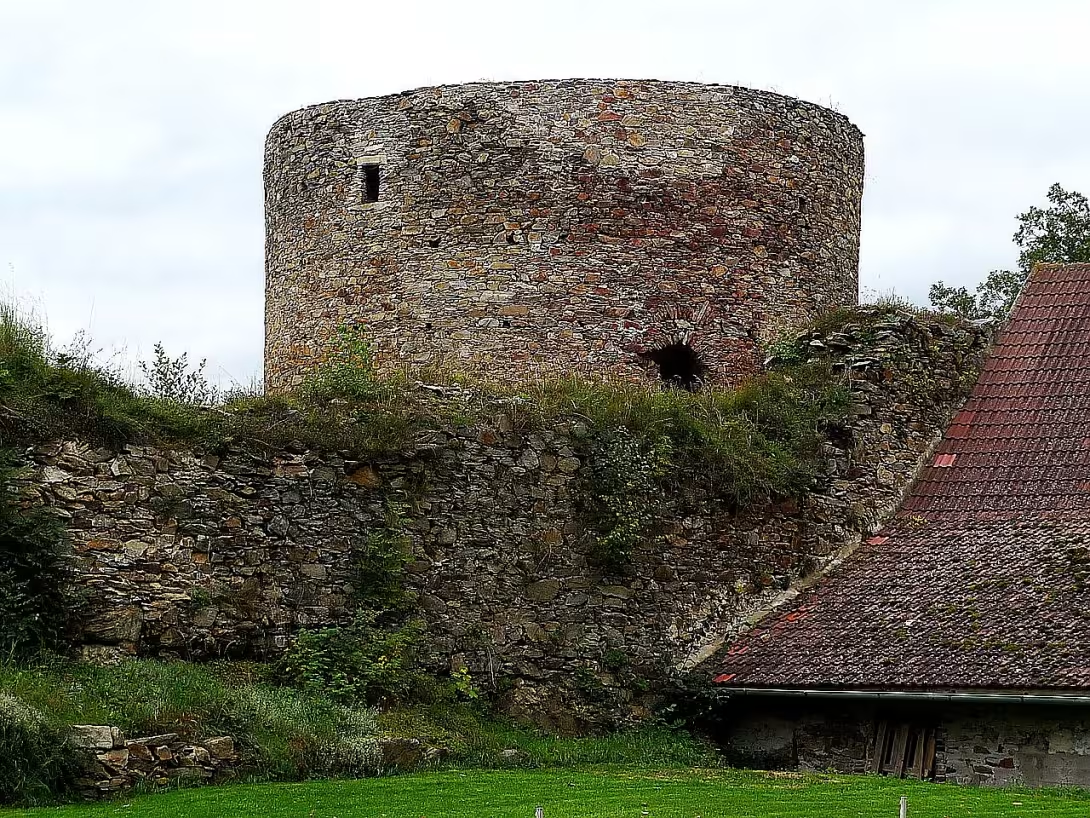
Haselburg (also called Hrádek or Round Bašta) is located north of the centre of Vimperka in the district of Prachatice, on the left side above the valley of Křesanov creek. He lies on a rocky edge, high above the Vimper Castle itself, and formed an important element of his defense.
The castle was built in 1479 by order of Peter Kaplíra, which at the time let the town of Vimperk fortify. Due to the unfavourable location of the original Vimper castle on the southern slope, Kaplíř decided to build a new defense element on the mountain: a bastion with a massive circular tower surrounded by a horseshoe wall. The coat of arms of the Kaplich from Sulevic with 1479 dates are carved above the entrance.
In 1494 the Vimperk estate was owned by the Malovce family from Malovice, who essentially rebuilt the castle. In 1531 the property was divided between the brothers Peter and John Malovka of Chýnov. Haselburg became a separate residence of Petr Malovka for a short period of time, but then remained a separate bastion of Vimperk Castle. This role changed in 1547 when Malovec of Chýnov lost his property after the Battle of Mühlberg to support the rebellion against King Ferdinand I. Since then Haselburg has served as a leading defense element of the Vimper complex under new owners.
Jan Oldřich of Eggenberg owned the castle since 1630. In 1710 Jan Kristián I of Eggenberg bequeathed him to his wife Maria Ernestina of Schwarzenberg, who in 1719 left him to his brother Adam Francis Fürst of Schwarzenberg. After 1729, the demolition began a militarily irrelevant fortress. When Adam František died in 1732, considerable parts of the walls were already torn down. His successor Josef Adam I. of Schwarzenberg's work stopped and released space for further development. From the mid-18th to 19th century, the surrounding area was built with numerous cottages.
The original building was preserved mainly by a two-storey round tower with 14 meters in diameter with cross vaults. The second floor originally served as a living space. Haselburg is privately owned and not accessible to the public. From the outside you can see the tower from a red marked tourist route leading near it and from the street Castle. In 2014, the construction of two recreational buildings was allowed in close proximity to the bastion, which do not correspond to the approved project and significantly interfere with the views of the historical tower.
Then and now
Drag the slider to compare how the landmark may have looked when it was built with the view today.
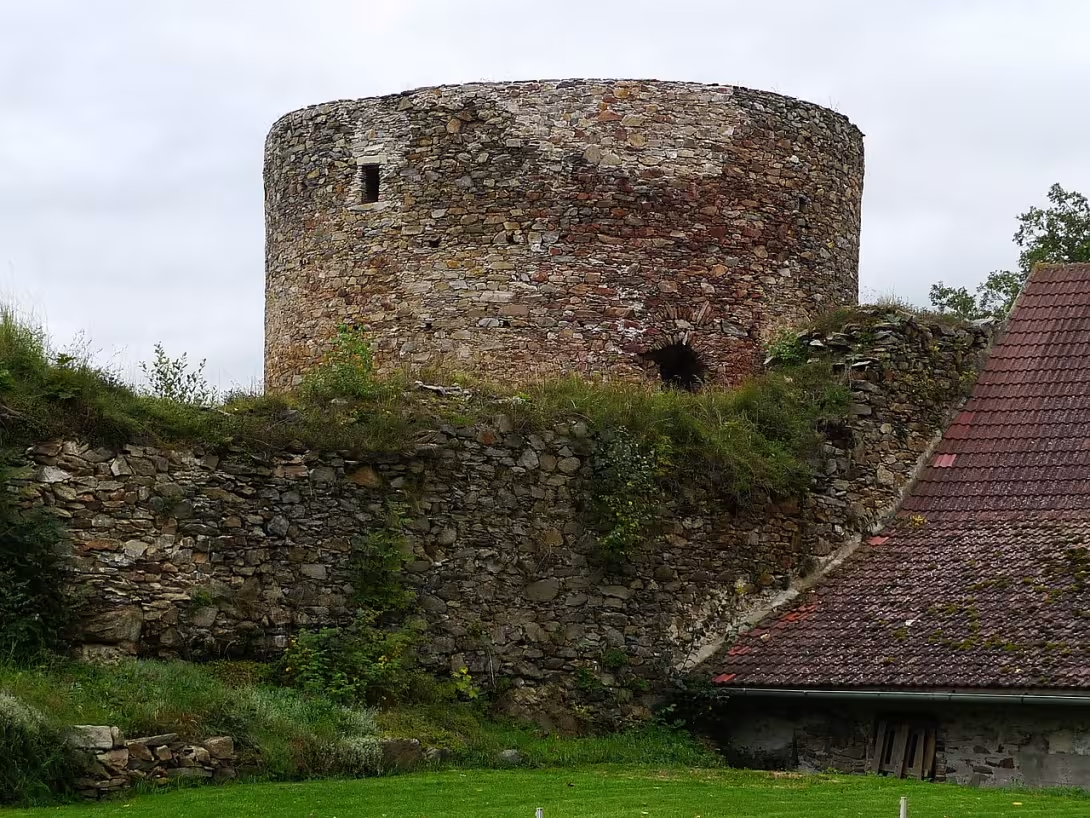

The historical appearance on the left is an AI-generated visualisation and serves as inspiration only.
Historical milestones
- 1479
- Petr Kaplíř built a bastion with a circular tower to protect Vimperk.
- 1531
- Haselburg became a separate residence of Petr Malovka from Chýnov.
- 1547
- Confiscation of Malovice property after the Battle of Mühlberg.
- 1729
- Commencing demolition at the time of the unused fortress.
Architectural development
The original core consists of a massive circular tower 14 metres in diameter surrounded by a horseshoe-shaped wall. In 1494, a significant reconstruction took place under Malovce from Malovice, which modified the accommodation on the second floor of the tower. Since the middle of the 18th century, the complex has been gradually absorbed by a small housing installation which used the area of the former fortifications.
Historical events
In 1479 the building started to protect the city and the castle. In 1547, the object was confiscated by the Malovs for participating in the anti-imperial resistance. Since 1729, there has been a gradual demolition of no longer needed fortifications.
Owners
Chaplers from Sulevic (1479), Malovci from Malovice (1494), Petr Malovec z Chýnova (1531), Eggenberg (1630), Schwarzenberg (1719), currently a private owner.
Points of interest
- Haselburg was built on a high rock edge because the original Vimper Castle was at a disadvantage on the southern slope. - Above the entrance to the building there is a stone coat of arms with carved ages of fourteen hundred seventy-nine. Although it was a military bastion, its second floor served as a living space in the past. - In the 16th century, the object ceased to be only part of the fortification and for a short time became a separate residence. - Until today, a massive round tower of 14 metres in diameter has been preserved with internal cross vaults.
Guide
This guide is narrated by a synthetic voice generated by artificial intelligence.
Show guide text
This text was created by artificial intelligence and has not been editorially reviewed. It may contain inaccuracies.
Haselburg, also called Hrádek or Kulatá bašta, is the ruin of a Gothic castle to the north of Vimperk's center. It stands on a rocky promontory above the valley of the Křesanovský stream, higher than Vimperk Castle itself.
Its origins are connected to the fortification of the town. In 1479, Petr Kaplíř had Vimperk fortified. Vimperk Castle lay on the southern slope of the castle hill above the town and its position was not advantageous for defense. That is why Kaplíř had a bastion with a massive circular tower built at the top of the hill, surrounded by a horseshoe-shaped wall. A coat of arms plaque of the Kaplířs of Sulevic above the entrance, bearing the date 1479, still recalls this period today.
In 1494, the Malovec family from Malovice acquired the Vimperk estate and substantially rebuilt the entire complex. In 1531, the brothers Petr and Jan Malovec from Chýnov divided the property between them. Haselburg then separated from the castle it was meant to protect for a short time and became the independent seat of Petr Malovec. However, he supported a rebellion against King Ferdinand the First and after the Battle of Mühlberg in 1547, he lost his property.
Under subsequent owners, Haselburg served again as the front bastion of Vimperk Castle. Between 1622 and 1624, Wolf Nowohradský from Kolovrat had a new Renaissance castle built on the site of the castle. In 1630, the estate was acquired by Jan Oldřich from Eggenberg. Jan Kristián the First from Eggenberg bequeathed it in 1710 to his wife Marie Ernestine from Schwarzenberg. She transferred it in 1719 to her brother Adam František from Schwarzenberg.
After 1729, they began to demolish the fortress, which no longer held any significance. When Adam František died in 1732, only part of the walls had been demolished. His son Josef Adam the First from Schwarzenberg stopped the work and freed up space for further construction. From the mid-eighteenth until the nineteenth century, a number of cottages grew up around the circular tower.
A massive two-story circular tower with cross vaults measuring fourteen meters in diameter has been preserved. The second floor originally served as living quarters. The tower is today in private ownership. In 2014, the construction of two recreational buildings was permitted in its immediate vicinity, which in 2016 significantly obstructed the view of the tower. The buildings do not conform in some details to the approved project, and local residents did not approve of them.
Tips for visitors
The best time to visit this monument is during bright days when sunlight best depicts the structure of the old masonry. We recommend morning or late afternoon hours when the place is the most quiet. Access to the building is possible directly from Vimperk.
For a safe tour of the ruins, you should definitely wear tight closed shoes because the terrain around the ruins can be uneven, loose and overgrown by vegetation. Since this is an outdoor site without facilities, pack a bottle of drinking in your backpack. For photography lovers, the best place is the space in front of the main tower, where the monumentality of the building can be captured in contrast to the sky, or sightseeing points towards the city.
In the immediate vicinity, which you can visit within half an hour, there is a monumental castle Vimperk, which is historically closely related to this bastion. For nature lovers, it is ideal to walk through the valley of Křisanov creek, which offers refreshment in the green.
Families with children should be more careful as it is an unguarded ruin with freely accessible parts of masonry. For children, a visit is a great adventure that reminds fairy tales of knights. The Adolfov settlement or the area near the local hospital, which lies within walking distance, can also serve as landmarks for a longer walk in the wider surroundings.
Frequently asked questions
Can the monument be visited?
This is a ruin. Such sites are often freely accessible, but some can only be visited with a guide or are closed for safety reasons. We have not verified the current situation – take care and respect any restrictions.
Where is the monument?
Location: Vimperk II, Jihočeský kraj. The map on this page shows the exact spot.
Why is the monument protected?
It is listed in the Central List of Cultural Monuments of the Czech Republic as a national cultural monument. It is protected as part of a larger listed ensemble.
For kids
Imagine going back 547 years, until the castle Haselburg was still standing and was an important place on the trade path between Bohemia and Bavaria. The town of Vimperk was a small village at the time, but Haselburg was its center.
Who lived here? Those who were supposed to live in cities came to Vimperk to supply themselves with food and drink. And those who went to trade were headed straight to Castle Haselburg to commend their goods. The castle was like a great fortress protecting the city from attacks.
Businesses nearby
Do you run a restaurant, accommodation, shop, museum, rental, wellness or other visitor service near this monument? Show yourself directly to the people heading to it — this is how they will see you in the app and on the web:
Events nearby

Zdroj akcí: otevřená data měst a obcí ČR (Národní katalog otevřených dat) a kalendář akcí Národního památkového ústavu.
Nearby
In the immediate vicinity is the castle of Vimperk, the valley of Křisanov creek and the historical center of Vimperk. The village of Adolfov and the hospital of Vimper are located nearby.
Accommodation nearby
Themed route
Thematic cruise route around the ruins Haselburg
1. Vimperk Castle * Type: * Historical castle * Why is it worth a visit: * Vimperk Castle, located near the ruins of Haselburg, is one of the most famous and best preserved castles in Central Europe. Its history dates back to the 13th century and offers visitors a view of the height with a large panorama landscape. It is an ideal place to understand the historical context of the area.
2. Valley of Křesanov creek * Type: * Natural area * Why is it worth a visit: * This valley is an ideal place for relaxation and a short walk after visiting Vimperk Castle. Here you can enjoy quiet moments in nature, hear the noise of the stream and look at wild flowers and trees that enrich the area.
3. Historical center of Vimperk * Type: * Urban landmark * Why is it worth a visit: * The historical centre of Vimperk is full of architectural pearls such as Gothic houses and Baroque churches. Walk on the streets of the city offers a view of the rich history of the area and allows you to explore local markets or visit one of the restaurants where you can look at the tradition of Czech gastronomy.
4. Ruins Haselburg * Type: * Historical ruins * Why is it worth visiting: * The main destination of the route is the ruins of Haselburg itself, which represents an interesting historical monument. It's a place full of secrets and legends that remind us of the history of the region. Visiting the ruins offers a unique view of the ancient defensive structure and its surrounding landscape beauty.
5. Osada Adolfov * Type: * Small village * Why is it worth a visit: * Osada Adolfov is a place where you can enjoy quiet moments and see typical rural architecture. It is an ideal stop on the route that offers an opportunity to enjoy local products or to look at life in a picturesque Czech village.
This route allows you to explore the historical and cultural wealth of the area around the ruins of Haselburg, offering diverse impressions from architectural monuments to quiet corners in nature.
Seasonal recommendations
Spring: During the spring season, the ruins of Haselburg in Vimperk II receive immense charm thanks to the reviving nature and warm sunlight that illuminate its ancient walls. Flowers begin to bloom around the ruins, providing a fine but lively color lane in the landscape. The atmosphere is calm and welcoming, making this time ideal for quiet walks and exploring history without excessive crowds. It is recommended to visit in the morning or in the middle of the day when the sun is high in the sky, but before they begin to run out of tourist waves. A good idea will be to bring light clothes that provide sun protection, and perhaps shoes suitable for walking on uneven terrain.
Summer: Summer brings many visitors to the ruins of Haselburg who enjoy warm days and long sun evenings. The sun illuminates every angle of ruin, creating dramatic shadows and underlining its historical beauty. The atmosphere is full of life, with many people visiting this location during summer holidays. For crowd control we recommend arriving as early as possible in the morning and taking advantage of the opportunity to observe the ruins before the start of the main visitor stream. It is advisable to dress comfortably, with emphasis on sun protection, and remember enough drinking water.
Autumn: Autumn brings the ruins of Haselburg to an atmosphere full of beautiful colors. Tree leaves change from living green to different shades of red, yellow and orange, creating views that are truly unique. The sun is less violent, allowing longer walks without the risk of overheating. Visiting is usually lower than in the summer period, which means a quieter and more intimate experience. It is recommended to visit the middle of the day when sunlight is ideal for photography. Due to colder temperatures, it is advisable to prepare your clothes in view of the possibility of significant weather changes.
Winter: Winter visit to the ruins of Haselburg offers a completely different atmosphere. Cold, often frost and snow sheets add mystical expansion to the already dramatic appearance of the ruins. The sun's rays illuminate the winter landscape with the diversity of shadows, which increases the sense of mystery and historical depth. Visiting is usually very low, which allows a peaceful walk without unnecessary interference. It is recommended to visit on longer sunny days and prepare warm clothes, including hat and cold protective equipment. It is also necessary to be informed of the possible closure time due to winter conditions.
Visualizations and artistic views


The visualisations are generated by artificial intelligence and serve as inspiration.
Photos from the area
Real photos taken near the monument


Zdroj a licence jsou uvedeny u každého snímku.
Atmosphere of the place
This atmospheric visualisation of the place and period was generated by artificial intelligence. It is not real footage of the location.
Tips from visitors
No tips yet. Be the first!
Log in and add your tip.
Sources and literature
Photos: H2k4 / CC BY-SA 4.0 — Wikimedia Commons. The author and licence also appear when you hover over the image.
Faktickým podkladem tohoto textu byl článek na Wikipedii, jehož autory jsou přispěvatelé Wikipedie. Článek je dostupný pod licencí CC BY-SA 4.0.
Location on the map





Příběhy a pověsti
Legendy, pověsti a příběhy spjaté s touto památkou

Fotografie návštěvníků
Zatím žádné fotografie. Buďte první, kdo přidá fotografii z návštěvy!
Log in a přidejte svou fotografii nebo hodnoťte.
Za ověřenou návštěvu v aplikaci získáte víc bodů — poznáme podle GPS, že jste na místě.
Reviews and comments