






Hlavní nádraží Other
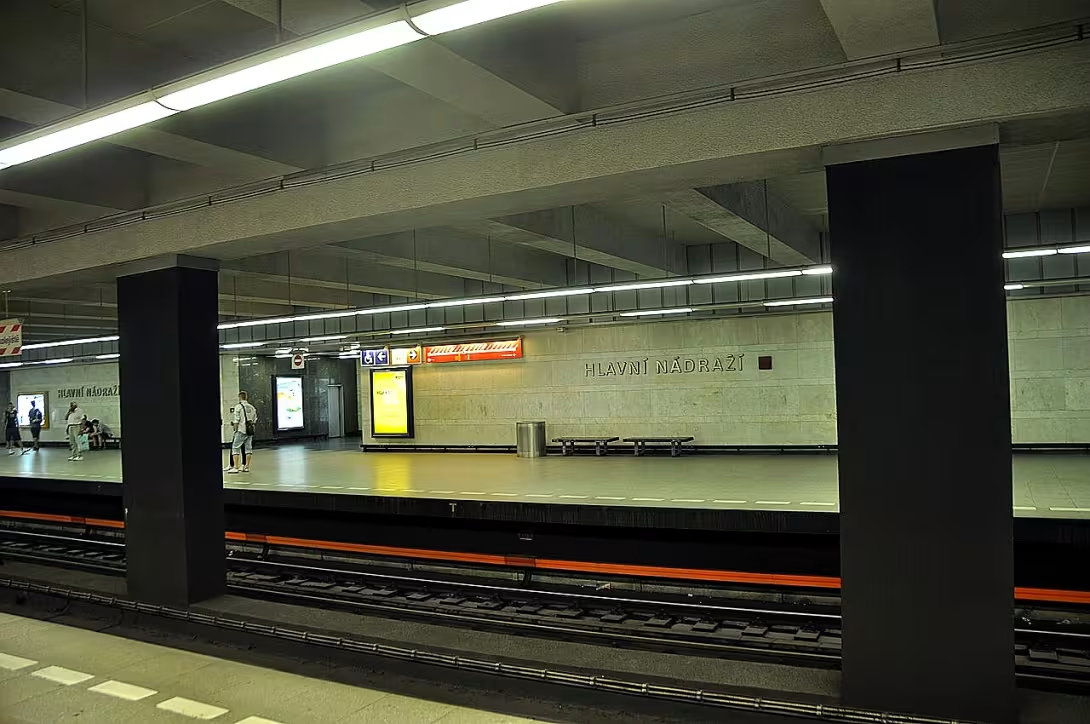
The station Hlavní nádraží is located in Prague 1 under the new check-in hall of the largest railway junction in the Czech Republic. This socialist landmark was opened on 9 May 1974 and ranks among the oldest metro stations on line C. Its exceptional nature lies in a design solution with side platforms, which is a direct consequence of the original plan for the construction of subsurface tram. Today this stop represents a key transfer hub connecting underground and rail transport to the capital.
Construction took place during normalization in the 1970s. The Prague Metro project was then one of the largest transport projects in urban infrastructure and served as a symbol of public transport modernisation. The station Hlavní nádraží became the first ever in Prague to be built. By 1972, its rough construction was almost finished. Official start-up for the public followed on 9 May 1974 as part of the opening of the first section of line I.C.
The construction site is a deep station created in an open construction pit at a depth of nine meters below the surface. Total length including technological installations is 222 meters. 61 million Kčs were built, 9.700 cubic meters of concrete and 1,000 square metres of underground walls were used. 49 150 cubic meters of earth were extracted. The construction features side platforms with columns between tracks, over which a new railway station clearance hall later grew. Two fixed staircases and two escalators lead to the hall from each side of the platform.
The owner and manager of this transport building is the Transport Company of the capital city of Prague. The original concept was created for the subsurface trams network in the section Pankrác - Hlavní nádraží. Since the trams at the time only had a door to the right, the architects designed a side platform. When the decision was made to change to a classic metro station, the modifications were no longer possible due to the advanced phase of the construction. The island platform has already been implemented at other stations along the route.
Other technical specificities relate to this development. The interstation section between the Museum and the Main Station is only 425 metres. It is the shortest section in the entire network of Prague Metro and the tunnel between them is partly double-track. An operational arrangement is also remarkable. Because of him, a man must leave paid space to move to the second platform. During the time of the impassable tariff, passengers had to go to a nearby station with an island platform to change direction without the need to buy a new ticket.
The station currently functions as a full part of the C line. It is immediately adjacent to the new check-in hall and the historic Fant building of the Main Station. The Vrchlický orchards, Wenceslas Square and the National Museum are nearby. The Hlavní nádraží is a remarkable proof of the technical development of Prague transport from the second half of the 20th century. When passing through this busy knot, it is worth noting its arrangement, which carries a unique print of old plans on the subsurface tram.
Historical milestones
- around 1972
- The rough construction of station Hlavní nádraží was almost finished.
- 1974
- Opening of metro station Hlavní nádraží and first section of line I.C.
Architectural development
The station was built in an open construction pit as a deep construction with a total length of 222 metres. Over 9,000 cubic meters of concrete and 1,000 square metres of underground walls were used for construction. Due to the original plan of subsurface trams was built with side platforms separated by columns between tracks. A new main railway terminal was built above the station.
Historical events
In 1972 the gross construction of the station was completed. On 9 May 1974, the station was officially opened to the public within the framework of the first section of Prague's I.C. Metro.
Owners
Transport company of the capital city of Prague
Points of interest
- The station was opened on the ninth of May in 1974 and ranks among the oldest on line C, and it was the first station in Prague that started to build. - Its uniqueness lies in the design solution with side platforms, which was a direct consequence of the original plan for the construction of the subsurface tram, whose cars only had the door on the right. - The interstation section between the Museum and the Main Station is only 425 metres long, which is the shortest section in the entire network of Prague Metro, and the tunnel between them is partly double-track. - Because of the operational arrangement with side platforms, one must leave the paid space to move to the second platform.
Guide
Show guide text
This text was created by artificial intelligence and has not been editorially reviewed. It may contain inaccuracies.
Welcome to the heart of Prague transport. Right now, you're standing in a place that connects thousands of human destinies, paths and stories every day. Put on your headphones comfortably, let the surrounding rush flow around you for a while and listen to the story about the station, which is much more than just a stop on the way home or to work. You are in the area of the metro station Hlavní nádraží, in a place that is firmly connected with the history of modern Prague and its transformation into a European metropolis.
Look around you. What you see is the result of bold plans and extensive construction works that have changed the face of this part of town forever. You are standing under the building of our largest railway junction. Above you is a structure that receives hundreds of trains every day, but you are now in its underground kingdom. Feel the strange atmosphere of a place where the world of above-ground tracks meets the world of deep tunnels.
Let's go back in time together now. To understand why this station looks what it looks like, we have to move to the early 1970s. The history of this place began to be written much before the first train of the underground railway came here. By the year one thousand nine hundred seventy two, the rough construction of this station was almost finished. It was a time of great expectations and technical challenges. Back then, Prague was preparing for a revolution in transport, which was intended to relieve congested streets on the surface.
This station holds one important primacy. It was the first station in the whole of Prague to start building. Its creation was a key moment for the entire route marked "C." The solemn moment came on the ninth May of the year a thousand nine hundred seventy-four. That's when the gates of this underground space opened up for the first time to the public, and people could use the first section of the line that connected the city in a new, fast way. Since then, this station has served without interruption and has become an integral part of the life of every Prague and visitor to our capital city.
I will now ask you to pay attention to the architecture and layout of the space you are in. If you have ever travelled through other routes of Prague Metro, you will notice something very unusual. Most Prague stations have one wide platform in the middle, to which trains come from both sides. But it's different here. Look at the tracks. They lead directly through the centre of the station and divide it into two separate parts. You are now standing on one of the side platforms.
This unusual appearance is not random. It has a deep historical reason that goes back to the original intentions of engineers. At a time when construction was being decided, it was not at all expected that there would be a classic, heavy metro as we know it today. The original plans envisaged the so-called subsurface tram. This side arrangement was ideal and practical for tram cars. Although plans have changed during the preparation process and Prague has finally decided on a fully-fledged underground track system, the construction solution of this station was already so advanced that it remained faithful to the original tram concept. It is a fascinating reminder of how visions of the future of the city evolved and changed directly under the hands of builders.
Notice also the depth in which we are located. We're not deep in the bowels of the earth. This station is so-called deep and its bottom lies just nine meters below the surface. This is compared to other, much deeper stations in the city centre, relatively small distance. This small depth allows quick and comfortable access to trains on the surface, making this place one of the most important transfer nodes in the country.
If you look at the walls and the overall design, you might wonder who's behind this work. Interestingly, the names of the particular architects who printed this station's face remain hidden in historical records. Although we don't know the names of individuals, their work speaks for itself. They were able to create a space that is functional, transparent and capable of embracing huge crowds of people that pass through here every day. It is a collective work of then engineers and workers who, in difficult conditions, built the foundations of modern transport.
Now let's think about the stories that this place remembers. Imagine the hustle and bustle in May of seventy-four, when the first sound of incoming sets sounded. It was a miracle of technology for the people back then. The station was a symbol of progress and a new era. Every stone and every panel here tells of the effort to link the historic city with the modern needs of its inhabitants. Even if we don't find statues of famous kings or commemorative plates of warlords, the heroes of this place are all the nameless people who designed and built the station.
One of the biggest attractions you can take away is the fact that you're standing in a place that was originally meant to be a tram stop. Imagine what it would look like if the plans hadn't changed. Instead of heavy subway cars, you would hear the jingling of trams coming from underground to Prague streets. This station is therefore a kind of monument to the unfulfilled dream of a subsurface tram, but it eventually gave way to a much more generous solution.
Try to close your eyes for a moment and feel the vibrations that spread through space. Do you feel that gentle lust every time a heavy train passes over you at the Central Station? It's a constant dialogue between the world up and the world down. This station is a bridge that connects these two worlds. It's a place of meetings, goodbyes, expectations and haste.
Our short stop at the history and architecture of the metro station Hlavní nádraží is slowly coming to an end. I hope the next time you go through this space, it won't just be a corridor and a platform for you. Remember the year nineteen hundred seventy-four, the courage of the then builders and the unique side platforms that remind us of the old plans for the tram track.
Now you can continue your journey. Perhaps you will take the stairs up to the historic building of the railway station, or you will board one of the trains and be taken to another part of our beautiful Prague. Wherever your steps lead, we wish you a good journey and many other interesting discoveries in the streets and underground of our capital city. Thank you for stopping by and listening to the story of this special place. See you next time you get to know Prague's sights.
Tips for visitors
The best time to visit the Main Station is in the early afternoon or in the evening when there are fewer people and you can enjoy a quieter atmosphere. This moment also offers a pleasant light for photographing historic buildings like the Fant building.
For transport to Hlavní nádraží it is advisable to use the metro, located under the new check-in building. You can park cars in nearby garages or parking lots, but we recommend checking the current parking options online.
When you visit, take your purse and sunglasses with you. It is also important to have a map with you or use GPS on your phone to make it easy to navigate around.
Photography will offer several interesting perspectives, especially from Vrchlické orfrom the metro station itself. Sunlight is ideal for capturing details of historical buildings.
The National Museum and Wenceslas Square are located in the vicinity of the Main Railway Station, which are suitable for a short walk or exploring exhibitions. For families with children, this area is ideal because it offers various attractions and the opportunity to enjoy the outdoor area.
Businesses nearby
Do you run a restaurant, accommodation, shop, museum, rental, wellness or other visitor service near this monument? Show yourself directly to the people heading to it — this is how they will see you in the app and on the web:
Events nearby

Zdroj akcí: otevřená data měst a obcí ČR (Národní katalog otevřených dat) a kalendář akcí Národního památkového ústavu.
Nearby
Nad stanicí se nachází nová i historická Fantova budova Hlavního nádraží a Vrchlického sady. V blízkosti se nachází také Václavské náměstí a Národní muzeum.
Accommodation nearby
Trips and activities nearby
Guided tours, tickets and activities nearby from GetYourGuide
Affiliate link: if you buy from the partner, we may receive a commission. The price for you does not change.
Search tours and activities →Themed route
Route for trip from Main Railway Station
1. Hlavní nádraží (Railway Station) Start your trip at this historic and modern place where the architecture of the different era meets. Hlavní nádraží is not only an important transport junction part of Prague, but also a beautiful place for walking around Vrchlický orchards and Fant's building.
2. Highlights (park) About five minutes' walk from the station is located this picturesque green oasis in the city centre. The sets are named after the famous poet Jaroslav Vrchlický and offer a quiet space for relaxation, walking or picnic.
3. Wenceslas Square (Square) Shortly after walking out of the Vrchlické orchards, you can get to this iconic local residence, where there is a monument to T. G. Masaryk and the National Museum. The square is the centre of political life and history of the Czech Republic.
4. National Museum (Museum) This important cultural establishment is not only home to rich collections, but also to architectural pearls with baroque facade. It is appropriate to explore the history and culture of the country.
5. Vodičkova street (street) About five minutes' walk from the National Museum is this alley named after Czech composer Antonín Dvořák. It is a place for walking and visiting local restaurants or cafés.
This trip offers meaningful knowledge of the main centre of Prague, from historical monuments to green spaces to cultural institutions.
Seasonal recommendations
Spring at Prague's main station brings a waking surrounding park in the historic neighbourhood, where the sun's rays penetrate through a glazed historical dome above the Art Nouveau main hall and create an impressive game of lights and shadows on old stone tiles. During this period there is a lively rush associated with the beginning of the tourist season, with the atmosphere fresh and full of expectations of travelers discovering the beauty of the Czech metropolis. We recommend to put on a light jacket or coat, because a cool spring draught sometimes unpleasantly stretches in the spacious halls, and for a more peaceful tour of architectural details it is worth arriving in the morning before noon peak, where there is no such long queues at the ticket office.
The summer lights up the monumental facade of the monument with a sharp noon sun, which radiates rich stucco decoration and attracts thousands of tourists to visit, making the inner spaces very busy and noisy. The atmosphere is charged with energy and the rush of people heading for holiday trips, which makes it an ideal time for a quiet visit first thing in the morning after dawn, when the rooms are still half empty and pleasantly cold. Choose breathable clothes and solid shoes for this period, because due to the large crowds you will spend a lot of time standing around and walking on hard floors, and remember to carry a bottle of drinking, as in the main summer season, the inner spaces can accumulate great heat.
Autumn covers the entire building in melancholy mood, where early dimming and foggy mornings underline the monumental nature of the historic building and artificial lighting of the inner corridors creates a cosy, until nostalgic atmosphere for all passing passengers. The crowds of tourists have already dropped significantly, which allows you to see in detail the original architectural elements and historical reliefs without pressurization. The practical advice is to wear a warm sweater and waterproof shoes, because the outdoor area in front of the entrance is usually wet and windy, and the best time for a visit is late afternoon, when artificial indoor lighting effectively blends with declining daylight.
Winter at the main station offers a unique atmosphere, where the outdoor snowfall blends with a warm glow of interiors and windows penetrating the muffled winter light reflecting from the frost on the surrounding historic roofs. There are increasing numbers of people looking for shelter from frost during the Advent time and during the holidays, which is why it is necessary to count on heavy traffic and more hustle. For a comfortable visit in this period, unconditionally choose layered warm clothes, winter coat and hat, as the transition from heated indoor areas out threatens to cool, and the most appropriate time for a quieter walk through the historic vestibule is the morning weekdays when the main burden of passengers falls.
Visualizations and artistic views

The visualisations are generated by artificial intelligence and serve as inspiration.
Photos from the area
Real photos taken near the monument


Zdroj a licence jsou uvedeny u každého snímku.
Tips from visitors
No tips yet. Be the first!
Log in and add your tip.
Sources and literature
Photos: Ralf Roletschek (talk) - Fahrradtechnik auf fahrradmonteur.de / FAL — Wikimedia Commons. The author and licence also appear when you hover over the image.
Faktickým podkladem tohoto textu byl článek na Wikipedii, jehož autory jsou přispěvatelé Wikipedie. Článek je dostupný pod licencí CC BY-SA 4.0.
Location on the map

Příběhy a pověsti
Legendy, pověsti a příběhy spjaté s touto památkou
Fotografie návštěvníků
Zatím žádné fotografie. Buďte první, kdo přidá fotografii z návštěvy!
Log in a přidejte svou fotografii nebo hodnoťte.
Za ověřenou návštěvu v aplikaci získáte víc bodů — poznáme podle GPS, že jste na místě.
Reviews and comments