



Hotel Axa Hotel building
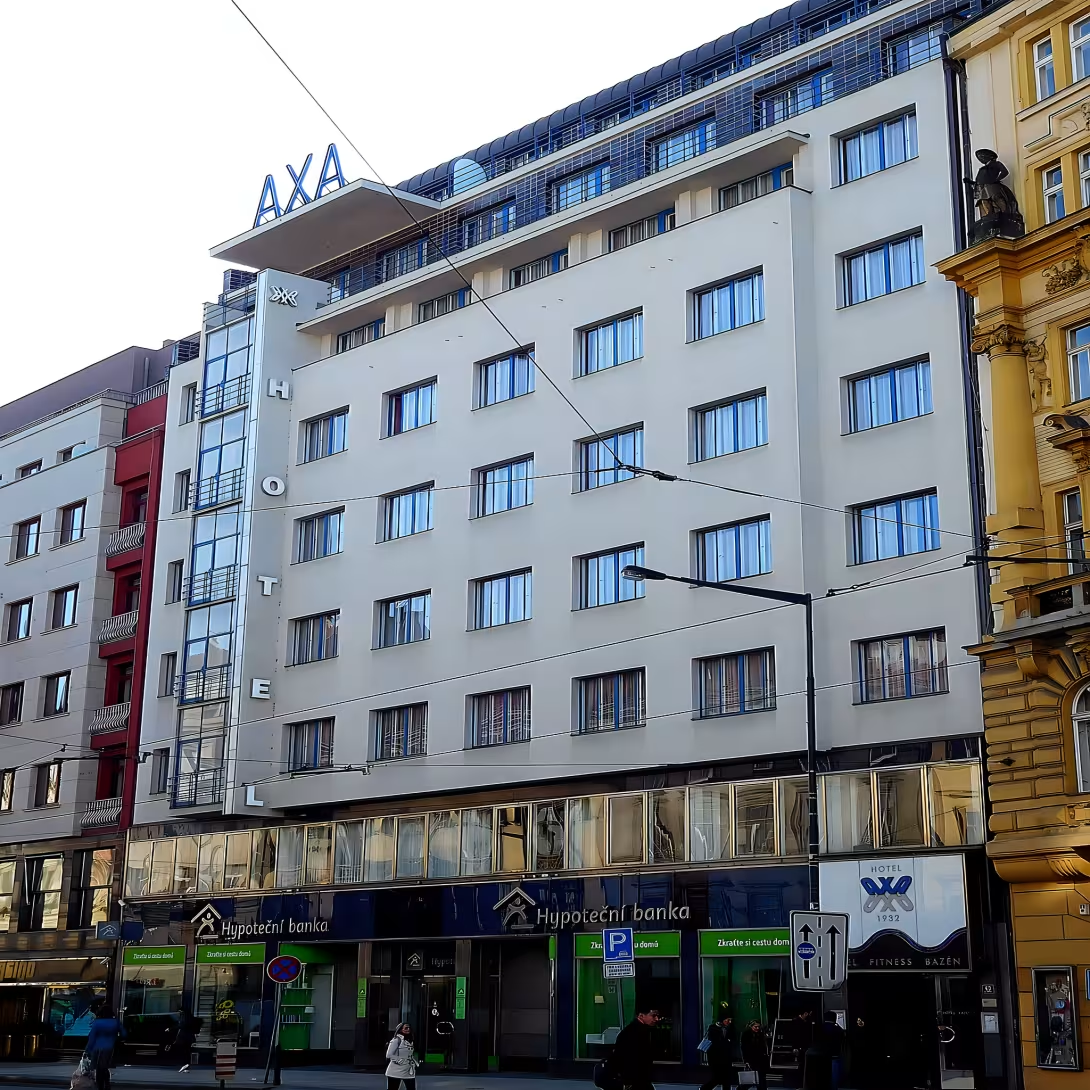
The AXA Hotel, also known as the AXA Palace, is a unique historical monument located in Prague in New Town in Na Poříčí street No. 1041 / II. This polyfunctional object, built in the style of functionalism between 1930 and 1932 by the architect Václav Pilco, is remarkable by its innovative combination of hotel, pension, cafes, office space, shops, garages and sports center with swimming pool. In 2014, the building was declared a cultural monument after successful reconstruction in the years 2013- 2014.
The formation of the AXA Hotel is set in the period of the first republic when functionalism was developed in Central Europe as an architectural direction. Architect Václav Pilc, who was also a building engineer, designed an object with an ambition to combine diverse functions into one building. His later wife Běla Friedländerová-Havlová, a well-known sport with experience from European and American projects, also participated in the proposal. This approach enabled the creation of a complex that was very modern for its time.
The AXA Hotel architecture is characteristic of functionalism with its simple and practical design. The building has a triple wing and nine above-ground floors, and its ground plan is made up of an irregular rectangle which extends to the letter "U" at the height of the 1st floor. Among the side wings is a hall with a 25-metre pool and above it a roof with skylights that illuminate the sports centre on the floor. The interior of the building preserved marble tiles, metal railing, patio and mosaic tiles, which adds elegance and historical value.
The history of ownership of the AXA Hotel is rich in events. After his completion in 1932 the building was initially in private property, but after 1948 there was nationalization and the hotel went under the administration of the state. At this time the swimming pool was mainly used by athletes from schools and Prague divisions. After 1994, the building was returned to the granddaughter of the original owners, which enabled its reconstruction and restoration of the original functional character according to the design of architect Rudolf Netík. The reconstruction included the purchase of tubular furniture, which was originally used in the hotel.
The key event in the history of the AXA Hotel is its reconstruction in 2013 and 2014. This adjustment was intended to restore the building in the spirit of the original design Václav Pilce, which included a sports function with swimming pool and gym. Thanks to this reconstruction, the building was reopened as a cultural monument to be visited.
Today the AXA Hotel is not only a monument to the architecture of functionalism, but also a living testament to the history of Prague and its development. Its unique design and rich history make the object an ideal place to visit. Explore Hotel AXA means not only to appreciate its architectural values, but also to immerse yourself in the past and understand how the functions of the building have been transformed over the years. This monument is an important contribution to the history of Prague and its architectural wealth, which makes it necessary for any interested local cultural heritage.
Then and now
Drag the slider to compare how the landmark may have looked when it was built with the view today.
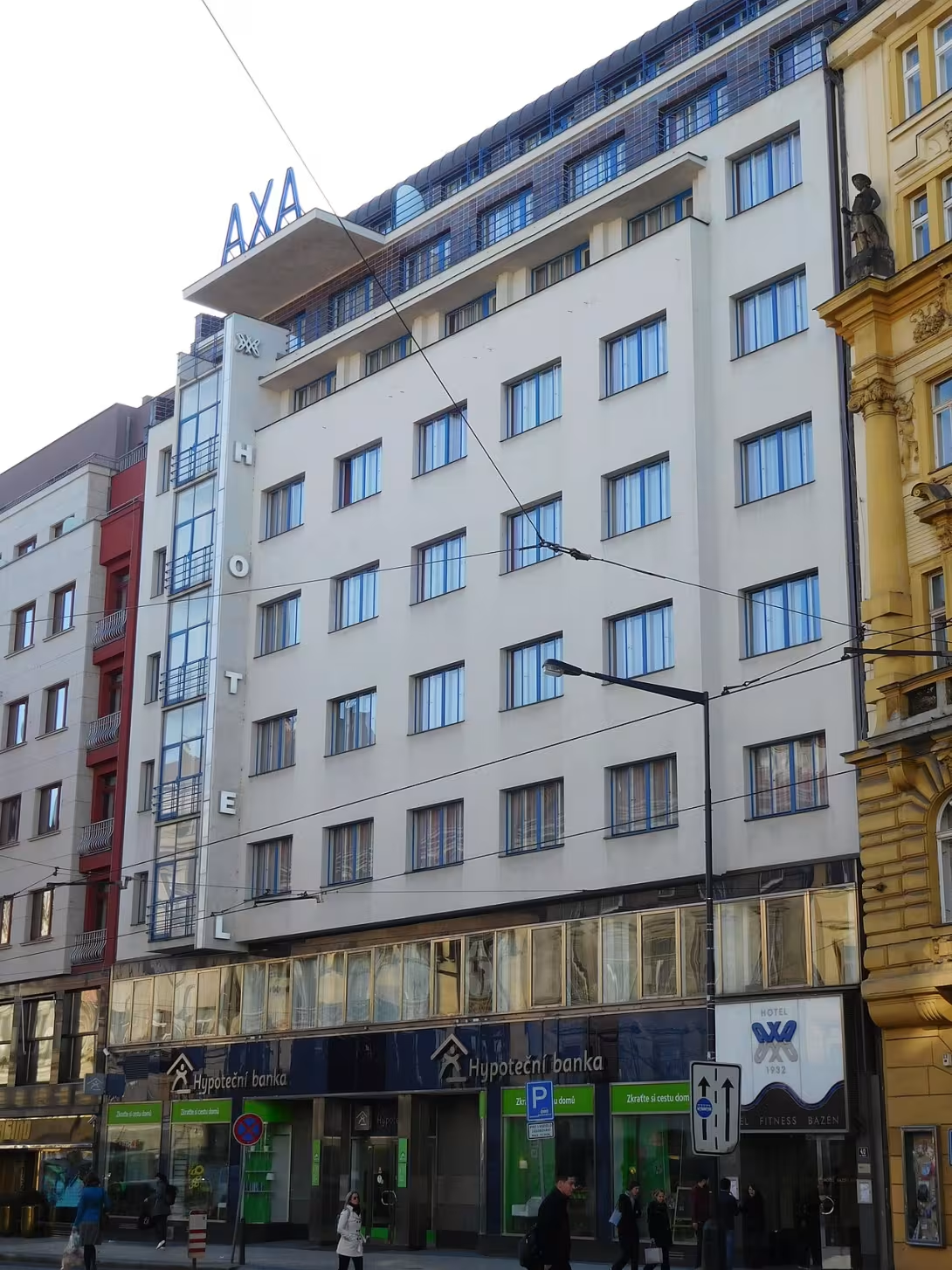

The historical appearance on the left is an AI-generated visualisation and serves as inspiration only.
Historical milestones
- 1932
- Completion of construction
- 1948
- Nationalization of the hotel
- 1994
- The restitution of the building to the granddaughter of the original owners
- 2014
- The building became a cultural monument
Architectural development
A functionalist three-wing building with nine above-ground floors. The interior includes marble tiles, metal railing and mosaics. The reconstruction was carried out from 2013 to 2014 according to the design of Rudolf Netík.
Historical events
1930-1932 construction realization, 1948 nationalization of the building, 1994 restitution of the building, 2014 declaration for cultural monument.
Owners
Václav Pilc (until 1948), State (after 1948), granddaughter of the original owners (since 1994).
Points of interest
- The AXA is a unique historical monument located in Prague in New Town. - The building was built in the style of functionalism by architect Václav Pilco between 1930 and 1932. - The AXA was declared a cultural monument in 2014 after successful reconstruction in 2013- 2014. - The architecture of the building is characteristic of functionalism with simple and practical design, has nine above-ground floors and a floor plan in the shape of "U." - Reconstruction in 2013 and 2014 was intended to restore the building in the spirit of the original designs Václav Pilce, which included a sports function with a swimming pool.
Guide
Show guide text
This text was created by artificial intelligence and has not been editorially reviewed. It may contain inaccuracies.
Welcome to the heart of Prague, right in New Town. You are standing in front of one of the most important building units in this neighborhood, which will immediately charm you with its appearance with its balance and purity. Before your eyes is a palace that is not just an ordinary building but a real symbol of modern life. Only at the first glance at its extensive structure can you feel the strength and clarity that its creators brought into this place. Feel the harmony of how the building floats over the street and how its lines lead you up. It's not just a khlièek of stone and mortar, it's a work that tells the story of ambition, change and effort to create space for a modern-century man.
Let us now return together in time and understand how this amazing object was created. Imagine Prague in the late 1920s and early 1930s. The city was full of energy, looking for a new direction and wanting to get rid of the cumbersome past. At this very time, between a thousand and nine hundred thirty and a thousand and nine hundred thirty-two, this building was completed. It was designed to serve many people at the same time, like the multi-function heart of the neighborhood. At that time it was believed that architecture had to be practical and that every part of the building had to have a clear meaning. But the fate of this place has not always been easy. In the year one thousand and nine, forty-eight, the time came when the state took control of this object, which was then called nationalization. The building went through various periods that changed its atmosphere, but its essential nature remained. Only in the year one thousand and nine, ninety-four things returned to their place when the building was returned to the granddaughter of the original owners. This was a crucial moment that allowed the building to restart its own full life.
Now pay attention to the architecture itself that you are currently observing. Look at this incredible extent. This building is not just one simple block, but it has three wings, which together form one coherent and logical whole. If you look up, you'll see nine floors above ground that are majestically rising to the sky. This whole object is a textbook example of a style called functionalism. This direction does not seek unnecessary decoration or complicated carving. Instead, it seeks beauty in clean lines, in the logical distribution of space and, above all, in how well the building performs its function. Everything you see has a purpose. This building was designed to connect many different worlds. It's a hotel, it's a guesthouse, it's a place for a coffee shop, offices and sports center with a pool. It's like a small town inside a building. In recent years, between two thousand thirty-three and two thousand fourteen, this monument has undergone a great transformation. There was a complete reconstruction that had one main goal: to restore the original character and face that its creators gave her almost a hundred years ago. Thanks to this work, we now see the building in its best form, where history meets the modern need for comfort.
But to fully understand the size of this work, we need to think about the people behind it. They weren't just craftsmen, they were visionaries. The main architect who brought such a bold and modern view to this part of Prague was Václav Pilc. His vision was clear - to create space that will serve people in their daily lives. Běla Friedländerová-Havlová and Rudolf Netík also cooperated on this project. These people together formed a team that could link technical skill to artistic perception of space. Běla Friedländerová-Havlová was a character whose name is now closely linked to the history of this place, and its contribution to the overall form of the object is undeniable. Imagine their efforts in every detail trying to express the ideal of modern housing and work.
Perhaps now you'll find one interesting thing that gives this place even greater weight. This building is not just an ordinary guest house or office space. It's an officially recognized cultural monument. This award came in two thousand fourteen, just after the successful and meticulous reconstruction that took place several years earlier. It is proof that what was built almost a hundred years ago is of enormous value not only to Prague but also to the entire history of architecture. There is also a mystery - how did it manage to maintain such a complex object that connects so many different activities in such a good state after so many decades of change? It is the result of the incredible quality of the original design and also the respect that its future repairers have had for this place.
Now that you've learned the basics of this place and understood its meaning, I suggest you continue your walk around New Town. Let yourself be inspired by this pure form and try to find a piece of history that still lives and still serves people. Look at the surrounding streets, see the atmosphere of this place and look at the buildings around you as living witnesses of time. Thank you for spending this moment with this monument and for being interested in her story. We wish you a beautiful rest of the day and many other interesting discoveries on your next tour of the city.
Tips for visitors
Best time to visit the hotel Axa is in the spring or autumn period, when Prague is particularly charming and less demanding for temperature. This time of year offers a quiet time to explore the polyfunctional building and its surroundings.
Check the current connection and routes in the previous search engine.
When you visit the Axa hotel, you can bring sports clothes to visit the pool or office comfort if you plan to use the work space. Also remember the camera because the building offers interesting architectural details.
Photography in hotel Axa is best in sunny weather when the three-wing layout of the building is illuminated ideally. The best places for photos are gardens and swimming pool on the terrace, offering views of Prague.
In the vicinity of the hotel Axa can find several attractions such as the historic street Na Poříčí with its characteristic business life. A walk in New Town and a visit to nearby parks are suitable for families with children.
Frequently asked questions
Can the monument be visited?
The building is in use (offices, a school, shops and the like). The interior is generally accessible only during operating hours and tours are not usually offered; we have not verified the details. You can see the exterior from the street.
Where is the monument?
Location: Nové Město, Hlavní město Praha. The map on this page shows the exact spot.
Why is the monument protected?
It is listed in the Central List of Cultural Monuments of the Czech Republic as a cultural monument (register no. 1803090650).
Businesses nearby
Do you run a restaurant, accommodation, shop, museum, rental, wellness or other visitor service near this monument? Show yourself directly to the people heading to it — this is how they will see you in the app and on the web:
Events nearby


Zdroj akcí: otevřená data měst a obcí ČR (Národní katalog otevřených dat) a kalendář akcí Národního památkového ústavu.
Nearby
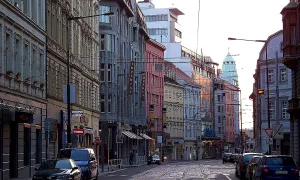
Praha, Nové Město, ulice Na Poříčí.
Accommodation nearby
Trips and activities nearby
Guided tours, tickets and activities nearby from GetYourGuide
Affiliate link: if you buy from the partner, we may receive a commission. The price for you does not change.
Search tours and activities →Themed route
Thematic cruise route from New Town
1. Hotel Axa (Palace)
Type: Historical hotel and former palace
Why is worth visiting: This elegant object is an important monument to architecture in New Town. Originally built as a palace, today it serves as a luxury hotel and offers a view of history and modernity.
2. Street Na Poříčí
Type: Historical street
Why is it worth a visit: Na Poříčí Street is one of the oldest and most memorable streets in New Town. It is famous for its historic houses, cafes and shops that carry the city's rich past to date.
3. Church of St. Nicholas
Type: Church
Why is it worth a visit: This Baroque church is one of the most famous sacral monuments in New Town. Its beautiful interiors and historical significance make it an essential part of local culture.
4. Square of the Republic
Type: Square
Why is worth a visit: The central square in New Town is known for its historical and cultural significance. There are many monuments, such as the National Theatre, which makes the square an ideal place to walk.
5. Café Slavia
Type: Historical cafe
Why is worth a visit: Slavia Café is one of the oldest and most popular cafes in Prague. It is famous for its peaceful environment, historical interiors and traditional Czech dishes.
This route offers a view of the rich history and culture of New Town, while bringing you from architectural monuments to cultural centers.
Seasonal recommendations
Spring: In the spring period, the hotel Axa (palace) in New Town is surrounded by flowering gardens that bring a living breath into the atmosphere. Sun rays penetrating through trees and flowers create unforgettable lighting that emphasizes the beauty of historical buildings. This time of year is ideal for walking around gardens and enjoying a quiet environment without crowd overloading. We recommend that visitors wear comfortable shoes because grass can still be wet and flowers can be planted. The best time to visit is in the afternoon when the sun lights up everything.
Summer: In the summer months, Hotel Axa (palace) shows its full beauty. Sunshine days and warm air attract a large number of visitors who want to enjoy a historical memory in a quiet environment. The atmosphere is full of life and excitement, making this time of the season unforgettable. We recommend coming early in the morning or late in the afternoon to avoid the biggest crowds and enjoy a peaceful walk around the palace. Don't forget the protective eye glasses and enough drinking water.
Autumn: In autumn, Hotel Axa (Palace) offers visitors a unique atmosphere when tree leaves turn into living colours. The sun falls on historic buildings from a different angle, which creates great lighting that emphasizes the architectural beauty of the palace. This time of year is ideal for a quiet visit without overfilling the crowd. We recommend wearing warmer clothes because winter is coming and November winds can be cold. The best time to visit is this afternoon when the sun is still strong enough.
Winter: In the winter months, Hotel Axa (Palace) offers a quiet and quiet atmosphere. Beautiful snow covering the palace creates views that are truly noble and resemble ancient times. Lighting is different from other seasons, which adds a mystical touch. Visiting during winter requires warm clothes and suitable shoes because it can be cold and snow conditions can occur. The best time to visit is in the morning when the shadows are shorter and the sun's rays illuminate the palace.
Visualizations and artistic views


The visualisations are generated by artificial intelligence and serve as inspiration.
Photos from the area
Real photos taken near the monument

Zdroj a licence jsou uvedeny u každého snímku.
Tips from visitors
No tips yet. Be the first!
Log in and add your tip.
Sources and literature
Photos: JiriMatejicek / CC BY-SA 3.0, rozlišení zvýšeno umělou inteligencí — Wikimedia Commons. The author and licence also appear when you hover over the image.
Faktickým podkladem tohoto textu byl článek na Wikipedii, jehož autory jsou přispěvatelé Wikipedie. Článek je dostupný pod licencí CC BY-SA 4.0.
Location on the map
More monuments – Nové Město
Show all in the municipality


Příběhy a pověsti
Legendy, pověsti a příběhy spjaté s touto památkou
Fotografie návštěvníků
Zatím žádné fotografie. Buďte první, kdo přidá fotografii z návštěvy!
Log in a přidejte svou fotografii nebo hodnoťte.
Za ověřenou návštěvu v aplikaci získáte víc bodů — poznáme podle GPS, že jste na místě.
Reviews and comments