



Hrobka rodu Scharff-Baumgarten Tomb
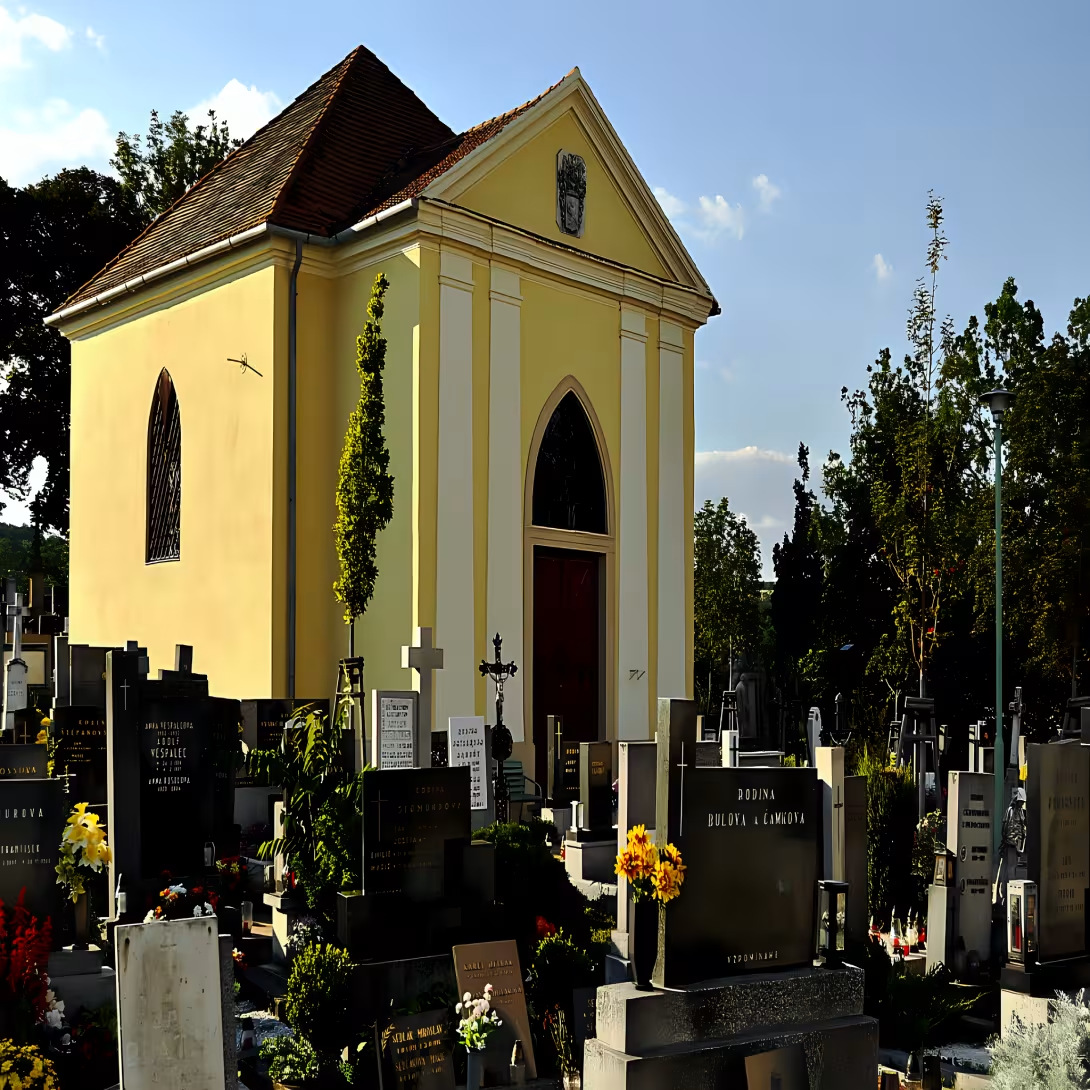
Hrobka rodu Scharff-Baumgarten is a classical funeral chapel with neo-gothic elements from 1840. It is located in a cemetery in the village Oslavany in the district of Brno-rural. The building served as a family burial ground of two noble families and since September 26, 2000 it has been led as a protected monument.
The chapel was built in 1840 thanks to the Scharff and Baumgartten families. There was a process of modernization and industrialization in the Czech Republic, which influenced the architectural styles at the time. The first buried was the founder and owner of the Johann Nepomuk Scharff birthday estate. After 1813 he was nobilitated into a state of free masters and used the title Freiherr von Scharff.
The construction combines elements of classicism and neo-gothic. In the interior there are sixteen tombs, of which ten are occupied with remains and six remain vacant. Originally, there were wooden tombstones with corresponding frames and Latin inscriptions on brass sheets. These elements were removed at a later reconstruction.
In addition to the Scharff and Baumgartten families, the Hentschels and Salamanca-Ortenburg were buried in the chapel, which represented the continuation of the family after the outlaw. The last funerals took place here in the first half of the 20th century. On February 14, 1937, the commander of the Austrian Dragoon Hanns Baumgartten was placed in the tomb. The last person to be buried in the chapel was Marie von Baumgartten, who was sent on January 8, 1942.
A significant change in the fate of the monument was the decision of the late 1950s to turn the family tomb into a funeral ceremonial hall for the inhabitants of Oslavan. The modification was completed on 1 August 1962 and the first funeral in the new regime took place here on 11 October of the same year.
In 2021 the chapel ceased to serve as a ceremonial hall and was closed. The construction stands against the cemetery gate and represents an important architectural element of the local burial ground.
The monument is a valuable testament to the history of the local estate and noble families. Her visit allows a glimpse into the architecture of the mid-19th century.
Historical milestones
- 1840
- The creation of a classical funeral chapel
- 1942
- Last funeral in the chapel
- 1962
- Completion of reconstruction into ceremonial hall
- 2000
- Entry into the Monument Protection Register
- 2021
- Closure of the chapel and closure of the ceremonial hall
Architectural development
The chapel was built in 1840 as a burial ground for the Scharff and Baumgartten families. At the end of the 1950s, it was converted into a memorial hall, which included the removal of tombstones.
Historical events
- 1840
- Construction of the Scharff-Baumgarten Chapel.
- 1937
- Last funeral in the chapel, Hanns Baumgartten.
- 1962
- Rebuilding the chapel to the funeral ceremonial hall.
Points of interest
- Hrobka rodu Scharff-Baumgarten is a classical funeral chapel with neo-gothic elements from 1840.
- The chapel served as a family burial ground for two noble families and since September 26, 2000 it has been guided as a protected monument.
- The first buried was Johann Nepomuk Scharff, the founder and owner of the birthday estate, which after 1813 was nobilized as free masters.
- Apart from the Scharff and Baumgartten families, the Hentschels and Salamanca-Ortenburg were buried in the chapel, which represented the continuation of the family after the outlaw.
- A significant change in the fate of the monument was the decision of the late 1950s to transform the family tomb into a funeral ceremonial hall for the inhabitants of Oslavan, which was completed on 1 August 1962.
Guide
Show guide text
This text was created by artificial intelligence and has not been editorially reviewed. It may contain inaccuracies.
Welcome to the celebrations. Please stop for a moment and take a deep breath. Right now, you're standing in front of a place where time has stopped and where in the silence of the cemetery space there are stories of two important families. In front of you is the tomb of the Scharff and Baumgarten family, a building that is not just an ordinary burial site but a real stone notebook of local history. Feel the atmosphere of this place, its calm and a certain sense of respect that radiates from the building. It is the space that was created for eternity to protect the rest of those who once had a major influence on the shape of this region.
Let us now look together at how this chapel was created and why it is standing here in the first place. Let's move back almost two centuries in our minds to 1840. At that time, it was customary for noble and wealthy families to create their own family burial grounds, which served not only as a final resting place, but also as a symbol of status, continuity and monuments of ancestors. For this very purpose, this chapel was built for the Scharff and Baumgarten families. Imagine the enthusiasm at the time for building and the desire to leave a mark in history. This building was supposed to be a safe port for the generations that followed, while proud of their identity.
Now pay attention to the very form of the building. If you look at the overall composition, you notice an interesting connection between two different epoch. Classicism is the dominant direction here. Classicism, as the name suggests, drew from the ancient, sought harmony, balance and purity of the lines. It's a style that radiates calm and balance, which is very convenient for the funeral chapel. However, if you take a closer look at the building, you will see the neo-gothic elements. In the nineteenth century, Novogotics were very popular with sacral and funeral buildings because it reminded of medieval spirituality and directed its expression upwards, towards the heavens. This connection of classical peace with neo-gothic nobility creates a unique character that makes the building much more than just an ordinary tomb. Look at the facade and see how these two worlds complement each other in one building.
So who were the people for whom this space was created? The key character is Johann Nepomuk Scharff. He was the founder and owner of the feast estate and became the first man to be buried in this chapel. Imagine him as a man of his time, who decided in 1840 that his family would have a place here for eternity. Together with him, the names of the Baumgarten family, such as Hanns Baumgarten, are associated with this place. These families were not just looking for a place to bury them, but they created a family archive in a stone. Every funeral that took place here was layered in this place by a new layer of history and emotion.
But the history of this chapel is full of changes and breakthroughs that reflect the history of our entire state. For years, it served as a private family burial ground until 1942, when the last family funeral took place here. That was the end of an era. With the arrival of new times and changes in the mode, the function of the chapel has changed. In 1962, the building was rebuilt into a ceremonial hall. The intimate family space thus became a public place, where they parted with the nearby generations of the inhabitants of Oslavan. The chapel thus gained new meaning and became part of the daily life and sadness of the local people.
It's fascinating to see how our view of this building changed. In 2000, exactly six hundred years after its creation, the chapel was recognised as a protected cultural monument. This means that the State has officially confirmed its architectural and historical value. Since then, it has been kept in the preservation register, which has ensured that its unique appearance will be preserved for future generations. However, history has brought another break. In 2021, the chapel was closed and its operation as a ceremonial hall was terminated. So today you're standing in front of a building that's gone silent again. It is a place that has returned to its original character of a silent tomb, even though its inner spaces are now no longer accessible.
You may be interested in one thing that makes this building a mystery. Think about how many secrets are hidden behind these walls. From the noble ambitions of the mid-nineteenth century, to the dramatic events of World War II, to the silent farewell in socialist times. This chapel saw everything. He's a silent witness who won't say anything anymore, but he keeps telling his story to anyone who stops and looks closely. It's fascinating how one building can turn from a private family sanctuary into a community space and eventually become a protected museum object that we're just watching from the outside today.
Now that you know the story of the Scharff and Baumgarten tomb, I suggest you stay with her for a while. Walk around it slowly, perceive the texture of the materials and watch how the light is played on classical and neo-gothic details. Try to imagine all the people who have come here over the last hundred and fifty years, and think about what this place meant to them.
This concludes our short stop at this beautiful monument. I hope this interpretation helped you see more than just an old chapel in the cemetery in this building. I will now invite you to further explore the surroundings of the Slavan and their hidden corners. We wish you a pleasant continuation in your journey to history and thank you for your attention. Goodbye.
Tips for visitors
The best time to visit is early morning or late afternoon, when soft light best highlights the details of classical and neo-gothic architecture. Due to the location in the cemetery, we recommend that you take care of the peace and respect of the place.
We recommend taking comfortable shoes suitable for cemetery terrain and possibly a photographic machine. Since this is an outdoor area, don't forget enough fluid.
For the best photos, focus on the contrast between the classical base and the neo-gothic elements. The ideal light for capturing the facade is during the so-called golden hour before sunset.
For families with children, visiting opportunities for a short lesson on the architecture of the nineteenth century and the history of family tombs can be important for children to learn about proper behavior in sacred space.
Frequently asked questions
Can the monument be visited?
Cemeteries and graves are usually accessible; please respect the dignity of the place. We have not verified the opening hours of this cemetery.
Where is the monument?
Location: Oslavany, Jihomoravský kraj. The map on this page shows the exact spot.
Why is the monument protected?
It is listed in the Central List of Cultural Monuments of the Czech Republic as a cultural monument (register no. 1000163914).
Businesses nearby
Do you run a restaurant, accommodation, shop, museum, rental, wellness or other visitor service near this monument? Show yourself directly to the people heading to it — this is how they will see you in the app and on the web:
Nearby
🏰 Historic sites (145)
- sv Jan Nepomucký 0.2 km
- Michal Šebela 1.4 km
- sv Jan Nepomucký 2.3 km
- Memorial of the Old Murder at Padochach 2.5 km
- Kamil Prokeš 2.9 km
- Projekt Zbyšov - water tank "Brodky" 3.3 km
- Mining Museum 3.4 km
- Col. 3.5 km
- Church of St. Martina 3.6 km
- U Flight 4.0 km
- Tomáš Procháza 4.1 km
- XXX- and deceased species in the world war 4.2 km
- Alfonse Memorial Muchy 4.3 km
- Anton Mauritz Worell 4.3 km
- Guido Adler 4.3 km
- Madonna 4.4 km
- sv Florian 4.4 km
- sv Roch 4.4 km
- sv. Karel Boromei 4.4 km
- sv Jan Nepomucký 4.4 km
🍽️ Restaurants and dining (148)
- Moravian Bašta 0.1 km
- Fresh Bistro U Lawyers 0.2 km
- Castle Restaurant Oslavany 0.3 km + 420 721 232 378 web
- Workhouse 0.4 km
- Restaurant at Práts 0.5 km 721681677; 511115421 web
- Espresso 0.7 km
- Refreshments in Towers 1.0 km
- Sokolovna 1.9 km
- Guesthouse at Nightingale 2.3 km
- Hossovka u Františka 2.4 km
- Viet 3.5 km
- Roj Kebab 3.6 km
- Stop Caffe 3.7 km
- Box bar 2006 3.8 km
- Na castle 4.0 km
- U rose 4.0 km
- Čečícká úsodka 4.1 km
- Ali Baba Kebab 4.1 km
- Lapacho 4.2 km + 420533386591 web
- RAF 4.2 km web
🏨 Accommodation (31)
- Restaurant - guesthouse Marek 4.4 km web
- _ 4.4 km + 420777172763 web
- Urban 4.6 km
- Zoopark Witch Court - Penzion 4.7 km + 420 511 140 818 web
- F-bifé 6.7 km
- Hotel Harmony 7.4 km + 420 773 074 737 web
- U Crlice 7.4 km
- Guesthouse Cristal 7.9 km web
- Penzion Pastzposka 9.4 km + 420 724 804 118 web
- Rokiten 9.7 km Znojemská 393 + 420 605 248 935 web
- Public campsite Fiola 9.9 km
- Hotel Restaurant Na Navsi 11.0 km
- Alpa 11.0 km + 420728066609 web
- Kemp Oáza 11.1 km Square William Dead 10 + 420 606 457 448 web
- Kobero 11.2 km
- Admiral 11.2 km (+ 420) 546 427 035 web
- Hotel Motorsport 11.5 km
- Princ 11.5 km
- Kouricks 11.6 km
- Grid 12.3 km
🚲 Rentals and sport (16)
- Bina Bikes 0.3 km web
- Sokolovna Padochov 1.9 km
- Sportisimo 3.4 km
- Wheels Berka 3.9 km
- M Sport 4.4 km
- Elektrosport 4.4 km web
- Airsoftpark Ketkovice 7.1 km
- spore hala 7.9 km
- Winter Stadium Rosite 8.0 km
- Swimming pool Liar 8.1 km
- Cycloservice Pavel Novotný 8.5 km
- Sokolovna 10.6 km
- ALBRIDGE, s.r.o. 11.3 km
- Sokol 12.3 km
- Offroad Park Automodrom Brno 12.8 km web
- Sokol 13.4 km
🥾 Hiking and nature (144)
- Dog well 0.5 km
- U Vazu 1.3 km
- Pod small ma 1.6 km
- Holy water 2.1 km
- Pramen u Berana 2.3 km web
- Pod Barborough 2.6 km
- Bouchal 2.7 km
- Mine Anna 2.9 km
- Cihelna 3.2 km
- Mine Simson 3.4 km
- Fish Rock 3.9 km
- Fish Rock 3.9 km
- Park Pústka 3.9 km Masarykova
- Natural monument Bakarka 4.2 km
- _ 4.2 km
- Former Jindřich II mine 4.7 km
- Garden Villa Panowski 5.1 km
- Patočkova hora 5.1 km
- View Alfonse Muchy 5.1 km
- Park Réna 5.3 km
Accommodation nearby
Trips and activities nearby
Guided tours, tickets and activities nearby from GetYourGuide
Affiliate link: if you buy from the partner, we may receive a commission. The price for you does not change.
Search tours and activities →Themed route
1. Grave area - Type: Park. The walk around allows you to perceive the peace and overall available sights. 2. Exterior chapel - Type: Architecture. The facade of the building represents an important aesthetic element in the landscape of the village. 3. Interior of the chapel - Type: Sacral space. The inner space serves to honor the memory of the Scharff-Baumgarten family. 4. Grave spaces - Type: Vault. The final resting place of the family that concludes a visit to this historic place.
Seasonal recommendations
The spring season offers a fine, scattered light that beautifully highlights the historical shapes of the building. There is a new green flower around the chapel, which gives the place a sense of peace and renewal. We recommend a visit in the morning when the air is fresh and around the sights are not many people. Clothes should be laminated to protect you from morning cold and afternoon heat.
In the summer months, the sun is strong, creating interesting shadows and contrast between light and darkness in the interior of the tomb. The surrounding area is deep green and is very lively. Due to possible higher temperatures and sudden visitors, it is best to arrive immediately after opening so that you enjoy your peace and avoid the greatest heat. It is ideal to choose light and breathable clothes.
Autumn brings a melancholy atmosphere to Oslavan, underscored by morning fog and golden shades of leaves. The light is low and very cozy in this period, which is ideal for observing details of the tomb. Prepare to visit a warmer jacket, because in autumn days it gets damp and colder. The best time for a tour is in the afternoon when the sun creates the most interesting light effects.
Winter time is the quietest and most noble for this memory, especially thanks to short days and cold air. The atmosphere is very serious, which perfectly matches the character of the place. Due to the limited opening time and lack of daylight, we recommend planning a visit around noon. The need is very warm and waterproof clothes to make your tour comfortable even in cold days.
Visualizations and artistic views


The visualisations are generated by artificial intelligence and serve as inspiration.
Photos from the area
Real photos taken near the monument


Zdroj a licence jsou uvedeny u každého snímku.
Tips from visitors
No tips yet. Be the first!
Log in and add your tip.
Sources and literature
Photos: Lucie Pauzová / CC BY-SA 3.0, rozlišení zvýšeno umělou inteligencí — Wikimedia Commons. The author and licence also appear when you hover over the image.
Faktickým podkladem tohoto textu byl článek na Wikipedii, jehož autory jsou přispěvatelé Wikipedie. Článek je dostupný pod licencí CC BY-SA 4.0.
Location on the map


Příběhy a pověsti
Legendy, pověsti a příběhy spjaté s touto památkou
Fotografie návštěvníků
Zatím žádné fotografie. Buďte první, kdo přidá fotografii z návštěvy!
Log in a přidejte svou fotografii nebo hodnoťte.
Za ověřenou návštěvu v aplikaci získáte víc bodů — poznáme podle GPS, že jste na místě.
Reviews and comments