



kostel Matky Boží Church
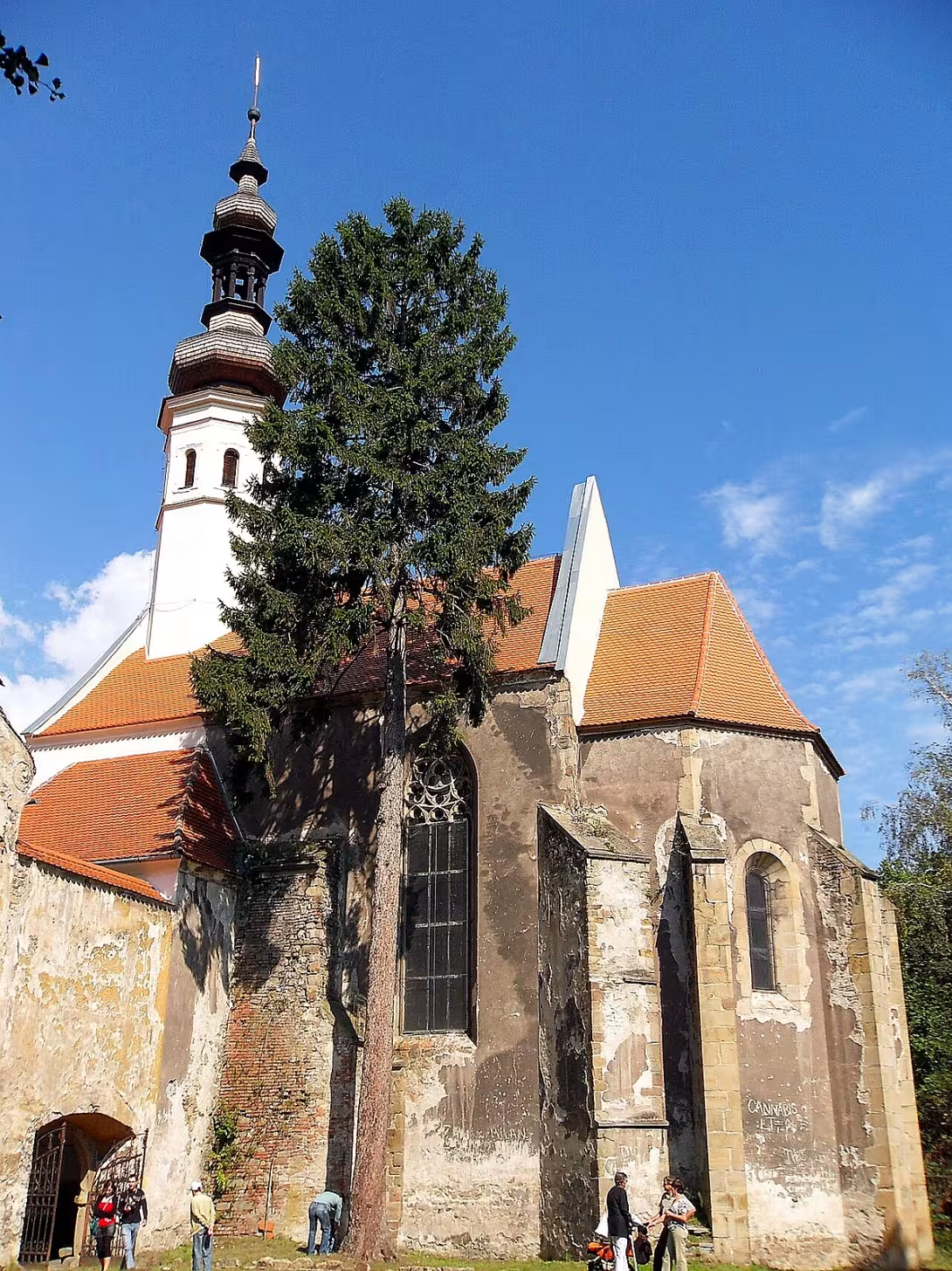
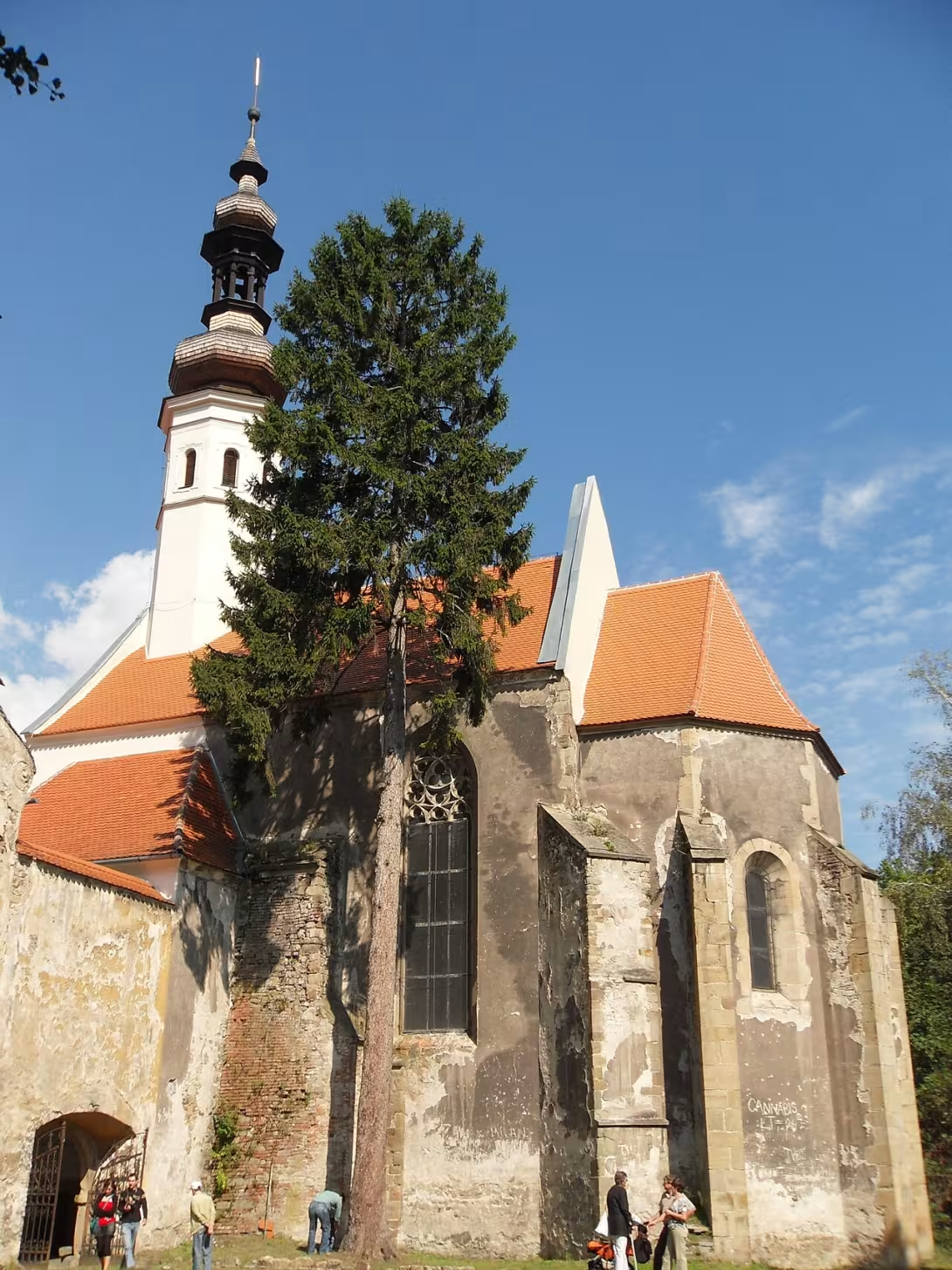
The Church of Our Lady is a Roman Catholic church in Oslavany, Czech Republic, situated within the former monastery and castle complex, a protected cultural monument. Its complex history began in the 13th century, marked by various renovations and restorations.
Construction started in 1225 with a plan for a basilica with a three-nave choir. However, the design was later changed to a hall church due to static issues. The church was built using a combination of stone and brick, with a wooden roof. The original plan was altered, and the project was eventually changed to a hall church with a choir.
The church was built in several stages. The first stage was the construction of the altar area, initially a temporary space for services during the construction of the rest of the church. The church has undergone several renovations and restorations over the centuries.
In the 14th century, the church was renovated, and a new choir was built. The original apse was replaced with a polygonal choir featuring a vaulted ceiling. The southern nave was demolished in the late 14th century. The interior was renovated, and a renaissance porch was added in 1583. The original nave was converted into a granary, while the former choir became a chapel.
The church has had several owners throughout its history. Initially, it belonged to the Cistercian nuns, followed by the Althan family, who converted it into a castle. The church's fortunes changed over the centuries, with multiple renovations and restorations. Its current state is a result of these efforts.
The Church of Our Lady has a unique history and has undergone several renovations and restorations. It is part of a larger complex including a castle and a monastery. The church features a beautiful renaissance porch and a unique choir. Located in Oslavany, in the South Moravian Region of the Czech Republic, it is surrounded by rolling hills and farmland.
Today, the church is a protected cultural monument and a filial church of the Oslavany parish. It was renovated in 2003 and again between 2019 and 2022. The interior, including the sacristy, was renovated during this time. The church is worth visiting for its unique history and architecture, as well as its beautiful renaissance porch and choir.
Then and now
Drag the slider to compare how the landmark may have looked when it was built with the view today.

The historical appearance on the left is an AI-generated visualisation and serves as inspiration only.
Historical milestones
- 1225
- Construction of the monastery and church begins
- 1228
- The church is consecrated by Bishop Robert
- 1240
- The church is renovated and a new choir is built
- 1583
- A renaissance porch is added to the church
Architectural development
The church was built in several stages, with the original plan being a basilica with a three-nave choir. However, the construction was later changed to a hall church. The church has undergone several renovations and restorations over the centuries, including a major reconstruction in the 14th century. The church was built using a combination of stone and brick, with a wooden roof.
Historical events
1225: Construction of the monastery and church begins
1228: The church is consecrated by Bishop Robert
1240: The church is renovated and a new choir is built
1583: A renaissance porch is added to the church
Owners
Cistercian nuns, Althan family
Points of interest
– The Church of Our Lady in Oslavany has a unique feature of having a renaissance porch, which was added in 1583, making it a rare example of this architectural style in the region.
– The church's interior was renovated in 2003 and again between 2019 and 2022, revealing its beautiful sacristy, which was previously hidden from the public.
– The church has undergone several transformations over the centuries, with the original nave being converted into a granary and the former choir becoming a chapel, showcasing its adaptability and resilience.
– The Church of Our Lady has a fascinating history of changing ownership, being initially owned by the Cistercian nuns, followed by the Althan family, who converted it into a castle, highlighting its complex and dynamic past.
– The church's current state is a result of numerous renovations and restorations, with the latest being between 2019 and 2022, making it a testament to the dedication of those who have worked to preserve this cultural monument.
Guide
This guide is narrated by a synthetic voice generated by artificial intelligence.
Show guide text
This text was created by artificial intelligence and has not been editorially reviewed. It may contain inaccuracies.
The Church of Our Lady in Oslavany is a Roman Catholic church in the area of a former castle and monastery, which is protected as a cultural monument. Today it serves as a filial church of the Oslavany parish.
Its origins are connected with a convent of Cistercian nuns. The church began to be built together with the monastery, possibly as early as 1225. According to archaeological research, a basilica-style three-aisled church with a three-aisled choir section was to be created. From that time, Romanesque side chapels have been preserved to this day. Construction also continued on the rest of the church, as evidenced by a partially preserved saddle-back portal in the former western façade. The side aisles in front of this façade extended into separate chapels and their dividing walls were meant to support an upper gallery.
In 1228, the church was consecrated by Bishop Robert in the presence of King Přemysl Otakar the First and his wife Konstancie. The consecration apparently took place in the completed presbytery, which temporarily served for worship during construction.
Then the plans changed. Instead of a basilica, a hall church with three aisles was to be built. However, after the vaults of the intermediate arcades were completed, serious structural damage appeared and the project had to be revised again. The construction was reinforced with a system of quarter-arches, had to be restructured, and instead of an upper gallery at the western façade, a choir gallery was created. At that time, the church had no vault and the presbytery had a flat ceiling as well.
Around 1240, the apse of the presbytery was demolished. It was replaced by an early Gothic polygonal section with a radiating vault, which the entire presbytery then received. At the end of the fourteenth century, the south aisle was demolished or collapsed on its own. During repairs, the choir gallery was adjusted and above it a brick bell tower was built.
In the first third of the sixteenth century, the monastery passed into secular hands. Eventually it was acquired by the Althan family and at the end of the sixteenth century they converted it into a castle. The church was modified at that time and in 1583 a Renaissance vestibule with a gallery was added to the choir of the former south aisle. The original aisle of the church later became a granary, but the castle chapel in the choir section continued to serve until 1930.
In 1952, some individual elements were conserved, otherwise the church along with the entire castle area deteriorated during the socialist period. At the end of the nineteen-eighties, an archaeological investigation took place there and afterwards the side chapels of the choir were restored. In 2003, the church was consecrated again. Between 2019 and 2022, the interior of the chapel and its sacristy underwent reconstruction.
Tips for visitors
The best time to visit the Church of Our Lady is during the spring and summer months when the surrounding landscape is in full bloom.
It's a good idea to bring a camera to capture the stunning architecture and beautiful surroundings. The best photography spots are around the church and in the nearby fields.
If you're visiting with children, consider bringing a picnic lunch to enjoy in the nearby park. There are also some playgrounds and a small pond nearby.
If you have time, consider visiting the nearby Oslavany Castle, which is a short walk from the church. It's a great place to learn about the history of the region.
Frequently asked questions
Can the monument be visited?
Religious buildings are usually open mainly during services; at other times a visit is normally arranged with the parish or the operator. We have not verified specific times.
Where is the monument?
Location: Zámecká 1/16, Oslavany, Jihomoravský kraj. The map on this page shows the exact spot.
Why is the monument protected?
It is listed in the Central List of Cultural Monuments of the Czech Republic as a cultural monument (register no. 14508/7-864). It is protected as part of a larger listed ensemble.
Businesses nearby
Do you run a restaurant, accommodation, shop, museum, rental, wellness or other visitor service near this monument? Show yourself directly to the people heading to it — this is how they will see you in the app and on the web:
Nearby
The church is located in the town of Oslavany, in the South Moravian Region of the Czech Republic. The surrounding landscape is rolling hills and farmland.
Accommodation nearby
Trips and activities nearby
Guided tours, tickets and activities nearby from GetYourGuide
Affiliate link: if you buy from the partner, we may receive a commission. The price for you does not change.
Search tours and activities →Themed route
Trasa: Oslavany - kostel Matky Boží
1. Kostel Matky Boží - dominantou obce Oslavan je krásný kostel Matky Boží, který stojí za návštěvu pro svou architektonickou hodnotu a krásnou fasádu. Kostel je také známý svou bohatou historií a zajímavými detaily. 2. Hradiště Oslavany - nedaleko kostela se nachází pozůstatky hradiště Oslavany, které stojí za návštěvu pro své archeologické hodnoty a krásnou lokalitu. Hradiště nabízí výhled na okolní krajinu a je ideálním místem pro odpočinek. 3. Park u kostela - kolem kostela se nachází pěkný park, který je ideálním místem pro odpočinek a relaxaci. Park nabízí také krásné výhledy na kostel a okolní krajinu.
Seasonal recommendations
Jaro:
In the spring season, St. Mary's Church is surrounded by beautiful nature awakening from its winter slumber. Green flowers and trees create a pleasant atmosphere that complements the historical and spiritual ambiance of the church. It is advisable to visit the church during quieter days in this period to avoid potential tourist crowds. Remember to dress warmly, as it can still be chilly even in spring weather.
Léto:
In the summer season, St. Mary's Church is very popular among tourists who wish to see this historical landmark. Therefore, it is best to visit the church early in the morning or late in the afternoon to avoid crowds. Summer weather is ideal for a stroll around the church and exploring its historic sections. Don't forget to bring sunglasses and an umbrella to protect against sunburn.
Podzim:
In the autumn season, St. Mary's Church is surrounded by beautiful fall foliage and crisp air. It is the perfect time for a walk around the church and exploring its historical parts. This period also offers quieter days suitable for visiting to avoid potential tourist crowds. Remember to dress warmly, as it can still be chilly even in autumn weather.
Zima:
In winter, St. Mary's Church is enveloped by a calm and quiet atmosphere. It is the ideal time to explore the church and its historical sections without tourist crowds. Don't forget to dress warmly and wear boots to protect against cold and wet conditions.
Visualizations and artistic views


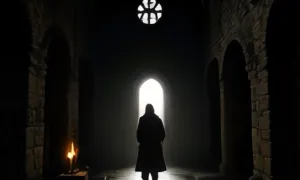
The visualisations are generated by artificial intelligence and serve as inspiration.
Photos from the area
Real photos taken near the monument


Zdroj a licence jsou uvedeny u každého snímku.
Tips from visitors
No tips yet. Be the first!
Log in and add your tip.
Sources and literature
Photos: Harold / CC BY-SA 3.0 — Wikimedia Commons. The author and licence also appear when you hover over the image.
Faktickým podkladem tohoto textu byl článek na Wikipedii, jehož autory jsou přispěvatelé Wikipedie. Článek je dostupný pod licencí CC BY-SA 4.0.
Location on the map




Příběhy a pověsti
Legendy, pověsti a příběhy spjaté s touto památkou
Fotografie návštěvníků
Zatím žádné fotografie. Buďte první, kdo přidá fotografii z návštěvy!
Log in a přidejte svou fotografii nebo hodnoťte.
Za ověřenou návštěvu v aplikaci získáte víc bodů — poznáme podle GPS, že jste na místě.
Reviews and comments