






Hrubé kolo Hillfort
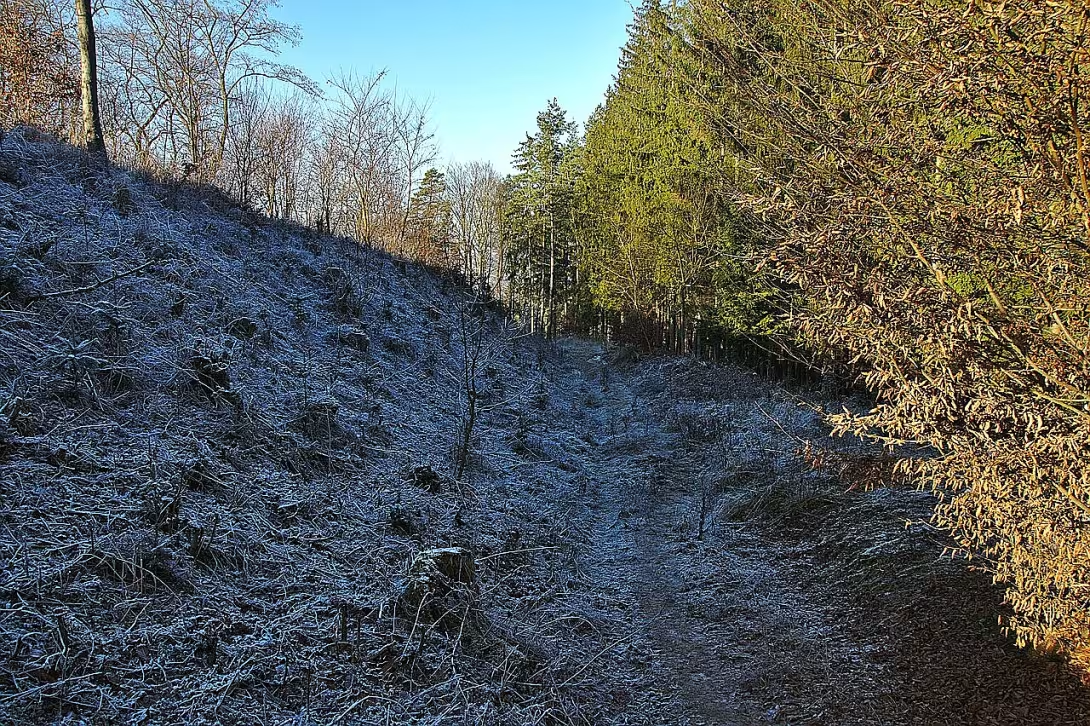
Hrubé kolo is an archaeological site on the surface of the village Biskupice in the district of Svitavy. It's an ancient castle with a rich history. The monument is remarkable for long-term settlements from the Bronze and Halštat times to the Middle Ages, when there was a supporting point for the governor of the prince's estate. The fort has a characteristic heart shape, the area is approximately 0.7 hectares and the place is protected as a cultural monument.
The history of the Gross Wheel dates back to prehistoric times, when the site was inhabited in the Bronze and Hallatite times. In 1948 it was first discovered and described by Jaroslav Mackerl, who dated the artifacts found in the period of the paying culture of the period of the Hallatians. Further research from 1998 revealed ceramic shards from the younger and late bronze age, which confirms the long use of this place. In the Middle Ages, the site was used to build a back point for the administration of the prince's property, reflecting its strategic location. In 1262, Hrubé kolo became part of the property of Olomouc bishop and the seat at the place of the original castle was subsequently abandoned.
From an architectural point of view, Hrubé kolo is interesting with its elements. The island with a castle in Drahan Mountains was naturally protected by steep slopes. On the accessible east side there was a fortification in the form of a moat and a wall surrounding the area of the heart-shaped shape of 90 × 80 meters. According to Miroslav Plačka, the primordial castle was fortified only by a palisade, while the low wall and moat are of medieval origin. Val is almost unnoticeable at times and higher only in the area of the access neck.
The ownership of the Gross Wheel changed over time. Since 1262 it belonged to the Olomouc Bishop, which confirms its importance in the regional administration system. During the Middle Ages there was a supporting point for the governor of the prince's property, which underlines the strategic importance of the site.
The interesting feature of the Gross Wheel is the long-term settlement and architectural development. The prehistoric fortifications were probably only made up of palisades, while the later addition of the wall and trench points to the evolution of defensive strategies in the region. The natural protection of the castle was provided by steep slopes, which was crucial to his defense.
Today Hrubé kolo is a protected cultural monument that attracts interested people about history and archaeology. The current state maintains traces of past settlements and fortifications, making the visit interesting for anyone who wants to understand the historical development of the region. The availability of the site allows visitors to get more acquainted with its archaeological and historical aspects.
Hrubé kolo represents not only an important cultural heritage, but also evidence of long-term settlements and strategic changes in the region. Visiting this archaeological site offers a unique view of the history of the Svitavy region and its development from prehistory to the Middle Ages.
Historical milestones
- Bronze and Halštatska
- The prehistoric settlement of the castle and the existence of the paying culture
- Media
- The creation of a back point for the administrator of the prince's property
- 1262
- Hrubé kolo became part of the property of the Olomouc Bishop
- 1948
- First discovery and description of the Jaroslav Mackerlem site
- 1998
- Archaeological research revealing ceramics from the Bronze Age
Architectural development
The ancient fort was probably fortified with a palisade. The low wall with a moat on the east side is according to experts of medieval origin. Traces of fortification are also visible on the other sides.
Historical events
In the High Middle Ages, there was a foothold for the governor of the prince's estate. In 1262 the site became part of the property of the Olomouc Bishop.
Owners
Since 1262 part of the property of the Olomouc Bishop.
Points of interest
- The fort has a characteristic heart shape and its area is approximately 0.7 hectares. - The locality has been inhabited for a long time, from the Bronze and Hallatin to the Middle Ages. In 1948, Jaroslav Mackerl first discovered it. - The prehistoric fortifications were probably only palisades, while the low wall and moat are of medieval origin. - In 1262, Hrubé kolo became part of the property of the Olomouc Bishop.
Guide
Show guide text
This text was created by artificial intelligence and has not been editorially reviewed. It may contain inaccuracies.
Welcome to the place where time has stopped and where the earth under your footsteps is intertwined with thousands of human efforts, faith and everyday life. You are standing right in front of the Hrubý wheel, an archaeological site that is much more than just a design in the landscape of the village Biskupice. You may find this view to be a calm, green high, but believe me, under this layer of grass and dirt, there is a fascinating story that goes back to the very roots of our civilization. Feel this atmosphere, feel the silence of this place that carries the echo of the ancient voices and sounds that sounded here centuries ago.
Let us return together to a time when this world seemed completely different. This site was not accidentally populated. Already in the Bronze period and later in the Hallatian period, people were looking for safety and strategic advantage. Imagine these first communities that built their homes here and which belonged to a significant paying culture. For them, Hrubé kolo was not just a piece of earth, but a fixed point, a fortress that provided protection and stability. It was a place where the first structure of society formed, where goods were exchanged and people gathered under the protection of their fortifications. This continuity of the settlement shows how exceptional this place was within the then landscape.
Now pay attention to what you see around you. Even if you don't see tall walls or stone towers today that would immediately attack you in the word of the castle, you have to let your imagination help you. The whole area has a very specific, characteristic heart shape. Now, if you look at the contours of this surface, you might see the very heart that's being inserted into the ground. This area, approximately 0.7 hectares, has been carefully used. In prehistoric times, there probably were no stone walls, as we know from later times, but instead there was probably a massive wooden palisade. Imagine a series of erected tribes that formed an impenetrable barrier and protected citizens from danger. This architecture was directly dependent on what people had at the time, yet it was strong enough to make this site a safe port.
But the history of this place did not stop in prehistoric times. As time went on, the role of the Rough Wheel changed, but its meaning remained. A whole new type of settlement was created here in the Middle Ages. This place was no longer a prehistoric fortification, but it became an important supporting point for the governor of the prince's estate. Imagine a medieval official who lived here and was in charge of the surrounding land and its wealth. Hrubé kolo was part of a wider administration and in 1262 it became part of the property of the Olomouc bishop. This tells us how strongly this place was involved in the region's political and religious structure at the time. The fort became a place where the power of the church and the state met.
However, in order to speak with such certainty about these events, we must thank the people who have decided to look into this country. The story of the Rough Wheel, as we know it today, began only recently. The first major discovery and detailed description of this site was made in 1948 by Jaroslav Mackerl. That was the moment when the ordinary design became a scientific source of knowledge. Mackerl saw in him a hidden treasure of history waiting to be discovered. Another important step towards understanding this place was brought only in 1998 when intensive archaeological research took place. It was then that a pottery from the Bronze Age emerged from the depths of the earth, which provided us with incredible precision as evidence of the presence of those people. Thanks to the work of experts such as Jaroslav Mackerl or Miroslav Plaček, today we can reconstruct the lifestyle of people who lived here thousands of years ago.
You may now wonder what the biggest mystery in this place is. It's the constant transformation. How is it that a place that began as an ancient fortification with a wooden palisade survived and transformed into a complex medieval administrative point? How did people stay in this particular place for so long, even though cultures, religions and political systems have changed? This constant connection to the soil is something you feel every step of the Round. It's a place that refused to be forgotten.
But now I will not simply keep you in my words. I suggest you take a slow walk all over the area and try to perceive its carnal shape in direct contact with the landscape. See the surroundings, see the direction of the wind, and imagine how people moved here in the past, how they built their wooden structures, and how fires were burning here at night. Every piece of this country has its own story waiting for you to explore it. Thank you for choosing to visit this special place and pay attention to its history. I wish you a pleasant walk and many other interesting discoveries in the surrounding countryside. Goodbye.
Tips for visitors
The best time to visit are early mornings or late afternoons, when the low sun better accentuates the relief of the terrain and remains of the primordial castle. Parking is possible near the village Biskupice, from where it leads the way to the top; the location is available by car and public transport, check the current connection in the search engine. For your journey, take a solid footwear suitable for the field, plenty of drinking water and a map of the surrounding area. For the best photos I recommend you find the highest points of the castle overlooking the landscape during the golden hour. In the surroundings you can explore the natural beauty of the Drahan Highlands. We recommend families with children to turn the path into an archaeological game where children will look for traces of ancient settlement in the landscape.
Businesses nearby
Do you run a restaurant, accommodation, shop, museum, rental, wellness or other visitor service near this monument? Show yourself directly to the people heading to it — this is how they will see you in the app and on the web:
Events nearby
Zdroj akcí: otevřená data měst a obcí ČR (Národní katalog otevřených dat) a kalendář akcí Národního památkového ústavu.
Nearby
Drahan High.
Accommodation nearby
Themed route
1. Drahan surface - Natural area. The walk through the surrounding landscape provides a spatial context for the location of the site. 2. Hrubé kolo - Archaeological site. Here you can see traces of ancient defense systems and landscaping. 3. Hrubé kolo (internal site) - Archaeological site. Exploring the area where the settlement and settlement centre were located in the past.
Seasonal recommendations
Spring: In the spring period, Hrubé kolo in Biographies is transformed into a place full of life when nature begins to come to life and green color covers the landscape. The sun's rays illuminate archaeological findings with a softer light, creating a unique atmosphere to explore history. At this time there may be more people eager to get the first heat of the year in this quiet place, so we recommend arriving in the early part of the day and clothes suitable for a mild temperature. Short gloves and braces may prove useful.
Summer: Summer on the rough bike brings long days full of sunlight that illuminates archaeological findings in the most beautiful possible way. This season the atmosphere is filled with heat and clean air, creating ideal conditions for long walks in historic places. A higher attendance rate is expected, so we recommend arriving early in the morning or late in the afternoon to avoid long fronts. Don't forget the sun protection rings and light clothes.
Autumn: In autumn, Hrubé kolo offers visitors views coloured with all shades of yellow, orange and red leaves. Sun rays illuminate archaeological sites with fine colours, creating an atmosphere of calm and relief from winter. At this time there are often fewer people to visit, so you can fully immerse yourself in history without worrying about crowd pressures. We recommend wearing warmer clothes and perhaps an umbrella for possible rain.
Winter: During winter, Hrubé kolo offers visitors a quiet space where they can relax and explore historical archaeological sites in mild light. Winter brings a cool atmosphere with the possibility to see some parts of the monument covered with snow, which is an interesting and unique experience for many. The opening hours may be shorter, so note the notice of the visit time. Hot clothes are necessary and we recommend arriving early in the day for full experience.
Visualizations and artistic views

The visualisations are generated by artificial intelligence and serve as inspiration.
Photos from the area
Real photos taken near the monument


Zdroj a licence jsou uvedeny u každého snímku.
Tips from visitors
No tips yet. Be the first!
Log in and add your tip.
Sources and literature
Fotografie: Jiří Komárek / CC BY-SA 4.0 — Wikimedia Commons. The author and licence also appear when you hover over the image.
Faktickým podkladem tohoto textu byl článek na Wikipedii, jehož autory jsou přispěvatelé Wikipedie. Článek je dostupný pod licencí CC BY-SA 4.0.
Location on the map
Příběhy a pověsti
Legendy, pověsti a příběhy spjaté s touto památkou
Fotografie návštěvníků
Zatím žádné fotografie. Buďte první, kdo přidá fotografii z návštěvy!
Přihlaste se a přidejte svou fotografii nebo hodnoťte.
Za ověřenou návštěvu v aplikaci získáte víc bodů — poznáme podle GPS, že jste na místě.
Reviews and comments