



Husova čp. 11 House
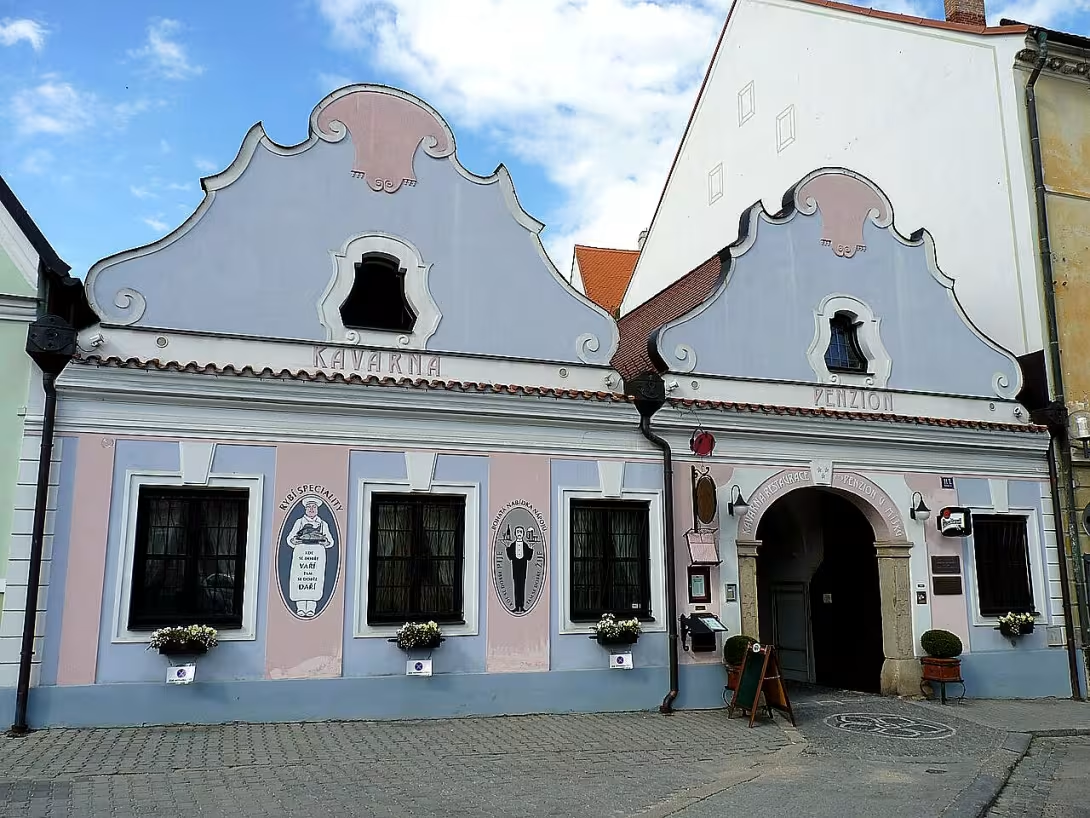
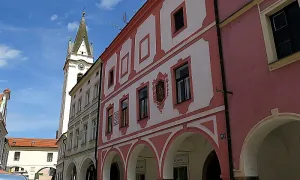
Husova čp. 11 in Trebon is a protected Baroque house, also known as the House of Míšky. It is a ground floor building built in the style of a peasant Baroque, important in its architecture and history associated with the history of the city.
At the site of the current construction was a wooden house which was later replaced by a townhouse in the Renaissance style. This object probably destroyed the fire at the beginning of the Thirty Years' War in 1618. The present Baroque house was built probably in the middle of the 17th century, with parts of its court even older.
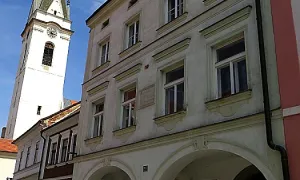
The architecture of the building is characteristic of the style of the Polish Baroque. The front of the house is divided into two parts with two shields, decorated with conspicuous laminated volutes. The entrance to the yard is located in the right part. Historical sources suggest that inside the building there was a block of crackers, of which only one fragment was preserved.
The fate of the house was influenced by several events. In 1781, there was a devastating fire that survived the house without suffering, as evidenced by the period vedute, on which the building is untouched. One of the shields shows the year 1833, but according to the records the building itself is older.
Owners were changing over time. The house belonged to private owners until 1881 when the town of Treboň bought it. In 1950 he transferred to the property of the state, which was manifested by the disintegration of the Baroque building. It has been declared a national monument and since 1958 it has been protected as a monument. After reconstruction the house was sold to private owners again.
A complex reconstruction took place at the building in 1996. Currently serves as a cafe and accommodation.
This house represents an interesting example of the peasant Baroque and witness of historical events in Trebon. We recommend to visit it as part of the city tour.
Historical milestones
- 1781
- The house survived the fire, which is recorded on period science.
Architectural development
Originally a wooden house, later a Renaissance townhouse. After the fire, the Baroque house was built in the middle of the 17th century. A comprehensive reconstruction took place in 1996.
Historical events
- 1618
- The fire during the beginning of the Thirty Years' War destroyed the original townhouse.
- 1781
- The house survived a devastating fire, as you can see on period science.
- 1958
- The object was declared a national monument.
Owners
First private owners, since 1881 the city of Treboň, since 1950 the state of Czechoslovakia. Since 1996 again private owners.
Points of interest
- Husova čp. 11 is a protected Baroque house also known as the House of Míšky. - At the site of the current construction was a wooden house, which was later replaced by a townhouse in the Renaissance style. - The present Baroque house was built probably in the mid-17th century and parts of its court may be even older. - The front of the house is divided into two parts with two shields, decorated with conspicuous broken volutes. There was a devastating fire in 1781 that survived the house without suffering.
Guide
Show guide text
This text was created by artificial intelligence and has not been editorially reviewed. It may contain inaccuracies.
Welcome to the beautiful town of Trebon. Right now, listening to these words, you're standing in front of one of those houses that makes up the real soul of this historic place. There's a building in front of your eyes at the number 11 of Hus. You may have heard of her under another, very popular name, like the House of Meatballs. Stop for a moment, perceive the atmosphere of this place and let yourself be carried away by the idea of everything this object has experienced over the centuries. The view of this building immediately brings you to the thoughts of the ancient times when the streets of Třeboň were filled with other movements and other sounds.
Looking at the current form of the house you can feel its solid and balanced structure. Although at first glance it may seem that this Baroque look has always been there, the truth is much more complex and fascinating. This house is like a book with many layers where each other layer was laid on the previous one, often after difficult trials. If you look at his face now, you will see the architecture we call the peasant Baroque. It is a style that carries special warmth and humanity, combining the nobility of baroque forms with simple beauty that was close to folk life. Feel how these shapes connect with the overall character of urban indigenous housing.
Now let's go deeper into history to understand how this house came into being. Its roots are far deeper than it might seem. The whole story didn't start with a stone, it started with wood. In this place where you're standing right now, there was a simple wooden house first. Over time, however, the city developed and the needs of the population grew. The wood was replaced by a much more durable construction. There was a townhouse in the Renaissance style. Imagine the time details, the elegance and symmetry that the architecture at the time brought to the urban environment. This Renaissance house was a symbol of the stability and rise of the then township.
However, history can be unpredictable and sometimes quite harsh. The fate of this place was suddenly changed by a great tragedy. At the beginning of the 30-year war, a time which brought many misfortunes to the whole Czech countries, this Renaissance house was destroyed by a devastating fire. Imagine the moment when everything that had been built for decades turned to ashes. But that's where the power of this place lies. The house wasn't abandoned, it wasn't forgotten. After destruction he was rebuilt to serve the people and urban life again.
The current form that you are currently observing was probably created in the mid-seventeenth century. It was at that time that the Baroque elements began to manifest themselves in its form and created the characteristic look that we now consider to be a monument-protected treasure. This process of reconstruction was proof of tirelessness and the will to restore the beauty of the city even after the biggest disasters.
Now pay attention to one very interesting thing that links the past to visual evidence. While time seems to flow relentlessly, there are clues that allow us to see the past almost as if it were happening before our eyes. In period paintings, which are called vedutes, the fate of this house is also captured. One of these historical paintings shows how the house survived another fire that took place in a thousand seven hundred eighty-one. It's fascinating that these artistic witnesses would allow us to know of the particular moments when the history of this house faced the dangers of fire. These records make sure that even though the buildings are changing, their story remains in the memory of art.
If you look now towards the inner spaces, towards the courtyard of the house, you may feel a certain mystery in yourself. Even if you see a Baroque structure, parts of his court may be much older than it seems. Perhaps there under the pavement or in the foundation of the wall still rest the remains of the oldest buildings that stood here before the Renaissance. It's like a hidden chapter that waits for its discovery, which reminds us that under every step you take in Trebon lies a layer of history that we are constantly learning to understand.
Today, this house is no longer just a private residence, but a meeting place. His role has changed, but his importance remains. It is now used as a cafe and accommodation. That means you can be a part of his history, too. You can relax in it, enjoy the coffee and just be in the presence of these old walls that surround you. It's a beautiful way to combine modern life with deep history.
On your next tour of the city, realize that every house you meet has its own voice. The number 11 of Hus is just one of the many stories Třeboň tells. It's a story about wood, stone, fire, and constant restoration.
Thank you for stopping by and paying attention to this memory. We hope that this brief insight into the past has brought you interesting ideas and new perceptions of the environment. Continue to explore the beauty of Trebon, walk through its alleys and let yourself be surprised by what other historical corners of the city have prepared for you. We wish you a nice walk and pleasant moments in this wonderful city. Goodbye.
Tips for visitors
For the best observation of the Baroque facade we recommend a visit during spring or autumn. In these times, light is softer, which better highlights the details of the peasant baroque and prevents excessive shadows.
You can travel by car or public transport to visit. The current connection and arrival options are best checked in internet search engines.
For photography it is ideal to choose the time around sunrise or sunset. In these hours the colours of the house work naturally and the architecture excels. The best angle for getting a picture is from the opposite side of the street to capture the entire object.
For families with children, the tour is suitable for outdoor activities. We recommend that you bring drinks and shoes suitable for walking on historical paths.
Frequently asked questions
Can the monument be visited?
This is a residential or farm building, not a museum with opening hours. Please view it from public space and respect the owners' privacy. We have no information about access to the interior.
Where is the monument?
Location: Třeboň I. The map on this page shows the exact spot.
Why is the monument protected?
It is listed in the Central List of Cultural Monuments of the Czech Republic as a cultural monument (register no. 1000129865).
Businesses nearby
Do you run a restaurant, accommodation, shop, museum, rental, wellness or other visitor service near this monument? Show yourself directly to the people heading to it — this is how they will see you in the app and on the web:
Events nearby
Zdroj akcí: otevřená data měst a obcí ČR (Národní katalog otevřených dat) a kalendář akcí Národního památkového ústavu.
Nearby
🏰 Historic sites (59)
- Viktor Metzl 0.1 km
- Felix Metzl 0.1 km
- Karel Brady-Metzl 0.1 km
- morový sloup 0.1 km
- Třeboň v marcipánu 0.1 km Masarykovo náměstí 103 +420601133025 web
- Třeboň 105 0.1 km Masarykovo nám. 105
- klášter Augustiniánů 0.1 km
- Růžena Orsteinová 0.1 km
- Berta Orsteinová 0.1 km
- Richard Orstein 0.1 km
- Zámecká lékárna 0.2 km Březanova 118 web
- Josef Šusta 0.4 km
- Jakub Krčín z Jelčan 0.4 km
- historický kamenný most 4.0 km
- Jakub Krčín 5.6 km
- Socha Sv.Jana Nepomuckého 6.5 km
- Památce vojínům 1914-1918 6.5 km
- Skanzen Ludmila 6.5 km
- Ema Destinová 7.2 km
- Na památky zlaté svatby knížete Adolfa Josefa a Idy ze Schwanzenbergu 8.2 km
🍽️ Restaurants and dining (133)
- U Míšků 0.0 km Husova 11 +420384721698 web
- ZH caffe 0.1 km
- Vinárna Morava 0.1 km
- U Kamenné studny 0.1 km
- U Čerta 0.1 km
- Cafe Pokrok 0.1 km Masarykovo náměstí 22
- Adéla 0.1 km
- Sahara 0.1 km
- Bistro 105 0.1 km
- Bufet na rynku 0.1 km Masarykovo náměstí 107 +420384757307 web
- Kafe na kašně 0.1 km
- Vratislavský dům 0.2 km web
- Zdejší kuchyně 0.2 km Masarykovo náměstí 107 +420384757111 web
- Figar's 0.2 km
- U Kapra 0.2 km
- Beseda 0.2 km +420 724 880 762 web
- Krčma u Kellyho 0.2 km
- Pizzeria Macondo 0.2 km
- Rožmberská Bašta 0.2 km web
- Top Spin 0.2 km
🏨 Accommodation (78)
- U Míšků 0.0 km Husova 11 +420384721698 web
- U Kubalů 0.0 km Husova 13 +420 736 76 76 13 web
- Bílý koníček 0.1 km
- Zlatá Hvězda 0.2 km Masarykovo náměstí 107 +420384757111 web
- Vratislavský dům 0.2 km web
- Pelikan 0.2 km
- U Bumanu 0.2 km
- Myslivna 0.2 km +420 384 721 833 web
- Rožmberská bašta 0.2 km web
- Galerie 0.2 km +420 384 385 293 web
- Design Hotel Romantick 0.2 km
- U Františka 0.2 km Rožmberská 36
- Bílý jednorožec 0.3 km +420 724 065 785 web
- Wellness Hotel Harmonie 0.3 km K Bertě 195 web
- Apartmány pod Světem 0.5 km
- Na Seníku 0.5 km
- Vila Jasmína 0.5 km Jablonského 571 +420 725 837602 web
- U Báby 0.6 km
- Panda Penzion 0.7 km
- Schwarzenberský seník 0.7 km +420 724 136 411 web
🚲 Rentals and sport (10)
- MEPO 0.1 km
- Veloservis Kocanda 0.9 km
- Electropower 1.2 km
- Fitness Reprezentant 1.3 km
- Ostende 1.5 km
- COP Slověnický mlýn 8.5 km
- Sportcentrum Mrkáček 10.6 km
- Sokolovna 11.8 km
- TJ Sokol 13.7 km
- Lodě 14.0 km
🥾 Hiking and nature (38)
- Komenského sady 0.3 km
- Zámecký park 0.3 km
- Pivovar Regent 0.3 km
- Třeboňské seníky 1.3 km
- Kotěrova vodárenská věž 1.4 km
- Lázeňský park 1.4 km
- bývalá vojenská střelnice 3.1 km
- akvadukt 4.2 km
- historický kamenný most 4.8 km
- V Rájích 5.1 km
- bývalá bobrovna 5.1 km
- studánka 5.7 km
- Dunajovická Hora 5.9 km
- psí hřbitov 7.0 km
- písečný přesyp 7.3 km
- vyhlídková věž Lomnice 10.8 km
- Čapí vrch 11.2 km
- Kamenný vrch 11.3 km
- Dvořiště 11.4 km
- Palackého náměstí 11.4 km
Accommodation nearby
Trips and activities nearby
Guided tours, tickets and activities nearby from GetYourGuide
Affiliate link: if you buy from the partner, we may receive a commission. The price for you does not change.
Search tours and activities →Themed route
Thematic cruise route: Husova čp. 11 and surroundings
1.Husova čp. 11 (house)
Type: Historical monuments
Why is it worth a visit: This house is connected to Jan Hus, an important figure in the Hussite movement. Visit the place where he lived and worked this important reformer and adopt the historic environment of the 15th century.
2. Church of St. James
Type: Religious monument
Why is worth a visit: The church is one of the oldest sacral objects in Trebon. His Gothic architectural style and history attract many visitors who want to see a rich artistic exhibition.
3. City Square
Type: Historical Center
Why is worth a visit: The square is the heart of the town of Trebon, where there are several historical buildings and monuments. It is an ideal place to relax and see local architecture.
4. City Museum
Type: Museum exposition
Why is worth a visit: The City Museum offers exhibitions related to the history of Třeboň and the region. It's a great way to learn more about local culture and history.
5. Brewery
Type: Cultural attractions
Why is worth a visit: The brewery is not only a place where traditional Fribon beer is produced, but also a place for cultural events. Visit him for a tour and explore the history of the brewery in Trebon.
This route offers a clear view of the historical and cultural aspects of the town of Treboň, with an emphasis on Husovo No. 11 and surrounding attractions.
Seasonal recommendations
Spring - After a winter's sleep, fresh greenery spread around the House of Hus, the trees begin to burst, and the sun's rays reflect off wet stone walls. Light is soft, but strong enough to reveal the facade details. It is recommended to come early in the morning when there are fewer visitors and the atmosphere is calm; light jacket, umbrella or raincoat are suitable because spring rains appear unexpectedly.
Summer - In the summer months the house is lost in the glow of the high sun, the shadows along the windows are short and the surrounding meadows are littered with flowers and buzzing insects. The temperature may be higher, therefore it is reasonable to choose free clothes, hat and sunscreen. The most suitable is the afternoon after noon when the sun is in the southeast position and lighting underlines the texture of the stone; crowds are usually scattered because many people prefer to search for water surfaces.
Autumn - Autumn light brings golden tones, leaves on trees turn red and orange, and cooler air gives a walk around the house a refreshing feeling. The humidity may be higher, so it is worth carrying a warmer sweater or a light jacket and solid footwear on slippery leaves. The best time is the late afternoon when the sun slowly falls and creates long shadows that highlight architectural details; there are usually no large number of tourists in this period.
Winter - In winter, the house is covered in quiet snow, the walls are shined under a white coat, and the sunlight is reflected from crystalline flakes, creating almost fairytale scenery. Cold weather requires a warm coat, hat, gloves and waterproof shoes to avoid slipping on a frozen sidewalk. The most suitable is the noon hour, when the sun is at most and provides enough light for a detailed view, the crowds are the smallest and the atmosphere is calm and focused.
Visualizations and artistic views

The visualisations are generated by artificial intelligence and serve as inspiration.
Photos from the area
Real photos taken near the monument

Zdroj a licence jsou uvedeny u každého snímku.
Tips from visitors
No tips yet. Be the first!
Log in and add your tip.
Sources and literature
Photos: Michal Klajban / CC BY-SA 3.0 — Wikimedia Commons. The author and licence also appear when you hover over the image.
Faktickým podkladem tohoto textu byl článek na Wikipedii, jehož autory jsou přispěvatelé Wikipedie. Článek je dostupný pod licencí CC BY-SA 4.0.
Location on the map


Příběhy a pověsti
Legendy, pověsti a příběhy spjaté s touto památkou

Fotografie návštěvníků
Zatím žádné fotografie. Buďte první, kdo přidá fotografii z návštěvy!
Log in a přidejte svou fotografii nebo hodnoťte.
Za ověřenou návštěvu v aplikaci získáte víc bodů — poznáme podle GPS, že jste na místě.
Reviews and comments