



Hvížďalka Fortress
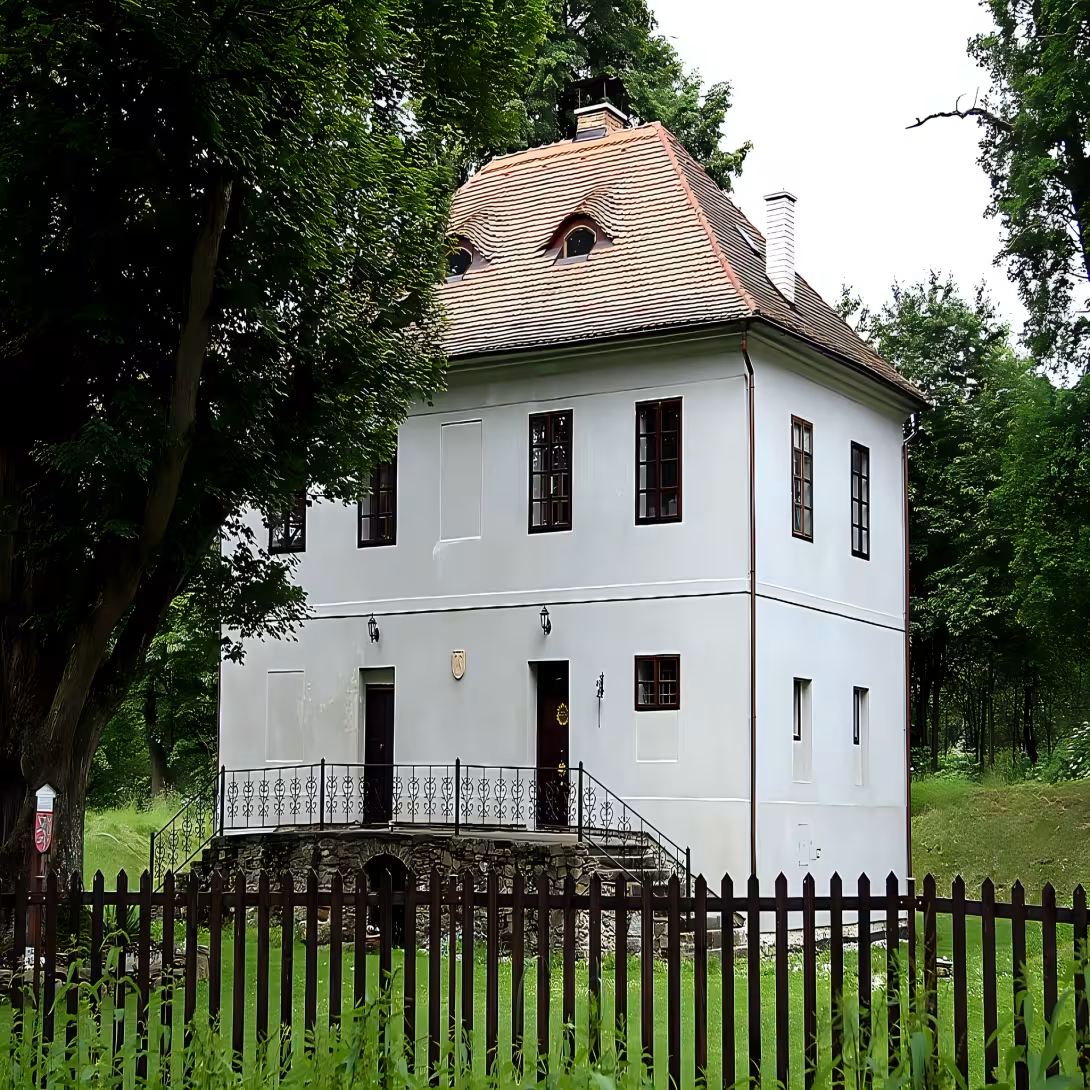
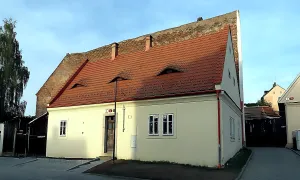
Hvížďalka is a Gothic fortress in Kalenice in Strakonice district, whose core is the late Gothic tower. It is located in a park in the middle of the village and is protected as a cultural monument. Remarkable is its architectural transformation from a fortified mansion into a classical building and the presence of a memorable maple klen.
The oldest mention of ownership in Kalenice dates back to the 14th century, when the Vladic rode of Kalenice from Kalenice was based here. In their coat of arms, there was a sign of two corners. The first documented representative was Jaroslav z Kalenic (1374), followed by the son of Jesus, which is listed between 1375 and 1398. The last of this family was Hynek, mentioned in 1413 and 1430, who probably sold the village.
The original building design was consistent with a tower fort. Its core, a late Gothic tower, has been preserved as a one-story building. The present appearance is the result of classical modifications from the mid-nineteenth century, when the construction was extended towards the west and gained new facades. The fortification consisted of a wall and a double moat, which was probably possible to discharge water from a nearby stream.
The interior consists of a basement and a ground floor encapsulated with valleys; segmental and flat vaults are also located on the ground floor. The floor has a flat ceiling with a graduated Fabion and a valb roof with a hambalic roof. Architectural details include stone lining of doors, granite blocks of cellar openings, doors with forging and granite plates in the floor of the entrance hall.
Since 1442, the chateau was probably owned by the brothers Sadla of Kladrub. It was later inherited by Henry Sadlo, who lived here until 1523. His son Václav Sádlo became a thieving knight, causing a major breakthrough in the history of the object. In 1520 the fortress conquered and destroyed the united army from Tábor, Vodňan, Czech Budejovice and Sand. Václav was promised a compensation of 500 kop of grosches for the destruction of the building in 1530.
Before 1543, the fortress went into the hands of Catherine Malovka and her children; In 1559, she was managed by her son Jan. Due to its debt, the construction was sold in 1569 to Petra Boubinski of the Újezda. During this period, the building was dilapidated because the owner was based on the missile. In 1601 it was taken over by Břeňek Ježovský from Lub. The property in the seventeenth century was subsequently touched by the House of Ježovský and later by Josef Mottl.
In the eighteenth century Kalenice Koc from Dobrše acquired them, who then sold them to Prince Jan Bedřich Lamberk. He's connected them to the Zichovice estate. In 1803 or 1804, Prince Karel Eugen Lamberk sold them to the knight Jan Josef Puteani. Since 1861, she was the owner of Marie Kräutner. In the second half of the twentieth century, the building was used by the Volenica Single Agricultural Cooperative.
Since 2001, the owner of the fort and adjacent park has been the doctor Pavel Kubíček, who gradually repaired the building and partially made it available to the public. In the park is a memorable maple klen with a trunk perimeter over five meters.
Hvížďalka represents a rare example of the transformation of the capital in later times. Its history - from robbery activities to classical reconstruction - makes it an interesting destination for visitors. We recommend visiting this monument and exploring its architectural layers.
Historical milestones
- 1374
- First mention of Jaroslav from Kalenic.
- 1520
- Conquered and destroyed by armies against Wenceslas Sadla.
- 1530
- Promising compensation for the destruction of Václav Sadla's fortress.
- 2001
- Taking over the fort and park by Dr. Pavel Kubíček.
Architectural development
The core of the mansion is a late Gothic tower fortress, which was converted into a classical style in the middle of the 19th century. The fortification consisted of a double moat and a wall that could be infused with water. The interior includes rolled, segmented and flat vaults and hambalic crows.
Historical events
In 1520, the fortress was conquered, and the armies were destroyed against the thieving knight Václav Sadel. In the middle of the 19th century a significant classical reconstruction of the tower took place. Since 2001, the building has been gradually restored under the control of the current owner.
Owners
Rode Kalenice (14th century), brothers Sadlové (from 1442), Jindřich Sadlo (from 1484), Kateřina Malovková (from 1543), Jan Malovcov (from 1559), Petr Boubínský (from 1569), Břeňek Ježovský (from 1601), Kocci from Dobrše (the 18th century), Prince Jan Bedřich Lamberk (the 18th century), Jan Josef Puteanu (from 1804), Marie Kräutner (from 1861), Volenice Agricultural Cooperative (the 20th century), Pavel Kubíček (from 2001).
Points of interest
- It's a Gothic fortress in Kalenice whose core is a late Gothic tower. - She went through an architectural transformation from a fortified mansion to a classicist building. - In 1520 the fortress conquered and destroyed the joined army from Tábor, Vodňan, Czech Budejovice and Sand. - In the park is a memorable maple klen with a trunk perimeter over five meters. - The fortification consisted of a wall and a double moat, which was probably possible to discharge water from a nearby stream.
Guide
Show guide text
This text was created by artificial intelligence and has not been editorially reviewed. It may contain inaccuracies.
Welcome to the heart of Kalenice Village. You have just stopped in a quiet part of the local park, where one of the most important monuments of this region awaits you. You're standing right in front of The Whistle. Imagine that this space, which now surrounds you with peace and greenery, has in the past been a place where power, fear, and incredible changes in fate have collided. Feel this atmosphere, feel the silence that exists here, but at the same time imagine what sounds these walls could hear hundreds of years ago. You can look at the surroundings and watch this historic building float in the middle of nature as if it were its natural, albeit impervious element.
Now let's go back deep into the past together to understand why this place is standing right here. The history of Whistle is not just a story of stones and mortar, it is a story of generations and political upheaval. The first clues that lead us to this place go back to 1374. That's when the name Jaroslav of Kalenic first appears in the historical records. Imagine that time, the medieval era, when the houses of the families were the key to controlling the landscape. Hvížďalka wasn't just an ordinary house, it was a tower fortress. The word itself carries a breath of defense and impotence. The tower fort meant that people didn't just want to settle here comfortably, but above all they wanted to hide and defend themselves safely. During this period, the fortress became a home for various representatives of the Kalenic family, such as Yesek or Hynek. Each of them left a trail here, even though their specific actions are not read directly in each stone today, their presence is felt in the very existence of this object.
But now we must enter a chapter that is much darker and full of tension. History knows not only the peaceful life of noble mansions. If you look at the building, you might think it's peaceful, but its walls bear the memory of a great conflict. In 1520, chaos and violence spread over this fortress. Not only a handful of soldiers penetrated Kalenic, but an entire army united at the time, which was a great force. They were allies from Tábor, Vodňan, Czech Budejovice and Sand. This force was so great that the fortress was conquered and then demolished. Imagine the moment when the solid walls that were supposed to protect the Kalenic family began to collapse under pressure from enemy forces. It was the destruction that struck Václav Sadl, who was linked to this place at the time. But fate was not entirely cruel. Ten years later, in 1530, there is a mention in history of a promised compensation for this destruction. This shows us that even in times of war there was an effort to restore order and justice.
Now let's pay attention to what you see right in front of you, and try to understand the architecture of this object. Hvížďalka is a fascinating example of how time and human needs can turn into architecture. If you look at the very foundation of the building now, know that what you see is just a layer on the layer. The heart and heart of the whole building is a late Gothic tower. That's the oldest part that carries the soul of the original tower fort. It's the impenetrable, medieval part that was designed to defend itself. However, the appearance of the building today is the result of much later times. In the middle of the nineteenth century, the fortress had undergone a major transformation. Instead of just being a fortified mansion, it was modified into a classic building.
So notice this interesting duality. On the one hand, you have a Gothic base that is crude and functional, and on the other hand, a classical face that looks into a world with more elegance and order. This architectural transformation from a fortified mansion to a building with classical features is proof of how life in the region changed. People no longer had to fight for survival in closed towers, but began to seek beauty, symmetry and comfort. This reconstruction has changed the overall appearance of the building and made it a place that we see today as a harmonious part of the park.
The historical chain of personalities associated with this place is incredibly long and varied. In addition to the early members of the Kalenic family, there have been other people here over the centuries whose names are carved into the memory of this place. We can name Peter Boubinsky, Břenek Ježovský or Jan Bedřich Lamberk. Each of these figures represents a different era, a different way of seeing the world and a different relationship to this soil. And if we look at the closest history, we must not forget 2001. That's the year that gave Whistle a fresh start. In this year took over the fort and her park doctor Pavel Kubíček. Thanks to his efforts and care, this object has become what it is today - a protected cultural monument which has been gradually repaired and which we can admire today in its beauty. It is proof that even after centuries of destruction and transformation, the monument can be saved and revived for future generations.
But now I want to invite you to something that may not be as obvious at first sight as the building itself, but what is absolutely essential to this space. While you are looking at the fort, please also pay attention to nature around you. In the park that surrounds this monument, a real miracle grows. It's a memorable maple klen. This tree is not just an ordinary plant sample. His tribe is so massive, his perimeter is over five meters. Imagine the size, the strength and the longevity. This maple is a silent witness to everything that has happened here. He saw the battles, he saw the reconstructions, he saw the coming and going of the families. While human lives are short and history is constantly changing, this maple stands here as a symbol of stability and the link between the past and the present. It is a fascinating contrast - a stone, human-made fortress and a living, nature-created tree, but both together form an integral whole.
So you don't just see the building when you look at the Whistle. You see the layering of time. You see medieval defenses, you see war destruction, you see classicist elegance, and you see modern efforts to save the heritage. It's a place where history doesn't just read from books, but where you can literally feel it in every view of the building walls and every breath under the trees.
I hope this short trip over time has brought you new views of this place. But don't leave too quickly. I invite you to continue your walk through the park, to stop at the memorable maple tree and just let yourself be stopped for a while in the calm Hvížďalka offers. Explore the surrounding corners, perceive the atmosphere of this place and enjoy the beauty of Kalenic. Thank you for choosing to visit this historic monument. We wish you a pleasant further tour and a beautiful day.
Tips for visitors
Best time to visit The whistle is in the spring or autumn season, when the vegetation in the park is full of blood and the temperature is pleasant. This historical object offers a peaceful atmosphere to understand its architectural details without excessive sunlight.
For those travelling by public transport, it is advisable to check the current connection before visiting to ensure a smooth arrival. Parks around the village can be limited, so it is advisable to arrive soon.
When visiting, bring sun protection clothes and shoes suitable for walking on the lawn. Complete your trip with a chocolate or fruit drink, which you can enjoy in one of the quiet places in the park.
For photography it is advisable to visit A whistle in the morning or in the evening when light is softer and shadow effects contribute to the aesthetics of images. The best places for the photo are the gardens of the park, where the tower is projected in the background.
It is possible to visit the park in the central part of the village of Kalenice and the nearby stream. These places offer a peaceful opportunity for relaxation or short walks around the area.
Frequently asked questions
Can the monument be visited?
Some buildings of this kind are open for guided tours, others serve another purpose or are privately owned. We have not verified whether and when this monument is open – please ask the operator.
What are the opening hours and admission?
We have not verified the opening hours or admission. Current information is published by the operator.
Where is the monument?
Location: Plzeňský kraj. The map on this page shows the exact spot.
Why is the monument protected?
It is listed in the Central List of Cultural Monuments of the Czech Republic as a cultural monument (register no. 1000138309).
Businesses nearby
Do you run a restaurant, accommodation, shop, museum, rental, wellness or other visitor service near this monument? Show yourself directly to the people heading to it — this is how they will see you in the app and on the web:
Events nearby
Zdroj akcí: otevřená data měst a obcí ČR (Národní katalog otevřených dat) a kalendář akcí Národního památkového ústavu.
Nearby
Park in the middle of the village Kalenice and a nearby stream.
Accommodation nearby
Themed route
1. Park in the middle of the village Kalenice (Park) - Ideal place to start a trip in a pleasant and shady environment. It offers a quiet start near the village center. 2. Close stream (Water flow) - A natural route along running water. It provides a refreshing atmosphere and the opportunity to observe the surrounding nature. 3. Hvížďalka (fortress) (Historical monument) - The main destination of your journey, which represents the historical core of the entire route. It is worth visiting for its unique architecture.
Seasonal recommendations
Spring: Hvížďalka offers a unique experience in spring, when nature wakes up and the fortress is lit by sunlight. Flowers and trees are beginning to bloom, which gives the surroundings a romantic atmosphere. For visiting this time we recommend clothes suitable for mild temperatures with the possibility to add layers because the weather can be variable. The best times to visit are early morning or late afternoon, when the temperature is lighter and the crowd is less.
Summer: In the summer period Hvížďalka attracts visitors with its long days and warm sunny lights, which depicts historical architecture in the best light. Nature is at the top of its beauty with full flowers and green louses, creating an ideal environment for a tour of the fortress. We recommend arriving earlier in the day to avoid the hottest hours and crowds that are common in the main summer season. Don't forget the sunscreen and sun blankets.
Autumn: In autumn months, Hvížďalka offers an experience fertilized by a calm atmosphere, where tree leaves are colored in various shades of yellow and red. Sunshine days are ideal for sightseeing, while cooler evenings bring more peaceful visitors. Dress in layered clothes to be ready for changing weather. The best times are early morning or late afternoon, when the temperature is pleasant and the crowd is less.
Winter: Hvížďalka in the winter season offers a unique view of the historical monument under the cover of snow, which gives the fortress an atmosphere of mystery and peace. Shorter opening times require planning of the visit in the previous date. We recommend warm clothes, protective shoes and perhaps an umbrella for a snowstorm. The best times to visit are early morning or noon, when the sun is usually bright and warm.
Visualizations and artistic views


The visualisations are generated by artificial intelligence and serve as inspiration.
Photos from the area
Real photos taken near the monument


Zdroj a licence jsou uvedeny u každého snímku.
Tips from visitors
No tips yet. Be the first!
Log in and add your tip.
Sources and literature
Photos: Chmee2 / CC BY 3.0, rozlišení zvýšeno umělou inteligencí — Wikimedia Commons. The author and licence also appear when you hover over the image.
Faktickým podkladem tohoto textu byl článek na Wikipedii, jehož autory jsou přispěvatelé Wikipedie. Článek je dostupný pod licencí CC BY-SA 4.0.
Location on the map
More monuments – Plzeňský kraj
Show all in the region



Příběhy a pověsti
Legendy, pověsti a příběhy spjaté s touto památkou

Fotografie návštěvníků
Zatím žádné fotografie. Buďte první, kdo přidá fotografii z návštěvy!
Log in a přidejte svou fotografii nebo hodnoťte.
Za ověřenou návštěvu v aplikaci získáte víc bodů — poznáme podle GPS, že jste na místě.
Reviews and comments