



Kalingerův mlýn Water mill
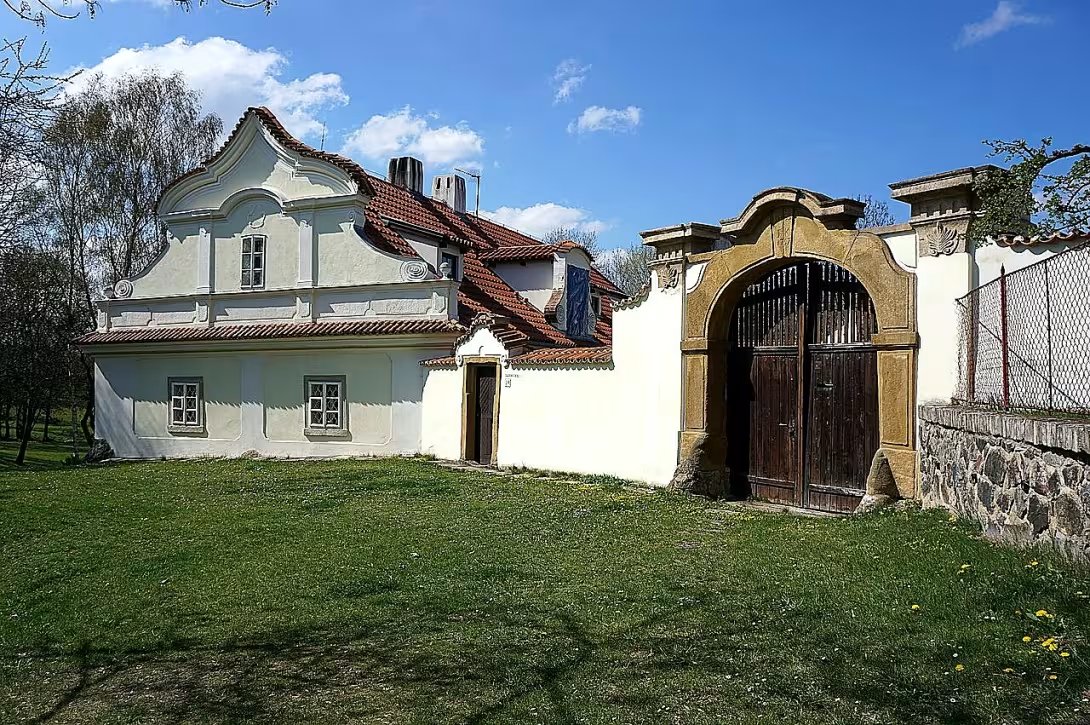
Kalingerův mlýn is a baroque water mill in the Praha- west district, situated on the Zakolanská creek. As a real cultural monument of the Czech Republic, it includes a residential building with a mill, an economic building and a wall. The building is important in its long history and preserved architecture from the middle of the 18th century.
The first historical mention of the mill dates back to 1415, when it was given when Peter Meziřicský was bought. In 1547, Marie Magdalena Kolovrat's fluffy mill worked here. Around 1700 arable land belonged to the operation in the range of 18 strychelles and meadow. In 1713 the mill was purchased as a master building with double composition and rising on unstable water. According to the contracts of 1731 and 1743, the miller had a duty to grind for free. The mastery of the miller paid compensation to the miller when it was impossible to grind was responsible for the maintenance of the pond's swim.
In the second half of the 18th century, the mill for the price of 1500 gold was bought by Jan Kalinger, the miller from the Prizeževsi. In 1752 he rebuilt the building, which fundamentally affected its present form. By 1800 mill still had two compositions and a rise. The miller cultivated both rustic and emphyteutic fields and took the rent from the mill.
The area has an irregular, elongated plan and is surrounded by a stone wall. On the southeast side of the slope is the main building with a residential part and a mill. In the southwest corner, a lower wing is perpendicular to it, which originally served as a forge. The northwest side consists of an economic building in the form of a letter Z which has undergone a new treatment. On the east side there is a barn from which a long ground-floor economic building leads to the western part of the complex. The main entrance gate stands between the barn and the northeast corner of the mill. Above the entrance is preserved the inscription J.K. 1752 and in the shield of the fresco of the Virgin Mary with Jesus, which was originally supplemented by figures of St. Ludmila and St. Wenceslas.
The water was brought into the mill by a drive from a large pond which later disappeared and was converted into pasture. In 1930, Francis's turbine machine with 5 HP power was operated in the mill, 5.5 metres and 0.105 m ³ / s.
The mill is located about 1.2 km north of the centre of the village of Midboys near the motorway bridge. In its immediate surroundings is the Natural Park of the Zakolanský potok and Natural Park of the District and Budče.
Kalingerův mlýn represents a valuable example of rural Baroque architecture and technical heritage of water management. Visit this place to get to know the history of Central Czech mill.
Historical milestones
- 1415
- The first historical mention of the mill in the purchase of Petr Mezričský.
- 1752
- Jan Kalinger rebuilt the mill.
- 1930
- Francis' turbine was in operation at the mill.
Architectural development
The area consists of a residential building with a mill, an economic building on the ground plan of the letter Z and the barn. Above the main entrance lies the inscription J.K. 1752 and in the shield of the fresco of the Virgin Mary with Jesus. Originally there was also a forge connected to the main building.
Historical events
1415: the first mention of the mill in the purchase of Petr Meziřičský; 1752: Jan Kalinger mill rebuilt; 1930: operation of Francis's turbine in the mill.
Owners
Petr Meziříčský; 1547: Marie Magdalena Kolovratová; second half of the 18th century: Jan Kalinger
Points of interest
- The first historical mention of the mill dates back to 1415. - According to the contracts of 1731 and 1743, the miller had a duty to grind for free. - Jan Kalinger bought a mill for 1500 gold and rebuilt it in 1752. - The inscription J.K. 1752 and the fresco of the Virgin Mary with Jesus is preserved above the entrance. - The water was brought from a large pond which later disappeared and was converted into pasture.
Guide
Show guide text
This text was created by artificial intelligence and has not been editorially reviewed. It may contain inaccuracies.
Welcome to Kalinger's Mill. You've just stopped at a place where history meets the constant movement of water and where every stone tells a story from centuries ago. You are standing in front of the historic water mill, which is a solid part of this landscape and which, by its presence in the Middle Boys, seems infallible and peaceful. Before you go any further, stop for a moment and feel the atmosphere. Listen to the noise of the Zakolansky creek, which flows just next to this object and which has been the main engine of everything that has happened here for centuries. In front of your eyes, the area is spread with an irregular, elongated plan, which is surrounded by a solid stone wall. This wall is not just the boundary of the property, but a reminder of how important this space was in the past and how it had to be protected. The whole complex that you are now observing is a harmonious whole of the residential building, the mill itself and other economic buildings, which together create a picture of a rich and functional rural economy.
Now let's look deeper into the past together to understand how deep the roots of this place go. You might be surprised that the history of this mill is measured not only by hundreds, but by centuries. The first historical mention of this place dates back to 1415. This is the time when history is happening in Czech countries around large families and powerful masters. This year the mill was first recorded in the purchase documents made by Petr Meziříčský. Imagine the era, back then in the Middle Ages, when the mill was an absolute necessity for the survival of the whole neighborhood. It was the point of the center of the universe for every peasant who needed to process his grain.
But now pay attention to the architecture and the details that you have right in front of you. While the overall plan works organically and adapts to the terrain, when looking at specific parts of the building you can see the care with which individual parts of the complex were built. Pay particular attention to the main gate, which serves as an entry into this historic space. When you come near her, look up, right above the entrance. That's where the details are hidden to tell you who was the architect of the current appearance of this place. You'll see J.K. and 1752. These letters and numbers are a clear signature of the man who rebuilt this mill in the mid-eighteenth century. And right next door, as the spiritual protection of the whole house, here you will find a beautiful fresco depicting the Lord Mary with Jesus. This religious motive was very common at the time and served as a request for protection for the miller and his family, so that their life and work under God's blessing.
This man we were just talking about is Jan Kalinger. His name is most associated with this mill. Jan Kalinger wasn't just an ordinary tenant, he was a man with great ambitions and abilities. He bought this mill at an incredible 1500 gold, which at that time was an amount that required not only considerable wealth, but also great courage and faith in future profit. Thanks to its investment and workmanship, the mill was rebuilt in 1752 and gained the form that we can see today in many ways. Kalingerův mlýn became a symbol of success and stability.
Looking at this object, however, we must not forget that the life of the miller was not just about ownership and building. It was a life of duty to powerful families. If we go back to 1731 and 1743, we can look into the legal and social order at the time. According to the agreements at the time, the miller had one very demanding duty: he had to grind for the supreme for absolutely free. This means that even though the mill was private property, it had to serve the interests of the nobles, such as Marie Magdalena Kolovratová. Imagine the responsibility and pressure that the miller had to put up with to offset the cost of the operation while fulfilling his duties to the estate. It was a constant struggle between self-reviving and serving the higher classes of society.
The interesting thing is that this mill was able to adapt to modern times that came with technological advances. Although its foundations are centuries old, over time its technical equipment changed. If we move a few centuries further into 1930, we will find that a modern Francis turbine was already in operation in this historic environment. This detail shows us how the mill transformed from a simple wooden mechanism to a machine that used the latest scientific knowledge of its time. It is a fascinating combination of old stone and modern technology that took place here over time.
Now that you know the stories of the people who lived here and the details you see here, I suggest you continue your tour of the premises. Feel the constant connection between water, stone and human labor. Look at the structure of the buildings, see the atmosphere of this place, and try to imagine how daily life took place here hundreds of years ago, how the pounding of millstones was heard and how people moved around here in times when every gold coin was extremely rare.
Thank you for spending this moment with us and paying attention to the history of Kalinger Mill. We hope that this view of the past has helped you better understand the beauty and importance of this place. We wish you a pleasant further part of your journey and enjoy the peace and beauty of the surrounding nature.
Tips for visitors
The best time to visit Kalinger Mill is during spring or autumn, when the surrounding landscape offers the most colorful views and a quieter atmosphere. It is recommended to use the morning or late afternoon light for photography, which will best highlight the details of the historical building and reflections on the water surface.
You can drive to the mill or use public transport.
When preparing for a visit, remember to bring with you comfortable shoes suitable for walking in the natural terrain and plenty of drinking water. For families with children it is ideal to prepare a short walk in nature, which can be very interesting for the smallest visitors.
As part of your trip you can explore the surrounding natural attractions such as Natural Park Zákolanský potok or Natural Park Around the District and Budče. These areas offer ideal conditions for relaxing and observing nature near the mill.
Frequently asked questions
Can the monument be visited?
This is a technical monument. Some are open as exhibitions, others are out of use or on private land. We have not verified whether this one is accessible.
What are the opening hours and admission?
We have not verified the opening hours or admission. Current information is published by the operator.
Where is the monument?
Location: Středočeský kraj. The map on this page shows the exact spot.
Why is the monument protected?
It is listed in the Central List of Cultural Monuments of the Czech Republic as a cultural monument (register no. 1000143462).
Businesses nearby
Do you run a restaurant, accommodation, shop, museum, rental, wellness or other visitor service near this monument? Show yourself directly to the people heading to it — this is how they will see you in the app and on the web:
Nearby
Natural park Surrounded by District and Budèe, Natural park Zákolansky stream, highway bridge.
Accommodation nearby
Trips and activities nearby
Guided tours, tickets and activities nearby from GetYourGuide
Affiliate link: if you buy from the partner, we may receive a commission. The price for you does not change.
Search tours and activities →Themed route
1. Highway bridge Type: Engineering construction Why to visit: It offers a view of the surrounding landscape and nearby natural areas.
2. Natural park Zákolanský brook Type: Natural park Why to visit: Provides a peaceful route along the water in the natural environment.
3.Kalingerův mlýn Type: Historical mill Why to visit: The main destination of the trip represents an interesting historical construction.
4. Natural park Surrounded by District and Budce Type: Natural park Why to visit: Offers a rich diversity of nature in protected territory.
Seasonal recommendations
Spring brings freshness and awakening nature around Kalinger's Mill. Growing trees and increased water flow around create an optimistic atmosphere. Lighting is ideal for photo lovers thanks to softer sunlight. I recommend you take layered clothes because the weather can be variable, and visit the place in the morning when the crowds are still minimal.
In the summer months the area of the mill is covered in thick green and the sun creates bright reflections on the water surface. This is the period of the greatest attendance, which is why it is best to arrive at the beginning of the day to avoid the biggest crowds and heat. Dress lightly, remember to protect yourself from the sun and enough fluids to enjoy the summer atmosphere in peace.
Autumn turns the surroundings into a landscape of gold and orange colors, which, combined with the morning fog above water, create a nostalgic atmosphere. Low sun creates long shadows, which gives the mill a dramatic look. For this time of year I recommend choosing fixed shoes because of wet surface and falling leaves, the best time to visit is afternoon.
Winter brings peace and quiet around the monument, especially when frost covers the surrounding countryside. The atmosphere is rough and lonely, which allows you to perceive history without interference. Due to the short days and cold you need to come at a time when there is the most light, and remember the very warm and waterproof clothes that protect you from moisture close to the water.
Visualizations and artistic views


The visualisations are generated by artificial intelligence and serve as inspiration.
Photos from the area
Real photos taken near the monument

Zdroj a licence jsou uvedeny u každého snímku.
Tips from visitors
No tips yet. Be the first!
Log in and add your tip.
Sources and literature
Photos: MartinVeselka / CC BY-SA 4.0 — Wikimedia Commons. The author and licence also appear when you hover over the image.
Faktickým podkladem tohoto textu byl článek na Wikipedii, jehož autory jsou přispěvatelé Wikipedie. Článek je dostupný pod licencí CC BY-SA 4.0.
Location on the map





Příběhy a pověsti
Legendy, pověsti a příběhy spjaté s touto památkou
Fotografie návštěvníků
Zatím žádné fotografie. Buďte první, kdo přidá fotografii z návštěvy!
Log in a přidejte svou fotografii nebo hodnoťte.
Za ověřenou návštěvu v aplikaci získáte víc bodů — poznáme podle GPS, že jste na místě.
Reviews and comments