



kaple svaté Anny (Panenské Břežany) Chapel
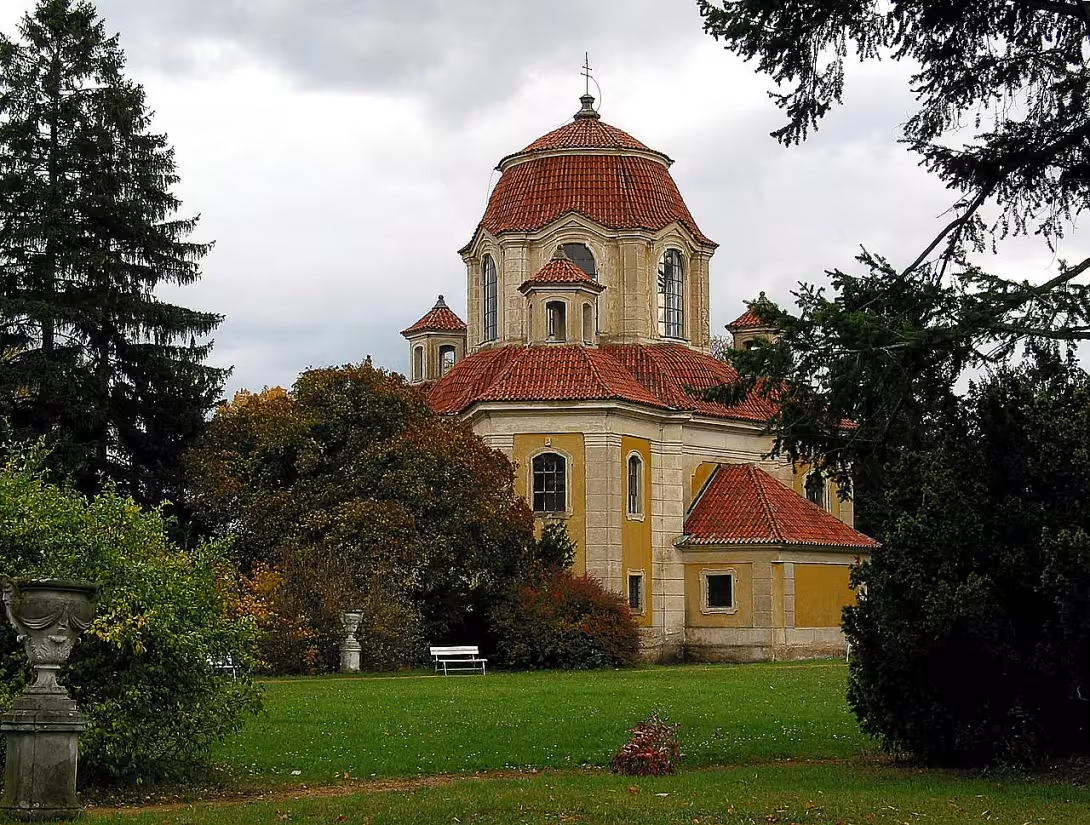
The chapel of St. Anne was established in the years 1705 to 1707 as a summer residence of benedictions from the monastery of St. George in Prague Chateau. The construction was initiated by a 60-year-old abbey František Helena Pieroni da Galiano, daughter of Italian mathematician and architect Giovani Pieroni. Construction according to plans by Jan Blažej Santiniho-Aichela was carried out by builder Filip Spannbrucker, from Austrian construction family. The whole building was built just three years ago and its costs amounted to 3895 gold and 20 tailors - the builder received a fee of 995 gold, Santini received 180 gold for plans and copyright supervision. These modest figures suggest that it was actually a small chapel, not a representative building.
The chapel is located in a park called the Upper Chateau, which served as a summer residence of the benedicts. Since its construction it has never been rebuilt with a single exception - in 1738 it added sacristy. The ideological concept of the building is thus preserved in complete originality and provides a rare insight into early Santini's work.
The architecture of the chapel is a matter of Santini's genius. It is his first radially developed ray centre, inspired by the great Italian Baroque Francesco Borromi and Guarin Guarini. The building has a ground plan based on concentrated circles: the foundation is a regular hexagon with a radius of 14 cubits, the three vertices of which are encased by smaller chapel formed by pentagon chapel. This number - three - is not random, because the chapel is dedicated to Saint Anne of the Self-Third.
From the outside, the building appears to be an equilateral triangle with lateral caples rather than as an централa building, which is defined in particular by the tambur dome. The facade is broken down by rusted presses with lisen frames. In the middle, a multi-wall dome is drawn out by the corner pillars. The roof lanterns above each side chapel have a five-sided shape with concave corners. The interior is surprised by the rich composition of the walls - wider and narrower parts are alternating, which give the impression of radial enlargement. The narrower walls are framed with editorials with monumental columns passing over two floors. On the ground floor and floor, these editorial fields are convex and open by arcades.
This chapel has become a prototype of the radiant headquarters which Santini has perfected in his top creation - especially in St. John Nepomuk's church on Green Mountain. He has repeatedly used Santini in later construction in Mladotice and Zvolí. He also introduced a new topic of "hollow pillar" through the editorial fields in the forehead into Czech top Baroque architecture.
The chapel is today protected as a cultural monument of the Czech Republic. The visitor will find evidence of how even a small, almost intimate building can carry the ideas of the highest architecture of its time.
Then and now
Drag the slider to compare how the landmark may have looked when it was built with the view today.
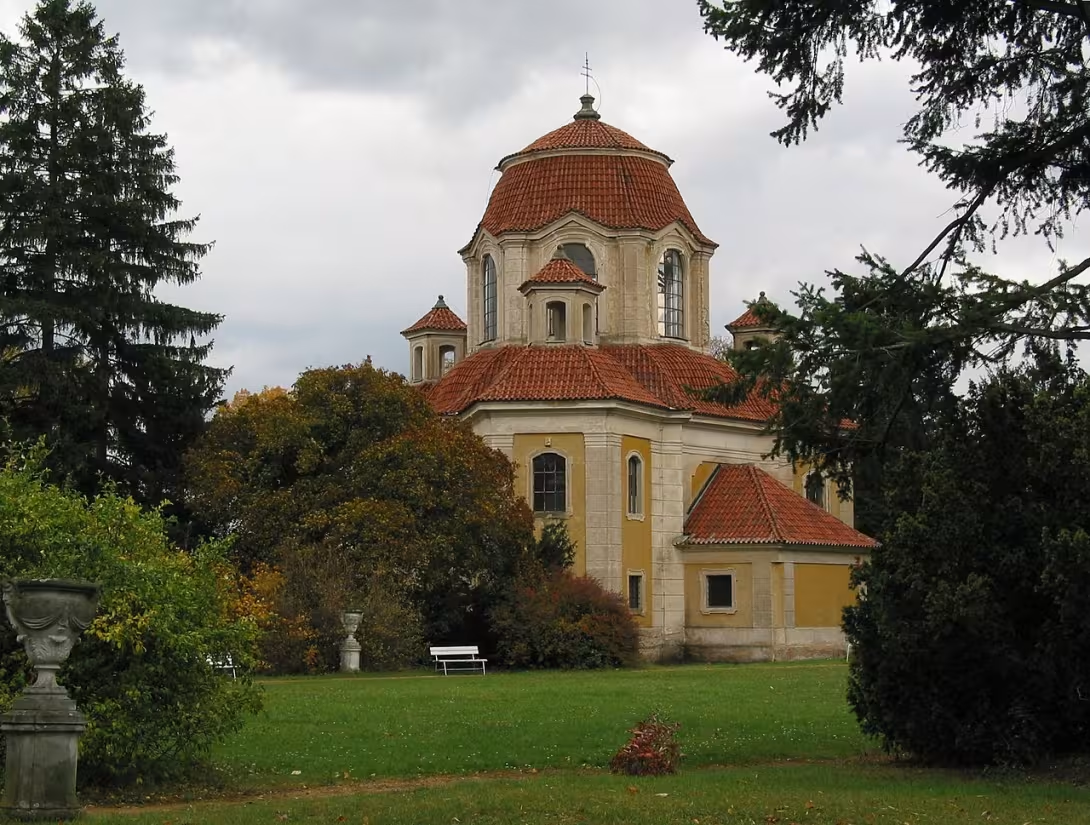

The historical appearance on the left is an AI-generated visualisation and serves as inspiration only.
Historical milestones
- 1705
- The beginning of the chapel construction.
- 1707
- Completion of the original building of the chapel.
- 1738
- Construction of the sacristy.
Architectural development
The chapel was built as a radially developed centre using the principle of concentrated circles. The exterior resembles a triangle and is characteristic of the corner pillars. In 1738 a sacristy was added to the original body.
Historical events
Implementation of the construction in 1705-1707 and subsequent extension of the sacristy in 1738.
Owners
St. George's monastery in Prague Chateau
Points of interest
- St. Anne's Chapel was built between 1705 and 1707 as a summer residence of the Saint George's monastery in Prague Chateau. - The construction was initiated by a 60-year-old abbey František Helena Pieroni da Galiano, daughter of Italian mathematician and architect Giovani Pieroni. - The chapel is the first radially developed ray centre of Jan Blazej Santini-Aichel, inspired by the great Italian baroque Francesco Borromini and Guarin Guarini. - The chapel was protected as a cultural monument of the Czech Republic.
Guide
This guide is narrated by a synthetic voice generated by artificial intelligence.
Show guide text
This text was created by artificial intelligence and has not been editorially reviewed. It may contain inaccuracies.
The Chapel of Saint Anna in Panenské Břežany was built between seventeen hundred and five and seventeen hundred and seven. Archives show that it was designed by Jan Blažej Santini-Aichel. The construction was commissioned by the then sixty-year-old abbess of the Convent of Saint George in Prague Castle, Františka Helena Pieroni da Galiano, daughter of the architect and mathematician Giovanni Pieroni. The builder who carried it out was Filip Spannbrucker from an Austrian building family.
The chapel stands in the park of the Upper Castle, which served as a summer residence for the Benedictine nuns of Saint George. Accounts have been preserved. The construction cost thirty-eight hundred and ninety-five golden coins and twenty kreutzers. The builder received nine hundred and ninety-five golden coins from this, and Santini received one hundred and eighty golden coins for the plans and supervision of the work. The chapel was completed in three years and, apart from the sacristy added in seventeen hundred and thirty-eight, it was never reconstructed. It thus remained preserved in its original form as evidence of Santini's early work.
It is his first radial central structure, inspired by the works of Francesco Borromini and Guarino Guarini. This type was later brought to perfection by Santini in the Church of Saint John of Nepomuk on Zelená hora. The articulated cylinder under the dome, called the tambour, he later improved and used in Mladotice and in Zvol.
The floor plan is based on concentric circles. In a large circle with a radius of fourteen cubits lies a regular hexagonal nave. Into three of its vertices extend smaller circles with a radius of six cubits with inscribed pentagons. From the nave thus project three side chapels, and their number refers to the dedication to Saint Ann and Her Parents.
From the outside the chapel resembles more an equilateral triangle with side chapels at the vertices. The hexagonal structure is mainly indicated by the tambour of the dome. It is circular inside and hexagonal outside and it is pierced by large windows arched with a semicircle. Above each side chapel rises a pentagonal turret with curved corners.
Inside, wider and narrower walls alternate, so that the nave seems to extend in three directions. The narrower walls frame robust pillars that rise over two storeys. Opposite the entrance is the place for the main altar. On two wider walls, pillars ending in a broken arch support a curved hanging gallery. It was precisely with such articulated walls that Santini introduced the motif of the hollow pilaster into Czech high baroque architecture.
Tips for visitors
The best time to visit the chapel of St. Anne in the Virgin Břežany is the early spring or late autumn, when the weather is pleasant and the park surrounding the chateau offers beautiful green. This time of the year also allows photography without overfilling tourists, which is ideal for capturing architectural details of the chapel.
Public transport users should verify the current connection with the search engine to reach the Virgin Břežany.
What to take with you: We recommend you bring a quality camera to capture the architectural beauty of the chapel. It is also important to wear a protective umbrella and plenty of drinking water, especially in warmer months. Don't forget to take a map of the surroundings for better orientation.
Photography: The best light for shooting the chapel is usually early in the morning or in the evening when the sun is not too high and shadows little. It is also recommended to photograph from different angles, especially from the park of the surrounding chateau, which will offer interesting prospects.
What to visit in the area: Last but not least, it is advisable to explore the area of the Upper Chateau and the related park. This historical complex offers a beautiful opportunity to walk in peace, with the possibility of viewing other architectural works. For families with children, the park is an ideal place for well-being and short walks.
Frequently asked questions
Can the monument be visited?
Religious buildings are usually open mainly during services; at other times a visit is normally arranged with the parish or the operator. We have not verified specific times.
Where is the monument?
Location: Hlavní 11, Panenské Břežany, Středočeský kraj. The map on this page shows the exact spot.
Why is the monument protected?
It is listed in the Central List of Cultural Monuments of the Czech Republic as a cultural monument (register no. 41314/2-2129). It is protected as part of a larger listed ensemble.
For kids
Imagine going back to the past and finding yourself in a small village of Panenské Břežany. St. Anne's Chapel has been standing here since 1700, and it was built as a sanctuary for people who were looking for help and protection.
How did it look here? The village was full of people who lived from the ground and raised animals. It was the villagers who took care of their kisses and defended their homes. The chapel was their sanctuary where they prayed and sought advice.
Businesses nearby
Do you run a restaurant, accommodation, shop, museum, rental, wellness or other visitor service near this monument? Show yourself directly to the people heading to it — this is how they will see you in the app and on the web:
Events nearby

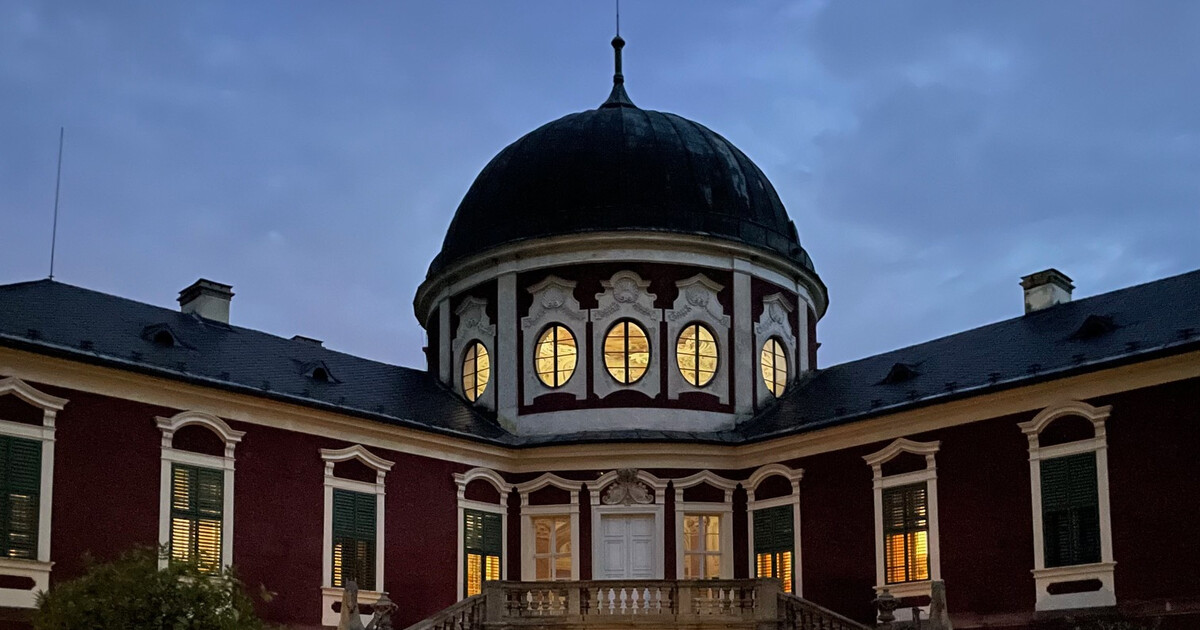

Zdroj akcí: otevřená data měst a obcí ČR (Národní katalog otevřených dat) a kalendář akcí Národního památkového ústavu.
Nearby
The area of the Upper Chateau and the related park.
Accommodation nearby
Trips and activities nearby
Guided tours, tickets and activities nearby from GetYourGuide
Affiliate link: if you buy from the partner, we may receive a commission. The price for you does not change.
Search tours and activities →Themed route
1. Related park (park) - Walk in a quiet green environment offers a pleasant introduction to the trip. 2. Area of the Upper Chateau (historical area) - Visitors can admire large spaces and historical architecture. 3. Saint Anne's Chapel (Chapel) - The main destination of the journey, which represents a unique sacral monument.
Seasonal recommendations
Spring season offers visitors awakening nature and fresh green color around the chapel. Soft morning light highlights the details of the sacral structure and creates an optimistic atmosphere. It is advisable to prepare more layers of clothing because the weather can still be variable. At this time the traffic is lower, allowing for a quiet observation of architecture without large crowds.
During the summer months the surroundings of the chapel are played by dense vegetation and the sun offers the maximum brightness that hits the historic facades. In the main summer season there are more people in place, so it is best to arrive early in the morning. We recommend to have a headgear and plenty of fluids to make the heat inspection pleasant.
Autumn moons bring golden shades and morning fog to the landscape, which deliver magical and melancholy sounds to the chapel of Saint Anne. The atmosphere is very quiet and meditative. It is necessary to choose stronger shoes for wet terrain and warmer upper clothing. The best time to visit is in the afternoon, when leaf colours are the best.
In winter, the chapel is very lonely and noble in the landscape, especially if the surrounding area is covered with snow or frost. The day is short, therefore it is best to visit the memory around noon when the light is the most. It's essential to wear very warm clothes because of the cold. In advent time and deep winter, availability or opening time may be limited.
Visualizations and artistic views


The visualisations are generated by artificial intelligence and serve as inspiration.
Photos from the area
Real photos taken near the monument


Zdroj a licence jsou uvedeny u každého snímku.
Tips from visitors
No tips yet. Be the first!
Log in and add your tip.
Sources and literature
Photos: Kf at Czech Wikipedia / CC BY-SA 3.0 — Wikimedia Commons. The author and licence also appear when you hover over the image.
Faktickým podkladem tohoto textu byl článek na Wikipedii, jehož autory jsou přispěvatelé Wikipedie. Článek je dostupný pod licencí CC BY-SA 4.0.
Location on the map





Příběhy a pověsti
Legendy, pověsti a příběhy spjaté s touto památkou

Fotografie návštěvníků
Zatím žádné fotografie. Buďte první, kdo přidá fotografii z návštěvy!
Log in a přidejte svou fotografii nebo hodnoťte.
Za ověřenou návštěvu v aplikaci získáte víc bodů — poznáme podle GPS, že jste na místě.
Reviews and comments