



Kaplička Nejsvětější Trojice (Bezděkov pod Třemšínem) Chapel
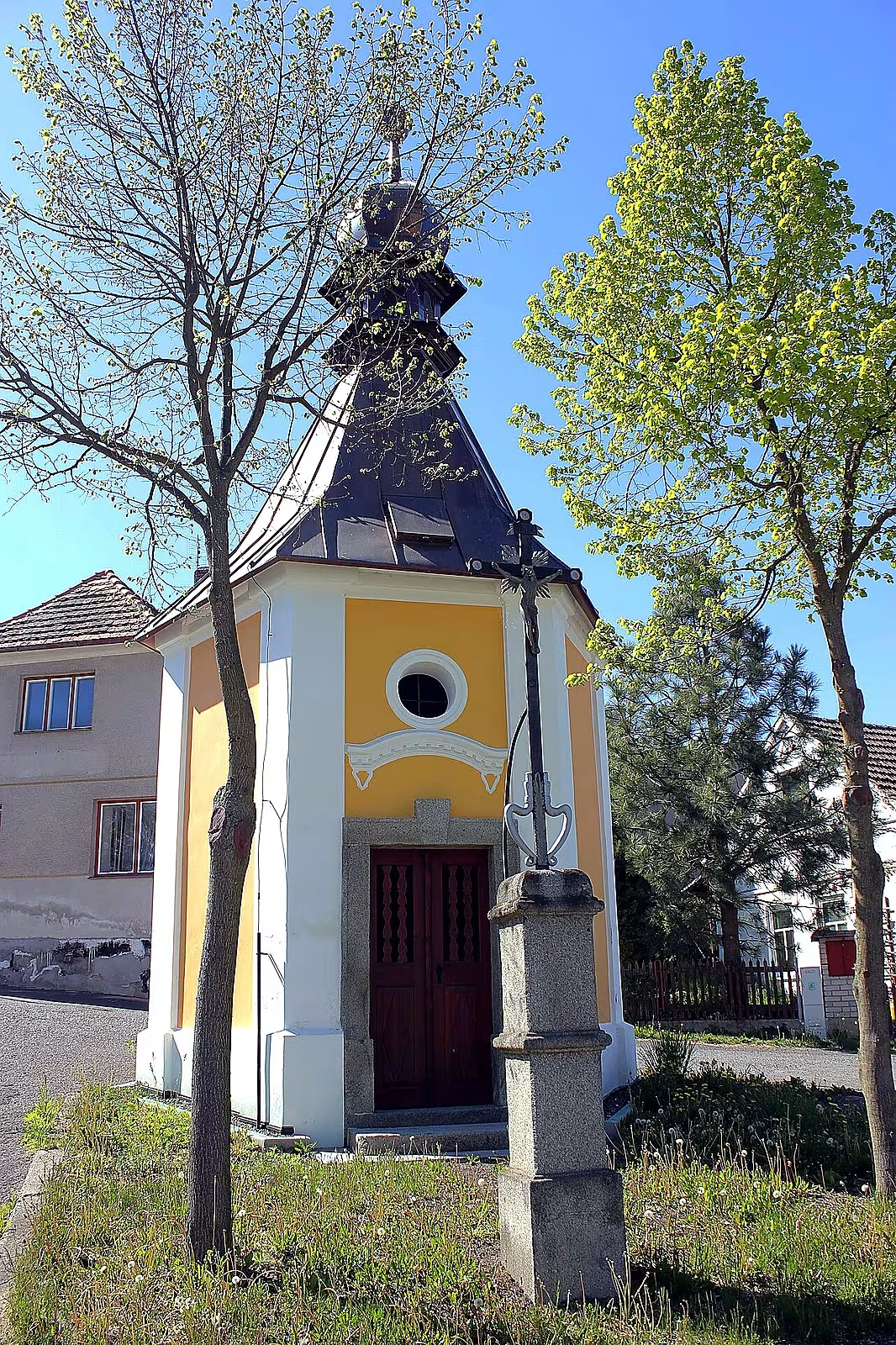
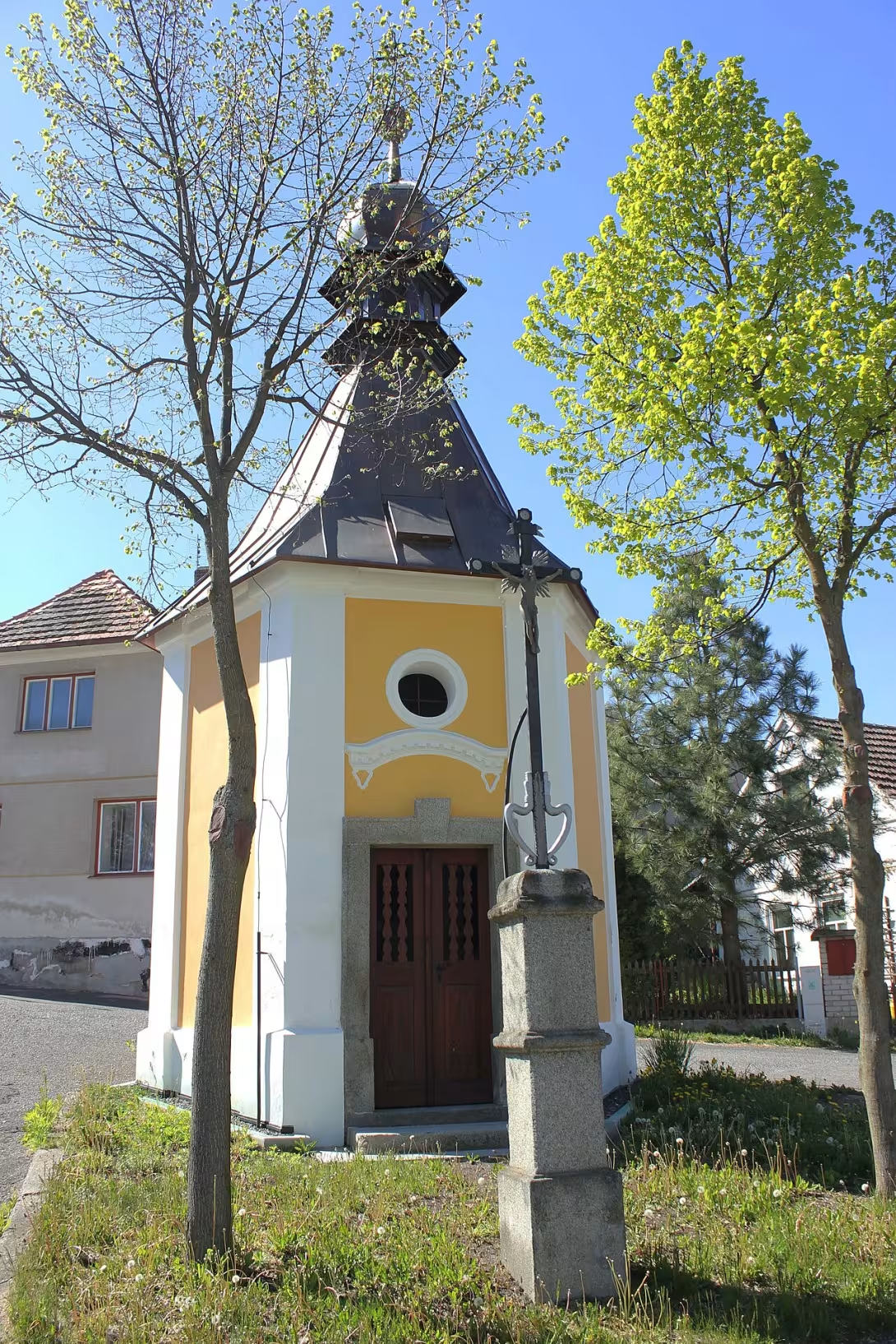
The Chapel of the Holy Trinity stands in the middle of a triangular village in Bezděkov under Tremšín, a small village in the district of Příbram. It is located on a small grassy plot near the main road. It's a classic building that the state protects as a cultural monument since 1958.
The exact circumstances of the chapel remain partially unclear. The figure of 1844 is based on the year carved into a stone plinth of cast iron cross standing in front of the chapel. However, the books of religious service announcements held at the parish office in the Old Rožmitál do not record the consecration of the chapel in Bezděkov, and it can therefore be assumed that the chapel was established before 1843. The first preserved written mention dates back to 1912 from the chronicle of local firefighters, which wrongly attributed it to St. John Nepomuk - but the book also rightly calls it the band of the Holy Trinity.
Since its inception, the chapel has become a living centre of public events in the village. Bigger cultural events started at the chapel - fire procession, milking, celebration of significant state anniversaries. In May, the locals sang traditional songs, and at Easter there were traditionally prayer groups of trick-or-treaters circling the village with fireworks.
The 20th century brought the chapel serious trials. In 1916, the Austrian-Hungarian army recited the original bell. After the war, in 1920, a monument was built before the chapel to the fallen in the First World War. In World War II, the mayor gave a new bell to the German occupants as a gift. After the war a new bell was hung in the chapel in 1949, cast in the former bell company R. Pernery in Dry Vrbý near České Budějovice. The bell bears the inscription, "IN THE VIEW OF WAR, 1914-1918 AND 1938-1945 EXPLANED IN 1949." The bell was consecrated on 20 May 1949; at the same time the chapel was blessed after it had undergone a major reconstruction with a new color and roof cover. On the occasion of the repair, a newborn was baptized in the chapel.
In the communist period, the chapel was not too well maintained. A larger repair took place in 1991. General renovation came only in 2018. Building foundations were drained, metal roof cover replaced copper plates. The interior was newly plastered, the facade got a new look with a warm yellow touch instead of an old pink. The stone lining of the entrance was exposed and wooden elements of doors and benches were repaired. Memory sheets describing the repair, a set of current coins and a message to future generations were stored in the chapel.
The construction is a small central structure on a hexagonal plan, broken down in the Nарo Pilaster formations. The needle roof is closed with a lantern with onion beating. The chapel is oriented by the front towards the east, the altar menu towards the west. The interior is decorated with paintings of saints - St. Wenceslas and St. Ludmila, which were made by Lubomir Peshek and were located in 2018. The rear wall features the painting of the Holy Trinity and the restored statue of the Virgin Mary. There are two desks at the entrance. In front of the chapel, there are two lids planted in 2010 instead of the original trees that had to be removed.
The ceremonial service associated with the blessing of the repaired chapel took place on 15th June 2019, symbolically just on the day of the Christian feast of the Holy Trinity. At present, the chapel does not hold services, but remains a living memory of the local tradition and testimony of the complicated journey that Czech society went through in the twentieth century.
Then and now
Drag the slider to compare how the landmark may have looked when it was built with the view today.

The historical appearance on the left is an AI-generated visualisation and serves as inspiration only.
Historical milestones
- 1844
- The proven year of the origin of the chapel based on the year on the plinth of the cross.
- 1912
- The first written mention of the chapel in the chronicle of non-thankless firefighters, although there is erroneously stated the initiation to St. John Nepomuk.
- 1958
- The chapel was declared a cultural monument.
- 1949
- The chapel was consecrated by a new bell and blessed after reconstruction.
Architectural development
The chapel was built probably before 1843, but the first written mention of it dates back to 1844 when the cross was placed on the plinth this year. The construction is a classical character with a hexagonal plan and a needle roof. In 1949, the roof was painted and repaired. The last extensive repair took place in 2018 when the roof cover was replaced with copper plates and wooden interior elements were repaired.
Historical events
- 1916
- The original bell of the chapel was restored for war purposes during World War I.
- 1942
- The next bell was given to the German occupants as a municipal gift, even though it was removed from the requisition for war purposes.
- 1949
- The chapel had been renovated and was consecrated by a new bell that resembles both world wars.
- 2018
- The chapel underwent a general repair during which the roof cover was replaced and the interior was replastered.
Points of interest
The chapel has been protected as a cultural monument since 1958.
- According to the year on the plinth of the cross before the chapel, its origin dates back to 1844, but the written records of the parish office in the Old Rožmitála do not confirm the chapel in Bezděkov.
- The chapel served as a place for the launch of major municipal events, such as fire processions, milestones or celebrations of state anniversaries.
- In 1949 the chapel was blessed after a great reconstruction and hung a new bell with a sign that resembled both world wars.
- In 2018, the chapel underwent extensive renovation, with commemorative leaves, coins and a message to future generations.
Guide
This guide is narrated by a synthetic voice generated by artificial intelligence.
Show guide text
This text was created by artificial intelligence and has not been editorially reviewed. It may contain inaccuracies.
The Chapel of the Holy Trinity is a neoclassical building in the village of Bezděkov pod Třemšínem in the Příbram region. It stands on a small grassy plot in the middle of a triangular village square, not far from the main road. It has been a cultural monument since nineteen fifty-eight.
Little is known about its origins. The year eighteen forty-four is usually mentioned, carved into the stone base of an iron cross in front of the chapel. However, the parish registers of announcements from Starý Rožmitál, kept from eighteen forty-three onwards, apparently do not record the chapel's consecration, so it may have been built even earlier. The first written mention comes only from nineteen twelve from the chronicle of the local fire brigade. The chronicler first attributed it to Saint John of Nepomuk, but later calls it the Chapel of the Holy Trinity.
The chapel has always been the center of events in the village. Fire brigade processions, harvest festivals and celebrations of state anniversaries set out from here, and May songs were sung there. At Easter, carolers who go through the village with wooden rattles still pray there to this day.
The fate of its bells is remarkable. The original bell was seized by the Austro-Hungarian army in nineteen sixteen. Its replacement was donated in nineteen forty-two by the mayor to the German occupiers, although small bells weighing up to twelve kilograms were exempted from confiscation. A new bell was cast in nineteen forty-eight by the bellmaking company Perner in Suchý Vrb near České Budějovice. It bears an inscription commemorating the war years nineteen fourteen to nineteen eighteen and nineteen thirty-eight to nineteen forty-five. It was consecrated on the twentieth of May nineteen forty-nine and at the same time the newly repainted chapel was blessed. That day also saw the christening of a newborn in it. A monument to those who fell in the First World War has stood in front of the chapel since nineteen twenty.
Under the communist regime, the chapel fell into disrepair and a major renovation did not come until nineteen ninety-one. A general renovation in twenty eighteen brought drainage of the foundations and a copper roof instead of a metal one. The façade changed from an old pink color to a warm yellow shade and the stone frame around the entrance was revealed. Memorial pages, coins and a message for future generations were placed in the spire. The renovated chapel was blessed on the fifteenth of June twenty nineteen. Services are not held in it today.
It is a small six-sided building with a pyramidal roof topped by a cupola with an onion dome. Inside hang paintings of Saint Wenceslas and Saint Ludmila by Lubomír Pešek. The altar wall is decorated with a painting of the Holy Trinity and a restored statue of the Virgin Mary. Two linden trees planted in twenty ten grow by the chapel, replacing two of the last from the original set of six.
Tips for visitors
The best time to visit the chapel is in the summer months, especially in June to September, when the weather is pleasant and nature around is in full glory. The chapel is small, but its atmosphere is the most beautiful in sunny weather, when light is reflected from white walls and needles roof. The morning or afternoon is ideal because you avoid direct sun and enjoy a quiet atmosphere without crowds of tourists.
It is recommended to arrive by car because public transport to Bezděkov under Tremšín is not very common. It is also recommended to have a little space in the car for any shopping souvenirs or refreshments nearby.
When visiting the chapel, take comfortable shoes, because the path to the monument is mostly asphalt or clean pavement. In the summer months it is advisable to carry sunglasses, hat or hat and plenty of water. If you are planning to take photos, bring a flashlight or a mobile light-measuring app, because the most beautiful photos can be taken at the golden hour, shortly after sunrise or before sunset.
Shooting the chapel is allowed, but the best places for the images are in front of the chapel, where there is a good angle on the whole structure, and also from the surrounding area better, which give the photos natural beauty. The most suitable light is for dispersed sunlight, for example in a slightly cloudy weather or in a golden hour. If you want to capture the detail of architecture, focus on the needle roof and classical details.
Around the chapel is worth a visit to the memorial of the fallen in the First World War, located just 100 metres from the chapel. This monument is an important historical monument and its visit will provide you with another historical context for the place. If you have time, you can also see the apples at the chapel, which are not only aesthetically pleasant, but also have an interesting history associated with the restoration of damaged trees.
The chapel is ideal for visiting with children because it is a small but interesting building that can be an interesting example of architecture for children. You can explain to them the meaning of the Holy Trinity and tell them about the history of the chapel. There is also enough space for short walks in the area and children can see the linden or monument. It is advisable for families with small children to take a toy or a small piece of food with them so that the children can relax and enjoy their visit.
Frequently asked questions
Can the monument be visited?
Religious buildings are usually open mainly during services; at other times a visit is normally arranged with the parish or the operator. We have not verified specific times.
Where is the monument?
Location: Bezděkov pod Třemšínem, Středočeský kraj. The map on this page shows the exact spot.
Why is the monument protected?
It is listed in the Central List of Cultural Monuments of the Czech Republic as a cultural monument (register no. 30934/2-2373).
For kids
Imagine going back to the time when the chapel of the Holy Trinity in Bezděkov was still young and full of life. It was like a game where the lead hero was waiting for his next quest.
This is where people lived who used to feed on agriculture and pasture. The village was small, but full of life's joy. People gathered in the chapel to pray to God for crops, health and happiness. The chapel was like the heart of a village where people came for advice and comfort.
Businesses nearby
Do you run a restaurant, accommodation, shop, museum, rental, wellness or other visitor service near this monument? Show yourself directly to the people heading to it — this is how they will see you in the app and on the web:
Events nearby

Zdroj akcí: otevřená data měst a obcí ČR (Národní katalog otevřených dat) a kalendář akcí Národního památkového ústavu.
Accommodation nearby
Themed route
I propose a thematic cruise route focused on sightseeing and natural attractions in the village Bezděkov pod Třemšínem.
1.Kaplička Nejsvětější Trojice (Bezděkov pod Třemšínem) - Type: Chapel - Why is it worth a visit: this sacral structure represents the main destination of our trip. It is located on a small grassy plot in the center of a triangle near the main road.
2. Lips by the chapel - Type: Nature - Why is it worth a visit: These two lids were planted in 2010 in place of the original trees which had to be removed due to damage. They grow in the immediate vicinity of the chapel and form a harmonious whole with it.
3. Memorial to the Fallen in World War I - Type: Memorial - Why is it worth a visit: This memorial commemorating the victims of the First World War was festively furnished in 1920. It is located just about 100 meters from the chapel.
Seasonal recommendations
Spring Chapel The holiest Trinity in Bezděkov, under Tremšín, awakens to life in a fine light in spring, when the sun penetrates among the young leaves of the surrounding trees and throws a silver glare on a white plaster. Nature around it is dressed in green and purple tones - spring flowers such as spleen or birdseed bloom, and the air smells fresh soil. The atmosphere is quiet, almost meditative, ideal for a short prayer or walk around the surrounding fields, where summer crowds have not yet appeared. It is practically advisable to visit the chapel early in the morning or in the afternoon when the sun stands below and the shadows extend. Clothes should be easy, but with the possibility of adding a sweater - spring weather is variable, and it can be cold in the morning. Comfortable shoes are also recommended, as roads around the chapel can be muddy after the rains.
Summer In the main summer season, the chapel of the Holy Trinity turns into a vivid image, when the sun shines directly on its roof cross and creates sharp shadows on stone steps. The surrounding area is green and widely visited, but in the afternoon heat becomes pleasant when the sun boils to the west. The atmosphere is cheerful, often accompanied by the sounds of birds and the occasional noise of tourists resting on benches. The best time to visit is early in the morning, when the chapel is still calm, or late in the afternoon, when the crowds disperse. It is recommended light, breathable clothes, hat and sunglasses because the sun at noon can be intense. It is not appropriate to forget the water because in the summer months the path to the chapel may be energy-intensive.
Autumn Autumn brings golden and red colours to Bezděkov under Tremšín, which are reflected in the windows of the chapel and create contrast with its white facade. The chapel appears to be a cozy shelter from the cold wind that begins to blow in October. Nature turns into a palette of warm shades, and air smells of fallen leaves and moisture. The atmosphere is quiet, almost mysterious, ideal for reflection or photography. The best time to visit is in the afternoon when the sun still shines enough, but the crowds are smaller than in the summer. Clothes should be warm but not too rough - autumn weather is variable, and in the morning can be cold. Comfortable shoes are also recommended, because forest roads can be slippery on fallen leaves.
Winter In winter, the chapel of the Holy Trinity becomes a picturesque snow formation, where the white coating covers its roof and stairs, and the surrounding trees are dressed in ice and snow. The sun, which rarely appears, casts long shadows and creates a magical atmosphere that resembles a fairy tale. The air is clean and cold, and the silence is almost palpable. The best time to visit is in the afternoon when the chapel is lit by the sun and the snow areas are still stable. It is recommended to warm but comfortable clothes, including waterproof jackets and warm shoes, because the paths can be slippery. Visiting in winter is ideal for those looking for the calm and beauty of the winter landscape, but it is necessary to assume that some paths can be difficult to passable after strong snowfalls.
Visualizations and artistic views


The visualisations are generated by artificial intelligence and serve as inspiration.
Photos from the area
Real photos taken near the monument


Zdroj a licence jsou uvedeny u každého snímku.
Atmosphere of the place
This atmospheric visualisation of the place and period was generated by artificial intelligence. It is not real footage of the location.
Tips from visitors
No tips yet. Be the first!
Log in and add your tip.
Sources and literature
Photos: Lucie Voříšková / CC BY-SA 4.0 — Wikimedia Commons. The author and licence also appear when you hover over the image.
Faktickým podkladem tohoto textu byl článek na Wikipedii, jehož autory jsou přispěvatelé Wikipedie. Článek je dostupný pod licencí CC BY-SA 4.0.
Location on the map
More monuments – Bezděkov pod Třemšínem
Show all in the municipality




Příběhy a pověsti
Legendy, pověsti a příběhy spjaté s touto památkou

Fotografie návštěvníků
Zatím žádné fotografie. Buďte první, kdo přidá fotografii z návštěvy!
Log in a přidejte svou fotografii nebo hodnoťte.
Za ověřenou návštěvu v aplikaci získáte víc bodů — poznáme podle GPS, že jste na místě.
Reviews and comments