



kaplička svatého Jana Nepomuckého (Tihava) Chapel
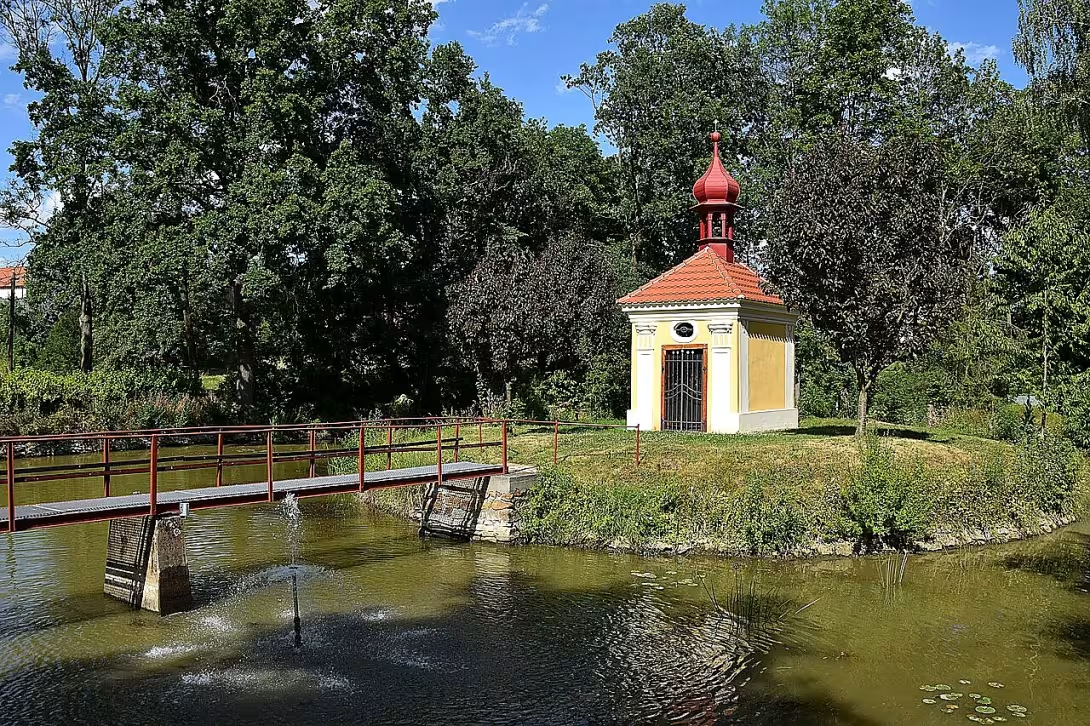
The Chapel of Saint John Nepomucene in Tihava is a small yet historically important chapel located within Kotopecy village, Beroun District, Středočeský region. Built on the site of an older medieval fortress with a moat, this cultural monument reflects the area's rich history and architectural evolution. Dedicated to Saint John Nepomucene, the chapel sits on an island in the moat, which varies from eight to sixteen meters wide. This location highlights both religious devotion and broader historical shifts in Bohemia during the late Middle Ages.
The origins of this site trace back to when Tihava housed two castles, with the current chapel's site being the older one. Historical records mention Mareš z Tihavy as its lord in 1393, marking documented ownership's start. His successor, Jan z Tihavy, inherited the estate and died in 1416, after which his widow Dorota acquired the Kotopecy estate. Figures like Drslav z Tihavy (mentioned in 1406) and Zdeněk z Koněprus (holding the estate from 1454 to 1472) further enrich its history. These transitions reflect dynamic land ownership and noble lineage during this period.
Architecturally, the site originally featured a medieval fortress with a moat, now transformed into the chapel dedicated to Saint John Nepomucene. The surrounding moat varies in width and may have remnants of an ancient embankment. Over time, the younger castle's significance diminished, leading to its disappearance. This transformation from a fortified structure to a place of worship illustrates changing priorities over centuries.
Ownership and administration saw several dramatic changes. After Jan z Tihavy's death in 1416, his widow Dorota acquired the Kotopecy estate. Drslav z Tihavy, mentioned in 1406, was succeeded by his widow Alžběta, who remarried Jindřich Labutě ze Švamberka. Later, Zdeněk z Koněprus held the estate and used the title 'z Tihavy' until his family line ended, leading to the estate becoming an odúmrť for King Vladislav II. These shifts reflect broader trends of inheritance and political influence during the late Middle Ages.
Key events include its transformation from a medieval fortress to a chapel dedicated to Saint John Nepomucene. The site's historical significance is underscored by its role as a cultural monument, protected for its value. While specific dramatic events are not documented, ownership transitions and architectural changes highlight its evolving nature.
Today, the Chapel of Saint John Nepomucene stands as a preserved cultural monument within Tihava. Its accessibility allows visitors to explore Bohemia's medieval past, offering insights into the region's historical and architectural heritage. The chapel's serene setting amidst moat remnants provides a unique opportunity for reflection on the area's rich history.
The Chapel of Saint John Nepomucene in Tihava is not just an architectural relic but a bridge to understanding Bohemia's complex past. Its preservation as a cultural monument ensures future generations can appreciate and learn from this significant historical site. Visitors are invited to explore its tranquil surroundings and immerse themselves in the history it embodies, making it a worthwhile destination for those interested in medieval architecture and heritage.
Historical milestones
- The site is a cultural monument protected for its historical significance.
Architectural development
The site originally featured a medieval fortress with a moat, which has since been transformed into a chapel dedicated to Saint John Nepomucene. The moat surrounding the island where the chapel stands varies in width and may have remnants of an ancient embankment. Over time, the significance of the younger castle diminished, leading to its disappearance.
Historical events
1393: Mareš z Tihavy is mentioned as the lord of the older castle in Tihava.
1416: Jan z Tihavy's death, leading to his Kotopecy estate being acquired by his widow Dorota.
1454–1472: Zdeněk z Koněprus held the estate and used the title 'z Tihavy'.
Owners
Mareš z Tihavy (mentioned in 1393), Jan z Tihavy (successor of Mareš), Dorota (widow of Jan, acquired Kotopecy estate after his death in 1416), Drslav z Tihavy (1406), Alžběta (Drslav's widow, remarried to Jindřich Labutě ze Švamberka), Zdeněk z Koněprus (1454–1472).
Points of interest
- The chapel is uniquely situated on an island within a moat that varies from eight to sixteen meters wide, symbolizing both its religious significance and the medieval defensive strategies of the area.
- Tihava originally housed two castles, with the site of the current chapel being the older one. This dual-castle history reflects the strategic importance and evolving land use in the region over centuries.
- The transition from a medieval fortress to a chapel dedicated to Saint John Nepomucene illustrates a significant shift in priorities—from military defense to religious devotion—highlighting broader historical changes during the late Middle Ages.
- Ownership of the site saw dramatic shifts, such as when Dorota acquired the Kotopecy estate after her husband Jan z Tihavy's death. These transitions reflect the complex inheritance practices and political influences of noble families in medieval Bohemia.
- The title 'z Tihavy' was used by Zdeněk z Koněprus until his family line ended, leading to the estate becoming an odúmrť for King Vladislav II. This reflects the feudal system's impact on land ownership and governance during that era.
Guide
This guide is narrated by a synthetic voice generated by artificial intelligence.
Show guide text
This text was created by artificial intelligence and has not been editorially reviewed. It may contain inaccuracies.
In Tihava near Kotopek in the Beroun region stands a small chapel dedicated to Saint John of Nepomuk. It was built in no ordinary place. They constructed it on the site of a fortified farmstead, that is, on the remains of a medieval stronghold. The entire stronghold area is protected as a cultural monument.
In Tihava there originally stood two fortified farmsteads. The older one was located in the southern part of the village, in an area called Na Baště. We have no written records about it. It apparently served as the residence of Mareš of Tihava, who is mentioned in sources in the year 1393. His successor was probably Jan of Tihava, who inherited property in Kotopek from his uncle. He died at the latest in the year 1416, and his widow Dorothy then acquired the Kotopek property.
At the beginning of the fifteenth century, two nobles divided the village between them and both used the name of Tihava as their surname. The first known member of the second family was Drslav of Tihava. In the year 1406 he is listed as a servant of Zdeněk of Chajn, from whom he inherited property in Kotopek. He soon died and his widow Elisabeth remarried to Jindřích Labut of Švamberek. A later holder was Zdeněk of Koněprus, who sometimes also called himself of Tihava. Sources mention him in the years 1454 through 1456 and again in the year 1472. Around that time his family died out and the property fell to the king Vladislav the Second as an escheat. He granted it to Mikuláš of Landštejn. The younger stronghold thus lost its importance and eventually disappeared. At the beginning of the sixteenth century, Tihava became part of the Hořovice estate.
The stronghold site Na Baště is formed by a water-filled moat that surrounds an islet in the middle. The chapel of Saint John of Nepomuk stands on that very islet today. The moat is eight to sixteen meters wide. On its outer side, a slight elevation is visible, which could be the remains of an embankment.
Previous literature considered the second stronghold to be completely destroyed. According to the historian August Sedláček, however, there still existed a stronghold site in the northern part of the village near the former mill in the second half of the nineteenth century. It had a rectangular ground plan and was surrounded on three sides by a shallow moat. Its remains were visible in this form in a garden west of house number 8. Shortly before February 2023, however, part of the house was demolished and the stronghold area was covered with construction debris and other rubble.
Frequently asked questions
Can the monument be visited?
Religious buildings are usually open mainly during services; at other times a visit is normally arranged with the parish or the operator. We have not verified specific times.
Where is the monument?
Location: Kotopeky, Středočeský kraj. The map on this page shows the exact spot.
Why is the monument protected?
It is listed in the Central List of Cultural Monuments of the Czech Republic as a cultural monument. It is protected as part of a larger listed ensemble.
Businesses nearby
Do you run a restaurant, accommodation, shop, museum, rental, wellness or other visitor service near this monument? Show yourself directly to the people heading to it — this is how they will see you in the app and on the web:
Events nearby
Zdroj akcí: otevřená data měst a obcí ČR (Národní katalog otevřených dat) a kalendář akcí Národního památkového ústavu.
Nearby
Tihava is located in the Středočeský region near Kotopecy village. The area features remnants of medieval fortifications and a chapel, with natural landscapes including moats and possibly ancient embankments.
Accommodation nearby
Themed route
Thematic Walking Tour: Tihava and the Chapel of Saint John Nepomucene
1. Chapel of Saint John Nepomucene (Tihava) - Type: Historical Religious Site - Why Visit: The chapel is a serene spot dedicated to Saint John Nepomucene, revered for his martyrdom in defense of the confessional seal. Its quaint architecture and spiritual ambiance make it an ideal starting point for exploring Tihava's historical charm.
2. Remnants of Medieval Fortifications - Type: Historical Ruins - Why Visit: A short walk from the chapel, these remnants offer a glimpse into Tihava’s medieval past. Visitors can explore the ancient moats and embankments that once served as defensive structures, providing insight into the region's strategic importance during turbulent times.
3. Natural Landscape Exploration - Type: Natural Area - Why Visit: The surrounding landscapes feature picturesque moats and possibly ancient embankments. This area is perfect for nature lovers looking to enjoy a peaceful stroll amidst Tihava’s natural beauty, offering both tranquility and a connection to the past.
This tour offers an enriching experience that combines historical intrigue with natural splendor, all within the charming locale of Tihava.
Seasonal recommendations
Spring: The spring season at the Chapel of Saint John Nepomucene in Tihava offers a refreshing atmosphere as nature awakens with vibrant colors and blooming flowers. Visitors can enjoy the soft, natural light that enhances the chapel’s serene ambiance. During this time, it's advisable to wear comfortable layers, as temperatures can fluctuate. Early mornings or late afternoons are ideal for visiting to avoid larger crowds, allowing a peaceful experience amidst the rejuvenating landscape.
Summer: Summer at the Chapel of Saint John Nepomucene is characterized by long days and warm weather, making it perfect for exploring the surrounding natural beauty. The lush greenery and clear skies create an idyllic setting for photography or leisurely walks. However, this season tends to attract more visitors, so arriving early in the day can help avoid crowds. Light clothing and sunscreen are recommended to stay comfortable during your visit.
Autumn: Autumn brings a picturesque transformation of the landscape around the chapel with vibrant hues of red, orange, and gold. The cooler temperatures make for pleasant strolls through the area, while the soft autumn light adds a mystical quality to the chapel’s interior. This season is less crowded than summer, offering a more tranquil experience. Wearing layers will ensure comfort as the weather can be unpredictable.
Winter: Winter at the Chapel of Saint John Nepomucene offers a unique and serene atmosphere with snow-covered surroundings that create a magical setting. The shorter days mean visiting earlier in the day to make the most of daylight hours, while the colder temperatures necessitate warm clothing, including coats, hats, and gloves. Despite fewer visitors during this time, it's important to check opening times as they may be reduced due to weather conditions.
Visualizations and artistic views


The visualisations are generated by artificial intelligence and serve as inspiration.
Photos from the area
Real photos taken near the monument


Zdroj a licence jsou uvedeny u každého snímku.
Tips from visitors
No tips yet. Be the first!
Log in and add your tip.
Sources and literature
Photos: Petr Kinšt / CC BY-SA 4.0 — Wikimedia Commons. The author and licence also appear when you hover over the image.
Faktickým podkladem tohoto textu byl článek na Wikipedii, jehož autory jsou přispěvatelé Wikipedie. Článek je dostupný pod licencí CC BY-SA 4.0.
Location on the map





Příběhy a pověsti
Legendy, pověsti a příběhy spjaté s touto památkou

Fotografie návštěvníků
Zatím žádné fotografie. Buďte první, kdo přidá fotografii z návštěvy!
Log in a přidejte svou fotografii nebo hodnoťte.
Za ověřenou návštěvu v aplikaci získáte víc bodů — poznáme podle GPS, že jste na místě.
Reviews and comments