



keltská viereckschanze u Mšeckých Žehrovic Archaeological site
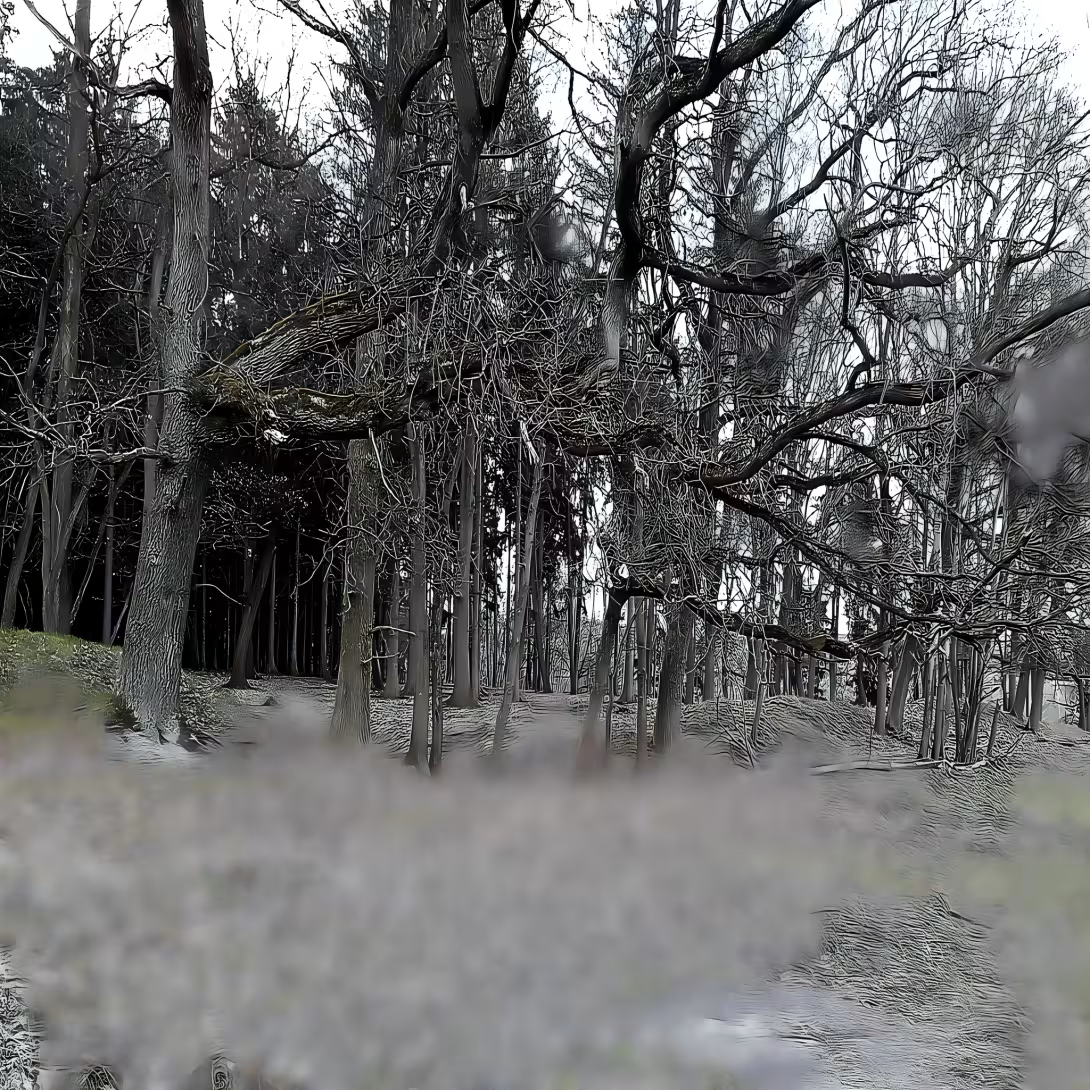
The Celtic Viereckschanze near Mšecký Žehrovic is an archaeological discovery, which represents the remnants of the walls from the time of Latin culture. This location is located in the district of Rakovice and has the status of a protected cultural monument. Archaeological excavations revealed key information about Celtic settlements in this area.
The creation of the viereckschanz can be dated to the last centuries before Christ, when the surrounding landscape was inhabited by Celts. This period is linked to the Latin culture that has spread throughout Central and Western Europe. Archaeological studies have shown that the site has not been permanently populated, which is confirmed by findings such as a bone-bone playing cube and ceramic fragments.
Architecturally, the viereckschanze manifests itself in the shape of an irregular rectangle made of clay and small gravel. The locality is trapezoidal with dimensions 116 × 162 metres and a width of 89 metres, surrounded by a moat. During excavations, a quadrilateral wall was discovered with a embankment that is still preserved to this day. Inside the area were found the foundations of a large building and deep cottages, whose origin dates back to the second or first century BC. One of these cottages found the remains of the iron furnace.
The key event in the history of Viereckschanz is the random discovery of the Celtic Druid's optic head in 1943, which became the world famous artifact of the National Museum in Prague. Other significant archaeological surveys took place in 1979- 1988 under the leadership of Natali Venclová, which revealed other structures and trenches.
Today viereckschanze is part of the protected field of Libeň and the natural reserve of Louka in the field of Libeň. The location is not freely accessible, but from the red marked tourist route is visible at least in part. Its historical importance associated with Celtic culture and archaeological findings makes Viereckschanze an interesting destination for lovers of history and archaeology.
The Celtic Viereckschanze near Mšecký Žehrovic is a testament to the rich history of the region, which bears traces of Celtic settlement. Visiting this archaeological site offers a unique view of the past and contributes to a better understanding of the cultural heritage of the area.
Historical milestones
- around the 1st century bc.
- The creation of Celtic Viereckschanz during the period of Latin culture.
- 2nd or 1st century bc.
- Establishing the foundations of a large building and a deep chat inside the viereckschanze.
- 1943
- Random discovery of Celtic Druid's opus head, becoming a world-famous artifact.
- 1979- 1988
- Archaeological surveys led by Natali Vencl revealed other structures and trenches.
Architectural development
The preserved walls were built from clay and small gravel. A large building, deep cottages and iron furnace were discovered in the location.
Historical events
- 1943
- Random discovery of Celtic Druid's opus head.
- 1979- 1988
- Archaeological research led by Natali Venclová, which revealed a quadrilateral wall and other structures.
Points of interest
- Celtic viereckschanze in Mšecký Žehrovic represents the remnants of the fence from the period of Latin culture. Archaeological excavations revealed key information about Celtic settlements in this area. - In 1943 the opus head of the Celtic Druid was randomly discovered, which became the world famous artifact of the National Museum in Prague. - Archaeological surveys under Natal Vencl took place in 1979- 1988 and revealed other structures and trenches. - Viereckschanze is part of the protected field of Libeň and the natural reserve of Louka in the field of Libeň.
Guide
Show guide text
This text was created by artificial intelligence and has not been editorially reviewed. It may contain inaccuracies.
Welcome to the place where time has stopped and where the earth under your footsteps touches ancient history. You are standing in front of one of the most important archaeological sites in our region, in a place called Mšecký Zahrovice. Perhaps all you see around you now is the quiet landscape of the Rakovnik district, the green fields and the silence that only breaks the wind. But if you stop and begin to perceive the atmosphere of this place, you will realize that here, beneath the layers of the earth, there are traces of human life that formed their community here more than 2,000 years ago. This space is not just an ordinary field, it is a place that once formed the center of life, a safe haven and a home for people who knew the rhythm of nature much deeper than we do today.
Let's go back together to a time when this county looked quite different. Imagine the period around the first century before our present marking. At that time, there was Latin culture, a fascinating society of Celtic people who were masters in crafts, trade and building solid settlements. What you see now is a remnant of their double, square castle space, which we professionally call viereckschanze. This name sounds foreign, but basically it means a simple and brilliant solution: a reflected square-shaped space that served as the basis for their housing and protection. The Celtic settlement in this area was not random. These people chose places that offered them not only safety, but also connections with the surrounding landscape, which they were able to make great use of.
Now pay attention to what happened here in the very heart of this settlement. Even though you don't see tall walls or wooden gates today, which were obviously part of the defense system at the time, archaeological surveys allowed us to see through the earth. If you look at the structure of the terrain, you can perceive clues that once formed solid boundaries. In the period between the second and the first century before our current marking, basic structures began to be built here. Imagine a large building that probably served as the center of the castle, perhaps a meeting place or a place where the gods worshipped each other. And around it were placed smaller, into the land of the cottages. These cottages, which we call deep buildings, were a very practical solution. Thanks to the fact that their floor was in the ground, they kept warm in cold days and pleasant cold in hot days. It was homes where they cooked, slept, and told stories by the fire.
In this history, however, there is one name and one object that has made this place unique. It's a story that happened much more recently, in the year one thousand nine hundred forty-three. Something unexpected happened here. In a random discovery, an incredible thing happened in the ground - a stone head. But it wasn't any head. It was the carved face of a Celtic druid, a spiritual leader and a scholar, made of a fine, brighter stone called optheka. This artifact was not just an ordinary find, it became a symbol of this entire era and its beauty and mystery immediately captured researchers around the world. Imagine the moment when someone in the earth finds the face of a man who lived here a thousand years ago, a face that looks at you through the dust of centuries. The head reminds us that Celtic society was not only about survival, but about deep spiritual life and artistic expression.
However, in order to speak with such certainty about these matters, we must thank the people who have dealt with this place with patience and great passion. These include, above all, an expert who, in the years between a thousand and nine hundred seventy-nine and a thousand and nine hundred eighty-eight, conducted extensive archaeological surveys. It is thanks to her work and her leadership that we are now able to understand how the trenches were deployed here, how the structures of the chatrooms looked and how exactly this settlement was organised. Without these excavations, this place would only remain a vague legend, but science is a living history for us to study and admire today.
Now, I want to invite you to think a little bit about a mystery that still surrounds this place. While we know about the existence of large buildings and chat rooms, there are still many questions that remain unanswered. Why did they choose this place? What kind of ceremonies took place here in those sunken cottages? And what else is under your feet? Every inch of this country can hide other fragments of ceramics, tools or traces of lit fire. There's something magical about it that even though people are long gone, their presence is still so strong. That druid head we mentioned is just the tip of the iceberg in the sea of information this place offers us.
Let me now leave you in peace so that you can explore this space for yourselves. Take a walk around the area, feel the silence and try to imagine those Celtic people moving around among their huts, building their fences and praying to the forces of nature. Let yourself be driven by imagination and look at this landscape not through the eyes of today's visitor, but through the eyes of a man from the time of Latin culture. Thank you for coming to see this precious memory, and we hope that this short journey to the past has enriched you. We will brighten up a pleasant continuation in discovering the secrets of our world. Goodbye.
Tips for visitors
The best time to visit the Celtic Viereckschanze in Mšecký Žehrovic is in the summer months when vegetation is best visible and the light of the sunny day allows a beautiful photo. This location offers a peaceful experience in nature with the opportunity to explore historical remains.
Access to the monument can be facilitated by using public transport or car. The location is located near the road with a red marked tourist route, which allows easy access for cyclists and pedestrians. We recommend checking the current connection in the search engine.
When visiting, it is recommended to take with you protective clothing, shoes suitable for walking on stale roads and warm coat if necessary. Additional equipment such as sunglasses or parasol may be useful, especially in the summer months.
For photography is the ideal time of the afternoon when light falls on remains from the period of Latin culture.
This location offers a wide range of biotopes and is suitable for families with children who can enjoy walking along the route or observing nature.
Frequently asked questions
Can the monument be visited?
This is an archaeological site. Often there is little to see on the ground and the land may be private. We have not verified access.
Why is the monument protected?
It is listed in the Central List of Cultural Monuments of the Czech Republic as a cultural monument (register no. 1000125254).
Businesses nearby
Do you run a restaurant, accommodation, shop, museum, rental, wellness or other visitor service near this monument? Show yourself directly to the people heading to it — this is how they will see you in the app and on the web:
Nearby
Lokalita je součástí ohrazené obory Libeň a přírodní rezervace Louky v oboře Libeň. V těsné blízkosti vede cesta s červeně značenou turistickou trasou.
Accommodation nearby
Themed route
Thematic cruise route around Celtic viereckschanze near Mšecký Žehrovice
1. Celtic viereckschanza near Mšecký Žehrovic
Type: Archaeological site
Why is it worth a visit: This historic site offers a unique view of Celtic civilization. It's a place where you can explore ancient defense structures and get knowledge of Celtic life and technology.
2. Replaced Area Libeň
Type: Historical park
Why is it worth a visit: The covered area is a beautiful natural and historical location where you can walk between ancient trees and enjoy a quiet moment in idyllic surroundings. It is an ideal place to relax after visiting an archaeological site.
3. Natural Reservation of Meadows in the Liberian sector
Type: Natural Reservations
Why is worth visiting: This reservation is home to rich flora and fauna, which makes it an ideal place for nature lovers. By exploring meadows and forests, you can see different kinds of birds and plants.
4. Red marked tourist route
Type: Tourist route
Why is worth a visit: This route leads through picturesque landscapes and offers beautiful views of the surrounding area. It is the perfect way to explore the region around the Celtic Viereckschanz with minimal effort.
5. Interactive exposure in Celtic Viereckschanza
Type: Educational equipment
Why is worth visiting: Exposure provides a detailed view of the history and meaning of Celtic Viereckschanza. Interactive elements allow a deeper understanding of this fascinating location.
This route offers a combination of historical, natural and educational experiences that are ideal for the whole family.
Seasonal recommendations
In the spring, the surroundings awaken to life and young grass helps to better perceive the relief of the terrain. The air is fresh and the atmosphere is full of hope. I recommend moisture-resistant shoes because the fields can be muddy. The best time is in the morning, when the sun gently illuminates the remnants of ancient valleys.
The summer season brings high grass and heat from the fields, giving the place a wild character. The light is sharp and the colors of the surrounding landscape are rich. It is advisable to choose light clothes and not forget the protection from the sun. I recommend a visit in late afternoon, when the temperature is more tolerable.
In autumn, the landscape is painted in gold and brown tones, and morning fog creates a mysterious mood. The lower sun makes the shadows deeper, which better highlights the remains of the Celtic building. It is practical to dress in more layers and set off in clear weather when visibility is best.
In winter there is silence and the landscape is free of leaves, so the outline of the monument is more clearly visible. Freezing air and any layer of snow give the place a raw and peaceful feeling. It is necessary to have warm clothes and fixed shoes. Due to the short days, it is ideal to plan the journey in the morning.
Visualizations and artistic views

The visualisations are generated by artificial intelligence and serve as inspiration.
Photos from the area
Real photos taken near the monument


Zdroj a licence jsou uvedeny u každého snímku.
Tips from visitors
No tips yet. Be the first!
Log in and add your tip.
Sources and literature
Photos: Vojtěch Dostál / CC BY-SA 4.0, rozlišení zvýšeno umělou inteligencí — Wikimedia Commons. The author and licence also appear when you hover over the image.
Faktickým podkladem tohoto textu byl článek na Wikipedii, jehož autory jsou přispěvatelé Wikipedie. Článek je dostupný pod licencí CC BY-SA 4.0.
Location on the map





Příběhy a pověsti
Legendy, pověsti a příběhy spjaté s touto památkou
Fotografie návštěvníků
Zatím žádné fotografie. Buďte první, kdo přidá fotografii z návštěvy!
Log in a přidejte svou fotografii nebo hodnoťte.
Za ověřenou návštěvu v aplikaci získáte víc bodů — poznáme podle GPS, že jste na místě.
Reviews and comments