



Kolej jezuitů v Chomutově Monastery
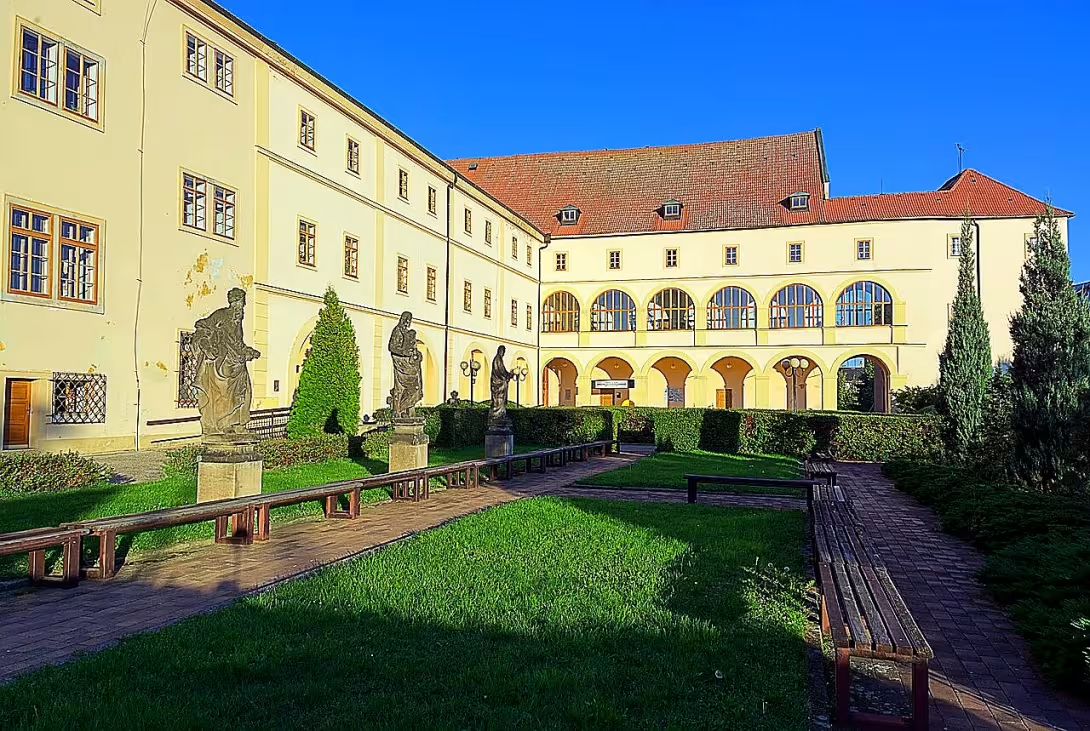
The Jesuit college of St. Ignatius is a historical monument in Chomutov. It was founded at the end of the 16th century as a key centre of Catholic missionary activity in Podkrošnohoří. The object is remarkable not only by its architecture, but also by its rich history, which reflects confessional tensions and cultural changes of the time. The institution served for education and religious activities until 1773 when the Jesuit Order was abolished.
The formation of the track was initiated by Jiří Popel z Lobkovic. In 1588 he exchanged the manor Chomutov and decided to introduce Jesuits into the city. The aim was to reclaim the Podkrushoří for the Catholic Church, which was linked to the wider anti-reform efforts of the Habsburgs in the Czech Republic. The first Jesuit sermon took place on 14 February 1589. Subsequently, the church was taken from the Protestants and transferred for Catholic services. The establishment of the track as a mission centre was approved by the general of the Jesuits Claudio Aquaviva. The construction of the complex began on July 29, 1590. For the following year, the foundation stone of the building was laid, which was to include ten classes, auditorium, ceremonial hall of the gymnasium, hostel and seminar.
The architecture of the track was characteristic of the Renaissance style. However, due to the fire in 1598, the construction remained unfinished. After the incident, the building had to be built almost completely from the ground up. In 1663 a new foundation stone was laid and construction was completed until 1671. This included the consecration of the Baroque church of St. Ignatius, whose builder was Carlo Lurago.
The Jesuit Order covered the ownership and management of the track from 1590 until its abolition in 1773. During its existence, the institution faced several dramatic events, including the strong resistance of local Protestants. This resulted in mutiny and escape of Jesuits from the city. After the 30-year war, the track was rebuilt and its activities spread to the wider surroundings.
Among the key events were the uprisings mentioned, and the city's devastating fire from 1598. Despite these difficulties, the college became one of the most important Jesuit institutions in the lithomeric diocese with a high level of education. The Jesuit school has greatly influenced the reCatholisation of the region and is famous for its theatre games.
Today, the Jesuit college of St. Ignatius in Chomutov is protected as a cultural monument. Its history represents a fascinating chapter of Czech confessional and cultural history. Visit this place and learn more about its significant contribution to the history of the region.
Then and now
Drag the slider to compare how the landmark may have looked when it was built with the view today.
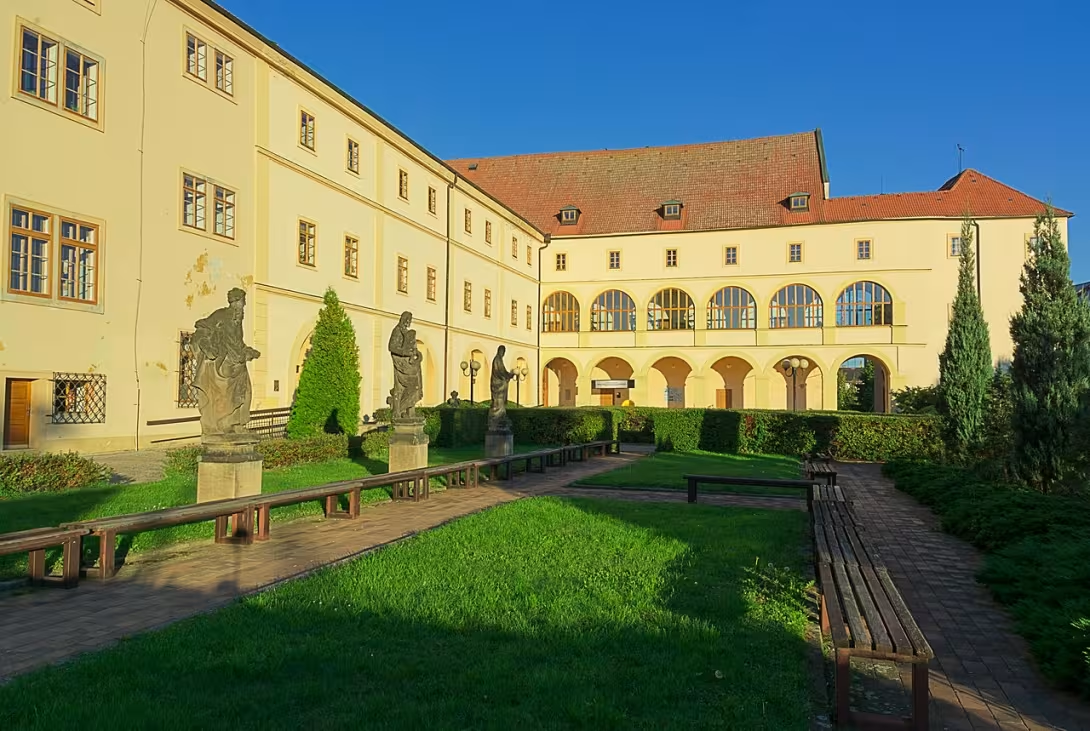

The historical appearance on the left is an AI-generated visualisation and serves as inspiration only.
Historical milestones
- 1589
- The first Jesuit sermon in Protestant Chomutov
- 1590
- Loading of the track base stone
- 1591
- Appointment of Martin Basta by the first rector
- 1773
- Termination of track activity by abolishing Jesuit rules
Architectural development
The construction started in 1590 by laying the base stone. In 1598, the building was badly damaged by the city fire and had to be built almost completely from the ground up. The complex was to include ten classes, auditorium, festive hall of gymnasium, hostel and seminar.
Historical events
1591 (protestant uprisings and escape of jesuits), 1598 (city fire and construction damage), 1618 (expulsion of jesuits from the country), 1773 (cancellation of order and cessation of activity)
Owners
Jiří Popel z Lobkovic (founder), Jesuit Order (1590-1773)
Points of interest
- Established at the end of the 16th century as a center of Catholic missionary activity in Podkrošnohoří. The first Jesuit sermon took place on 14 February 1589. - Because of the fire in 1598, the building had to be built almost completely from scratch. The Baroque Church of St. Ignatius was built by Carlo Lurago. - The institution was famous for its theatre games and was an important centre of education.
Guide
Show guide text
This text was created by artificial intelligence and has not been editorially reviewed. It may contain inaccuracies.
Welcome to Chomutov. You are standing in front of just one of the most important historical places in this city, bearing traces of centuries of struggle, faith and education. Before your eyes is a building that has been the heart of spiritual and intellectual life for decades. Do you feel the weight of history that radiates from these walls? This Jesuit college is not just a set of buildings, it is a silent witness to the great changes, religious disputes, and ups and downs that shaped our country.
Let's go back together to when everything started here. Imagine the end of the sixteenth century, an era where the maps of Europe were rewritten every day and when faith was the main pillar of human existence. It was during this period, at a time of great turnovers, that it decided to lay the foundations for something that would change the face of the entire Underworld. The main mover of this whole plan was the nobleman Jiří Popel z Lobkovic. He was a man of great ambition who had a clear goal: to regain this region for the Catholic Church. His vision was not just to build buildings, but to create a powerful centre that could influence people's minds through education and sermon.
However, this intention was not easy. Chomutov was very Protestant at the time, and the arrival of Jesuits caused considerable resistance to the local population. Imagine the tension in the streets of the city. The first real impact of these two worlds came on the 14th of February in the year fifteen hundred and eighty-nine, when the first Jesuit sermon took place here. It was like bringing a new element into a stable environment. A year later, in the year fifteen hundred ninety, the foundation stone of this building was actually laid, making an ambitious plan a tangible reality.
Now pay attention to the architecture you are currently observing. Even though the buildings seem solid and permanent, their history was very stormy. Do you know that what you see is the result of a huge recovery effort? In the year fifteen hundred ninety-eight this dorm was hit by a devastating disaster - a great fire that almost completely destroyed the original buildings. Everything had to be rebuilt, almost from the very foundation. Take a look at the Baroque Church of St. Ignatius. This important sacral complex, which dominates the surroundings, was designed by the famous builder Carlo Lurago. It was his work that gave the whole place the noble and dignified look you now feel. When looking at the facade and the overall structure of the complex, remember how the Baroque style could express the strength and dignity of the religious order.
But this college wasn't just about prayer and rituals. It was mainly an institution for education. Imagine those halls full of students and scholars. There was a high school, seminar and hostel that served as a home for many people seeking knowledge. It was a center of intellectual activity. The first rector to control this school and its life became Martin Bast. He and other prominent personalities, such as Claudio Aquaviva, helped build the prestige of this place. In these areas, the minds of future spiritual and scholars were formed, which subsequently influenced society. In connection with this place, the name of Emperor Rudolf himself appears in history, which only confirms how important this place was for the entire power and spiritual structure at the time.
But there is also a shadow side and the end of a great era. Even so strong an institution must one day give way to time. In fifteen hundred seventy-three came a fundamental change that ended everything. The Jesuit Order has been abolished, and with it the long-term activity of this college. A place that was once full of study, debate and religious enthusiasm became part of another history.
The interesting thing that may make you think deeper is the constant transformation. From the first sermon in freezing February, to the devastating fire, to the complete abolition of the order, this building has never been static. It's a living organism that had to constantly adapt to the outside world, which was often hostile. How many people have walked these halls? How many questions about the meaning of life have been addressed here in quiet classrooms?
We hope that this brief view of the past helped you better understand the face of today's Chomutov and gave you a sense of connection with the people who lived here before you. Continue to walk now and discover the next secret of this city. Every alley and every stone here has a story waiting to be revealed. Thank you for spending this moment with us. Goodbye.
Tips for visitors
The best time to visit is early morning during spring or autumn, when light is less soft and tourism; in these times you can easily admire the colours of the historical facade and the blooming gardens. What to take with you: comfortable shoes for walking on stone paths, umbrella or raincoat for unpredictable weather and water; If you are planning a longer stay, take a light snack pack. Photography: the best light is during the golden hour - shortly after sunrise or before sunset - when long shadows and colours are formed on the stone walls; We recommend shooting from the outer courtyard and from the tower height, where there is a view of the historic roofs of the city.
Frequently asked questions
Can the monument be visited?
Religious buildings are usually open mainly during services; at other times a visit is normally arranged with the parish or the operator. We have not verified specific times.
Where is the monument?
Location: Chomutov. The map on this page shows the exact spot.
Why is the monument protected?
It is listed in the Central List of Cultural Monuments of the Czech Republic as a cultural monument (register no. 1000159422).
Businesses nearby
Do you run a restaurant, accommodation, shop, museum, rental, wellness or other visitor service near this monument? Show yourself directly to the people heading to it — this is how they will see you in the app and on the web:
Nearby
🏰 Historic sites (57)
- sv. Josef 0.1 km
- sv. Anna 0.1 km
- sv. Jáchym 0.1 km
- Oblastní muzeum v Chomutově 0.1 km
- Trojičný sloup 0.1 km
- sv. Josef 0.1 km
- sv. Jan Nepomucký 0.2 km
- Zámek Chomutov 0.2 km
- sv. Jan Nepomucký 0.2 km
- sv. Hubert 0.2 km
- sv. Jan Evangelista 0.2 km
- sv. Kateřina 0.3 km
- sv. Vít 0.3 km
- sv. Barbora 2.0 km
- Nejsvětější Trojice 2.0 km
- sv. Jan Nepomucký 2.0 km
- Železniční depozitář Národního technického muzea v Chomutově 2.0 km
- Železniční depozitář Národního technického muzea v Chomutově 2.1 km web
- Skanzen Stará Ves 2.3 km
- Bergrutsch 3.9 km
🍽️ Restaurants and dining (80)
- GEST 0.1 km web
- Pepe Lopez 0.1 km
- U Dvou medvídků 0.1 km Revoluční 32/8
- U Dvou Rytířů 0.2 km +420 777 194 668 web
- Amerika Bar 0.2 km Revoluční 45/7 web
- Hradčany 0.2 km
- Corado steak restaurant 0.3 km Klostermannova 148 web
- Lagarto Café Galerie Pošta 0.4 km Palackého 5625
- Lagarto Café 0.4 km Farského 4732 +420 774 169 629 web
- Republika 0.4 km 28. října 1078/17 web
- Mexicana 0.5 km Mostecká 5894
- Na rozcestí 0.6 km
- Sklípek 0.6 km web
- Kulisárna 0.6 km Boženy Němcové 552/32 +420 722 122 122 web
- Srdcovka Monika 0.7 km
- Čekárna 0.8 km
- Tykev 0.8 km
- Stop Cafe 1.0 km
- Tropico bar 1.1 km
- Jídelna Roosveltova 1.1 km
🏨 Accommodation (30)
- Royal 0.1 km
- Beethoven 0.3 km Beethovenova 1146
- Hotel & Restaurant Mertin 0.5 km +420 736 144 711 web
- Clochard 0.8 km Blatenská 1099/48 web
- Penzion Sport 0.9 km
- Chicago 1.1 km
- Kamencové jezero 1.1 km
- Hotel Arena 1.2 km web
- Český dům 1.6 km Lipská 2097/44
- Hotel Kamenný vrch 3.0 km
- Partyzán 3.1 km (+420) 474 341 229;(+420) 602 285 568 web
- Chalupa Domina 5.5 km
- Tábořiště Druhý mlýn 7.1 km
- Penzion Blatno 7.1 km
- Penzion a restaurant Mezihoří 9.4 km
- Horský hotel Svahová 10.2 km
- U svatého Václava 10.9 km web
- Pytloun Wellness Hotel Hasištejn 11.6 km Místo 110 web
- Autokemp U Jakuba 11.7 km
- Autokemp Prunéřov 11.7 km
🚲 Rentals and sport (19)
- Pump track 1.0 km
- Areál Nový Chomutov 1.1 km
- Squash Fitness Chomutov 1.6 km Cihlářská 5478 +420 474 625 475 web
- Sportovní hala Březenecká 2.0 km Březenecká 4704
- Softball Chomutov 2.0 km
- Sportovní hala 2.8 km
- Sportisimo 3.1 km
- CYKLO POINT 3.1 km
- A3 SPORT 3.2 km
- Martes Sport 3.2 km
- Sportovní areál 3.5 km
- Motokros 4.7 km
- Elektrokola - CHULIT 4.7 km
- Koupaliště 8.2 km
- Sport centrum Labyrint 13.3 km
- Skatepark 13.4 km
- Střelnice 13.9 km
- Zajícův převis 14.3 km web
- Autodrom Most 14.5 km
🥾 Hiking and nature (79)
- Parčík s fontánkou 0.2 km
- náměstí T. G. Masaryka 0.4 km
- Městský park Chomutov 0.6 km
- náměstí Dr. Beneše 0.6 km
- jelen milu 1.4 km
- Letní areál Banda 1.6 km
- Kaštanový sad 1.9 km
- Sportovní areál Domovinka 2.1 km web
- železitá voda 3.6 km
- důl Nástup 3.9 km
- Olejomlýnského Parku 4.3 km
- Výhled na trať a Chomutov 4.3 km
- Telšská skála 4.6 km
- Svojsíkovy sady 4.6 km
- Morový sloup s Pietou 4.8 km
- Kludského vila 4.8 km
- Městské sklepy 4.8 km
- Smetanovy sady 5.0 km
- Hradiště u Černovic 5.4 km
- Karlova Výšina 5.8 km
Accommodation nearby
Themed route
Railway terminal, outer space: The entrance area, which gives the first impression of the architecture of the whole complex.
Church of St. John Nepomuk, sacral building: Dominanta area with rich interior equipment and spiritual atmosphere.
Interiors and exhibitions, indoor spaces: A tour of historical rooms and exhibitions focused on order history.
Monastic garden, park: Space for peace and rest in the immediate surroundings of the buildings.
Seasonal recommendations
In spring, life wakes up around historical walls. The trees start to green and the sun shines more gently, creating a pleasant atmosphere for walks. I recommend you take several layers of clothing because the wounds are still cold. The best time to visit is in the morning when the light is fresh and nature most alive.
In the summer months it is very sunny here and the days are long. Stone buildings can absorb heat, so it can be hot around the monument at noon. It is good to wear light and breathable substances and not forget the protection from the sun. It is ideal to come late in the afternoon when temperatures are decreasing and shadows are longer and more interesting.
Autumn brings golden and brown colors to the surroundings, which perfectly match the old architecture. The morning mist gives the place a mysterious and melancholy touch. Prepare stronger shoes because the road can be wet and slippery. The best place to visit is around noon, when the light is sufficient to observe the details.
Zimą makes the place very quiet and even worse, especially when everything is covered with frost or snow. The sun is low in the sky and creates long, sharp shadows on the facades. It is necessary to dress thoroughly in warmer layers, including gloves and caps. I recommend a visit on clear days when daylight is longest.
Visualizations and artistic views


The visualisations are generated by artificial intelligence and serve as inspiration.
Photos from the area
Real photos taken near the monument


Zdroj a licence jsou uvedeny u každého snímku.
Tips from visitors
No tips yet. Be the first!
Log in and add your tip.
Sources and literature
Photos: Pavel Kinšt / CC BY-SA 3.0 — Wikimedia Commons. The author and licence also appear when you hover over the image.
Faktickým podkladem tohoto textu byl článek na Wikipedii, jehož autory jsou přispěvatelé Wikipedie. Článek je dostupný pod licencí CC BY-SA 4.0.
Location on the map


Příběhy a pověsti
Legendy, pověsti a příběhy spjaté s touto památkou
Fotografie návštěvníků
Zatím žádné fotografie. Buďte první, kdo přidá fotografii z návštěvy!
Log in a přidejte svou fotografii nebo hodnoťte.
Za ověřenou návštěvu v aplikaci získáte víc bodů — poznáme podle GPS, že jste na místě.
Reviews and comments