



Kostel Nalezení svatého Kříže Church
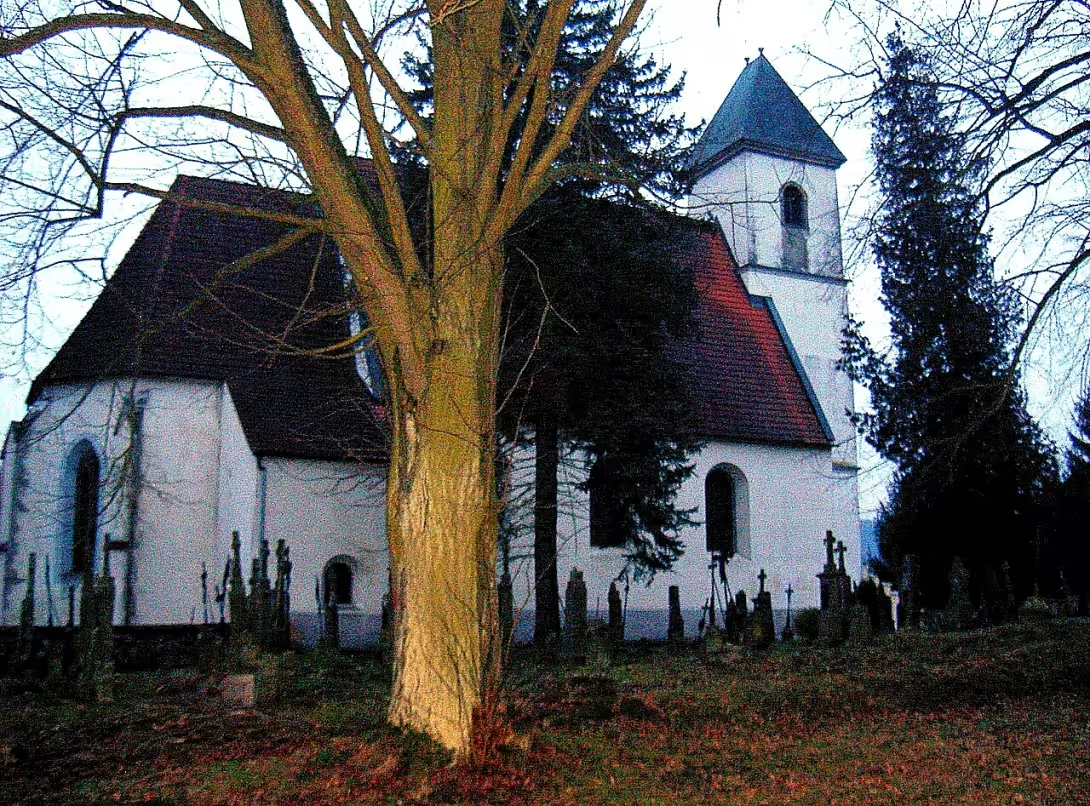
Kostel Nalezení svatého Kříže in the village Újezd Svatého Kříže is a Gothic sacral building. Its original core and sacristy dates back to the second half of the 14th century. The building is characterized by alternating architectural styles from medieval Gothic to Baroque to 19th century modifications.
The oldest parts, the core of the church and the adjacent sacristy, were formed between the 1950s and 1980s.
The construction is made of broken stone. The rough sandstone was used for more complex architectural elements and strengthening corners. The priestess has a five-sided ending and relies on five pillars, one of which is now integrated into the wall of the storey oratory on the south side. Both the priestess and the northern sacristy cover the Gothic rib arch, with many Gothic elements being completed in the 19th century.
The present appearance of the church is the result of successive modifications. During the Baroque period, the building was extended to a hall with tiered shield and a storey orator with circular windows on the south side. Some gothic windows of the ship have been blinded - for example, a southern window with a circle from the last quarter of the 14th century - another one has been extended and sealed in half-circle.
The essential benefit for the appearance of the building was the completion of a four-storey tower in 1818. The fire in 1859 followed the historic modifications and the interior was equipped with a pseudo-gothic mobility. Interesting details include the remnants of the original painted illusory quacking in the shell of the ship's windows, near the windows of the priestry and on the southwest and northwest corners.
A short gravel road leads to the church from the main road. The building represents a collection of building influences from several centuries. It is a suitable destination for visitors looking for details of original Gothic architecture in combination with later reconstructions.
Historical milestones
- 1350-1380
- The creation of the original core of church and sacristy
- 17.-18th century
- Baroque extension with hall and floor orator
- 1818
- Completion of four-story tower
- 1859
- Fire and subsequent historical modifications
Architectural development
The building of broken stone and sandstone was extended in the Baroque time by the hall and the oratory. A reconstruction was carried out after the fire in the 19th century, during which historical modifications were carried out and the tower was completed.
Historical events
In 1818, a four-story church tower was completed. In 1859 there was a church fire followed by historical modifications.
Points of interest
- Kostel Nalezení svatého Kříže has its original core and sacristy from the second half of the 14th century.
- The oldest parts of the church, the core and sacristy, were formed between the 1950s and the 1400s.
- The priestess has a five-sided ending and relies on five pillars, one of which is integrated into the wall of a bunk oratory on the south side.
- The church was extended during the Baroque period by a hall with tiered shield and a storey oratory with circular windows on the south side.
- The four-story tower was completed in 1818, which contributed to the current appearance of the building.
Guide
Show guide text
This text was created by artificial intelligence and has not been editorially reviewed. It may contain inaccuracies.
Welcome to the village Újezd Svatého Kříže. You're standing in front of one of the most important building units in this place, in front of the Church of the Holy Cross. Before you take the next step and start looking more closely at his facade, stop for a moment. Feel the atmosphere of this place and the strange weight of history that floats here in every stone. In front of your eyes is a sacral structure that is not just a simple builder, but a living witness for many centuries. Looking at its present form, you can see how different epochs intertwine in it, how different views of beauty collide in it and how it combines what is old with what was added much later.
To understand what you're seeing right now, we need to go back deep into the past together. The story of this church didn't start a few decades ago, but it goes back to the deep Middle Ages. His true beginnings, his very heart, go back to the second half of the 14th century. Between 1350 and 1380, what we can call the original core of the building along with the sacristy. At the time of the spread of goth across the European continent, the basic stone skeleton was laid here, which provides the building with its undisputed strength and original character. It's fascinating to think that the parts you see today were made up of people who lived in a completely different world, but their work here still lasts.
But now take a closer look at the overall structure and remember that the church before you is the result of constant movement and transformation. This building was never completed at one time, but it was constantly modified, expanded and repaired to meet the needs of faith and the changing taste of the people. In the seventeenth and eighteenth centuries, significant elements of the Baroque were brought into the face of the church. At that time the construction was extended to a hall and a storey oratory, which gave a whole new dimension and transformed its internal and external perception. These adjustments brought new dynamics to the church and extended the space for believers.
If you now raise your eyes towards the sky, you will encounter a dominant element of the entire area. It's a tower that was completed in 1818. Its four floors represent a certain level of technical progress at the time and provide the church with vertical dynamics that it probably did not have in its original, medieval form. This tower serves as an orientation point that was completed at a time when the world was beginning to change, but tradition still held its solid ground.
But the history of this place was not only about gradual improvement, but also about overcoming difficult moments. In 1859, the church found itself on fire. The fire was a fundamental test for this sacral structure and subsequent repairs led to the elements of historism being introduced into the architecture. It is thanks to this connection - the original Gothic, baroque extensions, niteteenth towers and historic modifications after the fire - that today's church appearance is so rich and complex. It's like there are several different stories in one building at the same time.
When looking at the construction itself, pay attention to details that reveal the technical skill of ancient masters. If you could look at the priesthood itself, notice its extraordinary conclusion. It's not a simple, simple shape, but a five-sided ending that requires precise work with space. This construction is based on five pillars which ensure stability of the whole place. However, one of these pillars is truly exceptional and deserves your attention. It is directly integrated into the wall of a storey oratory. It is a fascinating example of how architects had to work with limited space and how new elements, such as the Baroque oratory, had to be organically linked to older, bearing structures.
Although the names of particular architects and the names of significant personalities associated with this place are not lost in the historical records, their presence is perceived through the stones and shapes themselves. We don't know the names of the men who worked the first sacristy stones in the second half of the fourteenth century, nor the names of those who designed the baroque hall in the eighteenth century. Yet their work speaks for them. Every modification, every new pillar or floor of the tower is proof of their efforts to serve this place to the community in the Holy Cross for many generations. They're anonymous masters whose names may have fallen into the dust of time, but their visual reference here today is absolutely tangible to you.
But what can really interest you and leave you in wonder is the invisible continuity. It's a strange mystery how the original medieval core still hides beneath the layers of baroque ornaments and historic repairs. It's like the surface you see is still beating the heart from 1350. This layery is what makes this church more than just a building; It's a chronicle of time written in stone and space.
Now, from the invitation to observe again, we will not defend you. Look at the church from different angles, see how light changes on its walls and how individual epochs intersect in its silhouette. Feel every line, every pillar and every floor of the tower that stands here as evidence of human endurance and effort to connect with the immortal. Thank you for spending this moment with the history of the Holy Cross Church. We wish you a pleasant and inspiring next trip.
Tips for visitors
The best time to visit is early morning or late afternoon hour, where soft light hits the facade and highlights the details of the building from the 14th century.
With us we recommend to take comfortable shoes suitable for rural terrain and photographic machine for capturing unique sacristy.
For the best images, focus your lens on the original core of the church, which retains the atmosphere of the Middle Ages.
Families with children appreciate the peaceful environment of the village, which is ideal for a short walk and familiarization with the history of sacral architecture.
Frequently asked questions
Can the monument be visited?
Religious buildings are usually open mainly during services; at other times a visit is normally arranged with the parish or the operator. We have not verified specific times.
Where is the monument?
Location: Újezd Svatého Kříže, Plzeňský kraj. The map on this page shows the exact spot.
Why is the monument protected?
It is listed in the Central List of Cultural Monuments of the Czech Republic as a cultural monument (register no. 1000153263).
Businesses nearby
Do you run a restaurant, accommodation, shop, museum, rental, wellness or other visitor service near this monument? Show yourself directly to the people heading to it — this is how they will see you in the app and on the web:
Nearby
🏰 Historic sites (55)
- Castle Houston 2.5 km
- Castle White over Radbuzou 2.8 km
- Pink 4.0 km
- Jewish cemetery Mutín 4.0 km
- Fortress Mělnice 5.5 km
- Mohyl burial ground 5.8 km
- Mohyl burial ground 6.3 km
- Broken Church of the Virgin Marie 6.3 km web
- Former Vidice 6.8 km
- Residues of the fortress Vidice 7.5 km
- Ruins Certová mlna 8.1 km
- Throne militi 8.3 km
- Memorial Liberation Czechoslovakia 8.4 km
- sv Jan Nepomucký 8.4 km
- Monument 8.4 km
- Poseidon 8.4 km
- Decrease Krommelmühle 9.1 km
- Zaniklá village Saint Apolena 9.2 km
- ruin St. Nicholas Church 9.2 km
- Monument of Jan from Šitboří 9.2 km
🍽️ Restaurants and dining (27)
- Honey confectionery 2.6 km
- Club P 2.6 km
- Radbuza 2.7 km
- Dining room - restaurant "Wooden" 6.3 km
- Pezion Pohoda 6.5 km
- Restaurant and guesthouse Šidlákov 6.5 km
- Penzion-Chaty-Sycherak 6.5 km
- Vital Park Drahotin 6.7 km
- Restaurant Hubertus 8.3 km
- Vinotéka 8.5 km
- Rybnik 8.6 km + 420 379 496 124 web
- Ronsvalik 8.6 km Žižkova 220
- Guesthouse on Pleši 10.4 km + 420 602 432 178 web
- Hvozd 11.5 km
- Praha 11.9 km
- Stop Caffe 12.1 km web
- Blue laguna 12.1 km
- Grenzwirtshaus Gerstmeier 12.1 km + 49 9674 1268
- Gaststätte Zur Tillyschanz 12.7 km + 49 9653 356
- Hossovka u Bures 13.0 km
🏨 Accommodation (24)
- Chata Fox Hora 4.7 km
- Pension Old mill 5.5 km web
- Sycherák 6.1 km
- Recreacni stredsko Sycherak 6.5 km + 420 737 961 100 web
- Tábor Beelnice 7.9 km web
- Stellplatz Certová mln 8.0 km web
- Hotel Hubertus 8.3 km
- Rybnik 8.6 km + 420 379 496 124 web
- Accommodation Pokovovice - Tomáš Hrda 8.6 km Žžkova 217 + 420 723 692 785 web
- Na Pastvinás 9.1 km + 420 777 111 801 web
- U Vidic 9.2 km
- Pension Pleš 10.4 km + 420 602 432 178 web
- Resort Czech Les 11.4 km Iron 37 + 420 606 649 293 web
- Hotel Hrmda 11.9 km
- RS Primda 12.3 km North 284 web
- Mountain hotel 12.4 km
- Stellplatz Badeweier 12.8 km
- Rustica 13.0 km
- Landhaus Pension Sperl 13.7 km Dietersdorfer Hauptstraße 70
- Delta Understands auto camp 14.0 km
🚲 Rentals and sport (4)
- Pool Primda 12.1 km web
- Gotchaspielfeld Süd 13.5 km web
- Gym - TJ Sokol Poshokov 13.7 km
- Koupaliště Podlají 13.9 km
🥾 Hiking and nature (147)
- Chateau top 1.6 km
- Black Hora 2.7 km
- Mutezín lom 3.1 km
- Study 3.2 km
- Bystřské výstřích 3.9 km
- Smol Top 4.0 km
- U Cross 4.6 km
- Height 5.0 km
- Srnnící výství 5.6 km
- Slatino high 5.9 km
- Birds 6.1 km
- Mošna 6.3 km
- Above the pond 6.4 km
- Mostek 6.5 km
- Horšín haj 6.5 km
- Pan high 6.5 km
- Sedlo 6.7 km
- Sedlové vr 6.8 km web
- Stone 6.9 km
- Černa 7.0 km
Accommodation nearby
Themed route
1. Kostel Nalezení svatého Kříže (church) - Explore the inner space and religious elements of this building. 2. The reservoir of the church (area) - Take a walk in quiet space right at the temple walls. 3. Church tower (view) - Climb up for a beautiful view of the village.
Seasonal recommendations
Spring: In the spring period, the Church of the Find of the Holy Cross in the Holy Cross opens up in specific lighting, when the sun rays penetrate through coloured windows and create a lively atmosphere. Everything around it wakes up from the frost, in May and June the first spring flowers begin to bloom. For the visit it is advisable to equip yourself with warm scarves or raincoats, because the morning can become colder and the evening can warm up pleasantly. The best way to visit the church is in the early afternoon, where the least chance of large crowds is.
Summer: During the summer period Kostel Nalezení svatého Kříže takes the memory of life in the presence of full trees and greenery that provide shade and relaxing atmosphere. The main summer season is expected to increase visitors, which can create crowds, especially on Wednesday. It is recommended to visit the church early or late in the afternoon when the temperature is milder and the traffic is lower. Don't forget the sun protection - sunglasses, cap and plenty of drinking.
Autumn: In the autumn, the Church of the Holy Cross is fertilized by a melancholy atmosphere of curly leaves and delicate odours of fallen leaves. The sun becomes less intense, creating mild lighting suitable for photography and relaxation in the quiet corridors of the church. The humidity and temperature of the falling season require durable clothing such as a blanket or cape, and perhaps even shoes suitable for wet conditions. The best time to visit is in the morning or in the middle of the day when the atmosphere is quieter.
Winter: Winter brings the Church of the Holy Cross a unique atmosphere dedicated to silence and shady lighting. Freezing conditions can affect the opening times of the sights, so it is good to know about the current times before visiting. Hot clothing is essential - the idea of shoes with scars and a wide coat will be useful to you, especially when you are travelling along freezing roads. The best time to visit is in the morning when the temperature is a little higher and the church offers a peaceful experience without overloading the crowd.
Visualizations and artistic views


The visualisations are generated by artificial intelligence and serve as inspiration.
Photos from the area
Real photos taken near the monument

Zdroj a licence jsou uvedeny u každého snímku.
Tips from visitors
No tips yet. Be the first!
Log in and add your tip.
Sources and literature
Photos: MartinVeselka / CC BY-SA 4.0 — Wikimedia Commons. The author and licence also appear when you hover over the image.
Faktickým podkladem tohoto textu byl článek na Wikipedii, jehož autory jsou přispěvatelé Wikipedie. Článek je dostupný pod licencí CC BY-SA 4.0.
Location on the map
More monuments – Újezd Svatého Kříže
Show all in the municipality

Příběhy a pověsti
Legendy, pověsti a příběhy spjaté s touto památkou

Fotografie návštěvníků
Zatím žádné fotografie. Buďte první, kdo přidá fotografii z návštěvy!
Log in a přidejte svou fotografii nebo hodnoťte.
Za ověřenou návštěvu v aplikaci získáte víc bodů — poznáme podle GPS, že jste na místě.
Reviews and comments