






Kostel Nalezení svatého Kříže v České Lípě Church
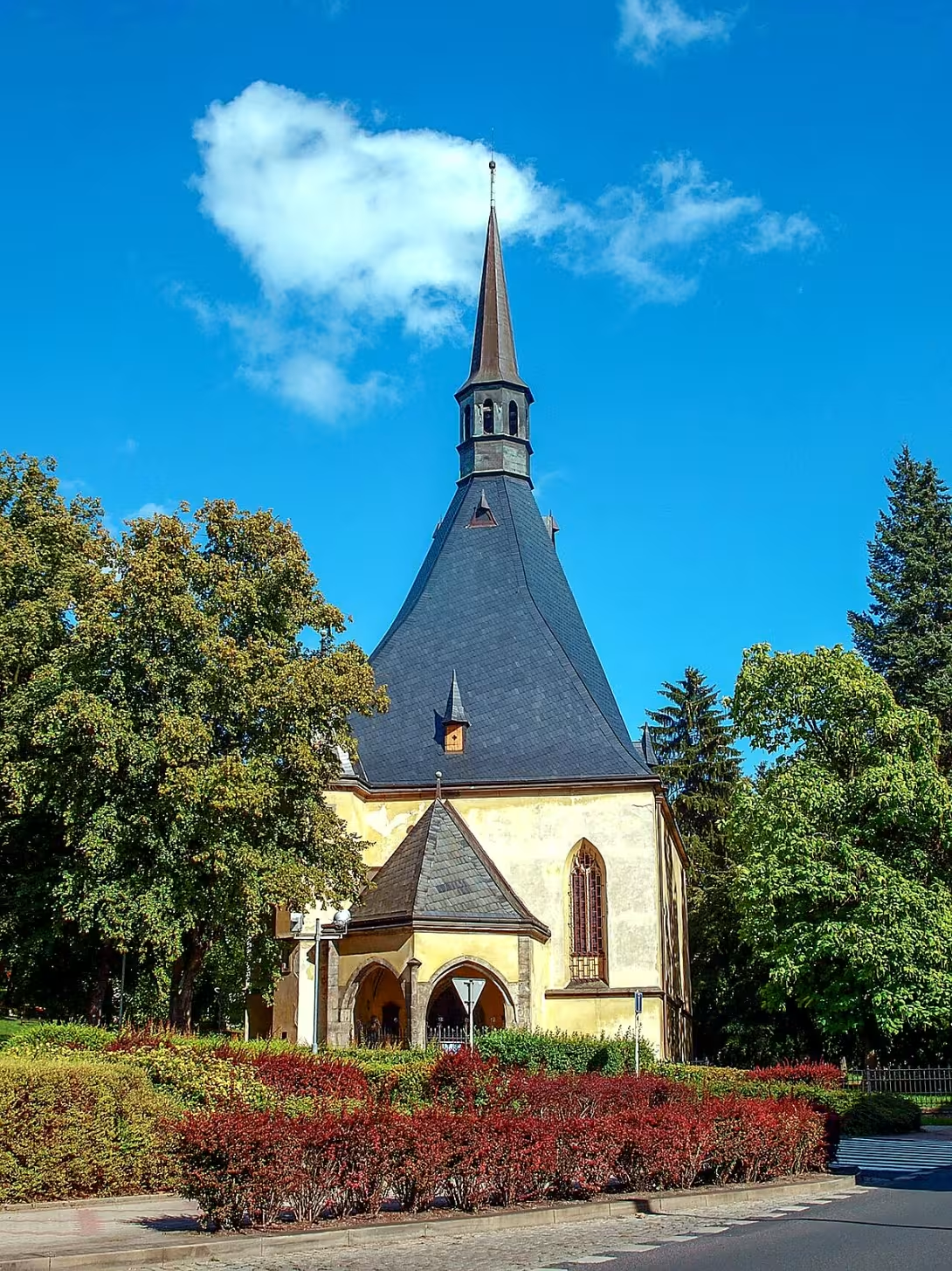
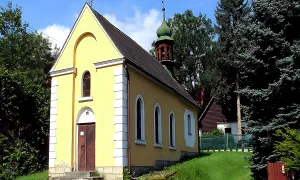
The Church of the Holy Cross is located in Moscow Street in České Lípa and is one of the important sights of the local city zone. The building is owned by the Roman Catholic Church, namely the parish and the deanery of České Lípa. The protection regime applies not only to the church itself, but also to the adjacent park with a set of small sacral structures - the Baroque sculpture of St. John Nepomuk, the Empire chapel and historical tombstones.
The exact date of establishment and the name of the builder are unknown. There are assumptions about the share of builder Peter Parlér, pioneer of the Gothic architecture. The oldest written mention of the existence of the church dates back to 1389, when the owner of České Lípa Hynek Berka from Dubé sold it with donation to the main altar. The church was already an existing building in Leipzig suburb at that time. This position predetermined it for an extraordinary test: in 1426, it was devastated by the great fire of the city. It can be repaired after a long time, but it is only in 1490. During the sixteenth century, non-Catholic priests preached here, reflecting the period of reformation. Return to the Catholic cult took place in 1622 when Albrecht of Valdštejn regained it for Catholics.
The church function was changing over time. Originally served as a cemetery church, the cemetery is located two meters up in the slope. Another test was the fire from 1787, which the church resisted and became a parish temple. In the course of the nineteenth century, he confessed to several repairs.
A fundamental change brought about by the era of Josef Mocker. From 1896 to 1897 this famous Czech architect made extensive modifications in the neo-gothic style, after a previous detailed survey and faithful documentation of the original state. The reconsecrated church was introduced to the lithomeric bishop Emanuel Schöble on 19 September 1897. In 1937 it was equipped with electric lighting and decorated with wooden ceiling with Eucharist symbols. The monument was officially registered in the national list in 1965.
Architecturally, it is a gothic single-boat structure with an ousted presbytery that covers a star cross vault with a saddle roof. Presbytery complements the neo-gothic sacristy on the north side. The west hall is open five-sided with a rib arch. The main ship has a cassette ceiling dating back to 1675. Part of the interior equipment comes from the St. Nicholas church in the Old Town of Prague, for example decorated choir bench with designs of works by Albrecht Dürera. The walls of the church carry coats of arms associated with its history - especially Berks and gentlemen of Kunštát. The outside holds several tombstones, among which the historic epitaph of the Elbel family.
Between 2002 and 2019, the Church of Orthodox Church lent to the church for worship. The Czechoslovak Orthodox village was abolished in January 2019, and the church is no longer led in official schemes as a place of Orthodox services. Today, it is actively used for a Catholic cult and represents worthless evidence of the layered nature of European urban culture.
Then and now
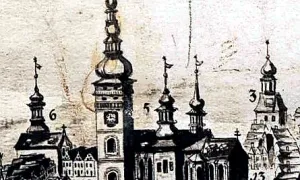
Drag the slider to compare how the landmark may have looked when it was built with the view today.
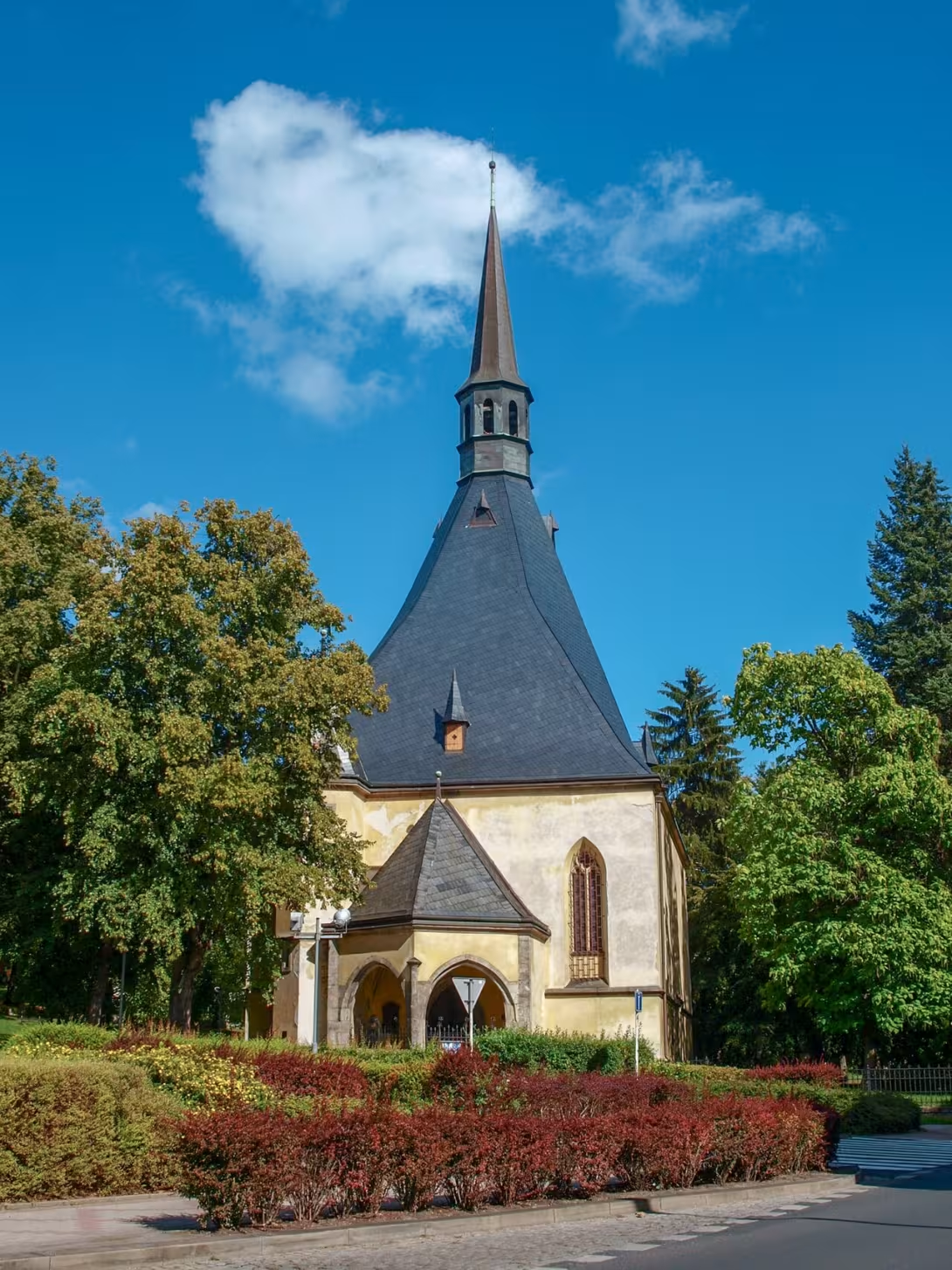

The historical appearance on the left is an AI-generated visualisation and serves as inspiration only.
Historical milestones
- 1389
- The first written mention of the church where Hynek Berka of Dubé sold the talent to the main altar
- 1426
- A great fire of the city in which the church burned down
- 1490
- The church was reconsecrated after the fire
- 1897
- The church passed through the neo-gothic reconstruction of Josef Mocker and was reconsecrated
- 1965
- Listed in the list of cultural monuments of the Czech Republic
Architectural development
The original Gothic one-ship building with the presbytery removed and the star vault was restored after the 15th century fire. In the 19th century there was extensive neo-gothic reconstruction of Josef Mocker, which gave the church its present form. In the interior there was preserved a cassette ceiling from 1675 and part of the device from St. Nicholas church in the Old Town of Prague. The church area also includes the Baroque sculpture of St. John Nepomuk and the Empire Chapel.
Historical events
1389 - First written mention of the church when Hynek Berka of Dubé sold the talent to the main altar
1426 - The great fire of the city in which the church burned down, reconsecrated in 1490
1897 - Extensive neo-gothic reconstruction of Josef Mocker, reconsecrated on September 19, 1897
1965 - Listed in the list of cultural monuments of the Czech Republic
Owners
roman Catholic Church, parish - deanery Česká Lípa
Points of interest
- The church is one of the important monuments in the centre of Česká Lípa and is owned by the Roman Catholic Church.
- The oldest written mention of the church dates back to 1389, when Hynek Berka of Dubé donated it to the main altar.
- The church was destroyed in 1426 by the great fire of the city, but was subsequently restored and consecrated in 1490.
- During the reformation in the 16th century, non-Catholic priests served here, and in 1622 he recovered it for the Catholics of Albrecht of Valdštejn.
Guide
This guide is narrated by a synthetic voice generated by artificial intelligence.
Show guide text
This text was created by artificial intelligence and has not been editorially reviewed. It may contain inaccuracies.
Welcome to the heart of Czech Lip. You just stopped in front of one of the most important and oldest building units in this city. You're standing right in front of the Church of Finding the Holy Cross. Before you go any further, I suggest you stop for a moment, put on your headphones and let yourself get through the atmosphere of a place that has been standing here for over six centuries. Look at the total silhouette of this building. Although the surrounding world was constantly changing around it, this church remained a fixed point, witnessing many events that shaped the face of the entire Liberec Region. Feel his presence, his seriousness, and the special combination of ancient and meticulous renewal that you can perceive in his form.
To understand why this church is so special, we need to go back deep into the past, to a time when medieval settlements have yet to form in these forests and cities. The oldest clue we can trace in the history of this place brings us to 1389. This is the year of the first written mention of this church. At that time, this builder was not just an ordinary building, but a symbol of faith and social order. The mention of 1389 tells us of a great figure at the time, a gentleman who was Hynek Berka of Dubé. At the time, this nobleman donated a gift to the main altar, which shows how important this building was for the then society and how much it was linked to the region's power and spiritual structures.
The history of this place, however, was not just a passe of peace and construction. The church had to face the greatest trials the city could experience. Imagine 1426. At that time, a devastating event hit Czech Lip - a great fire of the city. The flames were spreading relentlessly, and the church, despite its fortress, was the victim of this element. Burned out, left with nothing but test and dust. But it is at these moments that the true power of local communities manifests itself. The church wasn't abandoned. People came back to him, picked him up again from the ashes, and in 1490 he was reconsecrated after this difficult time. This ability to recover, this constant cycle of destruction and subsequent renewal, is one of the strongest stories this church carries.
Now that you know its darker and brighter moments, pay attention to the architecture itself that you are looking at. If you look at the details of the construction, you will notice that its appearance is the result of a dialogue between two distinct epoch. On the one hand, you have the original Gothic base, which dates back to the end of the 14th century. It's the ancient medieval soul of the building. On the other hand, you will see the influence of the nineteenth century. In this period, there has been an interest in returning to historical styles throughout Europe, especially gotics.
In 1897 the church underwent a major reconstruction, driven by one of the most important architects of its time, Josef Mocker. Mocker was a master at restoring and creating a neo-gothic style. It is thanks to his work that the church has this particular look that you see in it today. If you look around the facade now or watch the lines of the building, notice the precision and the effort to make the construction work harmoniously and factually in the spirit of old Gothic, even if it was modified much later. This neo-gothic restoration was not just a repair, it was an attempt to resurrect the beauty and dignity that the church had since its inception.
It's interesting to realize the role this church has played in people's everyday lives. It wasn't just a place of Sunday prayers. The Church of the Finding of the Holy Cross served as a parish church, i.e. as a spiritual centre for the whole surrounding village, but also as a cemetery church. This means that he was closely linked to the entire life cycle of the townspeople - from baptism to last farewell. This dual role gave him depth and reminded people of their connection to the past and eternity. The church is still in the possession of the Roman Catholic Church, which confirms its continuous continuity within faith and tradition.
If you're looking for something that might really surprise you, think about how long this object has resisted time. While political regimes were changing around it, the city grew, people came and went, but the church lasted. Its importance was so great that in 1965 it was officially included in the list of cultural monuments of the Czech Republic. It's not just a formal notation, it's a recognition that this object is an untouchable legacy that belongs to all of us.
Looking at the church, you can ask yourself how many faces history has. It's the story of nobles like Hynek Berka of Dubé, it's the story of architects like Josef Mocker, but it's also the story of thousands of strangers who prayed here, who sought comfort in the fires and who worshipped their dead here. Every stone and every line you see right now is part of this endless chain of events.
Now that you have a basic idea of what's in front of your eyes, I suggest you continue your search. Walk around, try to find different points of view of the construction, see how its shadow changes and how light hits it. Every look can reveal something new to you, something you won't see in a hurry. The Church of Finding the Holy Cross has something to offer you if you give him time. Thank you for choosing this meeting with history. We wish you a pleasant rest of the walk around Česká Lípa.
Tips for visitors
{'paragraph': 'The best time to visit the church Finding the Holy Cross is during the morning hours when the interior is pleasant light and fewer visitors. If you want to experience a quiet atmosphere, come here on Monday or late afternoon, when the church is often less disturbed. In summer it is advisable to visit the church during the week when the weather is pleasant outside and you can see the surrounding cemetery with its picturesque location in the slope.'}
{'paragraph': 'The church is easily accessible by car because it is located in the centre of České Lípa. In the vicinity of the church you will find several parking lots, including those near the town monument zone. If you arrive by public transport, stops are nearby and the current connection can be verified in the traffic search engine. It is recommended to walk on foot because the church and its surroundings are very compact and offer pleasant walks through the historical centre.'}
{'paragraph': 'When visiting, wear comfortable clothes and shoes because the church and the surrounding cemetery are located on a slightly steep terrain. In winter bring warm clothes because the outdoor areas can be cold. It is also important to take a map or navigation if you want to visit the cemetery, which is located about 200 metres from the church. If you are interested in photography, remember to take batteries and memory cards because the interior and exterior offer many interesting details.'}
{'paragraph': 'For photography are the most suitable places in the interior of the church where natural light is ideal for capturing gothic details such as stained glass and stone statues. The best time for photography is in the morning or afternoon when light is not too hard. The exterior of the church is also very photogenic, especially at sunset, when lighting the towers and facades. When shooting the cemetery, be careful to respect the privacy and peace of the visitors.'}
{'paragraph': 'There are several interesting places around the church that are worth visiting during your trip. You can visit the old cemetery near the church, which is part of the monument protection and offers a quiet environment with historical atmosphere. Another interesting thing is the town monument zone of České Lípa, which includes other historical buildings and picturesque streets. If you have time, you can also walk around the edges of the city and admire its natural beauty.'}
{'paragraph': 'For families with children, a visit to the Church of the Holy Cross is very interesting. Children can see gothic paintings and statues that fascinate them with their detailed processing. In the vicinity of the church it is also possible to play in the cemetery, which offers plenty of space for walking and exploring. It is also recommended to visit the urban monument zone where children can see historical houses and learn about their history. It is also interesting for children to visit nearby parks where they can play and relax.'}
For kids
Imagine going back to the past, when Česká Lípa was still a small town. The Church of Finding the Holy Cross was young and full of life back then. How did it look here? There were people here who lived for a living in agriculture and trade. The city was surrounded by forests and rivers that supplied water to the city pond.
It was like a game where everyone played their part. The church was the center of the city where people went to prayer and where weddings and funerals were held. The city was full of life, full of sound and smell.
Businesses nearby
Do you run a restaurant, accommodation, shop, museum, rental, wellness or other visitor service near this monument? Show yourself directly to the people heading to it — this is how they will see you in the app and on the web:
Nearby
{'sights': [{\ 'name': 'cemetery near the Church of the Holy Cross', 'description': 'Old cemetery is located about 200 meters above the church in the slope, part of the monument protection is also the wall of the wall.', 'station': '200 meters'}, {'name': 'Town Monument Zone of České Lípa', 'description': 'Church is part of a protected urban monument zone which includes the historical core of the city.', 'station': 'in the city centre'}], 'natural _ elements': [{'name': 'Moscow street (formerly Cross street)', 'description': 'Kostel stands in this street, which is part of the historical city centre of the city.'}}}}}}}}}}
Accommodation nearby
Themed route
1. Church Finding the Holy Cross in Czech Lípa Main objective This important church represents the main destination of our journey and is located right in the historical heart of the city. The building attracts visitors with its unique atmosphere and sacral architecture.
2. Town Monument Zone České Lípy Monuments The whole church is part of a protected urban monument zone, which includes the entire historical core of the city. The walk through this zone offers a view of the preserved urban development in the immediate vicinity of the main destination.
3. The cemetery at the church Finding the Holy Cross Monuments The old cemetery is located about 200 metres above the church in the slope. A historical wall is also part of the historical protection of this quiet place.
Seasonal recommendations
Spring in Czech Lípa brings about an awakening nature, where nearby parks and shores of nearby Ploučnice play a fresh green color. A tour of the Church of the Holy Cross is in this period a specific piercing spring sun, which, through the still unpolished trees, hits the historical facade and creates interesting shadows on the wall. The inner spaces of the temple attract pleasant silence and colder air after winter. From a practical point of view, this is an ideal time for a peaceful visit without large crowds of tourists, but due to frequent spring showers, it is worth packing solid shoes and waterproof clothing. The ideal time to enter the interior is the morning hours, when natural light best stands out on architectural details.
Summer in the vicinity of the Liberec Monument is characterized by pulsating urban life and long sunny days, which directly encourage all day trips. The atmosphere in the temple itself is very refreshing during July and August afternoons, as strong outdoor temperatures contradict the pleasant cup and shadow under the massive vaults. In the main summer season you will meet a higher attendance rate, which is why it is the best time for an early morning tour right after opening, when you enjoy the memory in complete peace. Put on light but decent clothes covering your shoulders and knees, don't forget your city-wide sunglasses and a bottle of drinking water, because on hot days you will spend more time out in the direct sun than you plan.
Autumn turns the whole city into a picturesque palette of ochre, golden and red colors, which adds an extremely photogenic character around the church. The specifics of this period are soft, low autumn light, which magically illuminates the old sacral architecture at sunset and induces a deeply quiet, melancholic atmosphere. But raw and windy weather with occasional morning fog requires thorough preparation. We recommend to wear a warm coat, scarf and comfortable waterproof shoes because the tiles around the building can be slippery after rain or morning dew. The number of visitors falls significantly at this time, so you can enjoy an uninterrupted experience in the afternoon when the sun falls to the horizon.
Winter in České Lípa covers the historic centre into a peaceful, sometimes snowy atmosphere, in which the monumental silhouette of the church excels with unprecedented purity. The interior of the monument in advent time and during winter months is very festive, but due to the absence of strong heating in historical buildings there are low temperatures. Practical advice for this period is absolutely essential: choose really warm winter clothes including cap, gloves and thermo-linens to enjoy every detail of the interior in peace. Due to a shorter day and a limited winter opening time, it is best to plan a visit to lunch hours, when it is the hottest outside and the surrounding alleys are the least snowed in.
Visualizations and artistic views


The visualisations are generated by artificial intelligence and serve as inspiration.
Photos from the area
Real photos taken near the monument


Zdroj a licence jsou uvedeny u každého snímku.
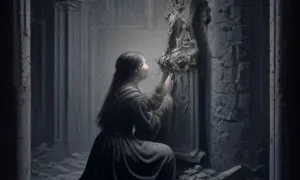
Atmosphere of the place
This atmospheric visualisation of the place and period was generated by artificial intelligence. It is not real footage of the location.
Tips from visitors
No tips yet. Be the first!
Log in and add your tip.
Sources and literature
Fotografie: VitVit / CC BY-SA 4.0 — Wikimedia Commons. The author and licence also appear when you hover over the image.
Faktickým podkladem tohoto textu byl článek na Wikipedii, jehož autory jsou přispěvatelé Wikipedie. Článek je dostupný pod licencí CC BY-SA 4.0.
Location on the map
Příběhy a pověsti
Legendy, pověsti a příběhy spjaté s touto památkou
Fotografie návštěvníků
Zatím žádné fotografie. Buďte první, kdo přidá fotografii z návštěvy!
Přihlaste se a přidejte svou fotografii nebo hodnoťte.
Za ověřenou návštěvu v aplikaci získáte víc bodů — poznáme podle GPS, že jste na místě.
Reviews and comments