






Sloup Nejsvětější Trojice (Česká Lípa) Holy trinity column
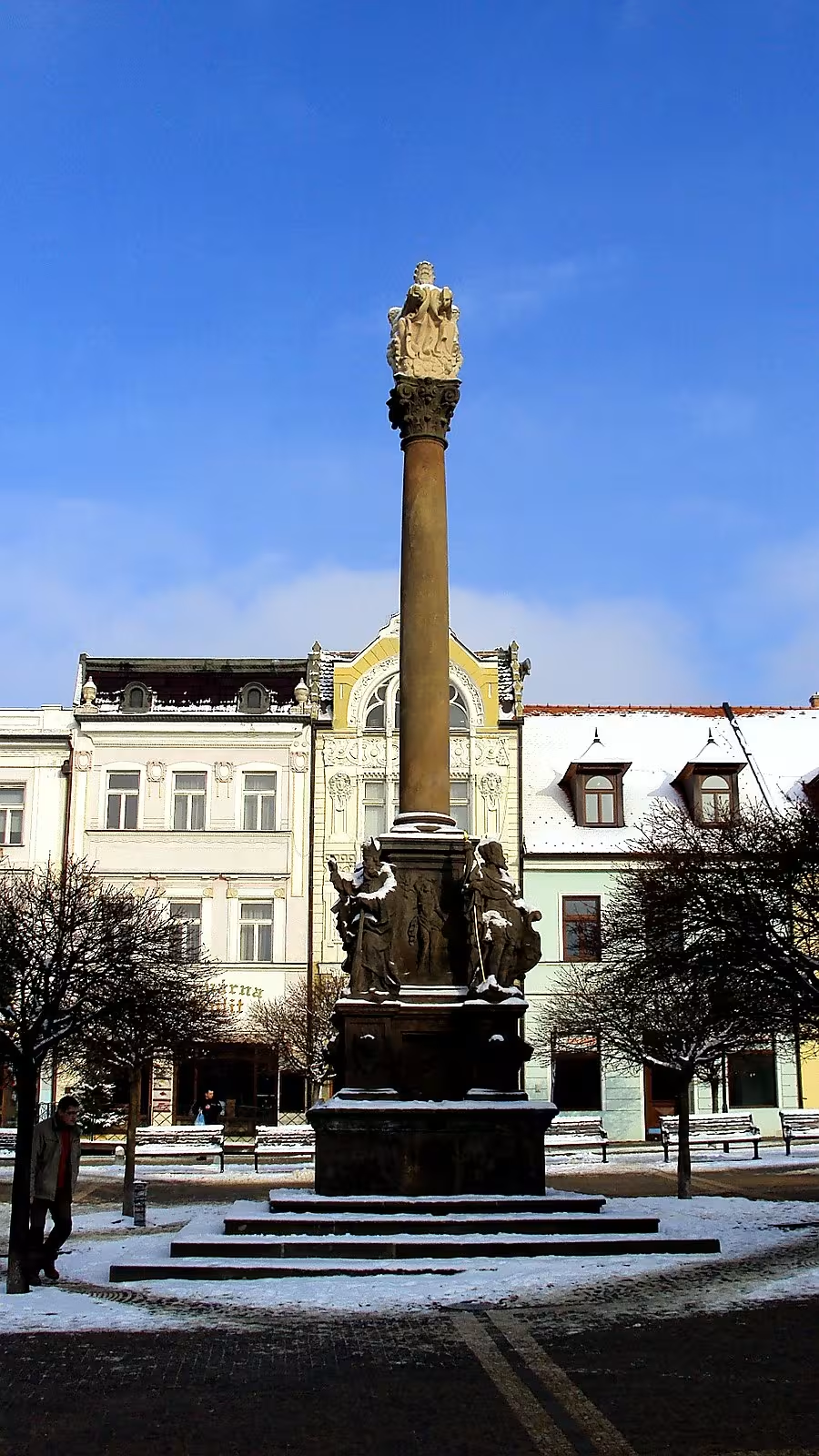
The column of the Holy Trinity, located on the St. G. Masaryk Square in České Lípa, is a Baroque pestilence column registered as a cultural monument in the Central List of Real Cultural Monuments of the Czech Republic. This monument is not only one of the pivotal sculpture monuments in Czechoslovakia, but also part of the urban monument zone announced in 1992. It was created as a memory of the plague epidemic in 1680, which strongly affected Czech Lípa and brought with it a tragic number of victims.
The plague column was built to commemorate a devastating plague epidemic that lasted seven months and ended on November 21, 1680. During this time, more than a fifth of the inhabitants of České Lípa died from the plague, namely 520 people. The original dates for the construction of the column vary in different sources - while some indicate the years 1681 to 1683, others indicate the year 1689. The author of this work belongs to sculptors Johann Christian Ulrich of Žitava, who is known for his contribution to baroque art in the region.
Architecturally, the column is characteristic of baroque style with Corinthians' head and central sculpture of the Holy Trinity, known as the Throne of Grace. This element adorns the top of the column and includes the figures of God the Father, Jesus Christ and the dove symbolizing the Holy Spirit. On the pedestal there are statues of four saints - St. Wenceslas, St. Florian, St. John of Nepomuk and St. Vojtěv - together with the reliefs of the Virgin Mary of the Able and the protectors against the plague. This artistic representation brings deep religious significance, which was often used during the Baroque era in Czech countries to celebrate faith and memory of tragic events.
Over the centuries, the column has passed through several stages of maintenance and reconstruction. The first mention of repairs dates back to 1720, followed by others in 1919, 2004 and 2014. These adjustments were necessary due to damage caused by weather conditions and vandalism. In 1780, statues of saints were added around the column, which further perfected its religious significance. In 1836, a granite railing with cast iron bars was built around the column, which was removed in 1965 and subsequently renewed in 2014.
Column of the Holy One The Trinity is today located at the historical centre of České Lípa, more precisely in the eastern part of T. G. Masaryk Square closer to the town hall. Its surroundings include an empirical fountain and a number of protected houses, which together form an urban monument zone. This site is not only a cultural heritage, but also a living center of the city, where history and the present meet.
Today stands the column The Holy Trinity as a witness to the past tragedy as well as the strong spirit of the inhabitants of Česká Lípa, who built a memory of these events. It is not only an artistic and historical treasure, but also a local meeting point and reflection of the past. For visitors it offers the opportunity to immerse themselves in the rich history of České Lípa and appreciate its cultural heritage, which is still a living part of the city space.
Historical milestones
- 1680
- The end of a plague epidemic that has hit the city.
- 1681
- Likely a year of pole raising.
- 1780
- Location of statues of saints Václav, Florian, Jan Nepomuk and Vojtěv on the pillar.
- 1836
- Position of granite railing with cast iron grid.
- 2014
- Restoring the railing around the pole in the form of a replica.
Architectural development
A Baroque column with a Corinthian head and the sculpture of the Holy Trinity. In 1780, statues of saints were added to the pillar. In the 19th century a granite railing with cast iron bars was installed around the pole.
Historical events
The plague epidemic in 1680, the construction of a pillar between 1681 and 1683, the addition of statues of saints in 1780, the installation of railings in 1836.
Points of interest
It was created as a memory of a plague epidemic in 1680. More than a fifth of the population of the city died during this outbreak, namely 520 people. The author of the work is sculptor Johann Christian Ulrich ze Žitavy. - The top of the pillar is decorated with the statue of the Holy Trinity, which includes God the Father, Jesus Christ and the dove. - On the pedestal there are statues of four saints and reliefs of the Virgin Mary's Helpers and protectors against the plague. - In 1836 a granite railing with cast iron bars was built around the column, which was replaced by a replica in 2014.
Guide
Show guide text
This text was created by artificial intelligence and has not been editorially reviewed. It may contain inaccuracies.
Welcome to Česká Lípa, a place full of history and beauty! If you look around you, you will see one of the most famous monuments of this city on T.G. Masaryk Square - the Baroque Pestilence Column of the Holy Trinity. Standing outside City Hall, this monument invites you to its past and tells stories from ancient times.
Let's dive into the history of this column. In 1680, the Czech Lípu plague epidemic affected more than one fifth of the inhabitants of the city. To give up these losses and show gratitude for overcoming this disease, the column was built in 1681. His author is sculptor Johann Christian Ulrich ze Žitavy, who left his artistic work to impress the whole city.
Look up and see how the top of the pillar is decorated with the statue of the Holy Trinity. This work is full of symbolism - in it you see God the Father, Jesus Christ and the dove, which represents the Holy Spirit. Around the pedestal you can see statues of four saints - Václav, Florian, Jan Nepomuk and Vojtěv, which were located in 1780. These figures remind us of the city and its inhabitants.
Now look at the railing around the pole. In 1836, a granite railing with cast iron bars was built, which underwent a replica renewal in 2014. This detail shows the care of the memory and its preservation for future generations.
The interesting thing is that this column is not only a monument to the plague epidemic of 1680 - it is also a testament to the artistic skill and spirit of the then craftsmen. The sculptor Johann Christian Ulrich ze Žitavy not only created a beautiful sculpture, but also an entire monument, which shows his talent.
I invite you to further explore Česká Lípa and its other historical monuments. The city has many stories waiting to be revealed. Whether you choose to visit the town hall or other attractions in the surroundings, every step here is full of historical signs and beauty.
Thank you for your attention and wishes for a relaxing exploration of Czech Lip!
Tips for visitors
The best time to visit the Baroque plague column in České Lípa is the early spring or late autumn period. The weather is pleasant these months, and you will visit a place without large crowds of tourists. In addition, sunlight creates beautiful lighting for a photo of the monument.
Parking can be found in the parking lots near T. G. Masaryk Square, where the column of the Holy Trinity is located. For those travelling by public transport, the place is well accessible by bus and tram; you can check the specific connection in the current schedule.
When you visit, wear a suitable suit because the weather can be variable. It is also good to wear protective sunglasses and water, especially if you plan to take an extended walk around the square and surrounding area.
Photography of the sights offers the best possibilities from different angles at T. G. Masaryk Square, especially in the early morning or in the evening when light is softer and the column gives dramatic effect. The Empire fountain nearby also provides a beautiful background for photos.
In the vicinity of the square you will find other attractions, such as the historical town hall and the town monument zone. It is advisable for families with children to visit the Empire fountain where children can play or enjoy a quiet moment.
Businesses nearby
Do you run a restaurant, accommodation, shop, museum, rental, wellness or other visitor service near this monument? Show yourself directly to the people heading to it — this is how they will see you in the app and on the web:
Nearby
Náměstí T. G. Masaryka, radnice, empírová kašna a městská památková zóna.
Accommodation nearby
Themed route
Thematic cruise route: Column of the Holy Trinity and its surroundings
1. Column of the Holy Trinity (memorial) - Type: historical monument - Why is it worth visiting: This column, built in 1716, is one of the most famous monuments of České Lípa. Its Baroque architecture and historical value attract many visitors. The column symbolizes victory over the Turkish threat and is the highest deliberately built pillar in the world.
2. T. G. Masaryk Square - Type: public area - Why it is worth a visit: The central square of the city is the living heart of České Lípa, where there are many historical and modern architectural elements. It's a place to relax and explore local life.
3. City Hall - Type: historical monument - Why is it worth a visit: Town Hall is an important architectural monument which represents a Baroque style. Its beautiful facades and history make it an essential part of the city.
4. Empire fountain - Type: artistic element - Why is it worth visiting: The fountain is an example of Empire style and gives the local environment elegance. It's a place where you can enjoy the quiet moments and beauty of art.
5. City Monument Zone - Type: historical area - Why it is worth a visit: The surrounding centre of České Lípa, this zone retains many historical buildings and alleys. It is an ideal place to walk and discover local architecture.
This route will guide you through the most interesting part of Česká Lípa, offering a view of its historical richness and art works.
Seasonal recommendations
Spring: In the spring period, the Column of the Holy Trinity in České Lípa appears in a beautiful green garment when trees and shrubs begin to bloom. This time of year is ideal for praise of the natural beauty of the surrounding park, which is illuminated by sunny rays and radiates with live color. When visiting you realize that due to the arrival of the tourist season the place can be more visited, so we recommend to come at the beginning of the day. Clothes should be medium-warm - the day may be warm, but the evening often cools.
Summer: In the summer period, the Column of the Holy Trinity is a charming target for visitors seeking relief from heat. Long sunny days and thermal night atmosphere provide an exceptional opportunity for a long walk under the green park where you can disconnect. At this time of year it is advisable to come early in the morning or later in the evening to avoid large crowds of tourists. Don't forget the sunscreen and enough drinking water.
Autumn: In autumn months, the Sloup of the Holy Trinity offers a unique atmosphere where tree leaves are colored in golden and red shades. This time of year is ideal for commendation of natural changes and quiet moments in the picturesque park. When visiting, please note that there may be a short rainy season - therefore we recommend wearing a suitable hat and clothes for mild weather. Moreover, at this time of the year, the likelihood of more people being attracted to local actions increases.
Winter: In the winter period, the Column of the Holy Trinity offers a completely different atmosphere. The park covered with snow and ice shapes of trees create views full of peace and mystery, especially behind shining sequences of park lighting. At this time of year it is advisable to come at the beginning of the day - opening hours may be short and the place is colder, so we recommend wearing warm clothes. Moreover, the number of visitors looking for quiet spaces in the city often increases during this period.
Visualizations and artistic views

The visualisations are generated by artificial intelligence and serve as inspiration.
Photos from the area
Real photos taken near the monument


Zdroj a licence jsou uvedeny u každého snímku.
Tips from visitors
No tips yet. Be the first!
Log in and add your tip.
Sources and literature
Photos: Zákupák / Public domain — Wikimedia Commons. The author and licence also appear when you hover over the image.
Faktickým podkladem tohoto textu byl článek na Wikipedii, jehož autory jsou přispěvatelé Wikipedie. Článek je dostupný pod licencí CC BY-SA 4.0.
Location on the map
Příběhy a pověsti
Legendy, pověsti a příběhy spjaté s touto památkou

Fotografie návštěvníků
Zatím žádné fotografie. Buďte první, kdo přidá fotografii z návštěvy!
Log in a přidejte svou fotografii nebo hodnoťte.
Za ověřenou návštěvu v aplikaci získáte víc bodů — poznáme podle GPS, že jste na místě.
Reviews and comments