



Kostel Nanebevzetí Panny Marie (Neustupov) Church
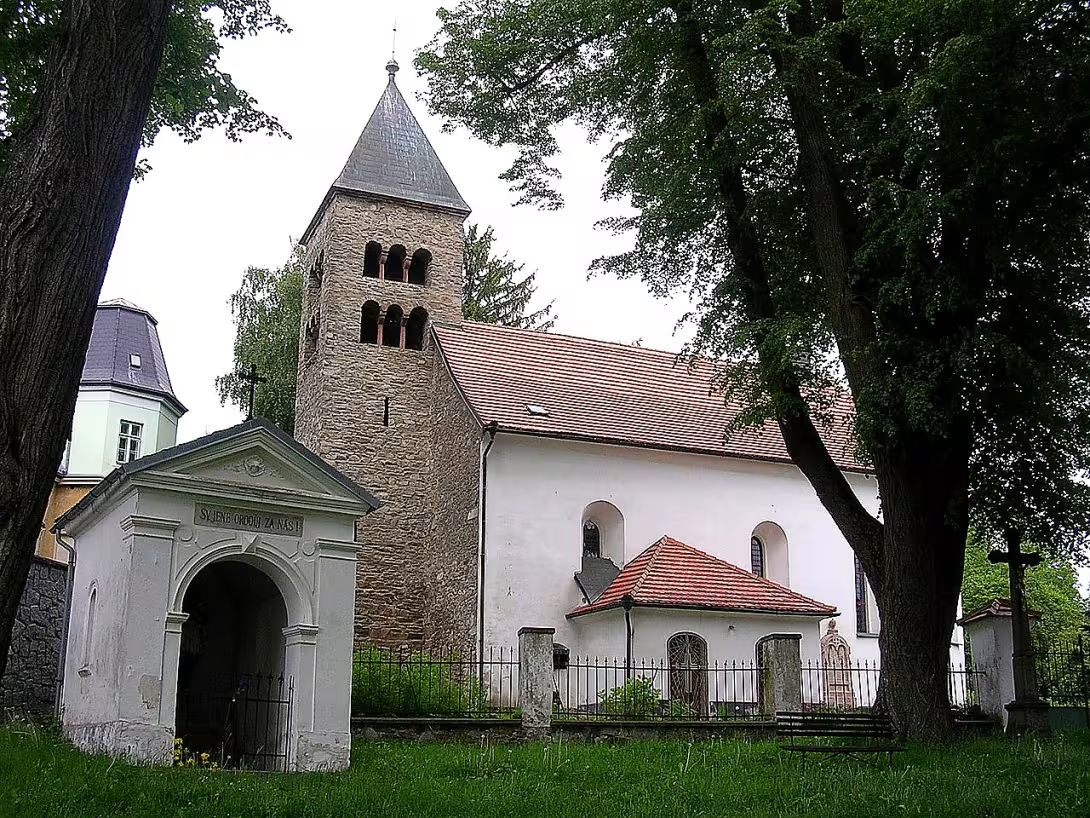
The Church of the Assumption of the Virgin Mary in Neustupov is one of the parish churches of the parish of Nepostav. Written references to it date back to the thirteenth century, when it appears in the form collection of Bishop Tobias of Becyne. The oldest building phase declared by the building survey belongs to the late Romanesque period.
In the early Middle Ages, the church had patronage rights most likely to be the Vyšehrad chapter, but over time, their execution went to local noble families. In the 14th and 15th centuries Mikuláš z Vlčkovice or Jan Unka z Neustupova are listed as patrons. From the fifteenth century until 1620, the village of the Vidlák family belonged to Slavkov and their heirs to the Kaplniks of Sulevic. The church, situated in the immediate vicinity of the superstructure - the original fortress, later converted to a chateau - served these families as a family tomb. In the second half of the fourteenth century, the church fell into the dean's office.
The Thirty Years' War on the Church has brought serious damage. He was robbed and soldiers searched even the graves for rings and other valuable objects. The owner of the Jan de Areyzaga estate had the remains of the deceased put in a shaft near the tower.
The construction form of the church is indicative of over eight centuries of gradual adjustment. The oldest part is the early Romanesque tower in the west, which was best preserved from that time. The ship and the apsida in its present forms come from the first half of the 14th century. The rectangular plan of the ship closes a semi-circular approach to the east. A larger two-space extension is adjacent to the north side of the ship; its part of the apside serves as a sacristy and the western part has been adapted to a chapel with a stone outline of the Lourdes cave. A smaller extension with a hall is located on the south side.
The Renaissance modifications appeared mainly in the interior. The ship was illuminated by five new broken windows and originally a flat ceiling replaced a rolled vault with a comb pattern. The crypts were dug under the ship. The ship separates the semi-circular victory arch from the apside, which is probably also related to the arch of the apside. The tower in the Baroque period was increased by the bell floor, but it was removed again during the purist adjustments in the 1920s. The tent roof of the tower comes from this very period.
The church's facilities mainly reflect the Baroque period. The Rococo main altar carries the picture of the Assumption of the Virgin Mary by Bedřich Kamarit from 1859. The other altars are decorated with a new statue of Our Lady and Savior and a painting of the Madonna of Chenstochov from 1738. The historical inventory is worth mentioning the Baroque pulpit from the second quarter of the eighteenth century and the tin baptist from 1611. According to preserved tombstones, members of the families of the Vidláks and Caplers were buried in the church from the second half of the 15th until the beginning of the seventeenth century.
The church is today protected as a cultural monument and represents a living reflection of the continuity of the Czech building tradition from the Romanesque period to the Renaissance to the Baroque decoration and modern modifications.
Then and now
Drag the slider to compare how the landmark may have looked when it was built with the view today.
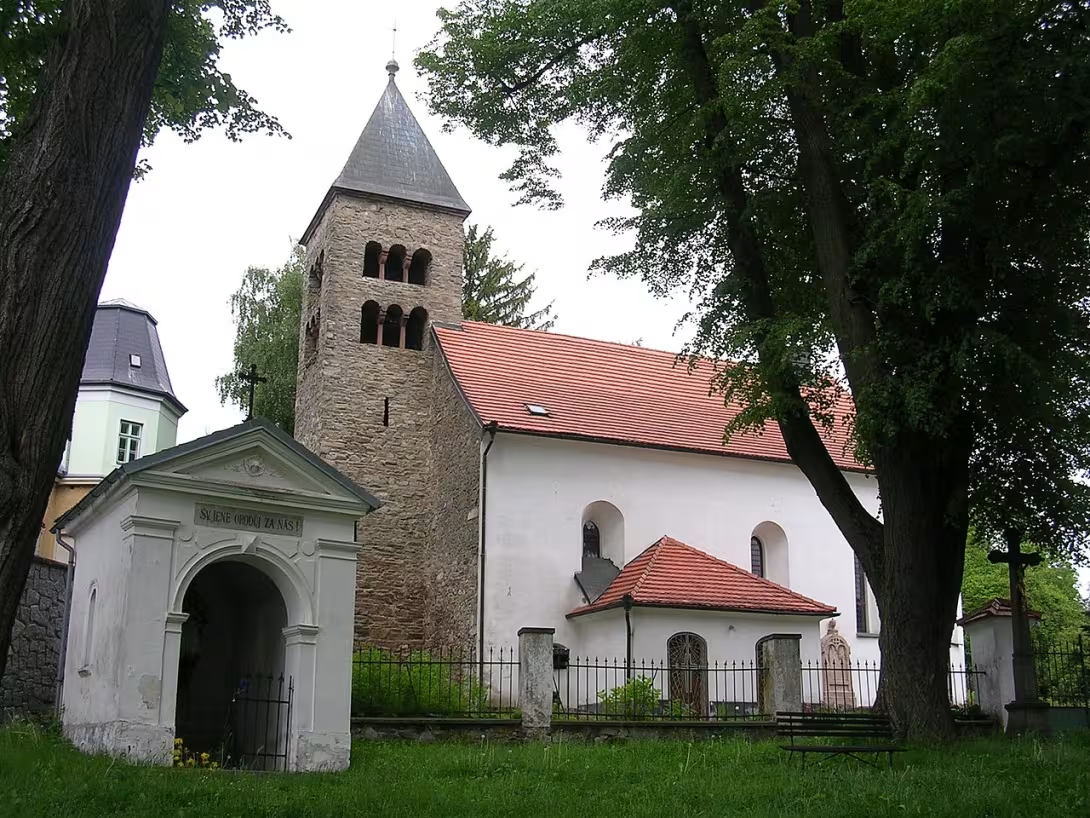
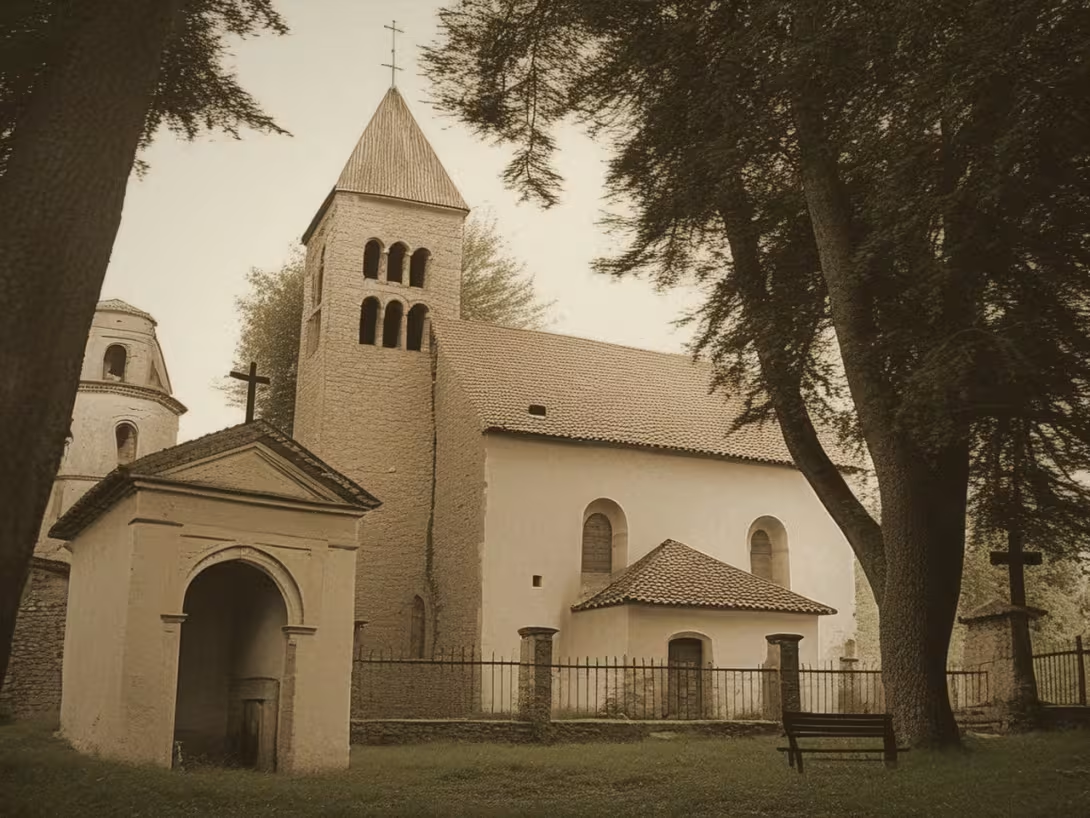
The historical appearance on the left is an AI-generated visualisation and serves as inspiration only.
Historical milestones
- 1280s
- First written mention of the church in the form collection of Bishop Tobias from Becyne.
- 14th century (1st half)
- The creation of a preserved form of ship and apside, the creation of crypts.
- 16th century (end)
- Renaissance reconstruction of the interior, the creation of a winning arch and the vaults of the apside.
- 1920s
- Puristic modifications, the demolishing of the Baroque bell tower floor and its tent roof.
Architectural development
The church has an original Romanesque core from the second half of the 13th century, but the preserved form comes mainly from the Renaissance reconstruction of the 16th century. The boat and apsida are from the first half of the 14th century, the tower is Romanesque with later baroque and puristic modifications. The interior was illuminated by new windows and covered with a coven-shaped vaults. In the 19th century the original entrance to the tower was walled up and the hall on the south side of the ship was added.
Historical events
- 1280s
- First written mention of the church in the form collection of Bishop Tobias from Becyne.
- 1620
- The end of the noble burial in the church after the loss of the Chaplains of Sulevic.
- 1618-1648
- Burglary of the church during the Thirty Years' War, including the opening of the caskets and the relocation of the remains.
- 1920s
- Puristic modifications of the church, including the tearing down of the Baroque bell tower floor.
Owners
- 1385
- 15th century (1930's)
Points of interest
- Written references to the church dates back to the 1880s, when Bishop Tobias of Becyne mentions it.
- The oldest part of the church is the Romanesque tower from the late Romanesque period, which has done its best.
- The church served as a family tomb of the families of the Vidláks of Slavkov and Kaplír of Sulevic from the fifteenth century until 1620.
During the Thirty Years' War, the church was robbed and the soldiers searched the graves, looking for valuables like rings.
- In the interior there is a baroque pulpit from the second quarter of the eighteenth century and a tin baptist from 1611.
Guide
This guide is narrated by a synthetic voice generated by artificial intelligence.
Show guide text
This text was created by artificial intelligence and has not been editorially reviewed. It may contain inaccuracies.
The Church of the Assumption of the Virgin Mary in Neustupov is the parish church of the Neustupov parish and is protected as a cultural monument. It has a Romanesque core. However, its present appearance is the result of Renaissance reconstruction and mainly purist modifications from the nineteen twenties.
The church is first mentioned in writing in the eighteen eighties of the thirteenth century, in the formulary collection of Bishop Tobiáš z Bechyně. The patronage right was apparently held initially by the Vyšehrad chapter. In the fourteenth century, however, it passed to the local nobility, for example to Mikuláš z Vlčkovic, documented in the year 1385, and later to Jan Unka z Neustupova.
From the nineteen fifties of the fifteenth century until the year 1620, the village belonged to the Vidlák family ze Slavkova, and after them to their heirs, the Kaplíř family ze Sulevic. They lived in the Neustupov stronghold, which was later rebuilt into a castle. The church in its immediate vicinity served them as a family sepulchre. The preserved tombstones commemorate, for example, Jan Vidlák Radimský ze Slavkova, buried in the year 1545, or Kuneš Vidlák Radimský ze Slavkova a na Neustupově, buried in the year 1563. Three sons of Petr Kaplíř and Alžběta Malovcová also lie here, buried in the years 1571 to 1573.
During the Thirty Years' War, the church was plundered. Soldiers opened even the coffins and searched in them for rings and other items made of precious metals. The then owner of the estate, Jan de Areyzaga, had the remains of the deceased placed in a shaft near the tower.
The church has a rectangular ground plan. In the west stands a prismatic tower and in the east the nave is closed by a semicircular apse. The tower is the best preserved Romanesque part. In the Baroque period it received a bell chamber, but the purist modifications removed it again. The present pyramidal roof dates from the nineteen twenties. The nave and apse in their present dimensions are from the first half of the fourteenth century. The Renaissance transformed mainly the interior. The nave received five new windows and a barrel vault with a comb pattern replaced the flat ceiling. Crypts emerged beneath the nave. The main entrance in the southern wall of the nave has an early Gothic frame.
To the north side adjoins an extension with a sacristy and a chapel, in which a suggestion of the Lourdes grotto is composed from stones. Inside is a Rococo high altar with a painting of the Assumption of the Virgin Mary by Bedřích Kamarýt from the year 1859. One of the side altars is decorated with a painting of the Madonna czestochowska from the year 1738. The furnishings also include a Baroque pulpit and a tin baptismal font from the year 1611.
Tips for visitors
The best time to visit the Church of the Assumption of the Virgin Mary is in the summer months, namely June to September. In these months the weather is pleasant and the church is usually open to visitors. In addition, cultural events such as concerts or exhibitions are often held at this time, which can enrich the visit even more. The summer is also the most light, which is ideal for photographing the inner and outer spaces of the church.
The church is accessible by car and public transport.
When visiting the church, wear comfortable clothes and shoes because the inside of the church can be cold and the floor often does not level. It is also recommended to take a small notebook or camera if you want to record details of the interior and exterior. Also remember the sunglasses and hat if you are planning a tour during the summer. It is advisable for children to take some activity with them, such as books or small toys, so that they can spend some fun during the visit.
Photography in church is permitted but it is recommended to follow certain rules. The best places for photography are the windows and the facade of the church where natural light is pleasant. The inside of the church is also interesting, but it is important to ensure that no historical elements are broken. The best time to take pictures is in the morning or in the afternoon when the light is softer and less demanding on exposure. Don't forget to respect the peace and quiet of the church
In the vicinity of the church is worth visiting Neustupov Chateau / Chateau, located just 200 metres from the church. This historic building was the seat of the families of the Vidláks and Kaplířů and offers the opportunity to discover another part of local history. Another interesting place is the cemetery wall and tomb of the Rombaldova family, which is part of the church area and contains historical tombstones and tomb of the noble family. For families with children it may be interesting to explore the surroundings of the church and the fortress, where there is often a small playground or area for relaxation.
For families with children a visit to the church in Neustupov is a great opportunity to explore history and culture. Children can be intrigued by the view of ancient stone elements and historical tombstones. It is possible to find a small area around the church where children can have fun. It is also recommended to use the opportunity to explain the importance of the church and its historical importance for children of adequate age. For children of older age, it may be interesting to look at detailed paintings and statues in the interior of the church.
Frequently asked questions
Can the monument be visited?
Religious buildings are usually open mainly during services; at other times a visit is normally arranged with the parish or the operator. We have not verified specific times.
Where is the monument?
Location: Neustupov, Středočeský kraj. The map on this page shows the exact spot.
Why is the monument protected?
It is listed in the Central List of Cultural Monuments of the Czech Republic as a cultural monument (register no. 20660/2-142).
For kids
Imagine going back to when Neustupov wasn't the city it is today. The Church of the Assumption of the Virgin Mary was then just a small Romanesque core, which served as a place of prayer for the locals.
How did it look here? Who lived here? What happened here? At the time, there were people in Neustupov who lived on agriculture and pastures. They were people who had close ties to nature and tried to make the most of it. The church was their sanctuary, where they prayed for rich interest and protection from shocks.
Businesses nearby
Do you run a restaurant, accommodation, shop, museum, rental, wellness or other visitor service near this monument? Show yourself directly to the people heading to it — this is how they will see you in the app and on the web:
Accommodation nearby
Themed route
Thematic cruise route after Neustupov
1. Church of the Assumption of the Virgin Mary * Baroque church from the 18th century with rich decoration and historical significance. In the interior, the main altar and the tomb of the Rombald family are worth paying attention. It is the heart point of the village where the spiritual heritage is mixed with local history. *
2. The cemetery wall and tomb of the Rombald family * Part of the church complex where there is an ancient tomb of a noble family with tombstones from the 19th century. Here you will touch the stories of local families and their connection to the church. *
3. Neustupov fortress / lock * The former residence of the families of the Vidláks and Caplers, just 200 metres from the church. Although it is apparently privately owned today, its historical form and location in the centre of the village offers a sense of the past. Suitable for short walk and photos.
The route is focused on the immediate surrounding of the church and its historical context, without turning into the wider surroundings. *
Seasonal recommendations
Spring: In spring, the Church of the Assumption of the Virgin Mary in Neustupov offers visitors unforgettable experiences when nature wakes up from its winter sleep. The green flower and the newly growing leaves of the surrounding trees create a lively atmosphere around the church, increasing its historical beauty. At this time it is advisable to visit a monument in the early spring season, when we are still avoiding crowds and we can enjoy a quieter visit. It is recommended to wear clothes suitable for mild temperature and be prepared for the possibility of a rain, because spring weather may be irregular.
Summer: Summer is the perfect time to visit the Church of the Assumption of the Virgin Mary in Neustupov. The sunlight and warm weather brings clear lighting to the church, which highlights its architectural details and increases the impression of historical majesty. Although this is the most popular period for visiting, we recommend to come early in the morning to avoid the evening crowds and enjoy a quieter moment. The advantage is also the possibility to relax in the surrounding greenery after exploring the church. Hot clothes, sunflowers and drinking lots of water are necessary.
Autumn: Autumn offers the Church of the Assumption of the Virgin Mary in Neustupov a unique atmosphere. The colours of autumn bring new life to the church when tree leaves turn into golden and red shades. This season is particularly comfortable for visiting due to mild temperature and relatively quiet environment when the crowd is already starting to avoid. The best time to visit is in the middle of autumn when the weather is still pleasant and we can enjoy a quiet walk around the church. We recommend wearing clothes suitable for mild cold weather and be prepared for the possibility of a rain.
Winter: In winter, the Church of the Assumption of the Virgin Mary offers visitors views that are unforgettable. The snowed surroundings and sunlight add a magical character to the church, while the colder atmosphere provides a calmer environment for visiting. Hot clothes and protective equipment are necessary to ensure comfort during the visit, and it is good to be aware of the possibility of snowfalls.
Visualizations and artistic views


The visualisations are generated by artificial intelligence and serve as inspiration.
Photos from the area
Real photos taken near the monument

Zdroj a licence jsou uvedeny u každého snímku.
Tips from visitors
No tips yet. Be the first!
Log in and add your tip.
Sources and literature
Photos: cs:ŠJů / CC BY-SA 3.0 — Wikimedia Commons. The author and licence also appear when you hover over the image.
Faktickým podkladem tohoto textu byl článek na Wikipedii, jehož autory jsou přispěvatelé Wikipedie. Článek je dostupný pod licencí CC BY-SA 4.0.
Location on the map





Příběhy a pověsti
Legendy, pověsti a příběhy spjaté s touto památkou
Fotografie návštěvníků
Zatím žádné fotografie. Buďte první, kdo přidá fotografii z návštěvy!
Log in a přidejte svou fotografii nebo hodnoťte.
Za ověřenou návštěvu v aplikaci získáte víc bodů — poznáme podle GPS, že jste na místě.
Reviews and comments