






Kostel Nanebevzetí Panny Marie (Valašské Meziříčí) Church
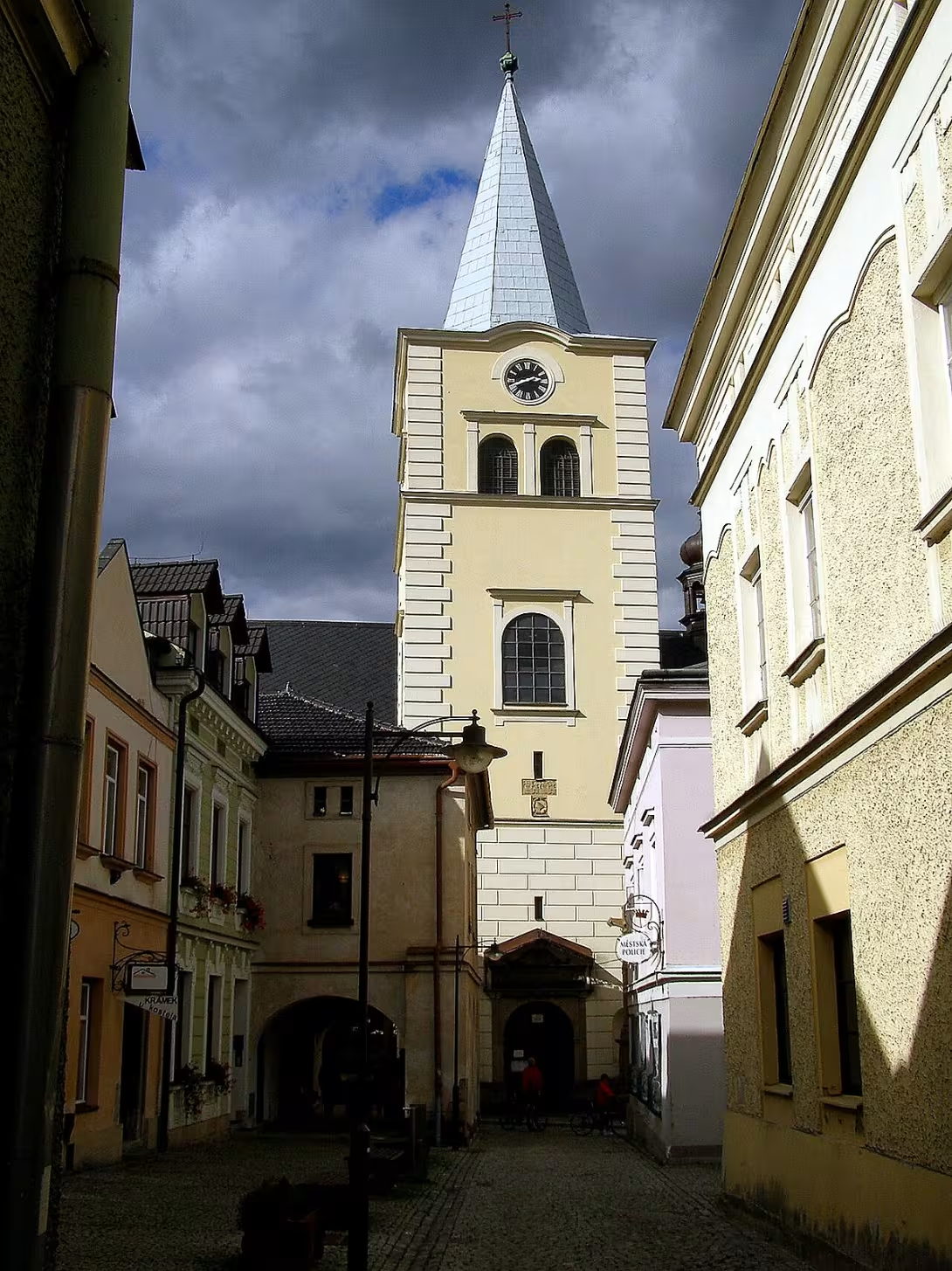
The Church of the Assumption of the Virgin Mary in the Valachian Mezirici is a Baroque parish temple and a protected cultural monument whose history dates back to the 13th century. It represents a significant dominance of the city and its surroundings.
The predecessor of the present building was the smaller church of St. Kunhuta from the 13th century. The first written mention of today's construction dates back to 1419, when it was built at the site of the original temple.
Originally, the Gothic building has undergone several major changes over the centuries. After the fire in 1572, it was remodeled and a new tower was built. In the middle of the 18th century the main ship of the church was rebuilt into a baroque style. In 1804, the second tower, originally forming part of the city's fortification, was reduced due to the decay and its space was subsequently adjusted to the sacristy.
During the Renaissance the church was owned by the family Žerotín. Their influence is evident on the portal from 1581, where the coats of arms of Bernard from Žerotín and his wife Anna Ester from Kunovice are depicted. Similarly, this character is depicted on the oratory, which was added between 1681 and 1682 together with the Baroque Chapel of the Virgin Mary.
The church has been hit several times in history by fires, especially during the Thirty Years' War. The Baroque gate to the parish yard with statues of the apostles Peter and Paul and the sandstone cross from 1790 are important accessories of the construction. A special feature is a set of statues depicting Jesus Christ and his disciples in the Gethseman Garden. Originally wooden sculptures from 1722 were replaced by stone parts in 1931, the author of which was Olomouc sculptor František Doležal.
Today, the Church of the Assumption of the Virgin Mary is protected as a cultural monument and continues to serve as the main parish temple. Thanks to its location and architecture, it remains a key landmark in the Valachian Mezričí space.
The monument offers a view of the layered history of architecture from Gothic to Renaissance to Baroque. Her visit is worth it thanks to high historical value and importance for the whole region.
Historical milestones
- 1419
- First written mention of the present church
- 1572
- Fire and Renaissance reconstruction
- 1681
- Addition of the Baroque Chapel and the Žerotín Oratory
- 1804
- Decrease of the second tower and its adaptation to the sacristy
Architectural development
The original Gothic church was remodeled after the fire in 1572. In the middle of the 18th century, the main ship was rebuilt into Baroque style. The second tower was reduced in 1804 and adapted to sacristy.
Historical events
1419 - first written mention of the current church; 1572 - fire and renaissance reconstruction; 1681 - addition of the baroque chapel; 1804 - adaptation of the tower to the sacristy.
Owners
House of Žerotín
Points of interest
- The history of the temple dates back to the 13th century and its predecessor was the smaller church of St. Kunhuta. - After the fire in 1572, the construction was remodeled and a new tower was built. - The second tower, which was originally part of the city fortification, was reduced in 1804 and adapted to the sacristy. - In the Renaissance period the church owned the family Žerotín, which is evidenced by a portal from 1581 with their coats of arms. - A set of statues depicting Jesus Christ and his disciples in the Gethseman Garden was replaced in 1931 by stone pieces by František Doležal.
Guide
Show guide text
This text was created by artificial intelligence and has not been editorially reviewed. It may contain inaccuracies.
Welcome to the heart of the Valachian Mezirich. You're standing in front of a building far beyond walls and roofs. The Church of the Assumption of the Virgin Mary is the dominant one that has been determining the rhythm of this city and its surroundings for centuries. When you look at it now, you see not only an impressive structure, but above all a living story that has been written here for seven centuries. Feel the atmosphere of peace and nobility radiating from this place. This building is not only the centre of the local community, but also a silent witness to all the great and small events that this city had to face.
Let's go back deep into the past together to understand where this church comes from. Although the current form may seem eternal to you, its roots date back to the 13th century. At that time, this church was not yet here, but a much smaller and simpler temple dedicated to St. Kunhuteda. Imagine that period landscape, a much less developed city, and this little point of faith that was the basis for everything you see today. The first clear trace of the current church, as we know it, appears in documents from 1419. This means that this building has resisted countless generations, survived many political change and social upheaval.
Now pay attention to the architecture right in front of your eyes. The church is not the result of one single time, but it is more like a mosaic composed of different epoch. If you look at his main tower, you'll see how important it is to the whole landscape. This tower serves as an orientation point and a symbol of stability. Note also the baroque elements you will find here. These details are not original, but were added later to give the construction its current, richer character. This change was neither random nor optional, but forced by fate. The church had to face the devastating fires that had hit the city in the past. Each such fire may have left burns, but at the same time it brought an opportunity to rebuild and make the church even more beautiful.
One of the most important moments in the history of this building was 1572. That's when the church had to deal with another devastating fire. But this event did not mean the end, but the beginning of a new chapter. After this fire, there was a renaissance reconstruction. It is thanks to this period that the construction has acquired certain features that you can still see in it. It's fascinating how tragedy has become an opportunity for architectural growth.
Let us now move forward in time by the next century. The family of Žerotín has entered into an important role. There was another fundamental change in 1681, when the Baroque Chapel and the so-called Jerotian Orator were built. This tells us that the church was not only a place for ordinary people, but also for important noble families who sought their spiritual background here. There were important moments in these areas for the region's power structures at the time.
Now look at the other tower, which is part of the whole complex. You may be surprised by her present appearance. This tower is not as dominant as the main one. There's a very interesting reason. In the original time, this tower was part of a city fortification. It was part of a defense system that protected the people from attacks. The city was much more focused on defense at the time than on quiet life. But with time, the city's needs have changed. In 1804, it was decided that this tower would no longer serve to defend itself. It was deliberately reduced and its space was adjusted to serve as a sacristy. It's a fascinating example of how the functions of buildings change by how the world around them changes. The military element has become space for the service of God and liturgy.
In the history of this place, there have been stories of specific people leaving their mark. We can name Bernardo from Žerotín, for example, whose name is closely linked to this place and to that important oratory. Let us not forget Anna Esther of Kunovice, who was part of the world at the time and whose traces in the history of the region are evident. And, of course, there is no place not to mention František Doležal, a character that is very important for the history of the local community and parish. These people were not just names in chronicles, but people with their own ambitions, beliefs and influence who helped shape the face of this church and the whole city.
If you're looking for something that really interests you, think about what you see around you. There's this interesting thing that connects the military to the religious one. The second tower you've just seen is living proof of how the boundaries between security and spiritual life are covered. Imagine the reconstruction in 1804. Imagine those people who had to decide not to build walls anymore, but would need a place for religious objects and the preparation of ceremonies. It is a symbol of the transition from a time of constant conflict to a time when people could focus more on their inner life and community.
You're standing in front of a place that's like a book with many leaves. Every layer of stone, every change in the shape of towers, and every baroque ornament tells about how people tried to build something lasting in an unstable world. The Church of the Assumption of the Virgin Mary is not only a monument, it is a living organism that still breathes the history of the Walash Mezirich.
I hope this brief insight into the past inspired you to explore again. In front of you there are still many other roads and corners worth exploring. Take a look at the surroundings, see the atmosphere of this place and let it take you by its history. Thank you for spending this moment right here with us. We wish you a nice walk and many more experiences in getting to know this beautiful city. We say goodbye and wish you a pleasant continuation on your journey.
Tips for visitors
The best time to visit the Church of the Ascension of the Virgin Mary in Valašské Meziříčí is autumn or spring, when the surrounding landscape is particularly charming and the light for photography is ideal. This church with a history dating back to the 13th century offers a wonderful view of the city and surrounding landscape.
Parking can be found near the sights, but we recommend the use of public transport or taxi for easier access. Current information about car parks and transport links can be found online.
When visiting, it is recommended to take sunglasses, hat or cap with you, especially in the summer months. It is also appropriate to bring your luggage for drinking water and refreshments as it may not be available on the premises itself.
For the photography of the church it is recommended to visit the place in the early morning or late afternoon when light is less intense and shading when shooting better. The best views offer west of the church towards the city centre.
In the vicinity of the monument there are several interesting places that can be visited within a 30-minute walk. These include the historic heart of the Valachian Mezirice and its streets full of picturesque houses. A visit to the local animal park is suitable for families with children, where children can enjoy time in nature and meet different species of animals.
Businesses nearby
Do you run a restaurant, accommodation, shop, museum, rental, wellness or other visitor service near this monument? Show yourself directly to the people heading to it — this is how they will see you in the app and on the web:
Nearby
Valašské Meziříčí
Accommodation nearby
Themed route
1. Church of the Assumption of the Virgin Mary (sacral monument) - A tour of the inner space and the capture of the spiritual atmosphere of the building. 2. Church Tower (Tower) - Output to get a view of the surroundings. 3. The reservoir of the church (area) - A quiet walk in the immediate vicinity of the monument.
Seasonal recommendations
Spring - In March and April, a soft, scattered light is spread over the Wallachian Mezirconia, which highlights the colour of the stone facades of the Church of the Ascension of the Virgin Mary. The first flowers bloom in the surrounding gardens, making the walk to the temple pleasant and peaceful. At this time visitors are still quite scattered, so it is worth arriving after lunch when the crowds do not rush to the main entrance. A light jacket or sweater is recommended because the wounds can be cold, and comfortable shoes on an uneven base of old stone paths.
Summer - In the summer months, the sun hits the high towers of the church at an angle that creates significant shadows and underlines Gothic details. The surrounding forests are in full green robes, which provides a pleasant contrast to the stone. In the main summer season the traffic increases, especially during the afternoon, therefore it is best to arrive early in the morning when the gates are open and the queues are minimal. Due to higher temperatures, light clothes, sunglasses and headgear are useful; Remember the bottle of water, because walking on a stone courtyard can be hot.
Autumn - Autumn sun rays penetrate through the leaves, creating golden sparks on the stained glass and wooden portals of the church. The colour palette of surrounding parks - orange, red and brown - gives the place a nostalgic touch. During this period the crowds will gradually disperse, so even the afternoon visit is easy. Laminated clothing is recommended because the wounds are cold and the afternoon may appear mild wind; solid footwear is also suitable for wet leaves. The ideal time is the first half of October, when there is still enough light, but tourism has already receded.
Winter - In winter, the church looks majestic under white snow, and when the sun lights up its towers, an almost mystical atmosphere arises. In advent time, interiors are often gently lit with candles, which underlines the spiritual calm of the place. The opening hours may be shortened, so it is advisable to check the current operating hours and arrive during the morning. Dress warm - thermal linens, sweater, winter coat, hats and gloves - and don't forget to wear anti-slip shoes, because stone steps can be icy. A short visit in the morning allows you to enjoy the peace without waiting in line.
Visualizations and artistic views


The visualisations are generated by artificial intelligence and serve as inspiration.
Photos from the area
Real photos taken near the monument

Zdroj a licence jsou uvedeny u každého snímku.
Tips from visitors
No tips yet. Be the first!
Log in and add your tip.
Sources and literature
Faktickým podkladem tohoto textu byl článek na Wikipedii, jehož autory jsou přispěvatelé Wikipedie. Článek je dostupný pod licencí CC BY-SA 4.0.
Location on the map


Příběhy a pověsti
Legendy, pověsti a příběhy spjaté s touto památkou
Fotografie návštěvníků
Zatím žádné fotografie. Buďte první, kdo přidá fotografii z návštěvy!
Log in a přidejte svou fotografii nebo hodnoťte.
Za ověřenou návštěvu v aplikaci získáte víc bodů — poznáme podle GPS, že jste na místě.
Reviews and comments