



Kostel Navštívení Panny Marie Church
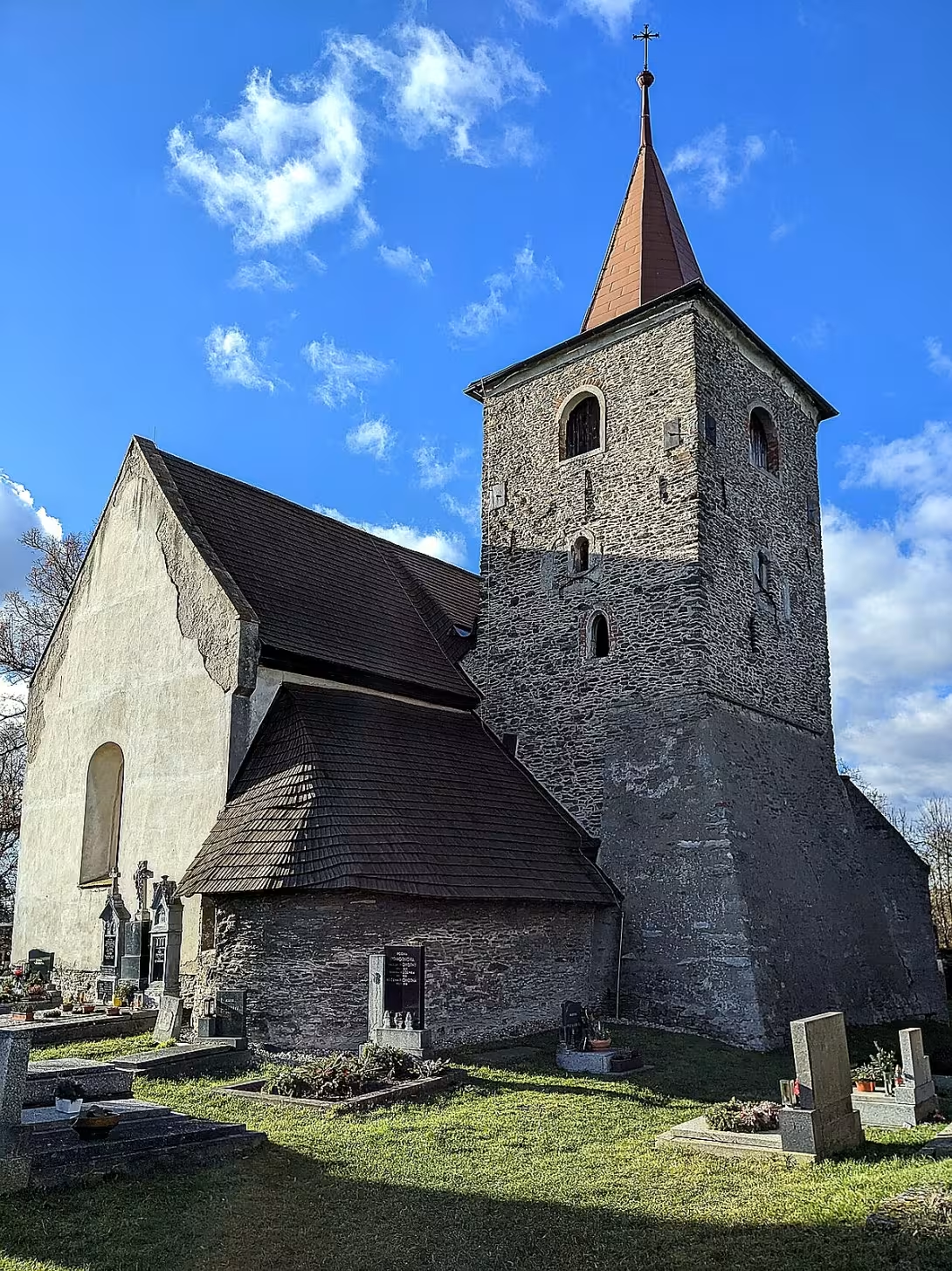
Kostel Navštívení Panny Marie in Vysoká is an early Gothic building from the last third of the 13th century. To this day, it has survived almost in its original form. It is located on the northern edge of the village Vysoká in the Central Bohemian Region and is protected as a cultural monument of the Czech Republic. The construction is especially important with its architectural integrity and recently discovered medieval wall paintings.
The church was founded in the last third of the 13th century. At that time the Gothic style developed in Bohemia and the country was part of the Luxembourg monarchy under the rule of King Wenceslas II. The oldest history of the building is the case with professional disputes that relate primarily to sacristy. Some historians consider it originally a separate, early Romanesque church from the 10th century, which was later incorporated into the present building. If this hypothesis were confirmed, it would be one of the oldest preserved buildings in the Czech Republic.
It is a rectangular one-boat church with a rectangular priesthood, a rectangular sacristy with an unsymmetrically elongated apsid and a massive prism tower on the north side. The façades are smooth, the windows are thick, profiled and with a deep pancake. The steep southern entry portal represents a typical example of heavy early goth. There is a Romanesque window of archaic shape with a compressed arch. The priestess is a glass vault with wedge ribs, while the sacristy is a glass of valene and an unsymmetrical apsid of the condom. In the ship is preserved wooden ceiling from the first half of the 18th century and a circle from 1722. The interior is complemented by a Baroque pulpit from 1700 and an early Baroque portal altar from 1648 with original paintings of the Visitation of the Virgin Mary and the Holy Trinity.
In the 14th century, the church was parochial. In 1745, however, the rectory was abolished and transferred to Suchdola. Currently, the building is managed by the Cologne parish.
The key event in recent history was 2020 when remarkable wall paintings from three time periods were uncovered on the walls of the presbytery. The oldest group of paintings dates back to around 1300. It includes a large scene of the Crucifixion with the figure of Christ on the cross, the Virgin Mary on the left and Saint John the Evangelist on the right. In the pallets of the window in the east wall are displayed figures of saints: the right part of St. Barbara with a tower and the left part of St. Bartholomew with a knife in his right hand. These paintings were created by an unknown author who was familiar with the style of Master Theodoric and the principles of making the so-called Master of the Třeboň altar. The second phase includes a template ornament on the south wall of the mid-15th century. The youngest layer is a blue painting of an interclave space presbytery from the end of the 15th or mid 17th century. After removing the later coatings, it turned out that the arches were originally red with black separating stripes. In the years 2021-2024 there was professional restoration work, for which it was ak.mal.. Helena Slavíková designed for the annual award of the National Heritage Institute Patrimonium for futuro.
The church is located at an altitude of 430 meters off the road leading to the Red Peček. It is a place where the development of architecture and art can be directly monitored from the early Middle Ages to the Baroque. The monument represents a rare and authentic example of preserved Gothic construction.
Then and now
Drag the slider to compare how the landmark may have looked when it was built with the view today.
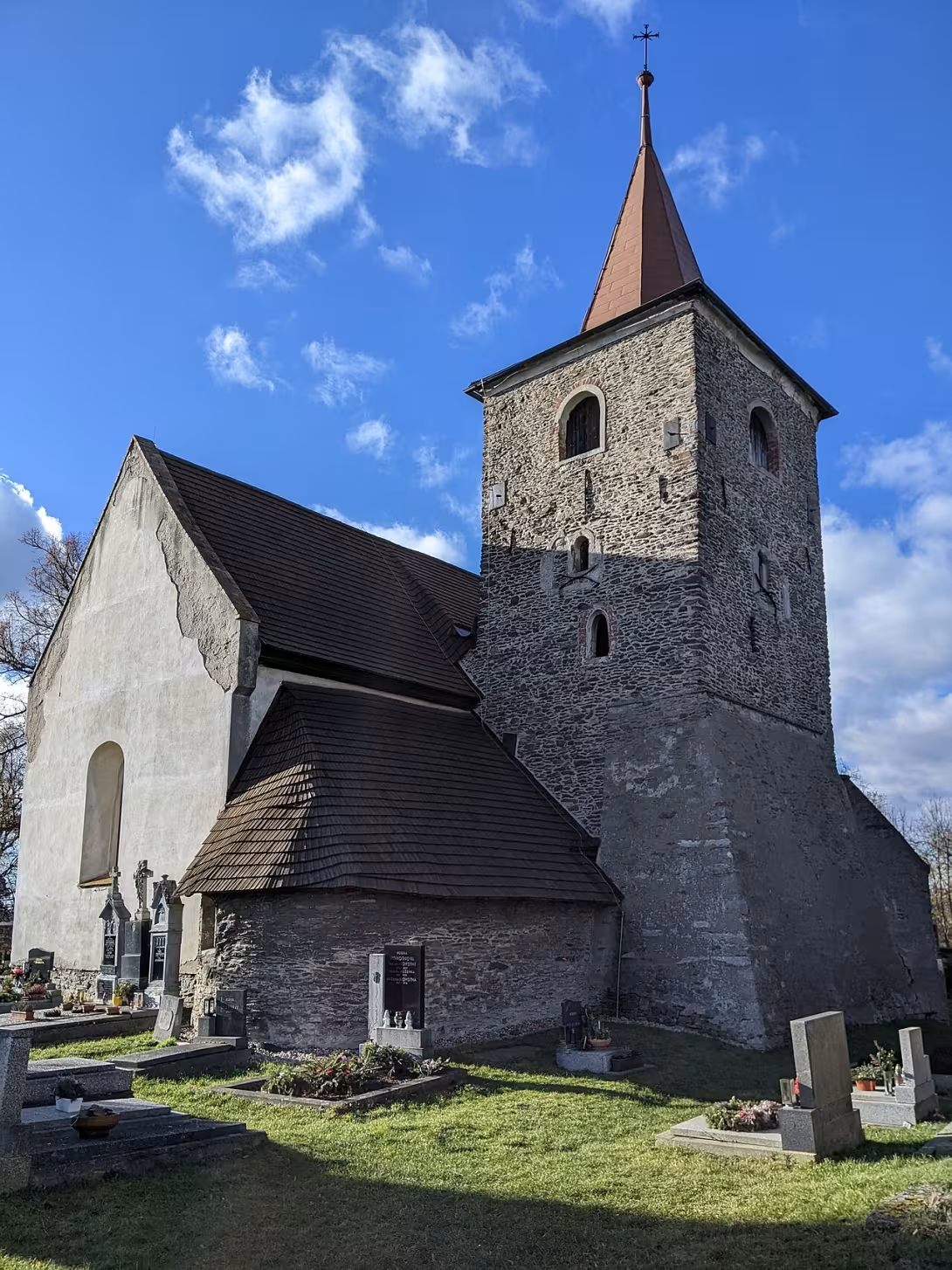

The historical appearance on the left is an AI-generated visualisation and serves as inspiration only.
Historical milestones
- around 900
- Possible creation of the original early Romanesque church in the place of sacristy
- Last third of the 13th century
- The creation of a contemporary early Gothic church construction
- around 1300
- The creation of the oldest group of medieval wall paintings
- 14th Century
- Church functions as parish church
- 1648
- The formation of the early Baroque portal altar
- 20
- Discovering medieval wall paintings in presbytery
Architectural development
The church is a rectangular single boat with a rectangular priesthood and sacristy. The facades are smooth, the windows are pointy profiled. A wooden ceiling from the first half of the 18th century and a circle from 1722 were preserved in the ship. The priestess is a glass of the vault, a sacristy of valenas.
Historical events
- 1745
- The rectory was canceled and transferred to Suchdol.
- 20
- On the walls of the presbytery were uncovered remarkable wall paintings from three time periods.
Points of interest
- Early Gothic building from the last third of the 13th century was preserved almost in its original form. - Some historians consider the sacristy originally a separate Roman church from the 10th century. If confirmed, this would be one of the oldest preserved buildings in the Czech Republic. - In 2020, wall paintings from three time periods were unveiled in the presbytery, the oldest from around 1300. - The oldest painting was created by an unknown author who was familiar with the style of Master Theodoric and Master of Třeboň Altar. - After removing the later coatings, it turns out that the arches were originally red with black separating stripes.
Guide
Show guide text
This text was created by artificial intelligence and has not been editorially reviewed. It may contain inaccuracies.
Welcome to Highland. You are standing in front of one of the most important and most precious architectural treasures of this region, in front of the Church of the Visitation of the Virgin Mary. Before you take another step, I suggest you stop for a moment and just soak up the atmosphere of this place. Look around you. The church is situated on the northern edge of the village, just off the road to Red Pěcky, and its presence here is unwavering and peaceful. Feel the weight of history that radiates from these walls. It is not just an ordinary building, it is a witness of centuries, which we have managed to preserve almost in its original, intact form. What you are now observing is a rare sample of early goth that has survived the storm of history and remained faithful to its original purpose.
Now let's look deeper into the past together and understand how this object was created. Although the construction you see appears to be monotonous, its roots extend far deeper into the dark ages of the Middle Ages. Historical records and the very form of construction point us to a fascinating journey through centuries. The main part of the church, this early Gothic whole, dates back to the last third of the 13th century. At that time, architecture was changing, new shapes were trying to meet new spiritual needs, and it was here that these changes became stone. In the 14th century, this church fulfilled its important role as a parish church, becoming the heart of the local community, the place of meeting, prayer and social life of all people who lived here.
Now pay attention to the very structure of the building that is right in front of your eyes. If you look at the total silhouette, you'll see the one-ship structure. This means that the inner space is one, uniform and clear, which is typical of the early period. With your eyes, no doubt, the mighty, prismatic tower must be made first. Its mass gives the whole a sense of stability and protection. Note how the church consists of several parts that fit organically. It has a rectangular priesthood that forms the body of the church, and a rectangular sacristy. But this sacristy is more than just a practical space for spiritual aids.
When you look at the details, try to realize that this building is not just the result of one time. Although the dominant style is goth, later periods are reflected in its layers. For example, in the year sixteen hundred forty-eight there was an early Baroque portal altar. This element brought a new, richer aesthetics into the church, which contrasts with the original, the moth and the strong Gothic form. It is a fascinating dialogue between two completely different worlds that meet here within one building.
But now I want to invite you to the most important, to the secret that this place holds and that still pulses in it. Prepare yourself for something that can completely change your view of this church. The historians and researchers are still discussing one very likely but constantly tested theory. Look at the rectangular sacristy you just recorded. There are strong assumptions that this part may not have originally been part of the Gothic church, but that it could have been a separate Romanesque object dating back to the tenth century. If this theory had been confirmed, we would have talked about one of the oldest preserved buildings in the Czech Republic. Imagine this - you are facing something that has its roots at a time when our country has just formed. The sacristy would be like a small, ancient jewel, which later was connected to a larger Gothic total.
This fascination with the old and undiscovered does not end at our present age. Just recently, in the year 2,000, a new chapter has opened up in the history of this place. During the survey in presbytery, medieval wall paintings were discovered. Imagine the excitement where faces and images that have been forgotten for hundreds of years are reexposed beneath the layers of time and dust. These paintings, dating back to around 300, give us insight into the spiritual life and aesthetic sensations of people who once worshipped God here. These are the silent voices of the past that are now coming back to us.
Although we do not know the names of the particular architects who worked these stones or the names of the prominent figures who worked here over the centuries, their presence is felt in every detail. Every cut in the stone, every line of the tower and every hint of painting is the work of unknown masters who put their faith and their craft into this building. You are facing a monument that is not just a pile of stone, but a living document of human effort, an effort for eternity and a connection with something higher.
Now that you know the story behind these walls, I suggest you continue your search. Feel the silence that exists here and try to imagine how this place has changed over thousands of years. Take a look at the structure of the building from different angles, see how light hits its walls and how its appearance changes depending on the time of day. Every detail you find here can be the key to another secret. Thank you for taking the time to explore this special place. We wish you a pleasant further continuation in discovering the history and beauty that Vysoká offers us.
Tips for visitors
For the best experience we recommend a visit in the morning or late afternoon hours, when soft light best highlights the details of early Gothic architecture. When visiting we recommend shoes suitable for walking around the village. Families with children appreciate the peaceful atmosphere of this historic place, which serves as a living lesson in the history of medieval construction.
Frequently asked questions
Can the monument be visited?
Religious buildings are usually open mainly during services; at other times a visit is normally arranged with the parish or the operator. We have not verified specific times.
Where is the monument?
Location: Vysoká, Středočeský kraj. The map on this page shows the exact spot.
Why is the monument protected?
It is listed in the Central List of Cultural Monuments of the Czech Republic as a cultural monument (register no. 1000146585).
Businesses nearby
Do you run a restaurant, accommodation, shop, museum, rental, wellness or other visitor service near this monument? Show yourself directly to the people heading to it — this is how they will see you in the app and on the web:
Nearby
🏰 Historic sites (190)
- Belveder 0.7 km
- Vápenka 2.2 km
- Vápenná pec 2.3 km
- Pomník padlým 3.1 km
- Památník padlým 4.1 km
- Starý zámek Ratboř 4.2 km
- Nový zámek Ratboř 4.2 km
- sv. Anna 4.2 km
- Červené Pečky 4.5 km
- Památní deska zesnulým za 1. světové války 4.6 km
- Muzeum Malešov 4.7 km +420602262269
- Tvrz Malešov 4.7 km web
- Pomník zesnulých pruských vojáků 4.8 km
- obětem 1. a 2. světové války 5.0 km
- Mlýn Cimburk 5.0 km
- Hradiště Cimburk 5.1 km web
- Cimburk 5.2 km
- 1914 - 18 5.5 km
- Pamětní deska Karel Havlíček Borovský 6.0 km
- Pomník národního odboje 6.1 km
🍽️ Restaurants and dining (191)
- Restaurace Přítoky 4.3 km Přítoky 20 web
- U Řízka 4.5 km Dr. Dvořáka 108
- Kafíno 4.6 km náměstí 1. máje 9
- Restaurace Velas 4.7 km +420 602 282 860 web
- Přátelský pivovar Malešov 4.7 km web
- Krčma na konci světa 4.8 km
- Zrnko v hrnku 5.0 km +420725720072 web
- Úplně jiná hospoda 5.2 km
- Občerstvení u nádraží 5.5 km +420603851293
- Stop Cafe 5.5 km
- Bistro&Pub Barbora 5.9 km
- Bistro Skleník 6.0 km
- Žižkovka 6.0 km
- Bakalářská 6.0 km
- Restaurace Na Valech 6.0 km Husova 16 +420 720 442 051
- Kiosek u Saláků 6.0 km
- Trattoria Pizzeria Vyžlovka 6.1 km web
- Trattoria Pizzeria Vyžlovka 6.1 km
- Petr Polívka China Restaurant 6.1 km
- Kafírnictví v GASK 6.1 km
🏨 Accommodation (35)
- Ubytování u Fraňků 4.7 km +420723 327 329 web
- Autokemp Malešov 5.1 km web
- Pension Bed & Breakfast 5.9 km
- Barbora Kemp 6.0 km Tyršova 988 +420704737747 web
- Elvíra 6.0 km Kremnická 91/15
- Vista Apartments 6.0 km Kremnická 43/13 +420 601 355 466 web
- Restaurant a Penzion Barbora 6.0 km +420 327 316 327 web
- Hotel Opat 6.1 km
- U Varhanáře 6.2 km web
- Hotel Mědínek 6.5 km
- Penzion Havlíček 6.5 km web
- Hotel U Vlašského Dvora 6.5 km
- Elim 6.6 km
- Hotel Anna 6.6 km
- U Babky Bylinkářky 6.7 km +420 702 279 992 web
- Penzion Kutna 6.7 km
- Hotel Kréta 6.7 km
- Zlatá Stoupa 6.8 km
- Hotel U Kata 6.9 km web
- Ubytovna Lorecká 6.9 km
🚲 Rentals and sport (36)
- SKP Olympia 5.2 km
- TJ Sparta Kutná Hora, oddíl tenisu 5.6 km
- Tenisový klub 5.6 km
- TJ Sparta Kutná Hora 5.7 km
- Petr Kamenář 5.7 km +420 724 032 945
- Sport šampion 6.3 km Václavské náměstí 162/5 +420327513846
- Hala BIOS 6.4 km
- Sokol Kutná Hora 6.8 km
- Sparta Kutná Hora a.s. 6.9 km
- Ice Pool 7.0 km
- Sportovní hala Klimeška 7.0 km web
- Kutnohorská plovárna 7.0 km
- Kutnohorská plovárna 7.1 km web
- SKImania 7.3 km
- Sportisimo 7.8 km
- Motoškola Landa 8.2 km
- Střelnice Kolín 8.3 km
- Stáj Václav 8.3 km
- Trojka 8.6 km Polepská 667 +420602100555;+420603545616 web
- KOLÍNOKRÁM 8.7 km Havlíčkova 261
🥾 Hiking and nature (61)
- Vysoká 0.7 km
- Opatovický vrch 1.9 km
- Miskovický vrch 3.1 km
- Malešovský vrch 3.7 km
- Pramen sv. Vojtěcha 3.8 km
- Na černé rudě 3.9 km
- Písečný vrch 4.4 km
- Zámecký park 4.6 km
- Kamenný vrch 4.6 km
- menhir 5.1 km
- Lom u Červených Peček 5.2 km
- Malý Kuklík 5.3 km
- Park u pomníku 5.4 km
- hradiště Denemark 5.5 km
- Velký Kuklík 5.6 km
- Horní tvrz 5.8 km web
- View of the church 6.0 km
- Park GASK 6.0 km
- důl Osel 6.0 km
- Chlum 6.0 km
Accommodation nearby
Trips and activities nearby
Guided tours, tickets and activities nearby from GetYourGuide
Affiliate link: if you buy from the partner, we may receive a commission. The price for you does not change.
Search tours and activities →Themed route
Kostel Navštívení Panny Marie in the municipality of Vysoká represents the key point of this thematic cruise route, which focuses on the sacral architecture and spiritual history of the region. Since no specific surroundings are mentioned in the given background, the route is dedicated to a detailed examination of the monument itself and its immediate site, which allows a deeper insight into the history and artistic heritage of this place.
Kostel Navštívení Panny Marie Type: Sacral monument This temple is the heart of the village and its architecture departs from local building traditions. Visitors can enjoy the peaceful atmosphere of the interior, where history intersects with spiritual significance for the local community.
Tanks churches Type: Outdoor space The space around the temple offers an ideal place to relax and reflect. Here you can admire the details of the facade at close range and feel the connection with the local environment surrounding the temple.
Church Tower Type: Architectural element The tower dominated the village silhouette and served historically as an orientation point. Its structures and facade details are an important part of the overall appearance of the monument and deserve attention during the tour.
Interior and exposition Type: Interior Inside the church there are elements that testify to its long history and maintenance. Exploring the interior allows you to understand the liturgical and artistic aspects of this place, which are often the most important for visitors.
This route is designed to enable visitors to fully experience the atmosphere of the church and its surroundings without the need to leave the immediate area of the monument. Focus on the details of the construction itself and its immediate surroundings ensures an authentic experience that is consistent with the available location information.
Seasonal recommendations
Spring brings to the surroundings of the Church the Visitation of the Virgin Mary in the High Awakening of Nature, which creates a calm and reassuring atmosphere. The light at this time is soft and diffuse, which underlines architectural details of the building without sharp shadows. The surrounding meadows and trees are slowly green, which gives the whole area freshness and visual harmony. This period is ideal for visitors in terms of calm, as the main tourist season has not yet started and the crowds are minimal. It is recommended to dress in layers because spring weather is variable and temperatures may vary significantly during the day. The best time to visit is in the morning, when the air is the cleanest and the light is the most suitable for outdoor photography.
Summer offers the longest daylight and full vitality of surrounding vegetation, creating a lively and sunny atmosphere. Intensive sunlight can be difficult in the middle of the day, so it is crucial to adapt your clothes to light and breathable substances and protect yourself from direct sunlight. This period is typical of higher traffic, especially on weekends and in the main summer season, when groups of tourists come here. In order to avoid the biggest crowds and unnecessary waiting, it is recommended to arrive as early as possible in the morning or late in the afternoon, when temperatures are slightly reduced and the space is calmed down. Moisture summer days can be unpleasant, so it is advisable to have a drinking mode and possibly light umbrella protection in case of summer storms.
Autumn brings a unique atmosphere of heat and melancholy around the monument, underlined by golden and red shades of decaying leaves. Light in autumn months is lower and warmer, which creates dramatic shadows and highlights the texture of the church stone. Nature around the building gains on color richness, making the visit a visually very attractive experience. Visitors' doses decrease significantly during this period, which allows a quiet and private tour without interference. Clothes should be laminated and include a wind jacket because autumn wind can be cold and unpleasant. The ideal time is the late afternoon, when the sun boils towards the horizon and lighting the building becomes romantic.
Winter brings a quiet and peaceful atmosphere around the church, often decorated with snow, which contrasts with the dark stone of the building. Short days and low sun create specific, low light conditions that can be challenging for photography, but very impressive for the atmosphere. The temperatures are low, therefore it is necessary to dress up in warm winter clothes, including gloves and caps, so that the visit is not unpleasant. In winter, there are often shorter opening times and some services may be limited, which must be verified in advance. Visiting is the lowest during this period, which guarantees complete peace and the possibility of a concentrated admiration of the monument without any interference. The best time is in the morning, when the weather is warmer and the light is brightest.
Visualizations and artistic views


The visualisations are generated by artificial intelligence and serve as inspiration.
Photos from the area
Real photos taken near the monument


Zdroj a licence jsou uvedeny u každého snímku.
Tips from visitors
No tips yet. Be the first!
Log in and add your tip.
Sources and literature
Photos: MartinVeselka / CC BY-SA 4.0 — Wikimedia Commons. The author and licence also appear when you hover over the image.
Faktickým podkladem tohoto textu byl článek na Wikipedii, jehož autory jsou přispěvatelé Wikipedie. Článek je dostupný pod licencí CC BY-SA 4.0.
Location on the map





Příběhy a pověsti
Legendy, pověsti a příběhy spjaté s touto památkou
Fotografie návštěvníků
Zatím žádné fotografie. Buďte první, kdo přidá fotografii z návštěvy!
Log in a přidejte svou fotografii nebo hodnoťte.
Za ověřenou návštěvu v aplikaci získáte víc bodů — poznáme podle GPS, že jste na místě.
Reviews and comments