



Kostel Nejsvětější Trojice (Český Dub II) Church
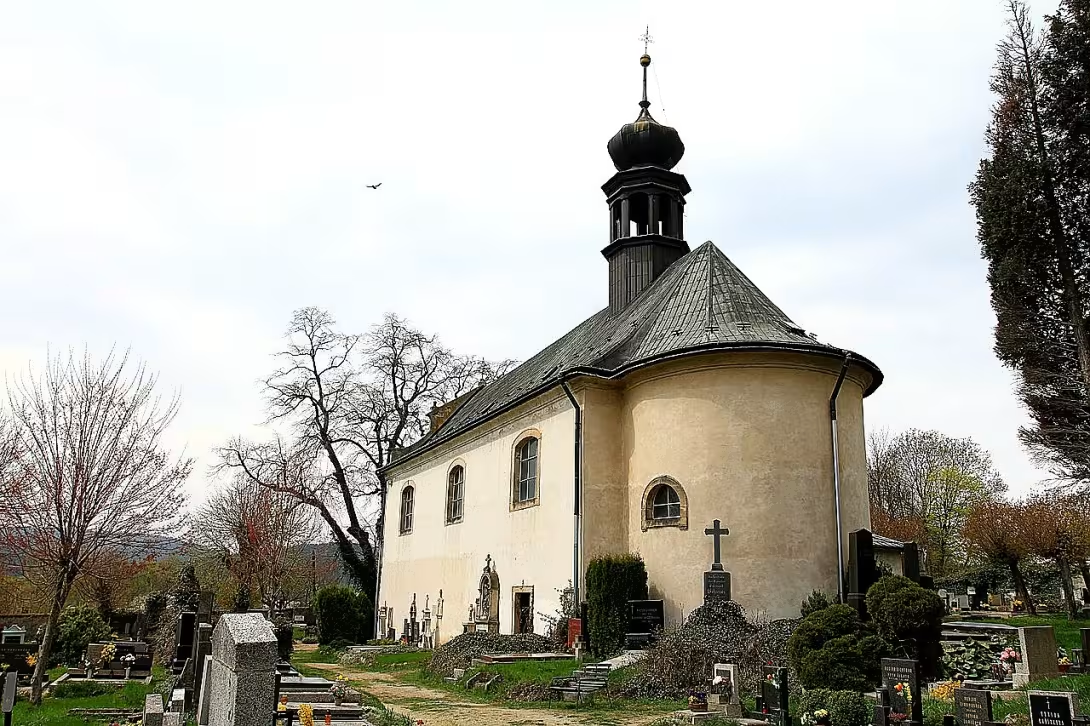
The Church of the Holy Trinity is situated in the cemetery area on the high rise north of Bedřich Smetana Square, behind the former walls of the historic Czech oak. It is a wall of a single-boat building of a rectangular plan, which is separated from other houses by a wall and belongs to the urban monument zone. The temple is protected as a cultural monument of the Czech Republic.
The church has a very long history. It is mentioned for the first time in the urban town hall from 1590, which means that the original building was built after 1570. In the beginning he served Lutherans who came to Czech Dub in numbers. Catholics began to use it at the beginning of the reCatholics. During the Thirty Years' War, the church was almost completely destroyed - it is believed to have been preserved by the western front. The present early Baroque form was acquired in 1681 at the latest, when they had it built by Norbert Knauth z Fahnenschwungu, the owner of the yard in the Burning Suburb, and Cyril Agricola z Limburku, who was the master of Rovni. This work by thanksgiving for the fact that their families were not affected by a major plague epidemic in the 1970s and 1980s.
The construction is characterized by simplicity and harmony typical of the time. The abandoned apside is closed in a semi-circular way and partially embedded in the ship's mass. The external facade of the членé lizene and segmented windows in stone sides. The octogonal lantern is mounted on the roof of the saddle with a roll over the presbytery with onion beating, poppy and top cross. The original shingles cover was replaced by sheet metal in the 1960s. Ground-floor sacristy is approaching the north front. The main entrance facade ends with a two-stroke shield with a triangular peak and an empty niche at the top. Above the entrance portal is a stone plate with carved Latin inscription and year 1681.
The interior is characterized by simplicity - the church boat has a recorded ceiling, presbytery is covered with cross. The facility comes from a large part of the construction period. The main altar is an early Baroque from 1663, a portal with a pillar structure and rococo portals with statues of saints Thomas and Dominic. The right side altar dates back to 1680 and displays the Poverty Patrons. The left altar is rococo from the second half of the 18th century. The walls are decorated with paintings - St. Francis of Paula from around 1720 in the original cut-up roll frame and the Jesse tribe from around 1700, which kept its original cut frame. The funeral shield of the Knauths family from 1771 is painted. There are stone tombstones from the 19th century on the perimeter of the church. On the north facade, the commemorative plate resembles three Prussian soldiers fallen in 1866.
The tomb of the Schmitt family is situated next to the church in a classic style with a crypt surrounded by a staircase and balustrade. Above it stands a square chapel with a dome and lantern, divided by ediculas with marble allegorical statues by F. Schwarz of Dresden. The area also contains the tomb of the Lehrer family, a pseudorenesance editorial with a statue of Madonna by the Schwarz brothers.
After 1945, the church lost a lot. Today it is used only exceptionally, especially for funeral ceremonies, but remains an important witness to three centuries of Czech history.
Then and now
Drag the slider to compare how the landmark may have looked when it was built with the view today.
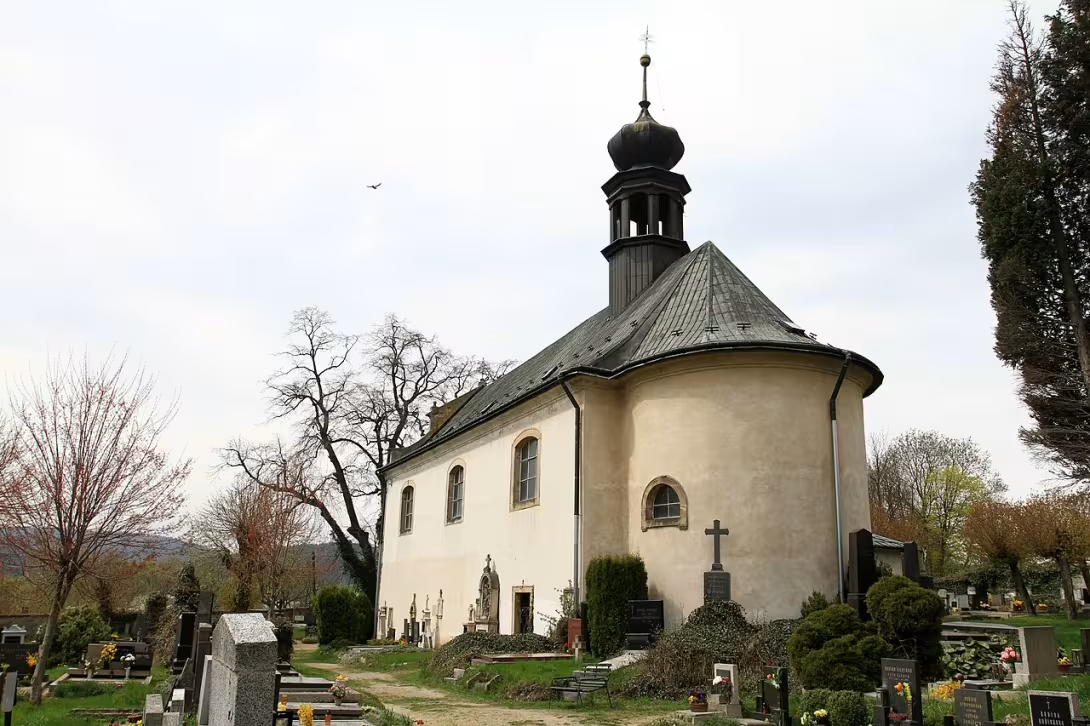

The historical appearance on the left is an AI-generated visualisation and serves as inspiration only.
Historical milestones
- 1590
- First mention of the church in the town hall
- 1618-1648
- Almost complete construction destruction during the 30-year war
- 1681
- Building the present early Baroque form of the temple
- 1771
- Painting of the Knauthi family funeral shield
- 1866
- Three heavy soldiers fell, reminded of a commemorative plaque
- 1960-1969
- Replacement of original shingles with sheet metal
Architectural development
The original church was exhibited after 1570 and used by lutherans before recatolation. After destruction during the Thirty Years War, the church was rebuilt into an early Baroque style in 1681 at the latest. The architecture includes a single-ship structure with octogonal lantern and a cross vault in the presbytery.
Historical events
In 1590, the construction was first mentioned in the Urbarian of the Dub estate. In 1681 the church gained its present early Baroque form.
Points of interest
- The church in the early days served Lutherans and later Catholics. During the Thirty Years' War, it was almost completely destroyed. - The current construction was created as a thanks to the fact that the founding families were not affected by a major plague epidemic. - The interior is decorated with paintings of St. Francis of Paula and the tribe Jesse in original cut frames. - On the north facade is a memorial plate for three Prussian soldiers fallen in 1866.
Guide
This guide is narrated by a synthetic voice generated by artificial intelligence.
Show guide text
This text was created by artificial intelligence and has not been editorially reviewed. It may contain inaccuracies.
The Early Baroque Church of the Holy Trinity in Český Dub stands in the middle of a cemetery on a raised area north of Bedřicha Smetany Square, beyond the former city walls. The entire complex is surrounded by a perimeter wall. It belongs to the municipal heritage zone and the church is protected as a cultural monument.
The church is first mentioned in the land register of the Český Dub estate from 1590. The original structure was built after 1570. It was a small church without a tower and was used by Lutherans, of whom a large number came to Český Dub at that time. With recatholization, Catholics took it over. During the Thirty Years' War it was almost completely destroyed and only the western entrance facade apparently survived. It acquired its present form no later than 1681. It was built by order of Norbert Knauth of Fahnenschwung, owner of a manor on the Upper Suburb, and Cyril Agricola of Limburk, lord of Rovni. It was their thanksgiving for the fact that the great plague epidemic in the seventies and eighties of the seventeenth century spared their families. After 1945 the church fell into considerable disrepair and today it is used only exceptionally, mainly for funerals.
It is a single-nave structure with a semicircular apse. The facades are divided by pilasters and segmented windows. On the roof, which was covered with sheet metal instead of shingles in the sixties of the twentieth century, sits an eight-sided lantern with a bulbous cupola and a cross. The facade is crowned by a two-storey gable with an empty niche. Above the entrance is a stone tablet with a Latin inscription dedicated to God in the Trinity alone, and with the year 1681. On the northern wall a memorial tablet commemorates the death of three Prussian soldiers in 1866.
Inside, the nave has a coffered ceiling and the presbytery has a cross vault. The furnishings are largely original. The main altar dates from 1663 and is decorated with statues of Saint Thomas and Saint Dominic. The right side altar from 1680 bears an image of the patrons against plague, the left one is Rococo style. There also hang paintings of Saint Francis of Paola and the Tree of Jesse in original carved frames and a painted funeral shield of the Knauth family from 1771.
Right next to the church stands a Classicist tomb of the industrial Schmitt family. Above the crypt with a staircase and a statue of Love rises a square chapel with a cupola and marble allegorical statues by the Dresden sculptor Schwarz. In the cemetery there is also a Pseudo-Renaissance tomb of the Lehrer family with a marble Madonna by the Schwarz brothers.
Tips for visitors
Best time to visit the church The most holy Trinity in Czech oak is autumn or spring, when vegetation is best coloured and the light of solar impact on architecture is ideal. These periods offer a quieter environment to explore historical details.
When visiting, bring protective clothing and shoes suitable for walking on the lawn, as the cemetery area may be unbalanced. Also remember the sunglasses and UV protection cream, especially during the summer.
For photography is the best time of the afternoon when light falls directly on the facade of the church. Don't forget to also explore the interior with its baroque elements and details which are exceptional in terms of artistic and historical.
In the vicinity of the monument you can visit the Holy Trinity Chapel, which is part of the complex, and explore the ancient tombs of the Schmitt and Lehrer families. These elements add another dimension to your visit.
For families with children it is advisable to organise a short walk around the cemetery area where children can learn about history and architecture. You can also design a small search engine with various details of the church or chapel.
Frequently asked questions
Can the monument be visited?
Religious buildings are usually open mainly during services; at other times a visit is normally arranged with the parish or the operator. We have not verified specific times.
Where is the monument?
Location: Český Dub II, Liberecký kraj. The map on this page shows the exact spot.
Why is the monument protected?
It is listed in the Central List of Cultural Monuments of the Czech Republic as a cultural monument (register no. 31680/5-4196).
For kids
Imagine going back to a time when our country was full of heroes and warriors. It was the time when the Czechs were under the rule of Emperor Rudolf II.
This place where the Church of the Holy Trinity in Bohemian Dubu is standing today was an ordinary village. People lived here in small houses and were mainly farmers. The village was surrounded by forests and a river, where people fed off fishing and hunting.
Businesses nearby
Do you run a restaurant, accommodation, shop, museum, rental, wellness or other visitor service near this monument? Show yourself directly to the people heading to it — this is how they will see you in the app and on the web:
Events nearby

Zdroj akcí: otevřená data měst a obcí ČR (Národní katalog otevřených dat) a kalendář akcí Národního památkového ústavu.
Nearby
The cemetery area with the chapel of the Holy Trinity, the morgue and the tombs of the Schmitt and Lehrer families.
Accommodation nearby
Trips and activities nearby
Guided tours, tickets and activities nearby from GetYourGuide
Affiliate link: if you buy from the partner, we may receive a commission. The price for you does not change.
Search tours and activities →Themed route
Kostel Nejsvětější Trojice (Český Dub II) Type: Church This is the main goal of your visit where you can see the sacral architecture and atmosphere of this local spiritual centre. The church is a key point for understanding the history and cultural heritage of the village Český Dub II.
Crest area with chapel Holy Trinity Type: Cemetery and Chapel In the immediate vicinity of the church there is a cemetery area which forms part of the total monument complex. Here you can admire the calm atmosphere and architectural details of the small chapel, which complements the main sacral building.
Marnice Type: Service building This building is an integral part of the cemetery area and serves traditional purposes associated with death and burial. Its presence demonstrates the functional organisation of this place as a centre of local community and memory.
Tombs of the Schmitt and Lehrer families Type: Memorial Tombs These particular tombs are mentioned as important elements of the cemetery area and can offer a view of the family history and social status of these families in the past. They are an important historical element that will enrich your tour with a social and genealogical context.
The route is designed to be as compact as possible and focused on the immediate vicinity of the main target. You start at the church, then you go to the cemetery area, where you visit the chapel, the morgue, and finally you look at the specific tombs. The whole walk takes place within one area, which ensures a smooth and logical course without the need for longer movements.
Seasonal recommendations
Spring in the Church The Holy Trinity brings gentle dawns, when the sun's rays penetrate through the stained glass and create a color game on the stone floors. The surrounding forests are awakening, the trees are green and the birch flowers provide fresh air. We recommend to arrive early in the morning when the visitor's current is even smaller, and dress in a light jacket or sweater, because it can be cold in colder parts of the day. The entrance door has been open since 9:00, so it is advisable to take more time before noon sun.
Summer brings bright sunlight to the church, which amplifies the contrast between golden ornaments and dark wooden interior. There is a green meadow in the surrounding area, and the trees cast a shadow, creating a pleasant atmosphere to relax after a tour. In the main summer season the visitor's interest increases, therefore it is reasonable to arrive immediately after opening, preferably between eight and ten o'clock, and wear comfortable shoes and light clothes with the possibility of sun protection, such as hat or sunglasses.
The autumn season gives the church warm tones of autumn when the sun's rays shine through the leaves and create golden and red reflections on stone columns. The surrounding area is spread with ripe crops and the smell of mushrooms, which underlines a calm and mild atmosphere. We recommend planning a visit for late afternoon when the crowds disperse and you can enjoy the quiet sound of the wind between the trees. Dress in layered clothes - sweater, light jacket and tight shoes, because autumn weather is variable and can bring colder sticks.
Winter in the Church The Holy Trinity offers an intimate atmosphere where snow covers the surrounding landscape and inner lighting highlights the details of Gothic columns and statues. In advent time, the interior is often heated with candles, creating a quiet and spiritual feel. We recommend to come between 10:00 and 11:00, dress in a warm coat, hat, gloves, and save time to warm up in the adjacent space, because the interior can be colder and the crowds less scattered.
Visualizations and artistic views


The visualisations are generated by artificial intelligence and serve as inspiration.
Photos from the area
Real photos taken near the monument


Zdroj a licence jsou uvedeny u každého snímku.
Atmosphere of the place
This atmospheric visualisation of the place and period was generated by artificial intelligence. It is not real footage of the location.
Tips from visitors
No tips yet. Be the first!
Log in and add your tip.
Sources and literature
Photos: Ondřej Kořínek / CC BY-SA 3.0 — Wikimedia Commons. The author and licence also appear when you hover over the image.
Faktickým podkladem tohoto textu byl článek na Wikipedii, jehož autory jsou přispěvatelé Wikipedie. Článek je dostupný pod licencí CC BY-SA 4.0.
Location on the map
Příběhy a pověsti
Legendy, pověsti a příběhy spjaté s touto památkou
Fotografie návštěvníků
Zatím žádné fotografie. Buďte první, kdo přidá fotografii z návštěvy!
Log in a přidejte svou fotografii nebo hodnoťte.
Za ověřenou návštěvu v aplikaci získáte víc bodů — poznáme podle GPS, že jste na místě.
Reviews and comments