



Kostel Nejsvětější Trojice (Sulejovice) Church
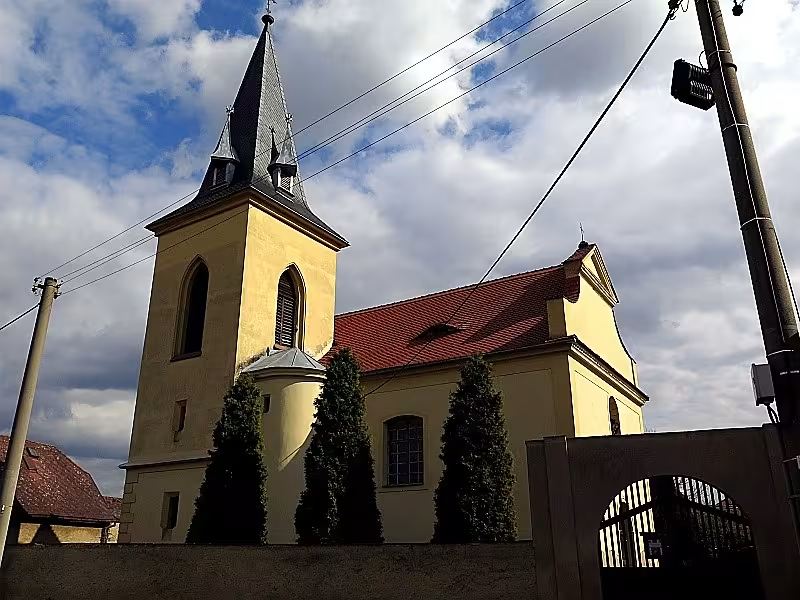
The Church of the Holy Trinity in Sulejovice near Lovosic dates back to the second half of the 14th century. According to available sources, Kunat ze Sulevic, a man of high standing in the state hierarchy, was responsible for its construction. In 1379 he held the position of Purkrabi at Ostrém near Benešov, in 1382 he was appointed Vice-Judicial Court and served as the highest mincmaster in the period 1386-1388. Subsequently in 1387-1391 he sat in the position of the highest scribe. It is this powerful representative of the period elite who built the church and profoundly called it a giant. The two family coats of arms located on the south side of the church - the coat of arms of Caplers and the coat of arms of Catherine of Vrábi, wife of Kunát.
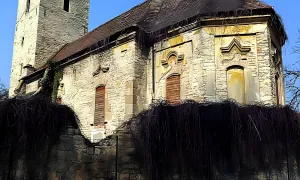
The architectural form of the church speaks of the long development of the building. The portal on the south side bears the features of Vladislav Gothic with the characteristic "donkey spine" - the tip at the top. Although these elements traditionally date back to 1440-1530, the portal itself is located in the second half of the sixteenth century and combines the elements of late Gothic with the strong ingredients of the Renaissance style. The family coats of arms are then in a purely Renaissance style and were placed up to two hundred years later - in the eighteenth century - as a memory of the patron saint of the church and his wife.
The fact that from 1713 until his death on February 28, 1741, the hermit Friedrich Niedel, brother of the Third Order of St. Francis Serafinski, lived near the church. The livelihood provided him with a hunting estate.
In 1788, the church suffered the devastating consequences of the fire. The following reconstruction took two years - the ship was rebuilt and modified in the period 1793- 1795. The report of August 24, 1887 mentions the files on this renovation held in the Prince's archive in Lovosice. The archive material was found intact in a tin tube hidden in a dome that was removed in August of the same year. Until now, stonework from after the fire has been preserved in the interior, especially the sanctuary and portal leading to the sacristy. The interior equipment comes mainly from the eighteenth century.
The last major intervention in the form of the church took place in 1887 when it was decided to increase the tower with the permission of Prince John Adolf II of Schwarzenberg and Bishop Emanuel Jan Baptist Schöbel. The construction was carried out by the Lovosice builder Carl Seeman according to the plan of the Prince's Building Office in the Citylobs. The hammer work on the tower, including the bullet, was entrusted to Master Vincent Hanikirsch. The document preserved from the time of renewal illustrates the names of all important persons and craftsmen involved in the work.
To this day, the church serves its original purpose - services - and remains a witness to several centuries of Czech history. The visitor will find a harmonious mix of Gothic and later elements that tell us about the life of the church over four centuries.
Then and now
Drag the slider to compare how the landmark may have looked when it was built with the view today.
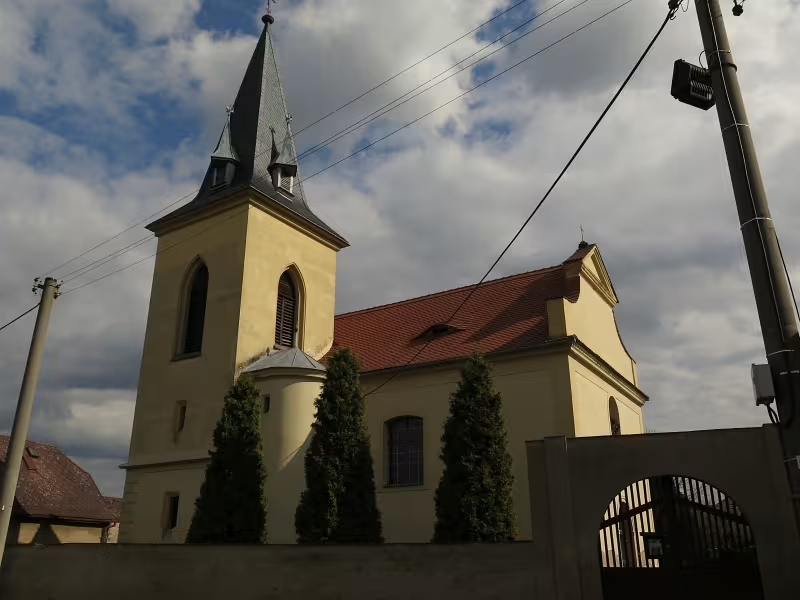

The historical appearance on the left is an AI-generated visualisation and serves as inspiration only.
Historical milestones
- 1713
- Near the church, the hermit Friedrich Niedel settled, who lived here until his death in 1741.
- 1788
- The church burned down, which, a few years later, required a massive reconstruction of the ship.
- 1887
- There was an increase in the church tower and overall renovation under the guidance of builder Carl Seeman.
Architectural development
Originally a Gothic building from the 14th century later acquired Renaissance and late Gothic elements such as a portal with donkey back. At the end of the 18th century, the baroque or classicist modification of the ship took place after the fire. At the end of the 19th century a prism tower was connected to the north side and its total monument renewal took place.
Historical events
In 1788 the church burned down and between 1793 and 1795 the reconstruction and modification of his ship took place. In 1887 the church tower was increased and the total repairs were carried out.
Owners
Lovosice Manor
Points of interest
- The construction of the church in the second half of the fourteenth century was due to Kunat ze Sulevic, who held a number of important state functions including the highest mincmaster and highest scribe. - On the south side of the church there are two family coats of arms - the coat of arms of Caplers and the coat of arms of Kunáta's wife Catherine of Vrábí. - From 1713 until his death in 1741, the hermit Friedrich Niedel lived near the church, whose livelihood was provided by the hunting estate. - In August of 1887, a metal tube was married from the dome, in which historical writings on the reconstruction of the church from the late eighteenth century were preserved intact.
Guide
This guide is narrated by a synthetic voice generated by artificial intelligence.
Show guide text
This text was created by artificial intelligence and has not been editorially reviewed. It may contain inaccuracies.
The Church of the Holy Trinity in Sulejovice near Lovosice was built in the second half of the 14th century and continues to serve religious purposes to this day. Originally a Gothic structure, the building underwent several reconstructions and is protected as a cultural monument.
Kunat ze Sulevic was behind the establishment of the church. He was an important man of his time. In 1379 he was castellan at Ostrý near Benešov, three years later he became court vice-judge, from 1386 to 1388 he served as the highest mint master, and from 1387 to 1391 as the highest clerk. According to the coat of arms above the portal, it was he who had the church built and he endowed it generously with prebends.
On the southern side of the church is an exposed small portal with two coats of arms. On the right is the coat of arms of the Kaplířs, on the left the coat of arms of Kateřina z Vrábí, Kunat's wife. The portal has what is called a broken-barrel arch, that is a point at the apex, typical of Vladislaus Gothic. It is set within a rectangular frame, which corresponds to Gothic style, but the stone above the point is already Renaissance. The portal therefore belongs to late Gothic with strong Renaissance elements and probably dates from the second half of the 16th century. Both coats of arms are Renaissance and were added approximately two hundred years later, apparently as a memorial by the family to the patron of the church and his wife.
From 1713 until his death on February 28, 1741, the hermit Friedrich Niedel, a tertiary of the Order of Saint Francis Seraphinus, lived in the vicinity of the church. His living was provided by the Lovosice estate.
In 1788 the church caught fire. From 1793 to 1795 its nave was reconstructed and modified. From that period, stonework has been preserved inside, particularly the sanctuary and the portal to the sacristy under the tower. On the outer wall of the sacristy, the outlet of a lavabo is visible. The interior furnishings also date predominantly from the 18th century. The documents concerning this restoration were later found undisturbed in a metal tube in the dome of the tower.
In 1887 the tower was heightened and the church repaired. Permission was granted by the patron of the church Jan Adolf the Second of Schwarzenberg and by the Litoměřice bishop Emanuel Jan Křtitel Schöbel. The construction was led by the Lovosice builder Carl Seeman according to plans from the princely building office in Cítolibě, and the tinsmith work including the sphere on the tower was carried out by master Vincenc Hanikirsch. During reconstruction in the 1990s, a document dated August 22, 1887 was found. It lists the names of the important people of the parish and craftsmen who repaired the church at that time.
Tips for visitors
The best time to visit the Church of the Holy Trinity in Sulejovice is in the morning, when the sun's light ideally radiates the historic facade of this Gothic sacral building from the 14th century. In addition, the calm atmosphere of the morning clock allows a deeper perception of the genius of the whole place. With you take comfortable shoes to walk around and possibly a telescope to observe the details of the exterior. For photography, it is best to use the afternoon side light to highlight the historical structure of the masonry, with the best shots achieved from the area before the main entrance to the church. The village Sulejovice located in the picturesque landscape of the Czech Central Mountains near the town of Lovosice is located within 30 minutes of the journey. Families with children appreciate the peaceful environment of the village without excessive tourism, which is ideal for a peaceful walk associated with the discovery of local history.
Frequently asked questions
Can the monument be visited?
Religious buildings are usually open mainly during services; at other times a visit is normally arranged with the parish or the operator. We have not verified specific times.
Where is the monument?
Location: Sulejovice, Ústecký kraj. The map on this page shows the exact spot.
Why is the monument protected?
It is listed in the Central List of Cultural Monuments of the Czech Republic as a cultural monument (register no. 16905/5-2325).
For kids
More than 626 years ago, when the trees in the gardens were swaying with a fine rain and the birds clenched the song, a wonderful building was built - the Church of the Holy Trinity in Sulejovice. It was like when little Count Kunat ze Sulevic wanted his home to have his own magnificent chapel, and she apparently appeared there!
Businesses nearby
Do you run a restaurant, accommodation, shop, museum, rental, wellness or other visitor service near this monument? Show yourself directly to the people heading to it — this is how they will see you in the app and on the web:
Events nearby

Zdroj akcí: otevřená data měst a obcí ČR (Národní katalog otevřených dat) a kalendář akcí Národního památkového ústavu.
Nearby
The village Sulejovice is located near the town of Lovosice in the picturesque landscape of the Czech Central Mountains.
Accommodation nearby
Trips and activities nearby
Guided tours, tickets and activities nearby from GetYourGuide
Affiliate link: if you buy from the partner, we may receive a commission. The price for you does not change.
Search tours and activities →Themed route
Municipality Sulejovice, village, picturesque village located near the town of Lovosice in the region of the Czech Central Mountains, which serves as the starting point of the whole trip and offers a quiet setting for the start of the trip.
Kostel Nejsvětější Trojice (Sulejovice), the church, the main destination of our route, located directly in the village Sulejovice and represents a significant sacral monument of the region in the region of the Czech Central Mountains.
City Lovosice, a city adjacent to the village Sulejovice in the picturesque landscape of the Czech Central Mountains, which forms the natural center of the whole area and concludes this thematic trip.
Seasonal recommendations
Spring: In the spring season, the Church of the Holy Trinity in Sulejovice opens to visitors with a new life when flowering shrubs and trees add their green shine to the atmosphere. Sun rays create fine patterns on the stone of the church, which gives the place unique beauty. This time of year is ideal for visiting due to mild temperatures and minimal crowds. The earlier arrival will allow you to enjoy a quiet tour without great collateral, but do not forget the warm clothes at the end of the day when the cool spring wind may appear.
Summer: In the summer period the monument in Sulejovice is full of life and light. Long sunny days allow a tour of the church even in the shade when open doors attract many visitors. Nature is in full power and you can enjoy flowering gardens and green fields that give the atmosphere a calm and refreshing feeling. It is recommended to arrive early in the morning or late in the evening to avoid heat and crowds. Don't forget the protective sunglasses and plenty of water.
Autumn: In the autumn, the atmosphere around the Church of the Holy Trinity in Sulejovice is strange when tree leaves start to change colour and fall. The sunny days are short and the warm sunshine of the sun gives the church a fine shine that is unique in this period. This time of year is ideal for a quiet visit because the crowd is decreasing and you can enjoy a peaceful tour. We recommend wearing warm clothes and bringing an umbrella with you because autumn weather is often random.
Winter: Winter in Sulejovice brings a peaceful and quiet feeling to the Church of the Holy Trinity when the country covers itself with snow. Light falls on white soil and decorated trees, creating a breathtaking atmosphere full of peace and mystery. The church is open to visitors even under winter conditions, but limited sunny days mean shorter opening times. We recommend warm clothes and suitable shoes for snow. Early arrival is advantageous because it often opens sooner than in other seasons.
Visualizations and artistic views


The visualisations are generated by artificial intelligence and serve as inspiration.
Photos from the area
Real photos taken near the monument

Zdroj a licence jsou uvedeny u každého snímku.
Atmosphere of the place
This atmospheric visualisation of the place and period was generated by artificial intelligence. It is not real footage of the location.
Tips from visitors
No tips yet. Be the first!
Log in and add your tip.
Sources and literature
Photos: Sovicka169 / CC BY-SA 4.0 — Wikimedia Commons. The author and licence also appear when you hover over the image.
Faktickým podkladem tohoto textu byl článek na Wikipedii, jehož autory jsou přispěvatelé Wikipedie. Článek je dostupný pod licencí CC BY-SA 4.0.
Location on the map

Příběhy a pověsti
Legendy, pověsti a příběhy spjaté s touto památkou
Fotografie návštěvníků
Zatím žádné fotografie. Buďte první, kdo přidá fotografii z návštěvy!
Log in a přidejte svou fotografii nebo hodnoťte.
Za ověřenou návštěvu v aplikaci získáte víc bodů — poznáme podle GPS, že jste na místě.
Reviews and comments