



Kostel Panny Marie Pomocné (Železná Ruda) Church
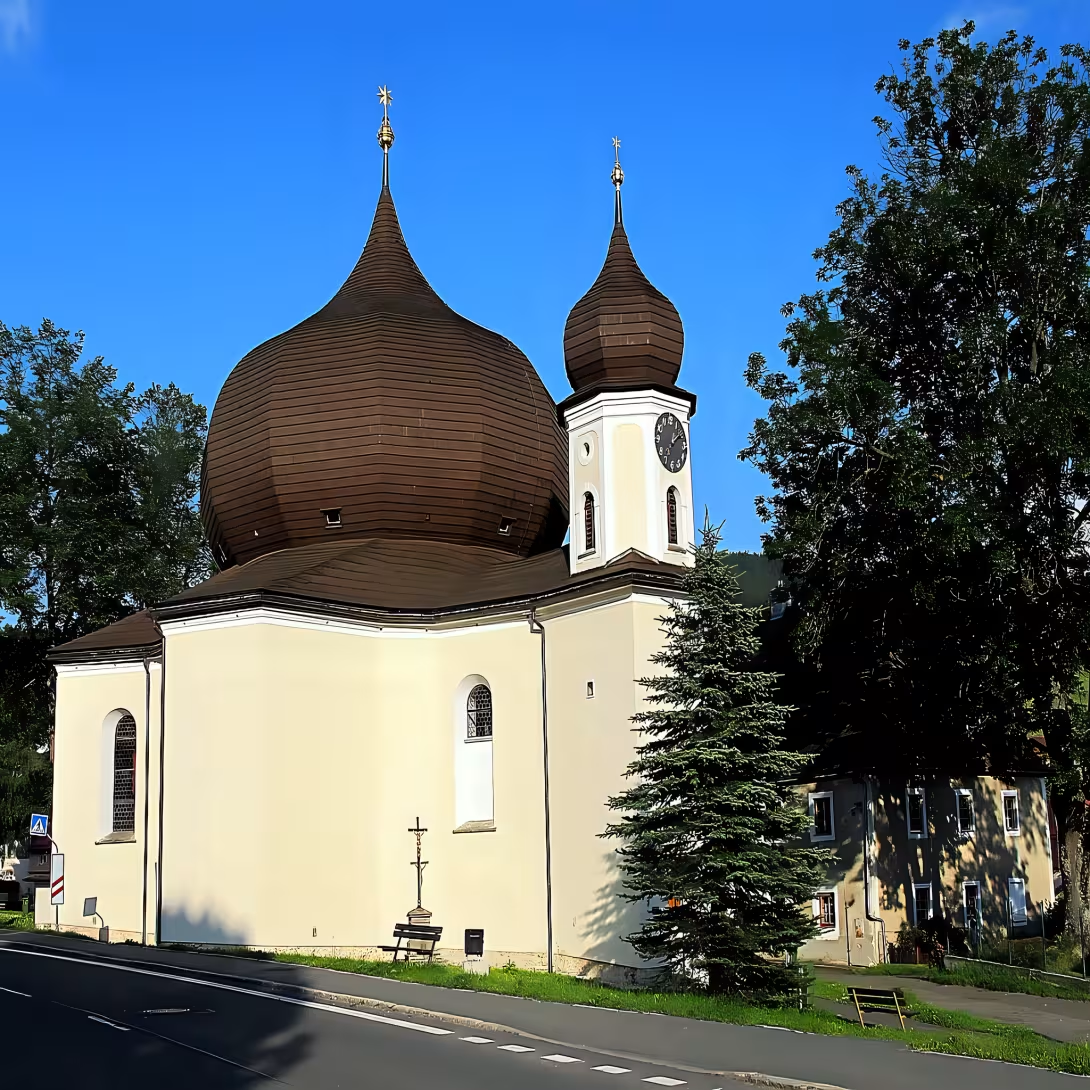
The Church of the Virgin Mary of the Star is a Baroque temple on Klostermann Square in Železná Ruda and serves as a parish church of the local Roman Catholic parish. In its name it refers precisely to the characteristic form of its construction, which fundamentally distinguishes it from ordinary sacral structures.
The church was built on the wishes of Wolf Henry Nothaf Count of Wernberg in 1729-1732 in the place where the original chapel used to stand. The construction was therefore based on the initiative of the local great, which was responsible for obtaining a more representative temple for Železná Ruda. Construction work continued after the late 1930s, when a smaller tower with an entrance was added to the main building in the 1970s, by which the believers reach the temple.
The architectural solution of the church is fully baroque, with its most remarkable element being an unusual ground plan made up of a six-pointed star. The construction crowns a significant dome whose constructive solution was challenging. The construction of the difficult roof was the work of carpenter Matyas Lehner, who had to handle the complex geometry of the stellar plan. The roof of the whole building is traditionally covered with shingles, which corresponds to the technical common Baroque solution.
The church's inner furnishings indicate the wealth of its benefactors. It was taken by Johan Georg Hafenbrädl and churches contain a number of valuable elements. Among them stands out a Marian altar painting, which represents one of two copies of the image of Madonna with a child from the Czech painter Lucas Cranach. Next to the main altar there are five other side altars in the temple. The baptism is made of Šumava granite and a chandelier of Šumava glass falls into the eyes. Particularly interesting are the tombstone epitaph slabs of Kehlheim marble, which bears the characteristics of members of the House of Hafenbrädle and resembles powerful local families associated with the history of the temple.
Then and now
Drag the slider to compare how the landmark may have looked when it was built with the view today.
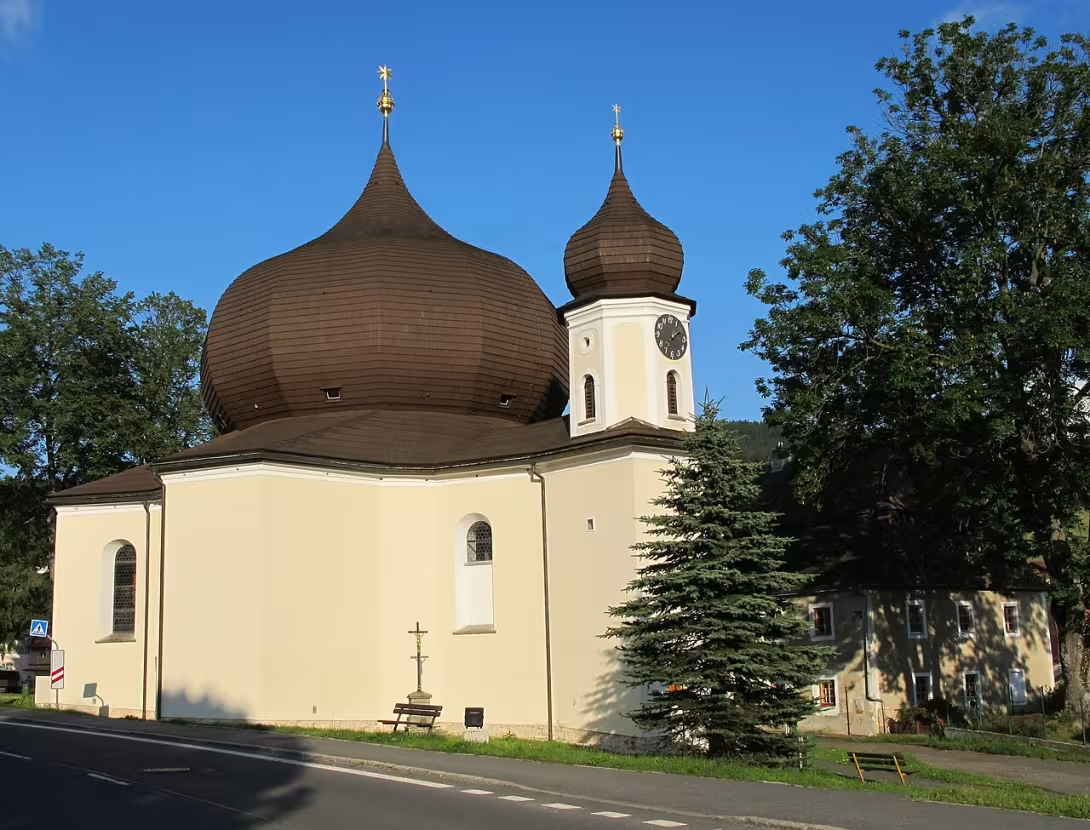

The historical appearance on the left is an AI-generated visualisation and serves as inspiration only.
Historical milestones
- 1729
- The decision to build the church on the site of the original chapel at the request of Wolf Henry Nothaf Count of Wernberg.
- 1732
- Completion of the main part of the church with a six-point star plan.
- 1770
- Finish adding a turret to the entrance.
Architectural development
The church was built in 1729-1732 as a Baroque building with a floor plan of a six-point star. The roof is covered with shingles, the dome has a complex cross from Matthias Lehner's carpenter. In the 1970s, a tower with an entrance was added. The interior equipment comes from the construction period and includes altars, altars, baptisms from Šumava granite and other art objects.
Historical events
- 1729
- The beginning of the church on the site of the original chapel at the request of Wolf Henry Nothaf Count of Wernberg.
- 1732
- Completion of the main part of the church with a six-point star plan.
- 1770
- Finish adding a smaller turret to the entrance.
Owners
The owner of the land was originally Wolf Jindřich Nothaf Count of Wernberg, later transferred to the administration of the parish Železná Ruda; the exact historical owners of the church as buildings are not listed in the supporting documents.
Points of interest
- The Church of the Virgin Mary the Auxiliary has an unusual floor plan in the shape of a six-pointed star, which distinguishes it from ordinary sacral structures.
- The construction was initiated by Wolf Henry Nothaf the Earl of Wernberg, who had the church built on the site of the original chapel in 1729-1732.
- A small tower with entrance to the temple was added to the main building later in the 1870s.
- The stellar plan required a complex construction of the roof made by the carpenter Matyah Lehner.
- The church contains a Marian altar painting, which is a copy of the famous work of Lucas Cranach - Madonna with a child.
Guide
This guide is narrated by a synthetic voice generated by artificial intelligence.
Show guide text
This text was created by artificial intelligence and has not been editorially reviewed. It may contain inaccuracies.
On Klostermannovo Square in Železná Ruda stands a Baroque church of the Virgin Mary Helper of the Star. It is the parish church of the local Roman Catholic parish.
Wolf Jindřich Nothaft, Count of Wernberg, had it built. The church was created between 1729 and 1732 on the spot where a chapel had previously stood. A smaller tower with the entrance was added only in the seventies of the eighteenth century.
What is most striking is the floor plan. The church has the shape of a six-pointed star and above it rises a distinctive dome. Its framework was demanding to construct and was built by carpenter Matyáš Lehner. The entire roof is covered with shingles.
Johan Georg Hafenbrädl took care of the interior furnishings. The altar is adorned with a Marian image, which is one of two copies of the Madonna with Child by painter Lucas Cranach. Besides it, there are five more side altars in the church. The baptismal font is made of Šumava granite and the chandelier is made of Šumava glass. Inside there are also epitaphial memorial plaques made of Kehlheim marble with the coats of arms of members of the Hafenbrädl family.
Tips for visitors
The best time to visit the church of Our Lady of Help is during the morning hours when the interior is pleasant light and fewer visitors. The Baroque architecture and the unique six-pointed star in the floor plan are thus better viewed and a quiet atmosphere is enjoyed. If you want to experience the church during a ceremonial service or concert, please inform the local parish in advance, as these events often offer a unique experience associated with music and liturgy.
It is recommended to arrive by car as public transport to Iron Rudy is not very common. The location is also available on foot from the city centre if you arrive from a nearby chateau, for example.
When visiting the church, wear comfortable clothes and shoes as it is a historic building with stone stairs and uneven surface. It is often cold in the interior, so bring a light sweater or coat. If you are planning to take pictures, do not forget the mobile charger, because you often do not allow large cameras in the church.
The best places for photography are the exterior facade of the church, especially its onion-shaped beating and the unique shape of the roof. For quality images is the ideal time in the morning or in the evening, when the light falls sideways and highlights the details. In the interior, photography is allowed only in places where it does not prevent other visitors, provided that you do not violate the peace of prayer space.
In the vicinity of the church is worth visiting the Baroque Castle Železná Ruda, which is located only about one kilometer away. Its park is ideal for a short walk and offers beautiful views of the surrounding countryside. Another interesting thing is Klostermann's house on the square, which is connected with the history of a significant family of entrepreneurs and offers a view of life in the past. Both of these places are easily accessible on foot
For families with children, a visit to the Church of the Virgin Mary Help is interesting thanks to its historic atmosphere and the opportunity to become acquainted with Baroque art. Children can see the unique shape of the church and look up details on the facade such as statues or ornaments. In the surroundings you can visit the Železná Ruda Chateau, where children often appreciate the park area and the opportunity to relax. It is also recommended to visit the local museum if it is open at the time of the visit or take a walk around the square and observe historical houses.
Frequently asked questions
Can the monument be visited?
Religious buildings are usually open mainly during services; at other times a visit is normally arranged with the parish or the operator. We have not verified specific times.
Where is the monument?
Location: Klostermannovo náměstí, Železná Ruda, Plzeňský kraj. The map on this page shows the exact spot.
Why is the monument protected?
It is listed in the Central List of Cultural Monuments of the Czech Republic as a cultural monument (register no. 38232/4-3520).
For kids
Imagine going back to the past, until Železná Ruda was a small town surrounded by trees and forests. The Church of the Virgin Mary the Auxiliary stood as a magnificent Baroque temple in the square where markets and festivities took place.
There lived people who lived in nature, hunted, collected fruit and crops. They were miners looking for gold and silver in deep mines. And then there was the church where services were held and people came to prayer.
Businesses nearby
Do you run a restaurant, accommodation, shop, museum, rental, wellness or other visitor service near this monument? Show yourself directly to the people heading to it — this is how they will see you in the app and on the web:
Accommodation nearby
Themed route
Thematic cruise route: The Baroque and Industrial Past of Iron Rudy
1. Church of the Virgin Mary Auxiliary * Type: Sacral construction * A unique church with remarkable architecture and historical frescoes, connected with the tradition of the Marian cult in the region. Its location in the heart of the village offers a quiet place to relax and admire the works of local artists.
2. Castle Železná Ruda * Type: Baroque residence * It lies only about 1 km from the church and represents a rare example of a noble residence with a well preserved park. Its history relates to the development of the village and is protected as a cultural monument.
3. Klostermann House * Type: Historical residence * It is located around the square and is connected with an important family of entrepreneurs who have influenced the economic development of the area. Its architecture and interiors reflect the wealth and lifestyle of its owners.
* The route combines the spiritual, cultural and economic heritage of the village, all of which are interconnected by short walking paths. *
Seasonal recommendations
Spring In the spring months, the Church of the Virgin Mary the Auxiliary is dressed in light, which penetrates through bright windows and creates fine, dispersed reflections in the interior. The surrounding area of the sights is still quiet until the surrounding area blooms in the woods and meadows, and the air carries a pleasant freshness after the rains. The atmosphere is quiet, almost meditative, ideal for a peaceful visit without disturbing crowds. It is practically advisable to visit the church early in the morning or in the afternoon when the sun rises or sets and creates playful shadows on the facade. Clothes should be layered - spring weather is variable, and even when the sun welcomes, evenings can be cold. It is also recommended to avoid weekends when tourists from the area can come here.
Summer In the summer months the church shines in full strength, when the sun illuminates its facade and creates sharp contrasts on the stone details. The surrounding area is lively, forests and surrounding peaks are transformed into green seas, and the visit can be associated with walking on natural paths. The atmosphere is more lively, but it still keeps quiet, especially in the morning. The best time to visit is early morning to avoid crowds that may appear in the main summer season, especially in the afternoon. Clothes should be easy, but with the possibility of covering the shoulders when entering the church. It is also recommended to take water and sun protection as the shade around the monument is not always sufficient.
Autumn Autumn brings a warm, almost mysterious atmosphere to the surroundings of the Church of Our Lady. The air is clean and cold, and the church appears to be a cozy refuge from the wind weather. Specific is also lighting - the sun sets earlier, and the church is often lit by natural light, which highlights its architecture. Practically best to visit the memory in the morning, when the light is the most beautiful and the crowds are less. Clothes should be warm, but not too heavy, because autumn weather can be variable. It is also recommended to avoid rainy days when paths to the monument can become slippery.
Winter In winter, the Church of the Virgin Mary of the Aids offers a unique atmosphere, where the snow blanket and frozen nature create a mysterious, almost fairy tale scene around it. The interior is warm and cosy, lit with artificial light, which emphasizes details of painting works and statues. The surrounding area is quiet because most tourists prefer a warmer season, and the visit can be a real experience for those who love winter silence. Clothes should be very warm, including warm shoes and gloves, as temperatures may fall below freezing. It is also recommended to monitor the opening times, which are usually shorter in winter, and to avoid visits in a time of severe snowstorms.
Visualizations and artistic views


The visualisations are generated by artificial intelligence and serve as inspiration.
Photos from the area
Real photos taken near the monument


Zdroj a licence jsou uvedeny u každého snímku.
Atmosphere of the place
This atmospheric visualisation of the place and period was generated by artificial intelligence. It is not real footage of the location.
Tips from visitors
No tips yet. Be the first!
Log in and add your tip.
Sources and literature
Photos: Huhulenik / CC BY 3.0, rozlišení zvýšeno umělou inteligencí — Wikimedia Commons. The author and licence also appear when you hover over the image.
Faktickým podkladem tohoto textu byl článek na Wikipedii, jehož autory jsou přispěvatelé Wikipedie. Článek je dostupný pod licencí CC BY-SA 4.0.
Location on the map
More monuments – Železná Ruda
Show all in the municipality



Příběhy a pověsti
Legendy, pověsti a příběhy spjaté s touto památkou
Fotografie návštěvníků
Zatím žádné fotografie. Buďte první, kdo přidá fotografii z návštěvy!
Log in a přidejte svou fotografii nebo hodnoťte.
Za ověřenou návštěvu v aplikaci získáte víc bodů — poznáme podle GPS, že jste na místě.
Reviews and comments