






Kostel Panny Marie Sněžné Church
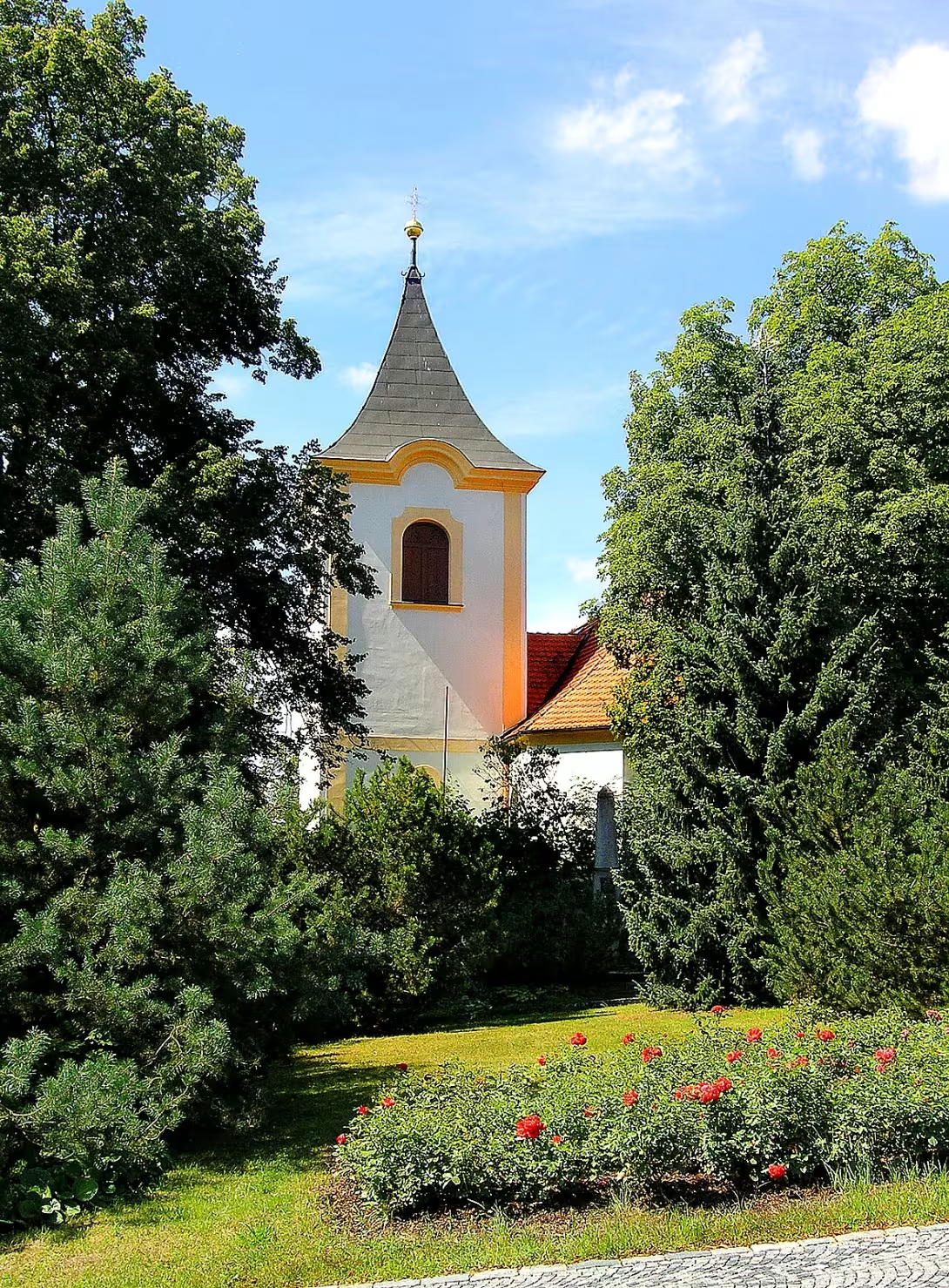
Kostel Panny Marie Sněžné in Great Popovice is a Roman Catholic filial church, protected as a real cultural monument. This building dominates the centre of the village by the main road and stands out with its layered architectural development: the Gothic core of the late 13th century was rebuilt into a baroque style in the 17th century, and in 1726 the tower was built attached to the south side of the presbytery. A key evidence of early dating was uncovering the southern portal during repairs in 2001.
The church area includes a cemetery with the original Hartmann family chapel, which today serves as a morgue, and the remains of the destroyed chapel of St. Prokop on the top of Dalek. The oldest history of the construction dates back to the end of the 13th century, which is confirmed by the Gothic southern portal discovered in 2001. In the 17th century, the original Gothic church was substantially rebuilt during the period of extensive Baroque reconstruction of the sacral objects in the region. The important construction phase was the year 1726, when the tower was built to the south side of the presbytery. By 30 June 2009, the church served as a parish, then became filial. Specific founders or original owners are not known from available sources; the administration and maintenance provided the parish in the long term, and later the municipality as owner of the cultural monument.
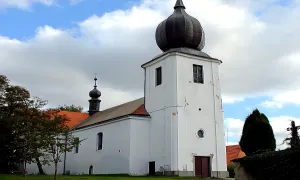
Architecturally, it is a brick oriented single-boat structure with a rectangular ground plan and a triangular presbytery. The facade is simple, divided by the lisen frames and ended with a profiled ledge; The windows are arc-closed. The western facade is decorated with a massive shield with volute wings, a blind round medallion and pilasters carrying a triangular peak framed by the ledge. The tower has a crown ledge in the middle of the sides of a half-circle bent upward over the clock dial; both the tower and the saddle roof of the ship are covered with bags. In the interior are the boat and sacristy (forming the ground floor of the tower) flat ceiling, presbytery is glassed with valenas with manatee lunettes and windows fill with colored stained windows. The Arc of Triumph is compressed, in the oblique walls of the presbytery are shallow niche for statues. The cemetery is surrounded by a wall of quarry stone. North of the church stands a rectangular morgue, originally a chapel with the Hartmann family tomb, covered by a valb roof. It is divided into three spaces connected by arcade arcs; the central space acts as a risalite with a shield of bent roms and oval skylight. The facade has four rectangular windows with lizens and stone sides of the entrances. The interior of the morgue has a flat reed ceiling, the central space is frescoed with the illusory architecture of the altar and the picture of the Crucifixion on the north wall; There are pilasters with Roman heads in them.
From the Hartmann family, it remained a tangible trace of their tomb in the morgue, documenting their connection to the local parish. The chapel of Saint Prokop on the hill of Dalek south of the church underwent a dramatic change of fate: built in 1700 from bricks and quarry stone, was abolished in 1780 during the josefin reforms and burned down in 1844; Her masonry was later dismantled. An important event for understanding the history of the object was already mentioned uncovering the Gothic portal in 2001, which moved the dating of origin a century earlier than expected. In 2009 there was a change of status from parish to filial church.
Today there is a church with a moorings, a statue of St. John Nepomuk, a fenced wall and grounds protected as a whole by cultural monuments. The building offers architecture readers a clear alphabet of styles - from gothic remains to baroque massivity of tower and portal to classical features of the morgue and romantic ruins of chapel in the forest. It is a place where the history of the region is reflected on a small scale, and it is worth a thoughtful visit not only to those interested in sacral architecture, but also to those who want to see how the functions and the face of one room have changed over centuries.
Historical milestones
- 2001
- Uncovering the southern portal with elements of Gothic architecture.
Architectural development
The church dates from the 14th century and was rebuilt in the 17th century, which included the position of the tower in 1726. During repairs in 2001, the southern portal with elements of Gothic architecture was exposed.
Historical events
- 1726
- Tower position.
- 2001
- Uncovering the southern portal with elements of Gothic architecture.
Points of interest
- Kostel Panny Marie Sněžné is protected as a real-estate cultural monument.
- The building has a layered architectural development: the Gothic core of the late 13th century was rebuilt into a Baroque style in the 17th century, and in 1726 the tower was built attached to the south side of the presbytery.
- Uncovering the southern portal during repairs in 2001 provided key evidence of early dating of the church by the end of the 13th century.
- The church area includes a cemetery with the original Hartmann family chapel, which serves as a morgue, and the remains of the destroyed chapel of St. Prokop on the hill of Dalek.
- The Chapel of St. Prokop was built in 1700, cancelled during the josefin reforms in 1780 and burned down in 1844.
Guide
Show guide text
This text was created by artificial intelligence and has not been editorially reviewed. It may contain inaccuracies.
Welcome to the Church of Our Lady of Snow, which stands in the middle of the village in Centrum on the main road. The visitor sits with headphones and this moment begins the sound path that will lead him to one of the oldest and most important monuments of the region. Under the clenching of trees and the silent walkways, you touch the ground that resembles the walls of the church. In front of you will be scattered one building, which, since its earthly creation, still retains its original character and yet attracts tourists and believers together. The building stands on the corner of the road and the rails in the surrounding area create a silence that is quite different from what we can record in the ordinary visitors' lists. The church is a secured real cultural monument of the Czech Republic, giving it a speci
Tips for visitors
The best time to visit is morning or late afternoon, when natural light best highlights the details of the church facade. For photographers we recommend to capture the contrast between the church building and the rustic wall of the quarry stone cemetery, which gives the images an atmosphere.
The church is accessible by car and public transport; Check the current connection and parking possibilities in the centre of the village in the internet search engine. We recommend to bring comfortable shoes that are suitable for walking around the surrounding cemetery area.
For families with children, the surrounding area of the church is ideal for a peaceful walk and familiarisation with the history of the village. The area around the sights offers a safe environment for a short rest in the centre of the village.
Within a short walk around we recommend visiting the ruins of the chapel of St. Prokop from 1700, which destroyed the fire in 1844, and exploring the cemetery surrounding the church.
Businesses nearby
Do you run a restaurant, accommodation, shop, museum, rental, wellness or other visitor service near this monument? Show yourself directly to the people heading to it — this is how they will see you in the app and on the web:
Events nearby
Zdroj akcí: otevřená data měst a obcí ČR (Národní katalog otevřených dat) a kalendář akcí Národního památkového ústavu.
Nearby
The ruins of the chapel of St. Prokop, built in 1700 and destroyed after the fire in 1844.
The church is surrounded by a cemetery with a wall of quarry stone.
Accommodation nearby
Trips and activities nearby
Guided tours, tickets and activities nearby from GetYourGuide
Affiliate link: if you buy from the partner, we may receive a commission. The price for you does not change.
Search tours and activities →Themed route
Route
1. Kostel Panny Marie Sněžné - church Historic building with bogat interior and sharp bouquet that discourages the tradition of regional architecture and is a place of peace.
2. Cemetery with walls made of quarry stone - back Satisfied past power and unique walls of broken stone add deep historical significance to the place.
3. Ruins of the Chapel of St. Prokop - ruins Observation point showing the original exposition and at the same time ideal place for photos and reflection of loneliness.
Seasonal recommendations
Spring season around the church of Our Lady of Snow is a period of awakening nature. The sun is already moving over the horizon and its light is fine, it lights up stone walls and throws long shadows on the pavement. Flowers begin to bloom, birds sing and the air is fresh, which creates a calm atmosphere. Visitors are less, so early in the morning, when it is still quiet, is an ideal time to walk. We recommend light layers of clothing because night cold may still be present, and take a light umbrella with you, as spring breaths are common.
The summer months bring intense sunlight and long days that illuminate historical memory with a clear, almost white shade. Nature is in full bloom, trees provide shade and heat creates a light but exhausting atmosphere. At this time the number of visitors increases, therefore it is best to come early in the morning or late in the evening when there is still relative calm. Clothes should be light, breathable and use sun protection is recommended. Take enough water with you to avoid drying.
Autumn brings golden leaves and colder temperatures that change the color of the surroundings and create a melancholy mood. The sun is already lower, its light is warm but short, and there is often a fine mist that surrounds the memory of a mysterious herpes. Visitors are less at this time, so a walk at noon, when the most light is, is very pleasant. We recommend warmer layers of clothing because temperatures may drop, and bring an umbrella, as rain showers are common.
The winter season is characterized by short days and a weak, scattered light that is reflected from snow and creates a cool, quiet atmosphere. Nature is calm, the trees are bare and the air is fresh but sharp. Visiting in winter brings the opportunity to experience a memory in a quiet environment where the crowds are minimal. The best time is around noon when the sun is at the highest and provides a little heat. Clothes should be warm, with layers, hat and gloves, and shoes should be anti-slip to avoid freezing on the sidewalk.
Visualizations and artistic views


The visualisations are generated by artificial intelligence and serve as inspiration.
Photos from the area
Real photos taken near the monument


Zdroj a licence jsou uvedeny u každého snímku.
Tips from visitors
No tips yet. Be the first!
Log in and add your tip.
Sources and literature
Photos: Czech Wikipedia user Packa / CC BY-SA 3.0 — Wikimedia Commons. The author and licence also appear when you hover over the image.
Faktickým podkladem tohoto textu byl článek na Wikipedii, jehož autory jsou přispěvatelé Wikipedie. Článek je dostupný pod licencí CC BY-SA 4.0.
Location on the map
Příběhy a pověsti
Legendy, pověsti a příběhy spjaté s touto památkou
Fotografie návštěvníků
Zatím žádné fotografie. Buďte první, kdo přidá fotografii z návštěvy!
Log in a přidejte svou fotografii nebo hodnoťte.
Za ověřenou návštěvu v aplikaci získáte víc bodů — poznáme podle GPS, že jste na místě.
Reviews and comments