



Kostel Seslání svatého Ducha Church
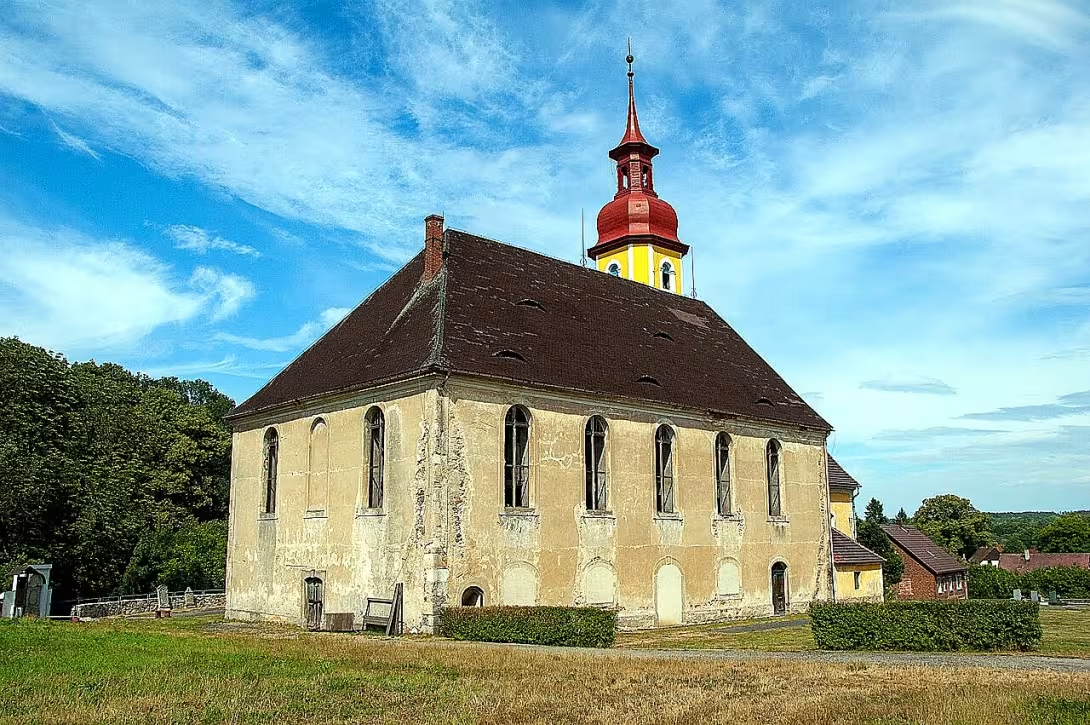
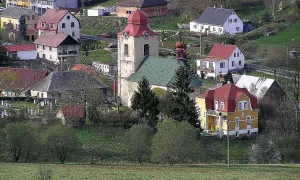
The Kostel Seslání svatého Ducha is located in the North Bohemian municipality of Višňová in the district of Liberec, in the Frýdlantské excerpt in the immediate vicinity of the Czech-Polish state border. It is a modest parish building with a rich history dating back to the Middle Ages.
The history of this building extends from the 12th to 20th century. According to German-language regional literature, the chapel existed already in 1160. The first written mention of the parish church dates back to 1346, when he had a tower, two bells and three altars. In 1468 he burned down; his successor was built in 1492. In the years 1802-1804 the church underwent a significant Baroque reconstruction during which the boat was raised. After World War II, he served as a warehouse and housing of cattle. During the establishment of the borders between Czechoslovakia and the People's Republic of Poland (Treaty signed on 13 June 1958), the church returned from Poland to the Czechoslovak territory.
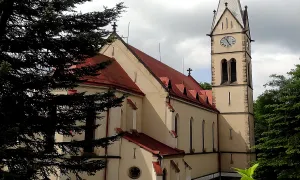
Architecturally, it's a single-boat structure in an early Gothic style. The presbytery has a rectangular plan; on its north side stands a square tower of prismatic shape, which ends with an eight-sided superstructure with onion-shaped beating. Two arches of the rib arch extend over the presbytery. The church ship is covered with a flat ceiling. There is a wooden side ring in the presbytery, a three-arm circle with two-story sides.
Especially remarkable is the unusual entrance to the tower. The door opening leads to a double enchantment made of carefully worked sandstone blocks. The front is closed with a full arc twice as high as the rear portal with a broken arch. According to the analogy with the city gates, it is assumed that the closure of the entrance may have been solved by the trap grid and thus the church could be among the fortified buildings; A similar solution is known from Poland and Romania. The tower has a square plan with a side length of 630 cm and a wall of 150 cm thick.
The inside of the church does not contain historically important equipment or organ. The figure tombstones from the turn of the 17th and 18th centuries, the second decade of the 18th century and around 1730 are interesting. On the south outer wall of the tower there are Baroque tombstones from the second half of the 17th and the beginning of the 18th century.
There is a cemetery surrounding the church, where there is a Baroque epitaph in the form of an altar with a high figure relief, decorated with ribbon and acanthus ornaments (early 18th century), and a classical tombstone from around 1800. These stones bear witness to the long continuity of life in this border temple.
Then and now
Drag the slider to compare how the landmark may have looked when it was built with the view today.
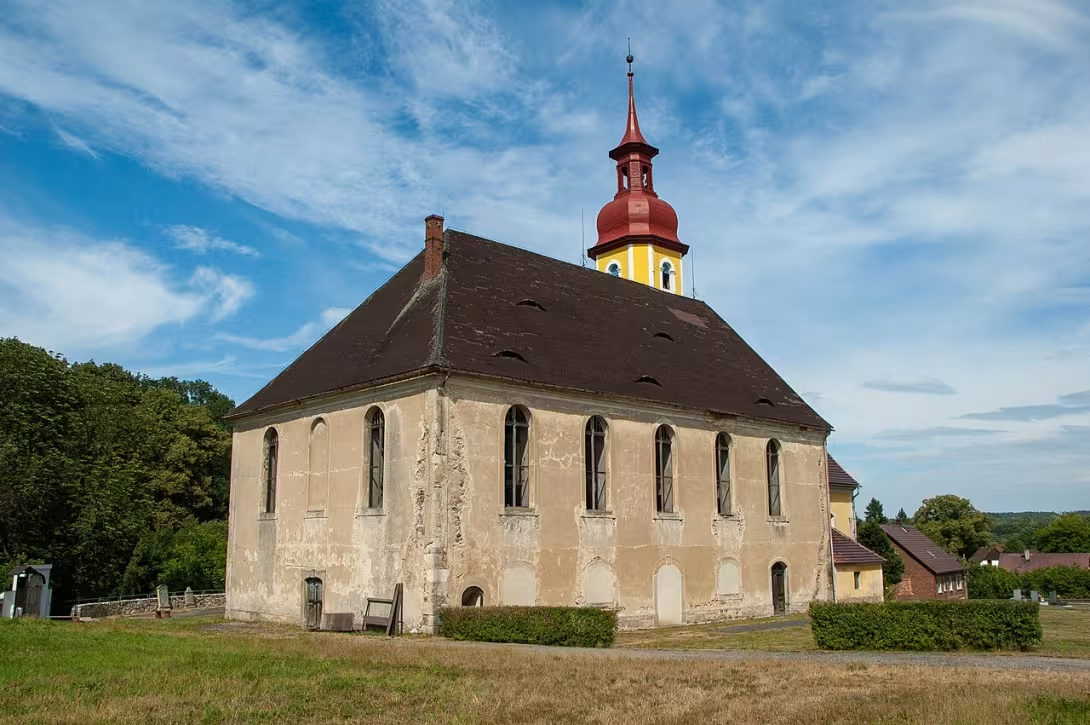
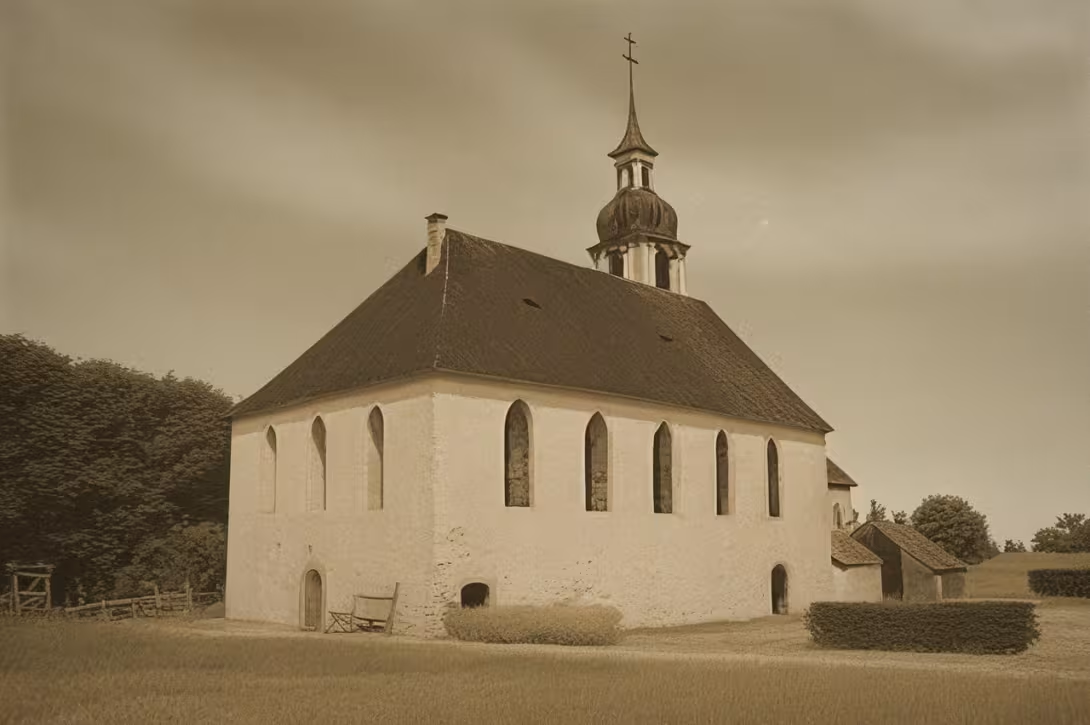
The historical appearance on the left is an AI-generated visualisation and serves as inspiration only.
Historical milestones
- 1160
- According to regional literature, it stood in the Cherry Chapel, but it is not documented in writing.
- 1346
- The first written mention of a church with a tower, bells and altars.
- 1468
- The church burned down and was subsequently rebuilt.
- 1492
- Completing the present form of the church after the fire.
- 1802-1804
- Baroque reconstruction and expansion of the ship.
- 1958
- Returning the church to the Czech administration after establishing the state border.
Architectural development
The original early Gothic presbytery from the end of the 13th century was supplemented by a single boat part with a flat ceiling. In 1492, the current form was completed after the 1468 fire. In 1802-1804 a Baroque reconstruction took place, during which the ship was significantly expanded and increased. The tower with a square plan and a unique entrance to the tower is a wall made of sandstone blocks. The interior includes rings and tombstones from the 17th to 18th century.
Historical events
- 1346
- First written mention of a church with a tower, two bells and three altars.
- 1468
- The church burned down and was subsequently rebuilt.
- 1945-1958
- After the war he served as a warehouse and cattle stable, then was returned to the Czech administration after the border was set.
Points of interest
- The church was originally built as a chapel in 1160, but the first written mention of the parish church dates back to 1346.
- In 1468 the original church burned down and its successor was built in 1492.
- The church tower has an unusual entrance with a double-height full arch front and broken arch rear, indicating the possibility of fortification with a trapdoor.
- The inside of the church contains figural tombstones from the turn of the 17th and 18th centuries, including those from around 1730.
- In the cemetery around the church there is a Baroque epitaph in the form of an altar with figural relief from the beginning of the 18th century.
Guide
This guide is narrated by a synthetic voice generated by artificial intelligence.
Show guide text
This text was created by artificial intelligence and has not been editorially reviewed. It may contain inaccuracies.
The Church of the Holy Spirit in Višňová is located in the Frýdlant protrusion in northern Bohemia, in close proximity to the Czech-Polish state border. It originally emerged in the early Gothic style and later underwent Baroque reconstruction and further modifications. The oldest part is the presbytery from the end of the thirteenth century. The church is protected as a cultural monument.
According to German-language regional literature, there was already a chapel here in eleven sixty. The first written mention of the parish church dates from thirteen forty-six and mentions a tower, two bells and three altars. In fourteen sixty-eight the church burned down and was replaced by a new building in fourteen ninety-two. Between eighteen oh-two and eighteen oh-four it was substantially reconstructed and its nave was considerably heightened at that time.
After the Second World War it served for stabling cattle and as a storage facility. When the state border was restored, it moreover found itself on Polish territory. It returned to the Czechoslovak side thanks to an agreement on the final delineation of state borders, which both countries signed on June thirteenth, nineteen fifty-eight in Warsaw.
The church has one rectangular nave and an equally shaped presbytery. On its northern side stands a prismatic tower with an octagonal superstructure, crowned with an onion dome. The presbytery is covered by two bays of ribbed cross vaults. From the nave with a flat ceiling it is separated by a pointed triumphal arch. Inside there are wooden galleries, in the nave a three-armed one with two-storey side wings. The church has no historically significant furnishings or organ.
The tower has a square ground plan with a side of six hundred and thirty centimetres and walls of a thickness of one hundred and fifty centimetres. Unusual is the entrance to the vestibule. The doors are in a doubled archway made of carefully worked sandstone blocks. The front part ends in a full arch, twice as high as the rear portlet with a pointed arch. Similarly to city gates, the entrance may have been closed with a portcullis and the church could thus belong among fortified churches. A similar solution is known from Romania or Poland.
In the interior there are figured tombstones from the turn of the seventeenth and eighteenth centuries up until around seventeen thirty. Further Baroque tombstones are on the southern outer wall of the tower. On the surrounding cemetery there is a Baroque epitaph in the form of an altar with a high figured relief from the beginning of the eighteenth century and a Classicist tombstone from around eighteen hundred.
Between nineteen eighty-seven and nineteen ninety-three, when the nave was already in a precarious condition, it was separated from the presbytery by a screen. The presbytery was then converted into a chapel so that services could be held there in dignified surroundings.
Tips for visitors
The best time to visit the Church of the Holy Spirit in Cherry is in the summer months, especially in June to September. At that time the weather is pleasant and surrounding nature, especially the Frýdlantý Outlet, offers ideal conditions for walks. In summer it is also possible to visit the church during the ceremonial services which are often held outside or in the interior. Morning hours are suitable for a quiet visit without crowds.
It is recommended to use public transport where possible. The location is well available from Liberece or Frýdlant. The current connection and departure times can be found in the transport search engine.
When visiting, take on comfortable clothes and shoes as the church is located in a mountain area with forest terrain. It is also convenient to take a map or navigation with you because the surrounding landscape may be unknown to visitors. Don't forget to wear suitable winter shoes and clothes in winter.
Photography is allowed in the church, but it is advisable to respect the peace and sacred character of the place. The best places for photos are the interior of the church, especially the early Gothic presbytery from the end of the 13th century, and the surrounding nature of the Frýdlant excerpt. It is recommended to take pictures in good light, morning or afternoon, in order to capture the best colors and light effects.
In the vicinity of the church is worth visiting the Czech-Polish state border, which is located right by the church. This border was set after 1958 and is an interesting place for historical interests. Another interesting thing is the Frýdlantý selection, the northernmost part of the Czech Republic, where you can explore the typical mountain and forest character of the landscape. Explore surrounding forests and picturesque trails.
For families with children a visit to the Church of the Holy Spirit is a great opportunity to explore history and nature. Children can see the ancient church and learn more about its history. In the surroundings it is possible to organize short walks and search for natural attractions. It is also appropriate to visit the border crossing and explain to children what the state border between the Czech Republic and Poland looks like.
Frequently asked questions
Can the monument be visited?
Religious buildings are usually open mainly during services; at other times a visit is normally arranged with the parish or the operator. We have not verified specific times.
Where is the monument?
Location: Višňová, Liberecký kraj. The map on this page shows the exact spot.
Why is the monument protected?
It is listed in the Central List of Cultural Monuments of the Czech Republic as a cultural monument (register no. 24014/5-4481).
For kids
Imagine going back 534 years into the past and finding yourself in a small village called Višňová. There was the Church of the Holy Spirit, which was built in 1492. The church was a haven for the locals who lived here and worked in the fields.
The lively tone of the village was full of music and singing. People gathered in church to celebrate holidays and Christmas. The church was also a place where weddings and funerals were held. There were people around here who came to visit the church and pray for their families.
Businesses nearby
Do you run a restaurant, accommodation, shop, museum, rental, wellness or other visitor service near this monument? Show yourself directly to the people heading to it — this is how they will see you in the app and on the web:
Events nearby
Zdroj akcí: otevřená data měst a obcí ČR (Národní katalog otevřených dat) a kalendář akcí Národního památkového ústavu.
Accommodation nearby
Trips and activities nearby
Guided tours, tickets and activities nearby from GetYourGuide
Affiliate link: if you buy from the partner, we may receive a commission. The price for you does not change.
Search tours and activities →Themed route
Thematic cruise route: Kostel Seslání svatého Ducha and the border landscape of the Frýdlantské way
1.Kostel Seslání svatého Ducha * Type: Baroque sacral monument * It is particularly interesting as one of the last Baroque buildings in the north of Bohemia. The church is located right at the Czech-Polish state border, which adds a special atmosphere to the visit. Interior equipment and architecture reflects the spiritual life of the region.
2. Czech-Polish state border * Type: Historical border line * The direct neighbourhood with Poland offers the possibility to know the border zone, which was finally established after 1958. Here we are touching the unique geographical and political border between the two states, which is also part of the Frýdlanta excerpt.
3. Frýdlant extract - natural surroundings * Type: Mountain and forest landscapes * A trip to the surrounding forests and hills allows you to know the northernmost part of the Czech Republic. There is a typical mountain environment with dense forests and picturesque views that are typical of this region.
This route is ideal for lovers of history, architecture and nature who want to explore a unique combination of cultural and natural attractions near the border.
Seasonal recommendations
Spring - During the period of flowering trees and bushes around the church, the sun's rays spread over freshly green grass and create fine, scattered lighting that highlights the Gothic details of the stone building. The weather is variable, so it is advisable to carry a light jacket and a thin layer underneath; An umbrella or a raincoat can be useful in sudden showers. Tourist traffic is not yet peak at this time, so if you arrive early in the morning, you will avoid smaller crowds and get a quieter atmosphere for contemplation in the interior.
Summer - The sunny days bring a bright, contrast light that underlines the color of the stone and the decoration of the church, while the surrounding meadows are covered with flowers and shines leaves in a warm breeze. In the main summer season the traffic increases, so it is best to arrive before noon when queues are even shorter and temperatures are more pleasant. Light, breathable clothes, sunglasses and sunscreen are recommended; If you plan to walk around, take comfortable shoes, because the roads can be slightly muddy after the rain.
Autumn - Golden leaves and dim sunlight create a melancholy atmosphere that underlines the quiet spiritual character of the church. The temperatures are falling and the air is fresh, so it is advisable to dress in layered clothes, such as a sweater under a light jacket, and have a scarf at hand for cooler afternoon moments. In this period the attendance is lower, so even afternoon hours are quiet and allow a slower tour; If you want to capture autumn colors, choose the time around 3:00 in the afternoon when the sun falls at an angle.
Winter - Covered trees and fresh snow around the church create a quiet, almost mystical scenery, while the sun's rays are weaker and reflected from white surfaces. Don't forget to wear warm clothes - thick coat, hat, gloves and tight shoes with anti-slip soles, because the sidewalks can be icy. In such an environment you get a unique sense of peace and you can enjoy the sound of the bells that are carried by the cold air.
Visualizations and artistic views


The visualisations are generated by artificial intelligence and serve as inspiration.
Photos from the area
Real photos taken near the monument

Zdroj a licence jsou uvedeny u každého snímku.
Atmosphere of the place
This atmospheric visualisation of the place and period was generated by artificial intelligence. It is not real footage of the location.
Tips from visitors
No tips yet. Be the first!
Log in and add your tip.
Sources and literature
Photos: MIGORMCZ / CC BY-SA 4.0 — Wikimedia Commons. The author and licence also appear when you hover over the image.
Faktickým podkladem tohoto textu byl článek na Wikipedii, jehož autory jsou přispěvatelé Wikipedie. Článek je dostupný pod licencí CC BY-SA 4.0.
Location on the map
Příběhy a pověsti
Legendy, pověsti a příběhy spjaté s touto památkou
Fotografie návštěvníků
Zatím žádné fotografie. Buďte první, kdo přidá fotografii z návštěvy!
Log in a přidejte svou fotografii nebo hodnoťte.
Za ověřenou návštěvu v aplikaci získáte víc bodů — poznáme podle GPS, že jste na místě.
Reviews and comments