



Kostel svaté Barbory (Hrob) Church
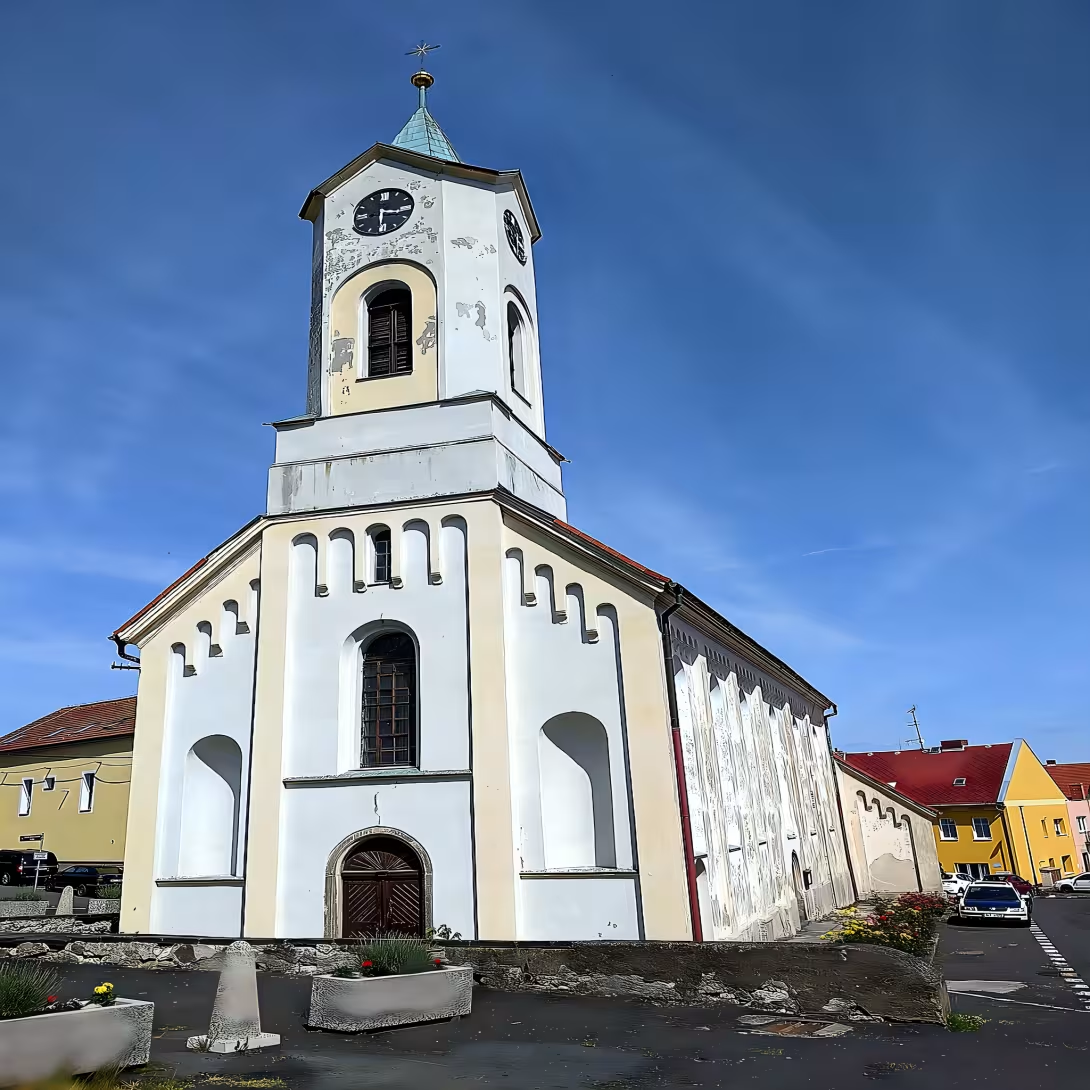
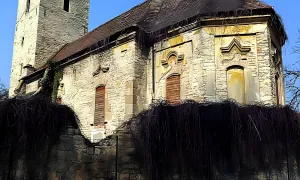
The church of St. Barbara is situated on the square of the former mining town Hrob, surrounded by a number of Baroque sculptures. Dedication is not random - Saint Barbara is traditionally the patron saint of miners. Since 1958, the church has been protected as a cultural monument of the Czech Republic.
The mining settlement Hrob has long owned a thermal first, since 1282 then the osoka monastery. This year, the church was also probably founded, originally in an early Gothic style. During the Hussite wars, the construction was damaged and subsequently restored. In 1447 Hrob acquired the rights of the royal upper town.
The church passed through the most intense reconstruction at the turn of the 16th and 17th centuries. From 1595 to 1602 it was renaissance and extended to the west. The reconstruction was initiated by the Prague Archbishop Zbyněk Berka of Dubé, who wanted to strengthen the Catholic faith in the predominantly Lutheran city - there were only four Catholic families in Hrob. Religious tension continued: in 1617, Archbishop Jan Lohelius had the evangelical church demolished, which became one of the stimuli for the uprising of states. During the Thirty Years War, the church was burned down in 1632 by retreating Saxons and restored in 1637. In the 19th century he passed pseudo-gothic modifications.
The construction is a single boat with a triangular finish by a presbytery and a prism tower above the west front. On the north side there is a rectangular sacristy, on the south side a smaller annex. The late Gothic portal on the south side of the ship resembles the original structure. The ship is covered by a cross vault with five non-equally wide fields, presbytery has a net arch with mortar ribs. The western facade bears traces of pseudo-gothic modification.
The interior equipment comes mainly from the 19th century. The altar painting was created by Václav Vavřinec Reiner, a late Gothic baptizer is located in the sacristy. In the facade of the west tower hanging bells from 1587 and 1874.
The church is surrounded by a set of works - a Baroque rectory from 1786 and a series of sculpture artifacts: a statue of St. Joseph from 1750, a statue of St. John the Baptist from the 17th century and a statue of St. Prokop from 1734.
Then and now
Drag the slider to compare how the landmark may have looked when it was built with the view today.
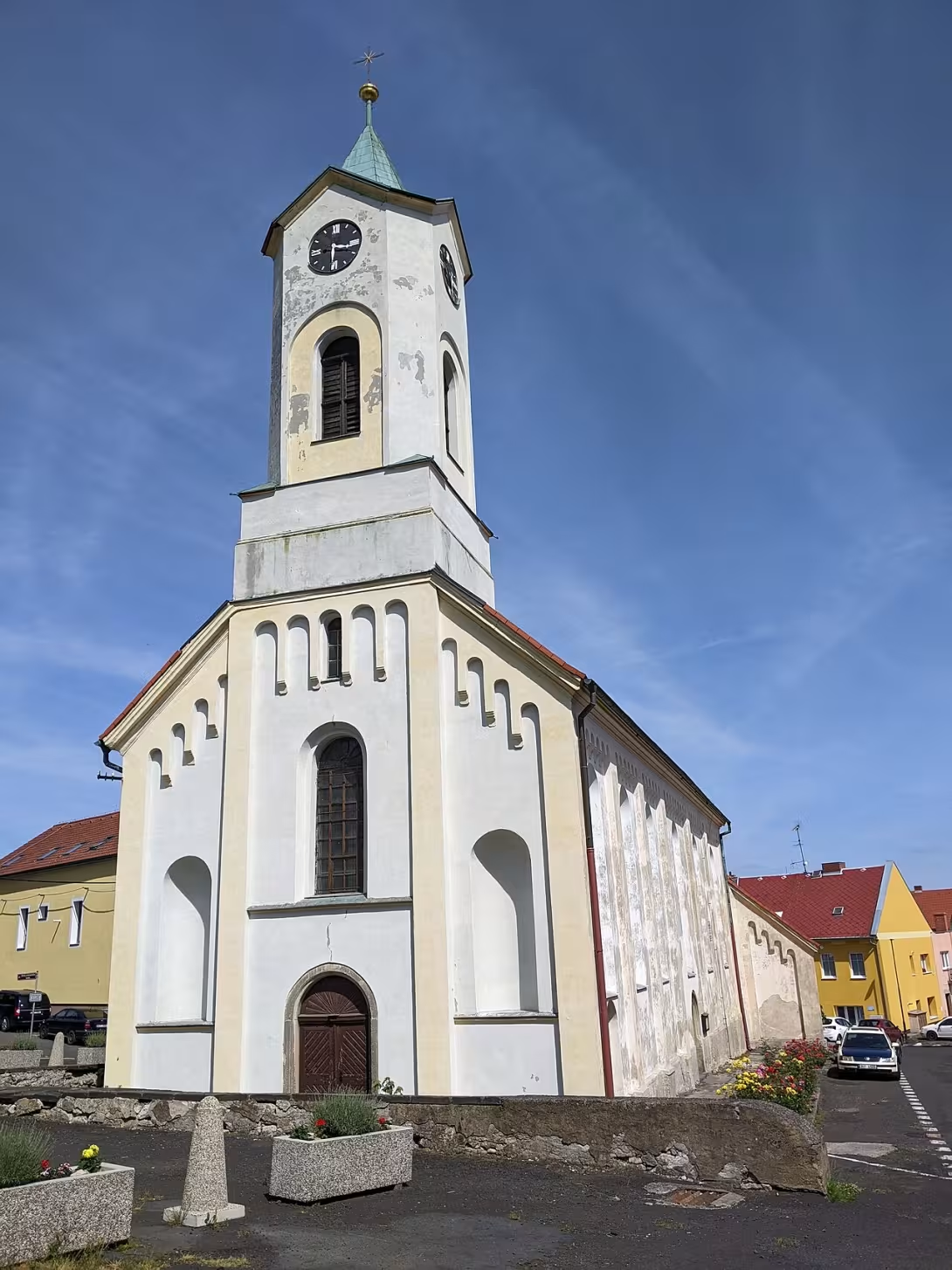

The historical appearance on the left is an AI-generated visualisation and serves as inspiration only.
Historical milestones
- 1282
- The establishment of the church of St. Barbara in connection with the promotion of Hrob to a mining town and the transfer of property from thermal to an osice monastery.
- 1447
- The promotion of Hrob to the royal upper city, which affected the importance of the church as the center of sacral life.
- 1595-1602
- Renaissance reconstruction of the church at the order of Archbishop Zbynek Berka of Dubé, who was to strengthen the Catholic faith in the city of Lutheran.
- 1632
- The destruction of the church during the Thirty Years' War, followed by a renewal in 1637.
- Pseudogotic treatment of the church, which has greatly affected its present form.
- 1958
- Registration of the church in the list of cultural monuments of the Czech Republic.
Architectural development
Originally an early Gothic church from the 13th century was remodeled in the years 1595- 1602 and extended to the west and adapted for Catholic services. In the 19th century it underwent a historic pseudo-gothic adjustment that affected the facade and interior. The building has a one-boat plan with tripod finished by presbytery, prism tower and original Gothic elements such as sharp windows and a late Gothic portal. The ship is sealed with a cross vault with a circle, the presbytery has a net vault.
Historical events
- 1282
- Establishing a church in connection with the promotion of Hrob to mining town.
- 1617
- The demolishing of the Evangelical Church at the command of Prague Archbishop Jan Lohelius, which became one of the stimuli of the state uprising.
- 1632
- The destruction of the church during the Thirty Years' War in the retreat of Saxon troops.
- The pseudo-gothic treatment of the church that affected its present form.
Owners
- 1282
Points of interest
- St. Barbara's Church is dedicated to the patron saint of miners, which corresponds to the historical importance of the city of Hrob as a mining centre.
- The church was founded probably in 1282, when Hrob transferred to the property of the Osaka monastery.
During the Hussite wars, the church was damaged and subsequently restored.
- Between 1595 and 1602 the church underwent a large Renaissance reconstruction initiated by Prague Archbishop Zbyněk Berka from Dubé.
- The church was burned in 1632 by retreating Saxons during the Thirty Years War and restored in 1637.
Guide
This guide is narrated by a synthetic voice generated by artificial intelligence.
Show guide text
This text was created by artificial intelligence and has not been editorially reviewed. It may contain inaccuracies.
The Church of Saint Barbara in Hrob bears the name of the patron saint of miners, Saint Barbara of Nicomedia. Hrob was originally a mining settlement that belonged to the Tepl Monastery and from the year 1282 to the Osek Monastery. In the same year, the church was founded as well, originally in the early Gothic style. During the Hussite Wars, it was apparently damaged and subsequently restored. In 1447, Hrob became a royal mining town.
At the end of the sixteenth century, the town was almost entirely Lutheran. Apparently, only four Catholic families remained there at that time. The Prague Archbishop Zbyněk Berka of Dubá therefore initiated a Renaissance reconstruction of the church, which was meant to strengthen Catholic faith. It took place from 1595 to 1602. The church was apparently extended toward the west during this period and consecrated anew in 1602.
Hrob entered history in 1617. Archbishop Jan Lohelius had the local evangelical church demolished at that time. This event became one of the impulses for the uprising of the Czech estates against the Habsburgs. During the Thirty Years' War, in 1632, the retreating Saxons burned down the Church of Saint Barbara. It was restored in 1637 and underwent a pseudo-Gothic modification in the nineteenth century. Since 1958, it has been protected as a cultural monument.
The church is a single-nave building with a presbytery ending in three sides and a sacristy on the northern side. Above the western facade, modified in pseudo-Gothic style, rises a prismatic tower. On the southern side of the nave, the original late Gothic portal remains. The windows are pointed with flamboyant tracery. The presbytery is covered with a net vault with mortar ribs. The nave has five fields of unequal width with cross vaults without ribs, and a gallery is built into the two western fields.
The furnishings are predominantly pseudo-Gothic. The image of Christ before Pilate dates from 1628 and the altarpiece is a work by Václav Vavřinec Reiner. In the sacristy is a late Gothic baptismal font. In the tower is a bell by Wolf Hilger from 1587 and a bell by Julius Herold from 1874. An older bell by Zachariáš Hilger from 1640 is now in the Osek Monastery.
The church is accompanied by a Baroque rectory from 1786. In the square stands a statue of Saint Joseph from around 1750. On its base is a relief depicting the betrothal of Saint Joseph with the Virgin Mary. A niche in the school is decorated with a statue of Saint John the Baptist from the seventeenth century, a copy of the Gothic original. On houses throughout the town we also find a statue of Saint Prokop from 1734, Saint John of Nepomuk, and a sculptural group of Saint Joachim, Saint Anne, and the Virgin Mary from 1752.
Frequently asked questions
Can the monument be visited?
Yes. We verified the opening hours or admission on the official website (2. 10. 2026); you will find them in the visitor information on this page. Please double-check with the operator before you travel.
What are the opening hours and admission?
Details verified on the official website (2. 10. 2026) are listed in the visitor information on this page. Official website: https://hornicke-muzeum.ucoz.com/
Where is the monument?
Location: Hrob, Ústecký kraj. The map on this page shows the exact spot.
Why is the monument protected?
It is listed in the Central List of Cultural Monuments of the Czech Republic as a cultural monument (register no. 42832/5-2603).
For kids
Imagine coming back 676 years. The place is a small town where today stands the beautiful church of St. Barbara. It's like she's back in the past, and now you're a witness to history.
Is this what it looked like? Who lived here? What happened here? The town was full of miners looking for wealth in deep mines. These people were proud and brave, but they also appreciated beauty and art. At that time, the church of St. Barbara stood on a mild hill, offering an amazing view of the surrounding countryside.
Businesses nearby
Do you run a restaurant, accommodation, shop, museum, rental, wellness or other visitor service near this monument? Show yourself directly to the people heading to it — this is how they will see you in the app and on the web:
Accommodation nearby
Trips and activities nearby
Guided tours, tickets and activities nearby from GetYourGuide
Affiliate link: if you buy from the partner, we may receive a commission. The price for you does not change.
Search tours and activities →Themed route
Thematic cruise route: Baroque Hrob and its sacral treasures
1.Kostel svaté Barbory (Hrob) * Type: Sacral landmark * The only preserved church in the area, built in the 18th century, which served as a spiritual centre for the surrounding villages. Its simple but distinctive architecture reflects a typical rural Baroque tradition.
2. Baroque rectory (Hrob) * Type: Municipal building * A single-storey building from 1786, which stands directly opposite the church. The number on the portal is reminiscent of the time when the priest worked here and the whole village was spiritually linked to the church of St. Barbara.
3. Statue of St. Joseph * Type: Baroque sculpture * Originally from around 1750, it stands in the square in front of the church and represents a typical Baroque cult of St. Joseph, the protector of the family. It's one of the few preserved statues in the village.
4. Statue of St. Prokop * Type: Baroque sculpture * Located on the front of house No. 11, dates back to 1734 and is a rare example of rural Baroque decoration. They testify to the tradition of religious processions and local godliness.
5. Statue of St. John the Baptist * Type: Copy of the Gothic original * Located in the niche of the school and is a copy of the Gothic statue from the 17th century. It reminds us that even in a small village there was a monument to older artistic traditions.
* The route follows short walking paths in the village, where sacral monuments complement each other and create a unique Baroque atmosphere. *
Seasonal recommendations
Spring The spring at St. Barbara's Church offers a unique atmosphere where the stone walls of the church are projected into the light of the spring rays that penetrate the trees in the surrounding area. Nature is awakening to life - the meadows at the church are blooming, and if you look around the grave, there is a fine aroma of the first spring flowers. The light is soft, scattered, and the sun illuminates the towers of the church so that they appear to rise higher. In this period it is also possible to see how the colours of the masonry change - a moist spring reveals fine shades of stone that remain hidden in other seasons. The ideal time for a visit is in the morning, when the church is still calm and the temperature is pleasant. I recommend taking light but protective clothing - umbrella or light jacket because spring weather is unpredictable. Avoid the morning classes in the main tourist season, when groups of schoolchildren come here. The best time to visit is the late afternoon when the crowds disperse and the atmosphere becomes quieter.
Summer Summer brings intense sunlight to Hrob, which illuminates the church of St. Barbara so that its stone details - such as window circles or statues - appear to be carved into a yellow background. Warm days create contrast with the cool inside of the church, where visitors cool down after walking on sunny paths. Nature turns into green vegetation, and if you look from the field at the church, there is a pleasant aroma of grass and trees. The atmosphere is lively, but in the main summer season you must count on crowds, especially in the morning. It is best to visit early in the morning when the church is still partially shielded and the crowds have not yet grown. I recommend light but covering clothes, sunglasses and plenty of water. Avoid noon hours when the sun is most intense and temperatures reach maximum. If you want to escape crowds, try a visit in the late afternoon when most tourists return.
Autumn Autumn at St. Barbara's Church offers a magical atmosphere where leaves on trees around the church turn into golden, red and brown shades that are reflected on stone walls. The light is warm, but already less intense than in summer, and the sun illuminates the towers of the church so that they appear to be surrounded by golden aureole. Nature becomes quieter, and if you walk around the grave, there is a quiet harmony that only rustling leaves disturb. In this period the church is surrounded by a quiet forest, which gives the visit a sense of peace and privacy. The best time to visit is early morning or late afternoon, when the church is less visited. I recommend warmer clothes because autumn days are already colder and evenings can be wet. Avoid visiting on rainy days when access to the church is more difficult and the atmosphere becomes depressing. If you want to experience autumn magic, choose a sunny day when leaves turn into fireworks of colors.
Winter The winter visit to St. Barbara's Church is unique due to a quiet atmosphere where the church appears to be surrounded by a white snow blanket that gives the whole place mysterious beauty. The light is soft and scattered, and the sun illuminates the towers of the church so that they appear to be surrounded by fine fog. Nature is calm and quiet, and if you look around the grave, there is a quiet harmony that only snow rustles disturb. During this period the church is less visited and therefore it is possible to enjoy the tour in peace. The best time to visit is early morning, when the church is still partially lit by the sun and the crowds have not yet grown. I recommend warm clothes, including warm jackets, gloves and hats because winter days are cold and windy. Avoid visiting on rainy days when access to the church is more difficult and the atmosphere becomes depressing. If you want to experience winter magic, choose a sunny day when the church turns into a white pearl surrounded by snow.
Visualizations and artistic views


The visualisations are generated by artificial intelligence and serve as inspiration.
Photos from the area
Real photos taken near the monument


Zdroj a licence jsou uvedeny u každého snímku.
Atmosphere of the place
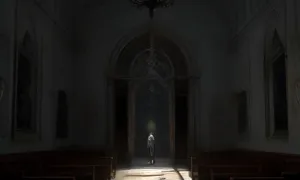
This atmospheric visualisation of the place and period was generated by artificial intelligence. It is not real footage of the location.
Tips from visitors
No tips yet. Be the first!
Log in and add your tip.
Sources and literature
Photos: MartinVeselka / CC BY-SA 4.0, rozlišení zvýšeno umělou inteligencí — Wikimedia Commons. The author and licence also appear when you hover over the image.
Faktickým podkladem tohoto textu byl článek na Wikipedii, jehož autory jsou přispěvatelé Wikipedie. Článek je dostupný pod licencí CC BY-SA 4.0.
Location on the map
Příběhy a pověsti
Legendy, pověsti a příběhy spjaté s touto památkou
Fotografie návštěvníků
Zatím žádné fotografie. Buďte první, kdo přidá fotografii z návštěvy!
Log in a přidejte svou fotografii nebo hodnoťte.
Za ověřenou návštěvu v aplikaci získáte víc bodů — poznáme podle GPS, že jste na místě.
Reviews and comments