



Kostel svaté Kateřiny ve Mšeci Church
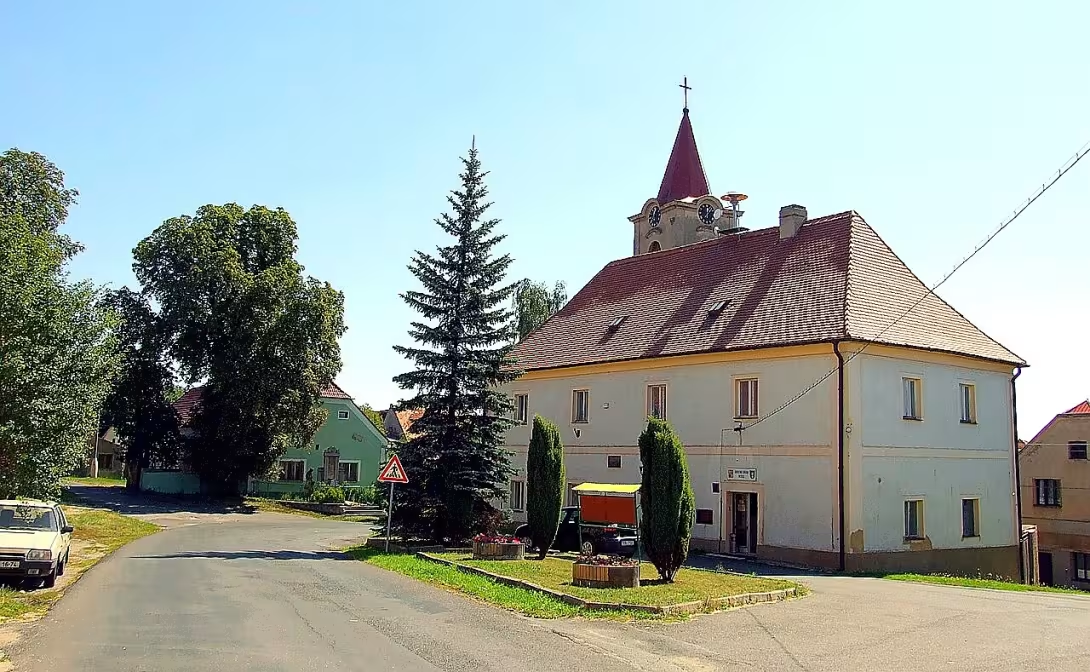
The Church of St. Catherine of Alexandria stands on a square in the heart of the village Mšec and is its distinct dominant place. It is a filial church under the Roman Catholic Church, which until 2003 served as a parochial church, then was joined to the Neo-Scaster parish. Today it is protected as a cultural monument.
The beginnings of the church date back to the Middle Ages when there was an older Gothic temple. The tower of the original building has a rich history. In 1601, on the initiative of Matthias Štampach from Štampach, a member of the court of the leaders and captain of the Slanské Region, they hung a big bell. This was at a time when the Mšek owner was getting his country a useful investment.
The present face of the church bears the features of the nineteenth century. In 1780 they built a new baroque one-boat church in the place of the older temple according to the design of Master Václav Výchl. The interior is a Baroque altar from 1782, the author of which was Ignác František Platzer. The dominant motif of the altar space is the Baroque painting of St. Catherine with the rococo frame from the hand of D. Gran de la Torre. After the fire that struck the church in 1832, the tower was restored in a new form. Only in modern times, since 2008, two new bells were placed in the tower: a larger bell with a weight of 200 kilograms cast from iron cast iron with the name of the Holy Heart of Jesus and a smaller bell weighing 80 kilograms called Saint Joseph.
The most valuable equipment of the church is the organ. These dates from 1587 and are among the oldest preserved organ in Bohemia. They were created during the period of the greatest boom in organ music and were originally placed in a Gothic church. When it was demolished, they were carefully moved to a new Baroque temple. The tool has one pedal for the game with legs, a stand-alone table and three whistle fields in the prospectus with beautifully carved details. From the eighteenth to the end of the nineteenth century, the organ had two manuals and contained so-called "continuoverk," which were small organs hidden right in the playing table. At the end of the nineteenth century, the continuoverk was removed.
Many experts have taken care of organ maintenance historically. In the second half of the eighteenth century, it was served by the organist Gút from Clean by Rakovníka, belonging to the oldest generation of tools on Rakovnice. The technical service of the bellows, which are 2.5 to 1.5 metres, was carried out by so-called calcants - persons who kept the air pressure in their bellows. In 1969, Marie Plusilova, one of the church members, performed this demanding work. Currently, the instrument was handled by the organist Adam Viktor, who is trying to collect funds for urgent repairs through concerts and charity collections. The main problem is staying infected with the organ with the worm and bad condition of the bellows. Although about 30,000 crowns were selected for the most necessary repairs and cleaning of whistles, the organ would benefit from further care. However, the visitor will find a quality tool here, which, despite various challenges, has retained its essential parts and continues to serve the church life of the village.
Then and now
Drag the slider to compare how the landmark may have looked when it was built with the view today.
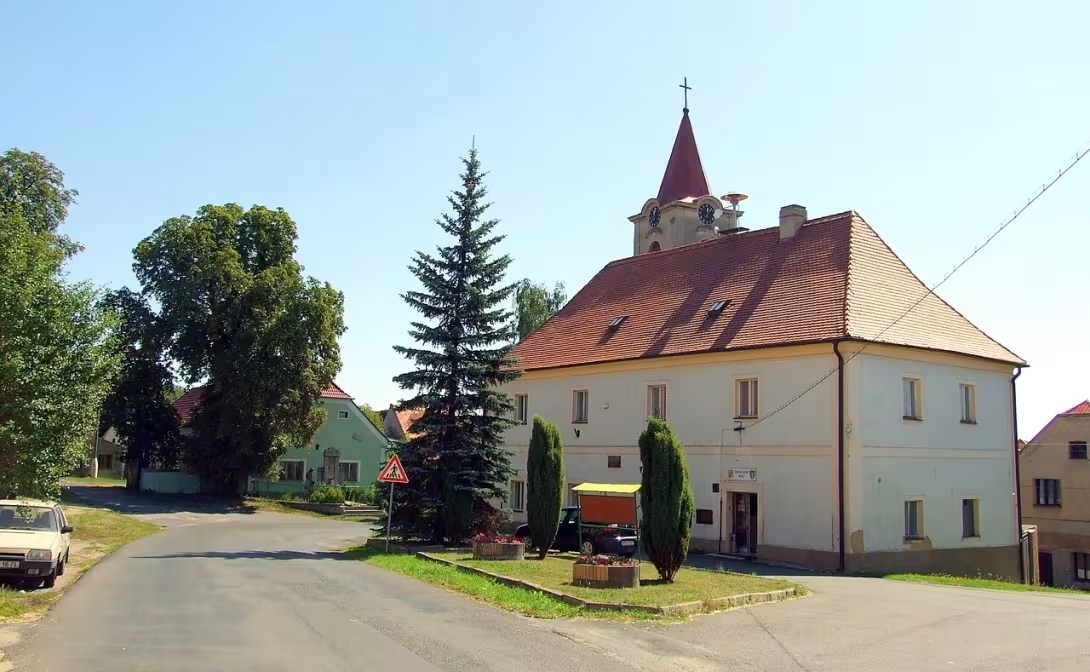
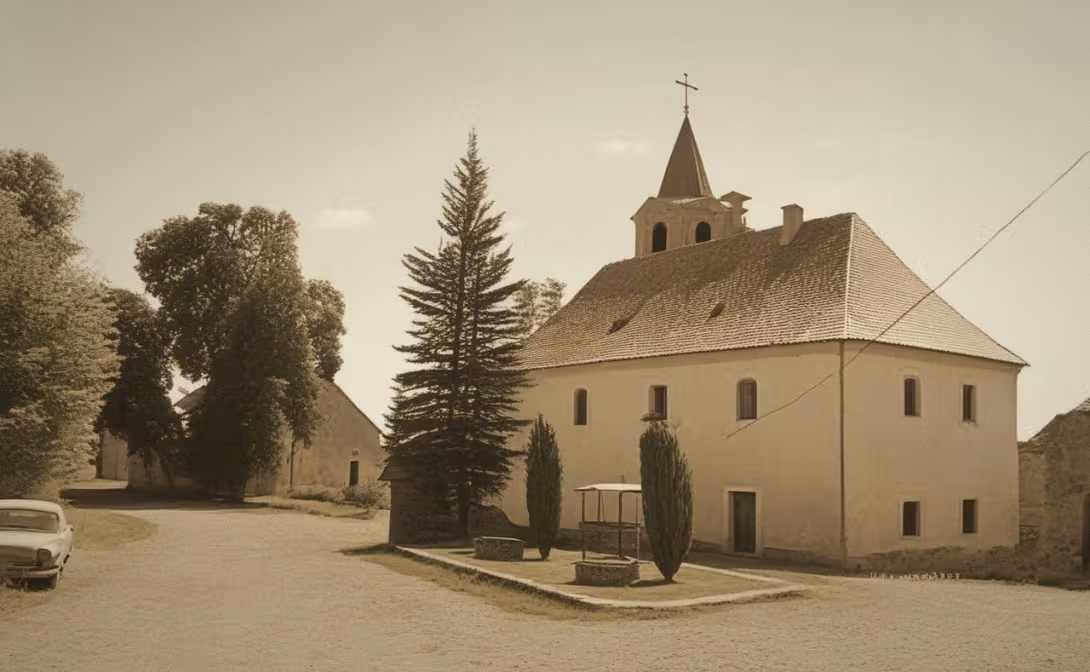
The historical appearance on the left is an AI-generated visualisation and serves as inspiration only.
Historical milestones
- 1601
- Hanging the big bell.
- 1780
- The position of the new Baroque church.
- 1832
- Replacing the tower after the fire.
- 2008
- The location of two new bells in the tower.
Architectural development
Originally, the church was built on the site of the older church according to the design of Master Václav Vychl in 1780. After the fire in 1832, a new tower was replaced. The church has a single-boat structure with Baroque altar and organ from 1587, which are among the oldest preserved in Bohemia.
Historical events
- 1601
- A big bell was hung on the church tower.
- 1780
- Built a new baroque one-boat church.
- 1832
- After the fire, a new tower was replaced.
- 2008
- There are two new bells in the tower.
Points of interest
- The organ from 1587 is one of the oldest preserved organ in Bohemia. Originally located in a Gothic church. - In 1601, on the initiative of Matthias Štampach from Štampach, a big bell was hung here. - The present baroque single-boat church was built in 1780 according to the design of Master Václav Výchl. - The interior is decorated with a Baroque altar from the year 1782 by Ignatius František Platzer and the painting of St. Catherine by D. Grana de la Torre. - Since 2008 there have been two new bells in the tower with the names of the Holy Heart of Jesus and Saint Joseph.
Guide
This guide is narrated by a synthetic voice generated by artificial intelligence.
Show guide text
This text was created by artificial intelligence and has not been editorially reviewed. It may contain inaccuracies.
The Church of Saint Catherine of Alexandria is a late Baroque building on a small square in the center of Mšec in the Rakovník district. It forms the dominant feature of the village and is protected as a cultural monument. Until 2003 it was the parish church, and from 2004 it has been under the parish in Nové Strašecí.
The church stands on the site of an older, originally Gothic sanctuary. As early as 1601 a large bell was hung on its tower. The credit for this goes to the then owner of the Mšec estate, Matyáš Štampach ze Štampachu, an imperial councillor and commander of the Slaný region. In 1780 a new single-nave Baroque church was built according to a design by the master Václav Vyčichlo. The Baroque altar from 1782 was created by Ignác František Platzer. It features a Baroque image of Saint Catherine in a Rococo frame by an artist named Grana de la Torre. After a fire in 1832 the church received a new tower. Since 2008 two new bells have hung in it. The larger one, made of cast iron, weighs two hundred kilograms and is named the Most Sacred Heart of Jesus. The smaller bell weighs eighty kilograms and is called Saint Joseph.
The greatest treasure of the church is its organ. It dates apparently from 1587 and is therefore among the oldest preserved organs in Bohemia. It originally played in the old Gothic church and after its demolition was moved to the new building. From the second half of the eighteenth century it was maintained by the organist Gút from Čistá u Rakovníka, a member of the oldest generation of organ builders in the Rakovník region.
The instrument has a freestanding console, a pedal for bass tones, three pipe fields on the facade and rich carvings. From the eighteenth until the end of the nineteenth century it had two manuals. It was a rare type of organ with what is called a continuo work, that is small organs hidden directly in the console. This was removed at the end of the nineteenth century.
Air is supplied to the pipes by bellows in a case measuring two and a half by one and a half metres. A bellows pumper operates them. According to a gauge they must maintain a constant amount of air, otherwise the organ would stop playing. In 2010 the bellows were in poor condition and the reservoir valve would bang loudly when drawing in air. Otherwise the organ is not missing any essential parts. The most serious problem is woodworm.
The instrument is cared for by organist Adam Viktora. He organizes concerts and charity collections. These collected thirty thousand crowns, which is enough for the most urgent repair of the bellows and cleaning of the pipes.
Tips for visitors
Best time to visit St. Catherine's Church in Mšeci is in the spring or autumn season when the weather is pleasant and fewer people are going to be here. This time of year also offers the most beautiful lighting conditions for photography, especially the sunrise illuminates the church tower and surrounding greenery.
Transport to Mšece is also ensured by public transport; for current connections and options we recommend using route search engines.
When visiting, remember the appropriate clothes, especially if you visit the church in colder months. Photographers should bring their equipment and consider buying a filter to reduce radiance, especially if you plan to photograph at noon.
For families with children, St. Catherine's church is an interesting place because of historical organ and architectural details. After visiting the church you can go for a walk around the surrounding countryside, offering opportunities to relax and discover nature.
In the vicinity of the church you can visit the historical site Rakovník, located near Mšece. This area offers other cultural monuments and possibilities for tours, which is the perfect supplement to visit St. Catherine's Church.
Frequently asked questions
Can the monument be visited?
Religious buildings are usually open mainly during services; at other times a visit is normally arranged with the parish or the operator. We have not verified specific times.
Where is the monument?
Location: Mšec, Středočeský kraj. The map on this page shows the exact spot.
Why is the monument protected?
It is listed in the Central List of Cultural Monuments of the Czech Republic as a cultural monument (register no. 26758/2-2680).
For kids
Hello, boys and girls! Today we are going on an adventure set in time when baroque music was roaring on the streets, raising carpet ceiling paintings with spirit. And it's in Mšec! There is a church of St. Catherine, like an old book man full of secrets and stories.
Businesses nearby
Do you run a restaurant, accommodation, shop, museum, rental, wellness or other visitor service near this monument? Show yourself directly to the people heading to it — this is how they will see you in the app and on the web:
Nearby
ITEX Show interactive overview of the surroundings - restaurants, accommodation, rentals and other places within a 15 km radius.
Data: OpenStreetMap contributors, 15 km radius.
‡ Historical monuments
- Woods (7.2 km)
- grave T. G. Masaryka (9.1 km)
- Muz. sports (9.5 km)
- T. G. Masaryka (9.6 km)
- Lesnic Eduard Wollmann (9.6 km)
- sv. Jiří fighting the dragon (10.2 km)
- menhir Shepherd (12.3 km)
- Ruins Jban (13.4 km)
Restaurant and catering
- U Cucks (10.5 km)
- U Banks (11.4 km)
- Heda (12.4 km - 19)
- Heda (13.2 km)
- Na Strelnici (13.2 km)
- Na Plutu (13.4 km)
- El Alma (13.4 km)
- Prostor (13.5 km)
Accommodation
- Camping Bucek (5.5 km)
- Relax apartment Milejnice (6.3 km)
- Hotel Pod suncem (9.7 km - Třebíz 25)
- Astra (12.0 km)
- Motorest Na Šustné (12.0 km)
- Atlas (12.9 km)
- Ungelt (13.4 km)
- Hejman Court (13.6 km)
› Rental and sports
- Sport hall BIOS (5.4 km - Husova 1146)
- Sport hall Stochov (7.4 km - U stadium 531)
- JK Falco Krusovice (9.5 km)
- Tennis Club Lány (9.9 km)
- Hockey courses (12.0 km)
- Outdoor gym (12.2 km)
- Floater Slaný (12.7 km)
- Sokolovna (13.2 km)
© Tourism and nature
- Pod Little Louštěm (7.1 km)
- Rivničská Lísa (7.4 km)
- Small Louštín (7.8 km)
- Louštín (8.8 km)
- Merkovka (9.7 km)
- Libušín distribution road (11.6 km)
- Libušín - square (11.7 km)
- Na Rýni (11.9 km)
Accommodation nearby
Themed route
Thematic cruise route: Kostel svaté Kateřiny ve Mšeci
1. Kostel svaté Kateřiny ve Mšeci (church) - Type: Religious monument - Why is it worth a visit: This Baroque church is an architectural work with rich history and beautiful interior decoration. It is an ideal place to understand the cultural and religious heritage of the village Mšec.
2.Mšec (village) - Type: Historical village - Why is it worth a visit: Explore the street Mšeč, where there are many ancient houses with characteristic Czech architectural features. The village offers a view of life in the past and is an ideal place for relaxation.
3. Mšec (Municipal Office) - Type: Historical building - Why is it worth visiting: Municipal Office in Mšeci is built in a historical building that resembles the history of the village with its architecture. It is suitable for obtaining information about local events and activities.
4.Mšec (nav) - Type: Local square - Why is it worth visiting: Naves is the center of the village where there are many pawners and a place for meeting residents. It is an ideal place for relaxing or a short break on the road.
5.Mšec (park) - Type: Local park - Why is it worth visiting: Park in Mšeci is a quiet place where you can enjoy the natural beauty of the village. It is suitable for a picnic or for a moment of rest in green.
This route offers a comprehensive view of the cultural and historical aspects of Mšeč, allowing visitors to immerse themselves more fully in the atmosphere of this picturesque village.
Seasonal recommendations
Spring brings to the surroundings of Mšec the awakening nature and fresh green vegetation, which creates wonderful sets for the tour of the church. Light is soft and pleasant in this period, which is ideal for observing details of architecture without sharp shadows. We recommend a visit in the morning when the air is the cleanest and the movement of people is minimal. Prepare your layered clothes because the morning temperatures can still be cold.
In the summer months, the days are the longest and the sun illuminates the stone facades of the monuments. In the main summer times, the most intense is around the place, which is why it is best to arrive early in the morning so that you can enjoy your peace and avoid the greatest heat. Dress lightly and comfortably, and if you plan to take a longer walk around, don't forget enough water.
Autumn is characterized by golden colours of leaves and morning fog, which give the place a mystical atmosphere. In November, the landscape is often very colorful and melancholy when it comes to patron's holiday. For the best visual experience we recommend a visit in the afternoon when the sun shines low. Don't forget to wear warmer clothes and quality shoes in case of rainy weather.
Winter offers the greatest peace and opportunity to see the church in a snowy, quiet landscape, which seems very spiritual. In advent time the atmosphere is strange and relaxed, but it is necessary to count on a shorter time of light and cold. It is necessary to take very warm clothes and plan a visit in clear days to use the maximum amount of daylight.
Visualizations and artistic views


The visualisations are generated by artificial intelligence and serve as inspiration.
Photos from the area
Real photos taken near the monument


Zdroj a licence jsou uvedeny u každého snímku.
Tips from visitors
No tips yet. Be the first!
Log in and add your tip.
Sources and literature
Photos: I would appreciate being notified if you use my work outside Wikimedia. More of my work can be found in my personal gall / CC BY-SA 3.0 — Wikimedia Commons. The author and licence also appear when you hover over the image.
Faktickým podkladem tohoto textu byl článek na Wikipedii, jehož autory jsou přispěvatelé Wikipedie. Článek je dostupný pod licencí CC BY-SA 4.0.
Location on the map





Příběhy a pověsti
Legendy, pověsti a příběhy spjaté s touto památkou
Fotografie návštěvníků
Zatím žádné fotografie. Buďte první, kdo přidá fotografii z návštěvy!
Log in a přidejte svou fotografii nebo hodnoťte.
Za ověřenou návštěvu v aplikaci získáte víc bodů — poznáme podle GPS, že jste na místě.
Reviews and comments