



kostel svaté Ludmily (Řimice) Church
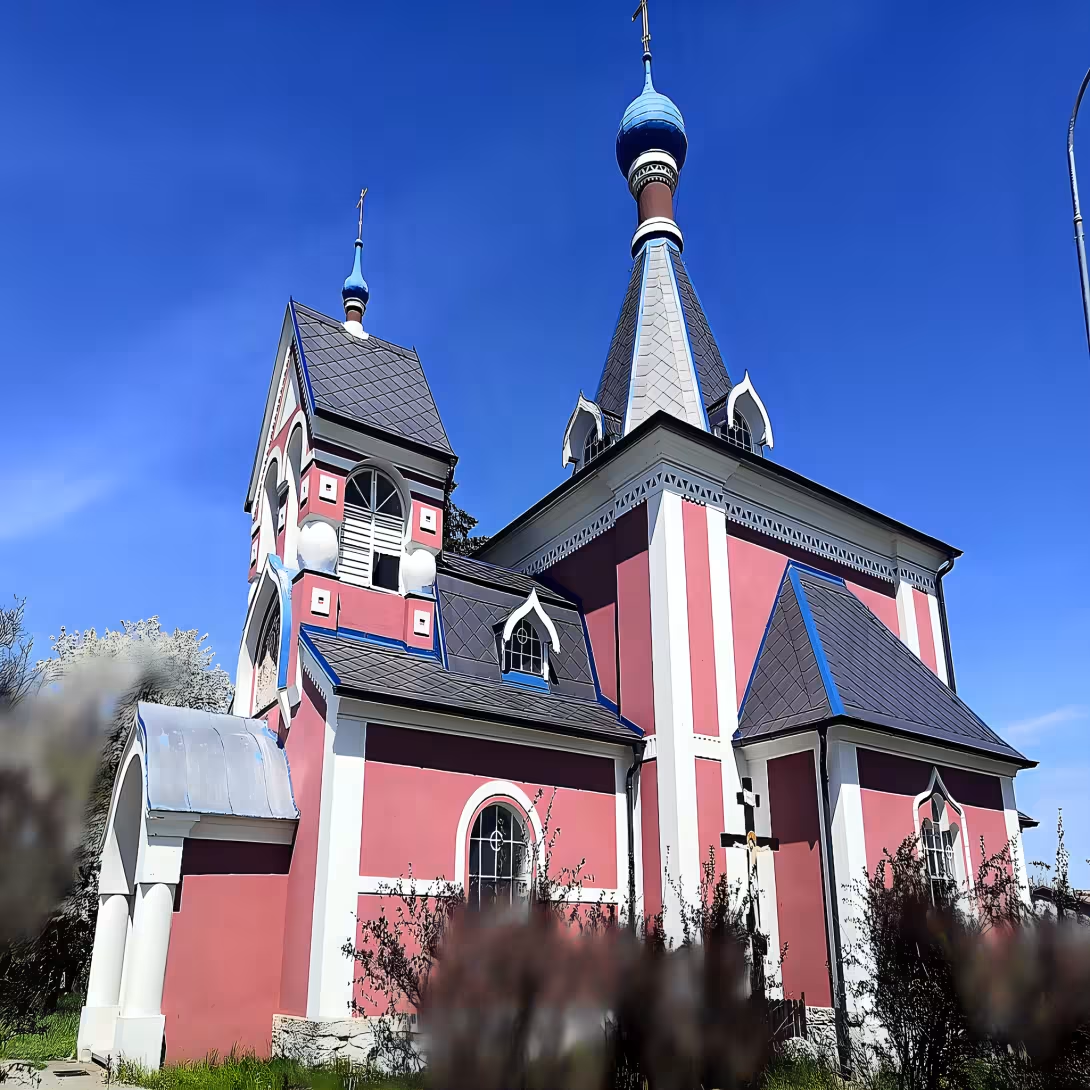
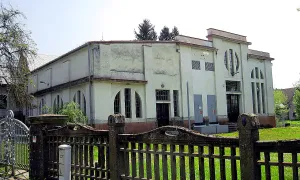
The Temple of Saint Ludmila is the main sacral building of the Orthodox Church in Řemice, which is part of the village of Bílá Lhota on Olomouc. It originated in the first half of the 20th century as an important spiritual center of a small Orthodox community.
The village was established on 22 February 1931 and its first spiritual administrator became priest Alois Václav Šnoflák. He sought his own temple from the beginning, but the first flight was difficult for the community. The city was operating in a commission, and financial concerns about potential debt were hampered by any initiatives. Although a construction committee was set up in 1932, its activities remained purely formal and without real progress.
The decisive twist came in the spring of 1933 when vladyka Gorazd (Pavlík) entered the matter. At the meeting of the church community he brought the priest and architect Vsevolod Kolomacký, who later became known as the archmandrite Andrei. Kolomacký had a number of temple buildings in Podkarpatské Rusi and the reputation of a builder who worked without debt and with minimal costs. His experience and pragmatism convinced the Roman community. The foundation stone was ceremoniously laid and blessed on 4 June 1933. The land was donated by Mrs. Beata Jarolímová. The construction was carried out quickly according to the Colomakian design and the temple was completed in record time. Vladyka Gorazd consecrated it on May 21, 1934, just on Holy Monday.
During World War II, the temple was in a difficult situation. On 24 September 1942, the Gestapo looted him as part of the persecution of the Orthodox Church after the assassination of Heydrich. Believers returned to their sanctuary on 10 May 1945 and only three days later, on 13 May, the first service was held in clean rooms. Since 1945, the temple has been continuously used by the local church community. In 1970 it was partially reconstructed, and in 1972 the entrance facade was enriched with the fresco of Saint Cyril and Methodius, which he will create according to the design of the famous Czech artist Mikolas Alš.
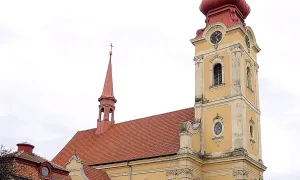
The building form of the temple is characterized by its simple elegance. In the centre there is a square temple box, which is supplemented by four tributaries. Three of them are right-angled, the one designed for the entrance is closed by a square bell. The fourth extension in which the altar space is located has an original oval finish. The temple box is covered by two needles - the lower one is a rotation and the top one is a hexagonal needle ended with an onion turret, which becomes a dominant building.
The inner space gained admiration mainly thanks to the distinctive iconostas. It contains a series of icons organized in several rows, including two upper belts of smaller paintings. The Last Supper of Christ, supplemented by the Icons of Birth and Resurrection, is traditionally displayed above the royal door. In the highest place of iconostas, in the onion frame, there is a small icon of the Holy Trinity - a copy of the famous icon by Andrei Rublev. On its sides there are icons of the birth of the Lord, the baptism of the Lord, the entrance of the Lord to Jerusalem and Ascension.
The temple, which survived the war rage for decades, continues to serve as a place for meeting believers. Its modest but harmonious architecture and rich iconographic program make it an interesting sacral structure, which is a testament not only to faith, but also to the resilience of the small community in the face of the difficulties of the 20th century.
Then and now
Drag the slider to compare how the landmark may have looked when it was built with the view today.
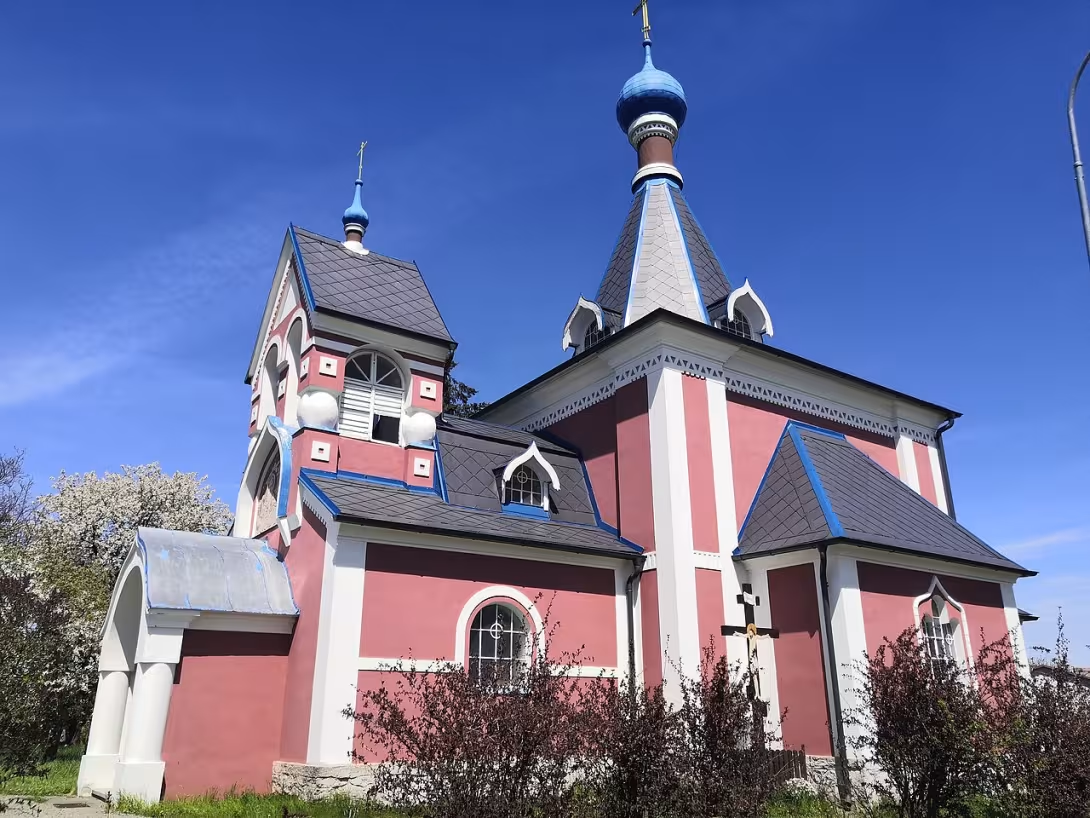
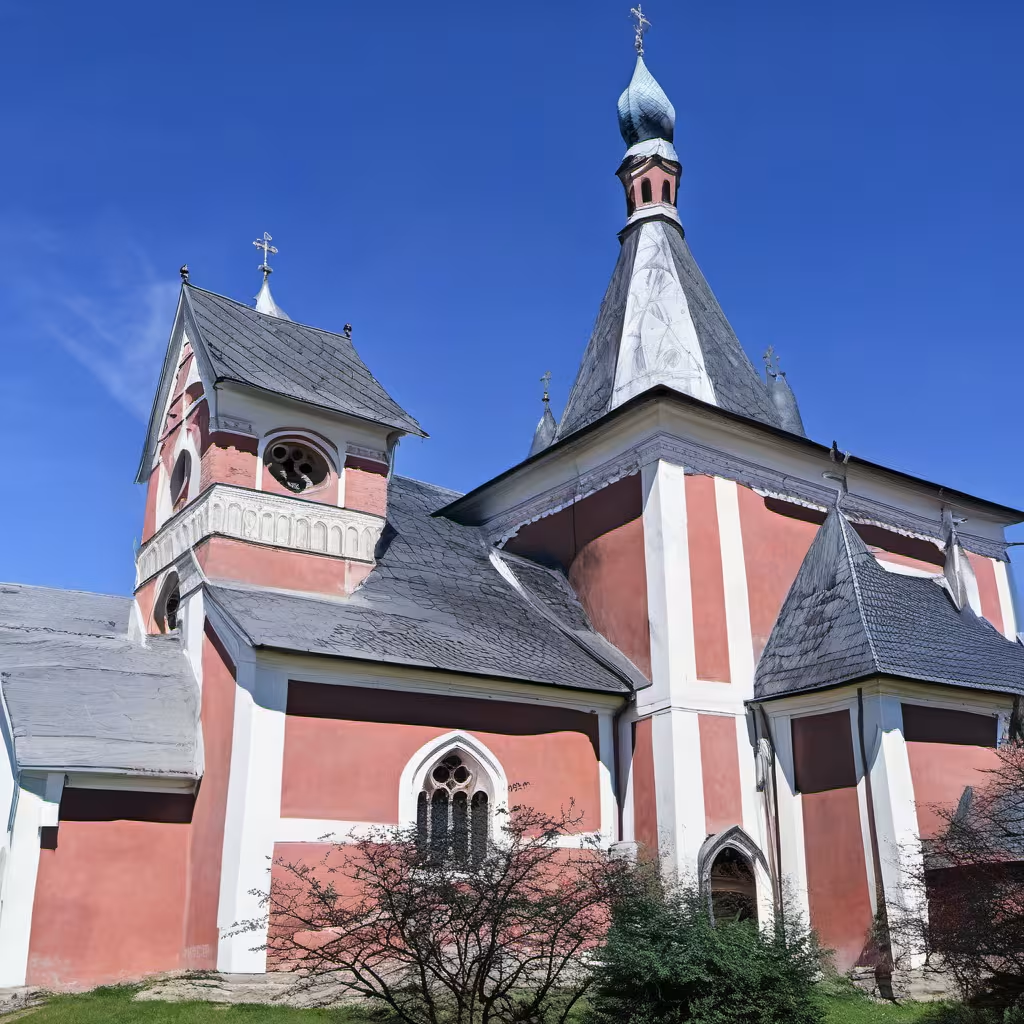
The historical appearance on the left is an AI-generated visualisation and serves as inspiration only.
Historical milestones
- 1934
- The ordination of the temple by Gorazdem.
- 1945
- Reusing the temple for worship after World War II.
Architectural development
The temple was designed by architect Vsevolod Kolomacký and built quickly in 1933-1934. It has a simple floor plan with a square box, tributaries and an onion turret. In 1972, the fresco of Saint Cyril and Methodius was applied to the facade of the temple.
Historical events
- 1931
- The establishment of the Orthodox Church in Romice.
- 1934
- The ordination of the temple by Gorazdem.
- 1942
- The temple was looted by the Gestapo during the repression of Orthodox Church.
- 1970
- Partial reconstruction of the temple.
Owners
Parish Řimice
Points of interest
- Architect Vsevolod Kolomacký was known for building temples without debts and with minimal costs. - The site was donated by Mrs. Beata Jarolímová. On September 24, 1942, the Gestapo raided the temple in pursuit of Orthodox Church. - The entrance facade has since 1972 been enriched with the fresco of Saint Cyril and Methodius according to the design of Mikolas Alš. - There is a copy of the famous icon of the Holy Trinity from Andrei Rublev.
Guide
This guide is narrated by a synthetic voice generated by artificial intelligence.
Show guide text
This text was created by artificial intelligence and has not been editorially reviewed. It may contain inaccuracies.
The Church of Saint Ludmila stands in Řimice, a part of the municipality of Bílá Lhota in the Olomouc region. It is the main church of the local Orthodox Church parish.
The parish was founded on February twenty-second, nineteen thirty-one, and its first priest became Alois Václav Šnoflák. The parish initially operated provisionally, and Father Šnoflák wanted to build its own church as soon as possible. However, many were afraid of going into debt. The building committee established in nineteen thirty-two existed only formally. A turning point came in the spring of nineteen thirty-three, when Bishop Gorazd Pavlík stepped in. At a parish assembly, he invited the priest and architect Vsevolod Kolomacký, who would later become Archimandrite Andrey. He had already built several churches in Subcarpathian Ruthenia, always with very low costs and without debts. He persuaded the people of Řimice, and on June fourth, nineteen thirty-three, the foundation stone was laid and blessed. The land was donated by Beata Jarolímová, and Kolomacký himself designed the project.
Construction proceeded quickly. Bishop Gorazd consecrated the church on May twenty-first, nineteen thirty-four, that year on Whit Monday.
On September twenty-fourth, nineteen forty-two, the church was ransacked by the Gestapo. This happened during reprisals against the Orthodox Church following the assassination of Heydrich, even before the ban on church activities on September twenty-seventh. The faithful returned on May tenth, nineteen forty-five. Three days later, a lay service was held in the provisionally cleaned spaces, which can be conducted in the Orthodox Church when a priest is not available. Father Bohumír Axman temporarily took over pastoral care, and from December first, nineteen forty-five, Father Ladislav Crhák took over. Since then, services have been held continuously here. In nineteen seventy, the church was partially reconstructed. In nineteen seventy-two, a fresco of Saints Cyril and Methodius was added to the entrance façade, based on a drawing by Mikoláš Alš.
The floor plan is fairly simple. In the middle is a square nave, to which four extensions adjoin. Three are rectangular, and one of them forms the entrance with a square bell tower. The fourth extension with the altar space is rounded at the end. The nave is covered by a pyramidal roof, from which rises a hexagonal pyramid with a bulbous spire.
The interior is dominated by an impressive iconostasis. Besides the principal icons, it has two upper rows of smaller icons. Above the royal doors is, according to tradition, Christ's Last Supper, with the Nativity and the Resurrection of the Lord on either side. Highest up, in a bulbous frame, is a small icon of the Holy Trinity, a copy of the famous icon by Andrey Rublev. On either side of it are two pairs of smaller icons. On one side are the Nativity of the Lord and the Baptism of the Lord, on the other the Entry of the Lord into Jerusalem and the Ascension of the Lord.
Tips for visitors
The best time to visit St. Ludmila's church in Řemice is autumn or spring season when the weather is quiet and pleasant. This time of year offers ideal conditions for exploring the historical environment without excess heat and light, which allows a better understanding of architectural details.
When planning a visit to St. Ludmila's church, it is advisable to take the camera with you, especially if you like photography architecture. The church offers a beautiful view from different angles and therefore we recommend arriving at the place at noon for the best lit photos. Don't forget to bring sun glasses.
In the vicinity of St. Ludmila's church you can visit other historical places nearby. Finding these places before visiting helps plan an effective and fun day for the whole family.
For families with children, St. Ludmila's church is a suitable goal where they can not only learn about history and architecture, but also enjoy peaceful walks around the surrounding territory. When visiting, notice children's information panels or leaflets, which may be interesting for younger visitors.
Frequently asked questions
Can the monument be visited?
Religious buildings are usually open mainly during services; at other times a visit is normally arranged with the parish or the operator. We have not verified specific times.
Where is the monument?
Location: Řimice, Olomoucký kraj. The map on this page shows the exact spot.
For kids
Imagine going back to the past, when St. Ludmila's Church was the largest and most beautiful state in the city. It was like a game where heroes lived, loved and fought.
The church stood in the middle of the city, between houses and streets that were filled with people gathering around it. They were merchants, craftsmen, nobles and warriors who came to the Romans to pray and seek solace. The church was their home where they collected and shared their thoughts and considerations.
Businesses nearby
Do you run a restaurant, accommodation, shop, museum, rental, wellness or other visitor service near this monument? Show yourself directly to the people heading to it — this is how they will see you in the app and on the web:
Events nearby
Zdroj akcí: otevřená data měst a obcí ČR (Národní katalog otevřených dat) a kalendář akcí Národního památkového ústavu.
Nearby
Ambient landscape, other monuments, natural elements up to 5 km or zero.
Accommodation nearby
Trips and activities nearby
Guided tours, tickets and activities nearby from GetYourGuide
Affiliate link: if you buy from the partner, we may receive a commission. The price for you does not change.
Search tours and activities →Themed route
Thematic cruise route: Spiritual and architectural heritage
This route focuses exclusively on the main objective and its immediate surroundings, since there are no other specific locations in the given background. Therefore, we propose a tour focused on the details of the monument itself and its premises.
1. Church of Saint Ludmila (church) The main point of the route, which is worth visiting for its historical value and architectural processing. The church is a key cultural element of the village Řimice and offers a view of local sacral traditions.
2. Tank Church of St. Ludmily (space) The immediate surroundings of the temple, where you can admire the harmony between the construction and the surrounding greenery. This place serves as a quiet space for relaxation and reflection after a tour of the interior.
3. Tower of St. Ludmily (architectural element) Dominant of the village, which offers a unique view of the Rojimic roofs and surrounding landscape. Visiting the tower (if accessible) allows you to understand the spatial relations between the church and the village.
4. Interior of St. Ludmily Church (exposition) Space inside the temple, where there is liturgical equipment and any historical memorial records. Here you can look into the spiritual life of the local community and appreciate the artistic details.
5. Park at St. Ludmily (green area) The surrounding green, which complements the painting of the monument and provides shade and peace. Ideal place to end the trip where the visitor can enjoy the atmosphere of the village Řimice.
This route is designed to respect the limitation of the assignment and to focus exclusively on the main objective and its immediate surroundings without complementing fictional or unspecified locations.
Seasonal recommendations
Spring brings fresh greenery and fine morning light around the temple, which highlights the details of the facade. The atmosphere is full of hope and the awakening of nature. I recommend choosing layered clothes because temperatures may fluctuate sharply. The best time to visit is in the morning when the air is the cleanest.
In the summer months, rich green and bright sun dominates, creating deep shadows in architecture. There are more people in the main season, so it is advisable to come first thing in the morning to avoid the biggest clusters and heat. Dress light, breathable materials and remember to protect against the sun.
Autumn season is characterized by golden leaves and foggy wounds that give the church a mysterious and peaceful touch. Soft evening light is ideal for observation of the building. The practical shoes are moisture-resistant and warm sweater, especially if you plan to walk around the monument.
The winter offers quiet and stopped space, while the snow can beautifully display the outlines of the building. The atmosphere is cramped and meditative. It is necessary to wear warm and waterproof clothes.
Visualizations and artistic views


The visualisations are generated by artificial intelligence and serve as inspiration.
Photos from the area
Real photos taken near the monument


Zdroj a licence jsou uvedeny u každého snímku.
Atmosphere of the place
This atmospheric visualisation of the place and period was generated by artificial intelligence. It is not real footage of the location.
Tips from visitors
No tips yet. Be the first!
Log in and add your tip.
Sources and literature
Photos: Palickap / CC BY-SA 4.0, rozlišení zvýšeno umělou inteligencí — Wikimedia Commons. The author and licence also appear when you hover over the image.
Faktickým podkladem tohoto textu byl článek na Wikipedii, jehož autory jsou přispěvatelé Wikipedie. Článek je dostupný pod licencí CC BY-SA 4.0.
Location on the map
Příběhy a pověsti
Legendy, pověsti a příběhy spjaté s touto památkou
Fotografie návštěvníků
Zatím žádné fotografie. Buďte první, kdo přidá fotografii z návštěvy!
Log in a přidejte svou fotografii nebo hodnoťte.
Za ověřenou návštěvu v aplikaci získáte víc bodů — poznáme podle GPS, že jste na místě.
Reviews and comments