



Kostel svaté Máří Magdaleny (Jeřice) Church
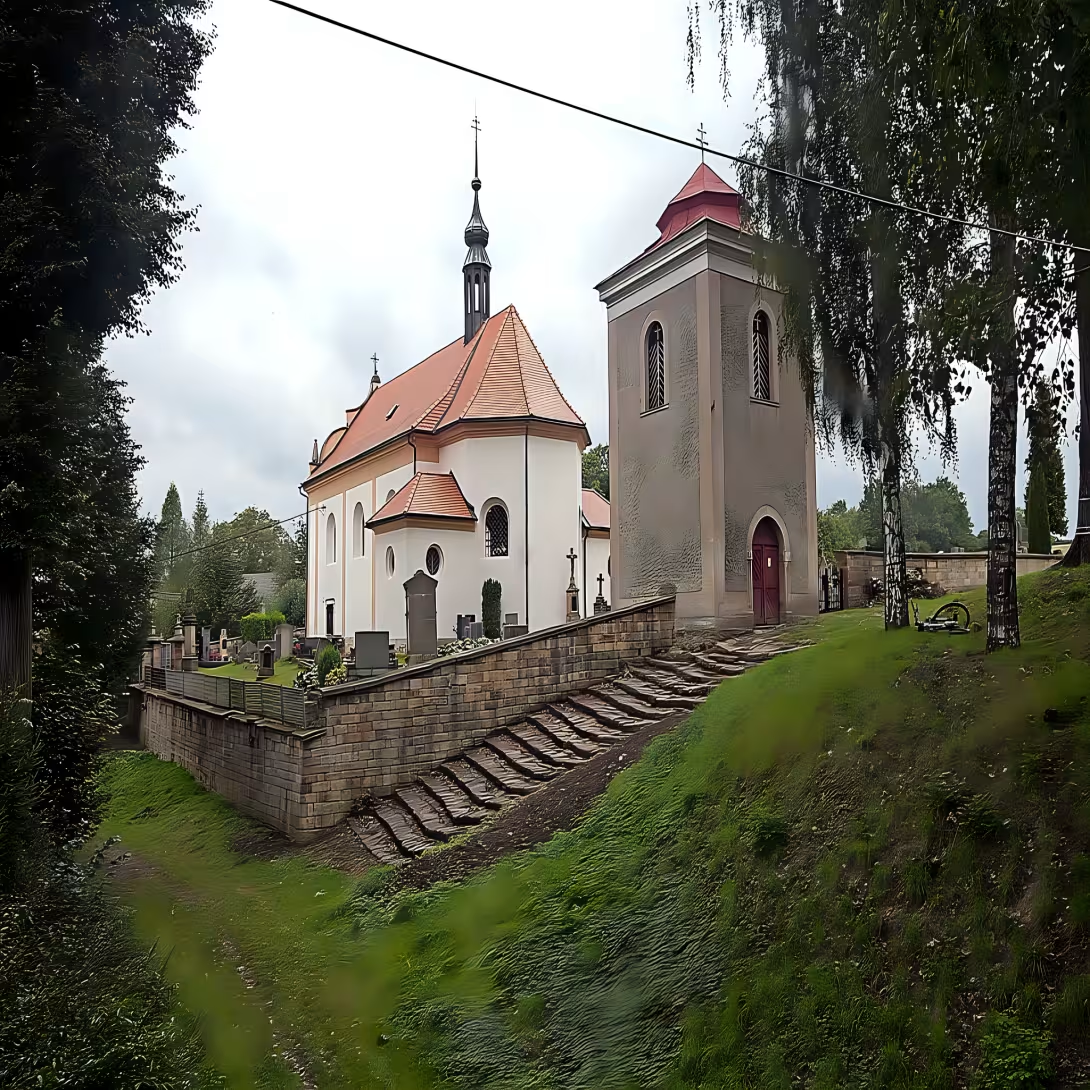
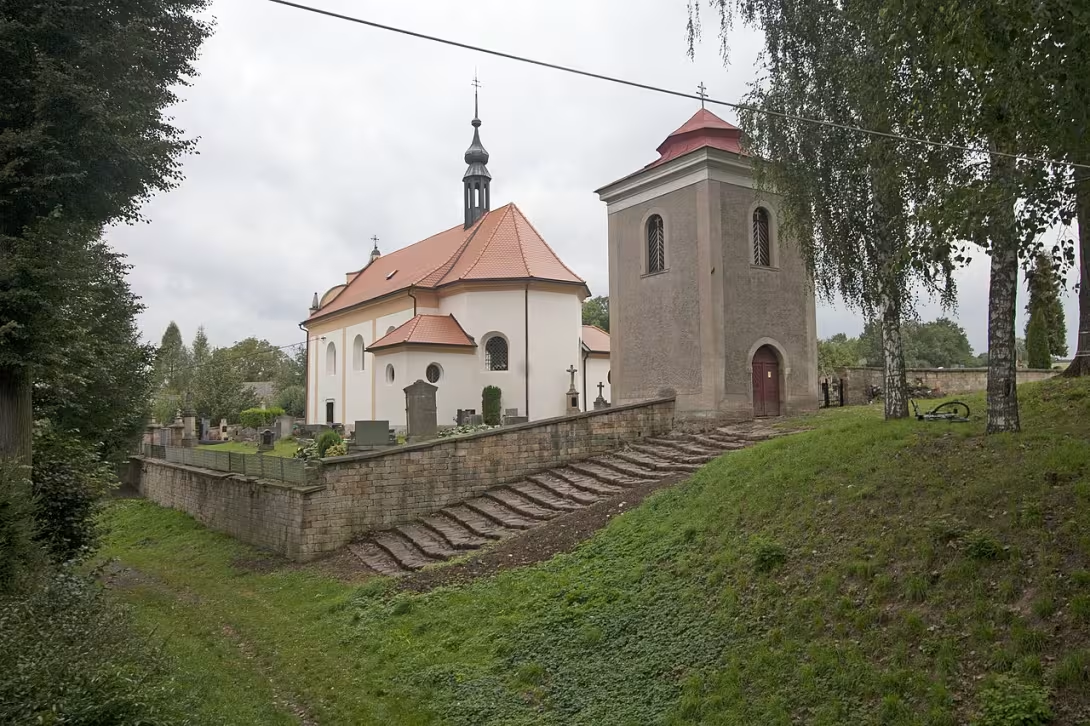
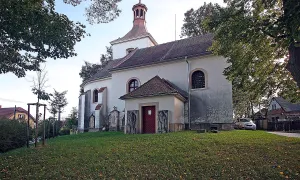
The church of St. Mary Magdalena in the village Jeřice in the district of Jičín stands on a slight high in the middle of the cemetery on the northern edge of the village. This is a filial church which is protected as a cultural monument of the Czech Republic. It owes its present form more than four centuries of architectural changes.
The oldest mention of the temple dates back to 1384, when it was already furnished with plebán. The original building was a typical Gothic building of the 14th century, surrounded by a cemetery and surrounded by a wall. However, this form changed radically in 1787, when бIndividual Church was rebuilt into the present Baroque form. At the same time, a storey bell tower was built east of the church with a passageway on the ground floor, which served practically as an access to the cemetery. The signs of gradual modernization are also wall paintings from 1864, which today decorate the interior walls.
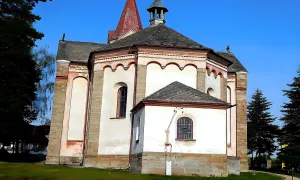
Architectural is a one-ship rectangular construction with narrower presbyterium. Presbyterium is externally sealed with tributaries, while internally has a semi-circular shape. The presbytery in the north and south is adjacent to the side spaces serving as sacristy and hall. There are two portals entering the church - the south under the crust and the main entrance from the west. The boat is 16 metres long and 7.92 metres wide with gothic walls of 0.96 metres thick. The lighting is provided by six windows with a segment lock. The dominant rolled arch with lunette sections is carried by pillars, from which the interwindows are decorated by Tuscan Pilasters. Presbyterium, which is separated from the ship by a semi-circular triumphant arch, has dimensions of five meters to five meters and is also covered by a coiled vault with a condom. Inventor of the church came from the 19th century, except the late Baroque pulpit from the late 18th century.
Two sandstone tombstones are an interesting part - one with dimensions of 0,47 × 0,54 metres and the other with a height of 0,99 metres with German inscription and the year 8 June 1667. Two coats of arms were still hanging over the main portal at the beginning of the 20th century, one of which carried the original sign of the princes of the Paars.
Since 2003, church initiation has also been reflected in the municipal emblem of Jerice - in the red-green, oblique-shaped shield, the red field depicts a golden covered container that symbolizes the box on Marie Magdalena's fragrance ointment. In mid-2006, the parish Jeřice was abolished and the church became a filial church of the deanery of Hořice in Podkrkonoší. From 1995 to 2014 an amount of CZK 3 890 000 was drawn for the reconstruction of the Architectural Heritage Programme.
Today, church services are held regularly on an odd week on Sunday from 10 o'clock. Visiting this temple is worth it to all who are interested in developing architectural styles or history of Czech parishes.
Then and now
Drag the slider to compare how the landmark may have looked when it was built with the view today.
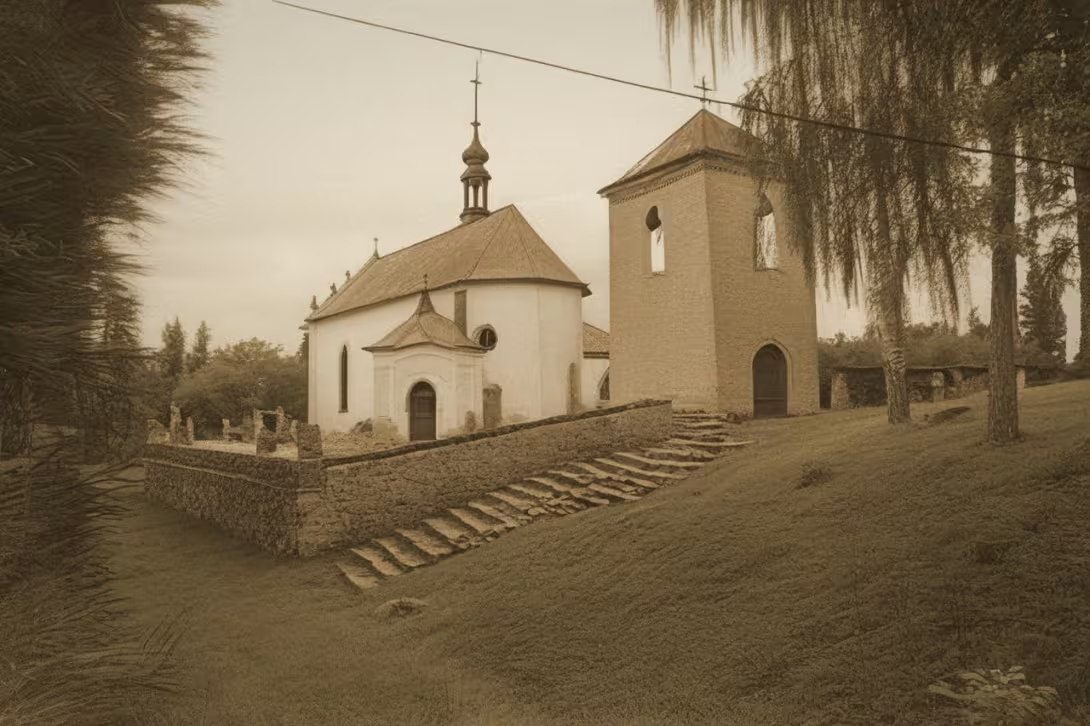
The historical appearance on the left is an AI-generated visualisation and serves as inspiration only.
Historical milestones
- 1384
- First mention of a plebán in church.
- 1787
- Reconstruction of the church into Baroque form and construction of bell tower.
- 1864
- The creation of wall paintings in the interior.
- 2006
- Cancellation of the parish Jeřice and change of status to the filial church.
Architectural development
Originally, it was a 14th-century Gothic church with very strong walls. In 1787 it was rebuilt into baroque style and supplemented with a storey bell tower with a passageway on the ground floor. The interior is finished with a Valen Vault with lunette sections and Tuscan Pilasters.
Historical events
1384: mention of plebán in church; 1787: reconstruction into Baroque form and construction of bell tower; 2006: abolition of the parish Jeřice.
Points of interest
- The oldest mention of the temple dates back to 1384. - In 1787 the church was rebuilt into its present Baroque form. - The interior walls are decorated with wall paintings from 1864. - An interesting part are two brick sandstone tombstones, one of which has a German inscription and the year 8 June 1667. - The initiation of the church since 2003 reflects the municipal emblem of Jerice, which depicts the golden jar symbolizing the box on Marie Magdalena's fragrance ointment.
Guide
This guide is narrated by a synthetic voice generated by artificial intelligence.
Show guide text
This text was created by artificial intelligence and has not been editorially reviewed. It may contain inaccuracies.
The Church of Saint Mary Magdalene stands on a gentle elevation in the middle of the cemetery on the northern edge of Jeřice in the Jičín region. It is a Roman Catholic filial church, formerly a parish church, and is protected as a cultural monument.
Its origins date back to the fourteenth century. As early as 1384, there is a record that the church had its own priest. The original Gothic structure was surrounded by a cemetery enclosed by a wall. In 1787, the church was rebuilt into its present Baroque form. At the same time, a two-story bell tower was erected to the east of it, and through its ground floor passage, one could walk to the cemetery.
The church's dedication has appeared in the municipal coat of arms of Jeřice since 2003. On the diagonally divided shield in red and green, a golden covered vessel appears on the red field, that is a container for the fragrant ointment of Mary Magdalene. In mid-2006, the Jeřice parish was abolished and its successor became the former deanery of Hořice in Podkrkonoší. Since then, the church has been filial. For its repairs between 1995 and 2014, three million eight hundred ninety thousand crowns were drawn from the Program for the Preservation of Architectural Heritage.
The church is a single-nave rectangular structure. The narrower presbytery is closed from the outside by a three-sided vault, and from the inside by a semicircle. From the north and south, a sacristy and vestibule are adjacent to it. Two portals lead into the church, the main one from the west and the southern one beneath the gallery. Above the main portal, there were still two coats of arms at the beginning of the twentieth century, and one of them bore the original coat of arms of the Paar princes.
The nave is internally sixteen meters long and seven point ninety-two meters wide. Its Gothic walls are zero point ninety-six meters thick. Light enters it through six windows with segmental vaults. The barrel vault with lunettes is supported by pillars, and those between the windows are adorned with Tuscan pilasters. The presbytery, five meters wide and five meters deep, also has a barrel vault with a conch. It is separated from the nave by a semicircular triumphal arch.
The walls of the church are decorated with frescoes from 1864. Two sandstone tombstones are built into the walls. The smaller one measures forty-seven by fifty-four centimeters. The larger one is zero point ninety-nine meters high and bears a German inscription in its upper part with the date of June eighth, 1667. The church furnishings date from the nineteenth century. Only the pulpit is older, a late Baroque from the end of the eighteenth century.
Tips for visitors
The best time to visit the church of St. Mary Magdalene in Jeřice is from spring to autumn, when the temperature is pleasant and the surrounding green landscape offers beautiful views. The Baroque architecture of the church is particularly marked in these months.
When visiting, it is recommended to bring protective clothing if you plan to tour the cemetery around the church. Don't forget to take pictures of your camera or mobile phone, because Baroque decoration and architecture are a great topic.
Photography is possible from special angles around the church which offer views of its Baroque tower and facade. The best light for pictures is usually in the morning or in the evening when the sun refreshes the roof of the church.
Around the church there are mild hills offering beautiful views of the surrounding countryside. For those who want to explore more history of the region, it is appropriate to visit the nearest villages and their monuments.
For families with children, the church is an interesting place to visit because of its architecture and history. Children can also enjoy walking around the cemetery if they are older, because here you will find inscriptions on old graves that tell about the past.
Frequently asked questions
Can the monument be visited?
Religious buildings are usually open mainly during services; at other times a visit is normally arranged with the parish or the operator. We have not verified specific times.
Where is the monument?
Location: Jeřice, Královéhradecký kraj. The map on this page shows the exact spot.
Why is the monument protected?
It is listed in the Central List of Cultural Monuments of the Czech Republic as a cultural monument (register no. 16229/6-1202).
For kids
About 239 years ago, when old and new worlds met in incredible adventures, a unique church was built in a small place named Jeřice. Imagine a place full of beautiful trees and sunshine where people sought solace in prayer, as if a new world had begun.
Businesses nearby
Do you run a restaurant, accommodation, shop, museum, rental, wellness or other visitor service near this monument? Show yourself directly to the people heading to it — this is how they will see you in the app and on the web:
Events nearby


Zdroj akcí: otevřená data měst a obcí ČR (Národní katalog otevřených dat) a kalendář akcí Národního památkového ústavu.
Nearby
ITEX Show interactive overview of the surroundings - restaurants, accommodation, rentals and other places within a 15 km radius.
Data: OpenStreetMap contributors, 15 km radius.
‡ Historical monuments
- War 1866 (7.1 km)
- War 1866 (8.3 km)
- Monument Dead battery (8.6 km)
- War 1866 (9.2 km)
- War 1866 (9.7 km)
- War 1866 (10.5 km)
- War 1866 (11.7 km)
- Monument of the Saxon Choir (11.7 km)
Restaurant and catering
- Motorest Milovice u Hořic (3.9 km)
- Restaurant Neighborhood house (6.5 km - square K. J. Erbena 98)
- U Heroes (8.7 km)
- Guesthouse XIII (11.4 km - Problem 13)
- Guesthouse U Prcka (12.0 km - 13)
- Motorest Piccolo (12.1 km - 191)
- Cafe Kino (13.2 km - Revolutionary 3097)
- Restaurant U Slunce (13.3 km - Přemysova 53)
Accommodation
- Hotel Royal Dvovar (4.3 km)
- Autocamp U Towers (4.7 km)
- Hostel cottages (5.1 km)
- Stanovani - dachch (5.1 km)
- Hotel White Poličany (6.0 km)
- Guesthouse Na Farí (9.5 km)
- V Kovarne (11.3 km)
- Hotel pod Zvicinou (11.8 km)
› Rental and sports
- Nextbike (3.6 km)
- Sports hall Gymnasia (3.9 km - Shalounova 2164)
- Swimming pool Dachch (5.0 km)
- Myslivek klub (8.8 km)
- Indoor swimming pool (11.2 km - 57)
- Kola Sír (11.6 km - T. G. Masaryka 297)
- Autokros (12.8 km)
- Motokros (13.0 km)
© Tourism and nature
- City Information Centre Hořice (4.3 km - Jiří z Poděbrad 3)
- Family house K.J. Erbena (6.7 km)
- White Third bridge (11.8 km)
- Spa Pod Zvicinou (hot.) (11.8 km)
- Masaryk well 1923 (11.8 km)
- Březina (rozc.) (11.9 km)
- Zvičina - Rais chata (12.2 km)
- Zvičina (12.2 km)
Accommodation nearby
Themed route
1. Church of St. Mary Magdalena (inner space) - A tour of the sacral space and observation of historical elements inside the building. 2. Church tower (view) - The output offers a unique view of the architecture of the temple and surrounding landscape. 3. The reservoir of the church (area) - Walk in a quiet environment right by the walls of the monument.
Seasonal recommendations
In the spring, the church surrounds the awakening nature and fresh greenery, creating an optimistic atmosphere. The morning sun gently hits the facade and highlights its details. We recommend wearing layered clothes because the weather is variable. Ideal is a visit in the morning when the surroundings are quiet and the air is the cleanest.
The summer season brings sharp light and rich green trees that provide a pleasant shade near the building. The atmosphere is playful and full of energy. Due to the increased attendance in the high season, it is advisable to arrive first thing in the morning to avoid the biggest crowds and heat. Remember light, breathable clothes and plenty of fluids.
Autumn is a period of golden colors and hazy mornings that give the memory a mysterious and melancholy touch. Soft evening light is ideal for the observation of architecture. It is practical to wear moisture resistant shoes and lighter jacket. The best time to visit is in the afternoon, when the color leaves around the church are most shining.
In winter, the church is still and steeply, especially if the landscape is covered with snow, creating a pure visual contrast. The atmosphere is quiet and brave. It is essential to choose warm thermal clothes and solid shoes.
Visualizations and artistic views


The visualisations are generated by artificial intelligence and serve as inspiration.
Photos from the area
Real photos taken near the monument


Zdroj a licence jsou uvedeny u každého snímku.
Atmosphere of the place
This atmospheric visualisation of the place and period was generated by artificial intelligence. It is not real footage of the location.
Tips from visitors
No tips yet. Be the first!
Log in and add your tip.
Sources and literature
Photos: Petr1888 / CC BY-SA 3.0, rozlišení zvýšeno umělou inteligencí — Wikimedia Commons. The author and licence also appear when you hover over the image.
Faktickým podkladem tohoto textu byl článek na Wikipedii, jehož autory jsou přispěvatelé Wikipedie. Článek je dostupný pod licencí CC BY-SA 4.0.
Location on the map

Příběhy a pověsti
Legendy, pověsti a příběhy spjaté s touto památkou
Fotografie návštěvníků
Zatím žádné fotografie. Buďte první, kdo přidá fotografii z návštěvy!
Log in a přidejte svou fotografii nebo hodnoťte.
Za ověřenou návštěvu v aplikaci získáte víc bodů — poznáme podle GPS, že jste na místě.
Reviews and comments