



Kostel svatého Fabiána a Šebestiána (Živohošť) Church
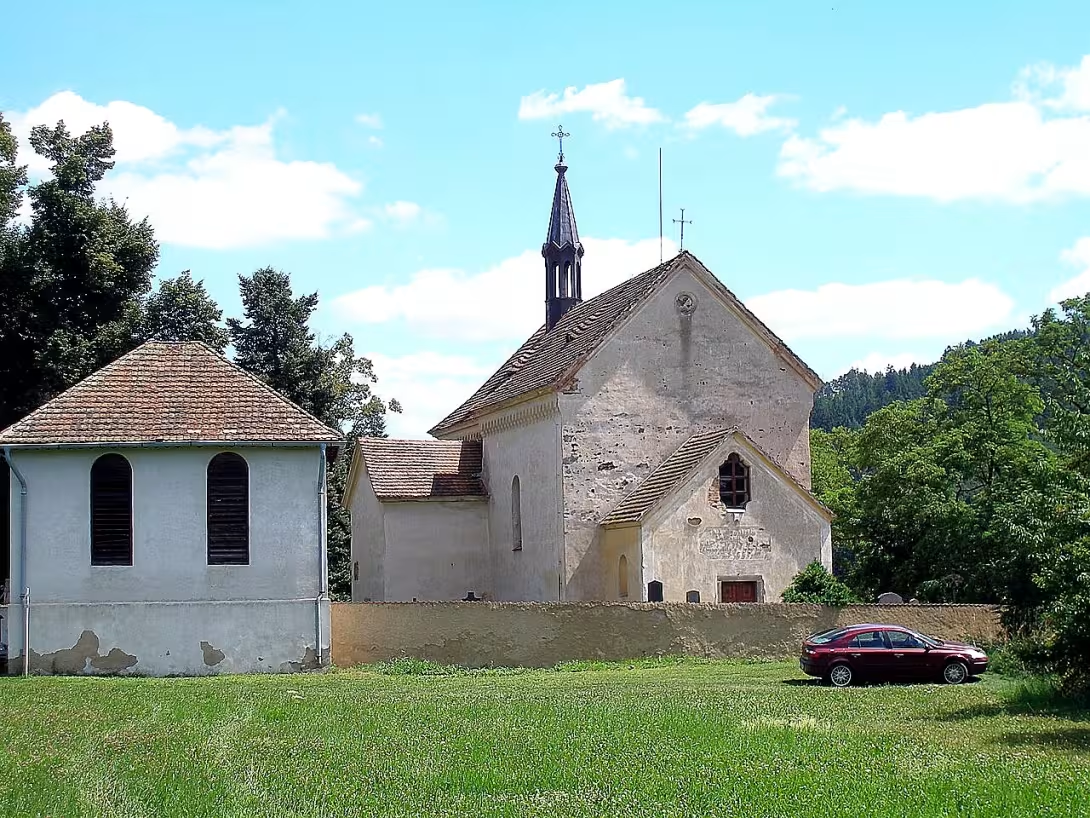
The Church of St. Fabian and the Shebestian in Old Vivihosti is a one-handed sacral building of early medieval origin, which was originally a three-handed Romanesque basilica. It is located on the grounds of the cemetery near the bank of the Sláska dam and is an important witness to the history of the area associated with the princely courts of the Přemyslovovce.
The settlement of the surrounding area of Viohoště has been taking place since the end of the 10th century, when the fishing centres of the ruling Přemyslovovce were established. The written mention from 1141 states that Prince Vladislav II. spent Christmas holidays in Life, indicating the existence of the sacral building at the time. The first documented mention of the church itself dates back to 1271, when Queen Kunhuta, the wife of King Přemysl Otakar II, donated the building of the order of cruisers with a red star.
The archaeological research by Josef Burget from 1975 showed that the construction was originally a Romanesque three-boat basilica with valed vaults. In the last quarter of the 14th century, probably in connection with the promotion of Viohost to the parish mansion in 1361, extensive Gothic reconstruction took place. That's when the side boats died and the right-angled priesthood was formed, ending with a two-field vault. The north wall of the priesthood complements the sacristy with the vault. The facade still shows the remains of gothic windows with four-leaf circles discovered during the survey in 1975. In the Baroque period, the windows were modified and in 1868-1869 a new Romanesque repair took place, during which the hall was built and replaced.
The fate of the church was closely linked to the changes in the surrounding region. In 1954, a large part of the original village of Viohost disappeared as a result of the launch of the dam, while the church was preserved on a small hill by the shore. The original manuscript illustrated mission from the pre-Hussite period, which is now stored in the National Library in Prague, has been preserved from historical artifacts. In 2000, a part of the wall painting of the Virgin Mary from the first half of the 14th century was saved thanks to the professional demise of the restorer Petr Bareš. The history of the building includes a folk legend of a knight and his wife, who, after escaping through Vltava, gave birth to two sons, Fabian and Shebestian, in whose honour the church was later built.
The church is located today in the cemetery area and falls under the Roman Catholic parish in the Old Moustache. In its vicinity you can still see preserved buildings of the former village, such as the rectory, church house or school. The construction represents a unique combination of Romanesque and Gothic elements in an environment that has undergone a major transformation due to the construction of the dam. It's a place worth visiting anyone looking for authentic traces of medieval architecture.
Historical milestones
- 1141
- Written mention of Christmas holidays by Prince Vladislav II in Vivihost.
- 1271
- Queen Kunhuta donates the church of the order of cruisers with a red star.
- 1361
- Likely time of extensive Gothic reconstruction related to the promotion to the parish mansion.
- 1954
- The demise of part of the municipality of Vivihost as a result of the construction of the Sláska dam.
Architectural development
In the 14th century, the Romanesque three-boat basilica with its valence vaults was rebuilt into a Gothic style. This reconstruction created a rectangular priesthood and sacristy with a cross vault. The current unitary state is the result of later changes and loss of side ships.
Historical events
In 1141 Prince Vladislav II. spent Christmas holidays in Life. In 1271, the existence of the church was documented in writing by the gift of Queen Kunhuta. In 1954, part of the village of Vihoště disappeared as a result of the launch of the Sláska dam.
Owners
In 1271 Queen Kunhuta donated the church of the order of cruisers with a red star.
Points of interest
- The Church of St. Fabian and Shebestian was originally a three-legged Romanesque basilica. The first documented mention of the church dates back to 1271, when it was donated by Queen Kunhuta of the Order of Cruisers with a Red Star. - In the last quarter of the 14th century, a large Gothic reconstruction took place during which the side ships died and a rectangular priesthood was created. - In 1954, a large part of the original village of Viohoště was destroyed as a result of the launch of the dam, while the church was preserved on a small high shore. - The original of the manuscript illustrated mission from the pre-Hussite period, which is now stored in the National Library in Prague, is preserved.
Guide
Show guide text
This text was created by artificial intelligence and has not been editorially reviewed. It may contain inaccuracies.
Welcome to the place where time has stopped and where the silence of the cemetery is bound to the noise of water from the nearby dam. You are standing in front of the church of St. Fabian and the Shebestian, which is much more than a walled building. He's a silent witness for centuries, a lone guardian of history who tries to survive in a landscape that has long since changed. Look around you. Feel this atmosphere of peace and cierta that surrounds you. This space, surrounded by tombstones, encourages you to move slowly and to see deeply what was once much more alive and busier.
This church is not just a random stand in the countryside. Its roots extend deep into the dark ages of the early Middle Ages, to a time when the power struggle and the rise of the Přemysník dynasty shaped the very foundations of our state. In 1141 important events took place here in Vihoště, such as the Christmas holidays of Prince Vladislav II. That means that the place he's standing on right now has been the heart of the prince's court in the past. Imagine the ancient glory, the knights' traditions and the political schemes that took place near these walls. The environment was not just an ordinary settlement, it was a significant residential area that had its weight and importance in the then Czech geography and administration of the state.
Now pay attention to the very structure that stands before you. Although at first glance it may seem like a uniform whole, in fact it is a fascinating palimpsest, layered story of various architectural styles. Originally there was a Romanesque three-boat basilica. The Romanesque style is characterized by its mass, strength and stability. It was a period when buildings were to be as strong as fortresses to provide shelter not only to the soul but also to the body. Feel the weight of the stone and the stability this building emits.
But history never stops and people's needs change. In the last quarter of the 14th century, the construction has undergone a major transformation. There was an extensive Gothic reconstruction. If you look at the shapes and lines of the building, you can feel this transition. Gothic has brought to architecture a desire for height, light and vertical direction to the sky. This reconstruction was closely linked to the fact that the church acquired the status of the parish mansion, which meant that it became a spiritual centre for the surrounding people. At this point, architecture clashed with the new social role of the building. Although some of the original parts have disappeared, the spirit of the period change is still felt in every stone.
Looking at the history of this place, we can't ignore the characters that left their mark. One of the most important characters was Queen Kunhuta. In 1271, she took a major step when this church donated the order of the red star cruisers. This gift was not just a simple transfer of property, it was a political and religious act that provided the church with a new life force and protection. Imagine the royal power that has decided to support this dowry, and imagine the orders that have been doing their duty here for centuries. Other names that appear in chronicles are princes and powerful people of times like Přemysl Otakar II., whose presence in this area was undeniable.
But now we have to look at something that is perhaps the most fascinating and at the same time the most sad. This building is in a landscape that is no longer the same as it was decades ago. There was a major break in 1954. Construction of the Sláska dam changed the face of the entire region. Part of the original village of Vivihost was simply flooded. Whole houses, streets, gardens and the lives of the people who lived here have disappeared beneath the water. The Church of St. Fabian and Shebestian remained as one of the few surviving elements of the old world. He stands here as a lone witness to the loss, as a monument to the memory of the world that was forever changed by water.
Notice the contrast situation. On the one hand, you have this historic, walled land that resists centuries, and on the other, you have a dynamic, constantly changing nature and a human pursuit of technical progress. There is a mystery about how this construction managed to survive all these storms of history, from the prince's courts to modern hydrotechnical structures. It's as if the church was anchored in something far deeper than the earth beneath it.
While you continue your search, I suggest you take your time. Take a look at the surroundings, see the shadows that throw themselves on the walls, and think about how many people have been here before you, how many prayers have been said and how many views have been made on this very tower. Every stone here can have its own speech if you give it enough time and attention.
Thank you for sharing this story with us. We hope that this short journey over time has brought you not only new information, but also a sense of connection to the past, which is still alive, even if it seems distant. Continue exploring this place and let yourself be carried away by the atmosphere it offers. Goodbye.
Tips for visitors
The best time to visit is early morning or late afternoon, when soft light best highlights the details of the stone working of the church and the atmosphere of the extinct village.
On your way, wear comfortable shoes, which is suitable for walking around the monument and among the remains of the former village. For photographers, the most interesting views of the facade of the church and the contrast between the sacral structure and the surrounding ruins are especially during side lighting.
In the immediate vicinity of the church, do not forget to visit the Slapska dam, the local cemetery and the remaining buildings of the former village such as the rectory, the church house and the school. For families with children, the site offers the possibility of exploratory walks between historical facilities, which may be an interesting experience for children from the discovery of history.
Frequently asked questions
Can the monument be visited?
Religious buildings are usually open mainly during services; at other times a visit is normally arranged with the parish or the operator. We have not verified specific times.
Where is the monument?
Location: Středočeský kraj. The map on this page shows the exact spot.
Why is the monument protected?
It is listed in the Central List of Cultural Monuments of the Czech Republic as a cultural monument (register no. 1000142032).
Businesses nearby
Do you run a restaurant, accommodation, shop, museum, rental, wellness or other visitor service near this monument? Show yourself directly to the people heading to it — this is how they will see you in the app and on the web:
Nearby
Slapská dam, cemetery, remaining buildings of the former village of Viohost (parish, church house, school).
Accommodation nearby
Themed route
1. Kostel svatého Fabiána a Šebestiána (Živohošť), type: sacral monument, main destination tour representing the historical core of the area. 2. Hřbitov, type: place near the temple, offers a quiet atmosphere right in the area of the former village. 3. The remaining buildings of the former village of Viohost (rectory, church house, school) , type: historical buildings, these remains of architecture resemble earlier life in the settlement. 4. Slapská dam , type: water surface, offers beautiful surroundings for relaxing after sightseeing.
Seasonal recommendations
In spring, the church surrounds the awakening greenery and fresh air, creating a feeling of a new beginning. Soft spring light gently hits the facade and highlights its details. We recommend wearing more layers of clothing because the morning temperatures may still be low. It is best to visit the memory in the morning when peace and nature are most saturated.
The summer season brings a radiant sun and a full bloom of surrounding gardens, which gives a place full of colors and heat. The atmosphere is full of energy, but there are more visitors in the high season. It is advisable to come first thing in the morning to avoid the biggest crowds and heat. Don't forget light, breathable clothes and plenty of fluids.
In the autumn, the surroundings of the church turn into golden and brown tones, while morning fog gives the whole area a mysterious touch. Lighting is milder during this period and very suitable for shooting architecture. It is practical to choose fixed shoes suitable for wet terrain. The ideal time to visit is late afternoon when the sun paints the walls into warm shades.
In winter, the monument is very quiet and sober, especially if the landscape is covered with snow, which will dampen all sounds. The atmosphere is meditative and quiet, typical of colder months and advent time. It is necessary to wear warm and waterproof clothes. Before travelling, check the opening times, which are often shorter during this period.
Visualizations and artistic views


The visualisations are generated by artificial intelligence and serve as inspiration.
Photos from the area
Real photos taken near the monument


Zdroj a licence jsou uvedeny u každého snímku.
Tips from visitors
No tips yet. Be the first!
Log in and add your tip.
Sources and literature
Photos: Miloš Hlávka / CC BY-SA 3.0 — Wikimedia Commons. The author and licence also appear when you hover over the image.
Faktickým podkladem tohoto textu byl článek na Wikipedii, jehož autory jsou přispěvatelé Wikipedie. Článek je dostupný pod licencí CC BY-SA 4.0.
Location on the map





Příběhy a pověsti
Legendy, pověsti a příběhy spjaté s touto památkou
Fotografie návštěvníků
Zatím žádné fotografie. Buďte první, kdo přidá fotografii z návštěvy!
Log in a přidejte svou fotografii nebo hodnoťte.
Za ověřenou návštěvu v aplikaci získáte víc bodů — poznáme podle GPS, že jste na místě.
Reviews and comments