



Kostel svatého Františka Xaverského Church
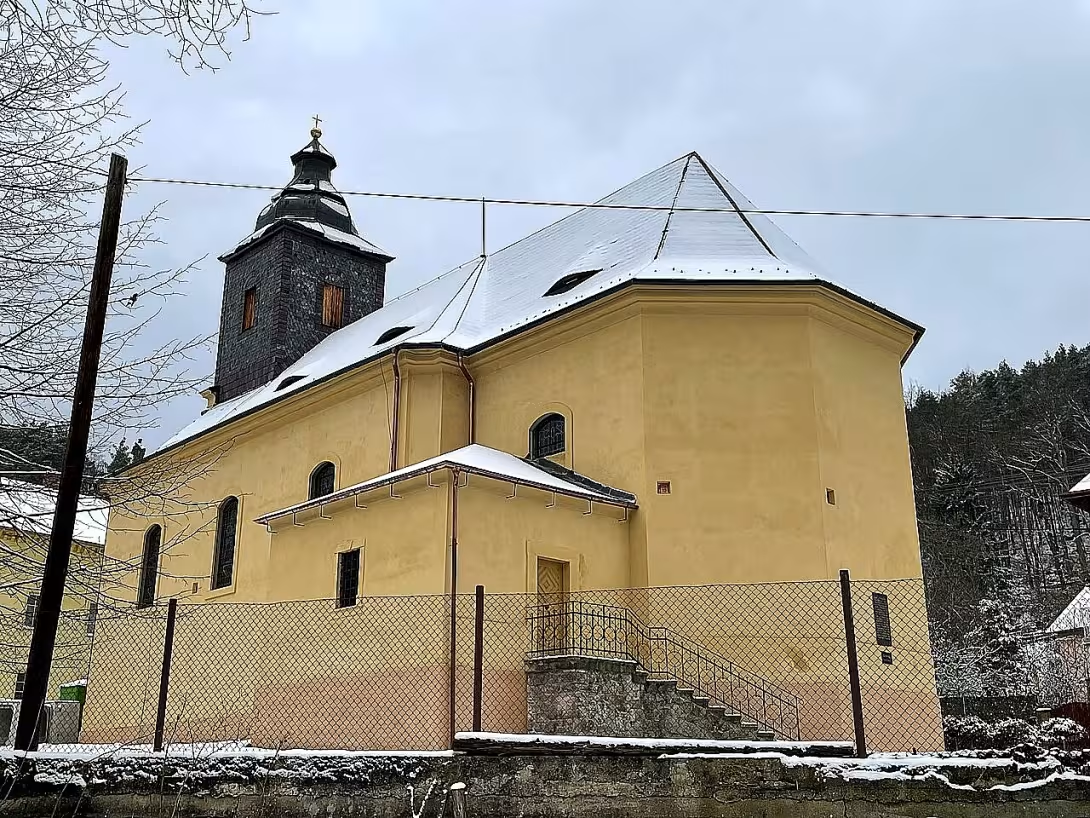
Kostel svatého Františka Xaverského in Belá u Děčína represents the late Baroque sacral architecture of northern Bohemia. It was created between 1787 and 1788 at the site of the original chapel which it replaced. The construction was financed by a religious fund and implemented by the North Bohemian builder Jan Václav Kosch. It still serves as a parish church and is protected as a cultural monument of the Czech Republic.
The history of the church in the 20th century has undergone interesting changes. After 1946, when the last German vicar Ernst John was displaced, spiritual administration fell under the parish Děčín-Sobbed. An important repair took place in 1960 to 1961 when the tower was re-roofed and repaired. The state was refinanced by the expense of 100,000 Kcs. Then the church ship served for a short time as a warehouse of equipment of other temples. There was a period of decline, when the roof was leaking, the vault was damaged and the coloured window tables were unloaded. The significant recovery took place only after 2000.
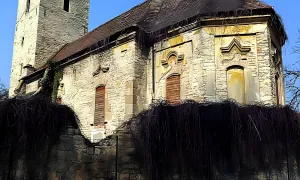
Architecturally, the church is a one-ship building of a rectangular shape. The presbytery is narrower and the tributary is closed, low sacristy is associated on the south side. The main facade has a three-axis composition with medium shallow risalite and is divided by pilastries. The rectangular portal bears the Latin inscription and chronogram 1787; above it is an oval window in the semi-circular frame. The shield is decorated with three statues - Virgin Mary, Saint Florian and Saint Wenceslas. The presbytery is baptized by a flat vault with a Fabion and decorated with classical Pilasters. The boat has a rounded corner and is covered with a flat reed vault with lunnets. A characteristic element is the crust on two pillars that runs into the temple ship.
The interior retains a Baroque character mainly from the 18th century. The main altar of pseudoboaric style - originally decorated by a painting by E. Brendel from 1930, depicting Christ's quivering storm on the lake, today there is a picture of the baptizing St. Francis Xaversky from 2006. The early Baroque pulpit carries images of evangelists and Christ as Good Shepherd. Kostел has a complex history of organ - original positives and organ from Prague organist Schiffner in the early 20th century disappeared during the communist era.
Then and now
Drag the slider to compare how the landmark may have looked when it was built with the view today.
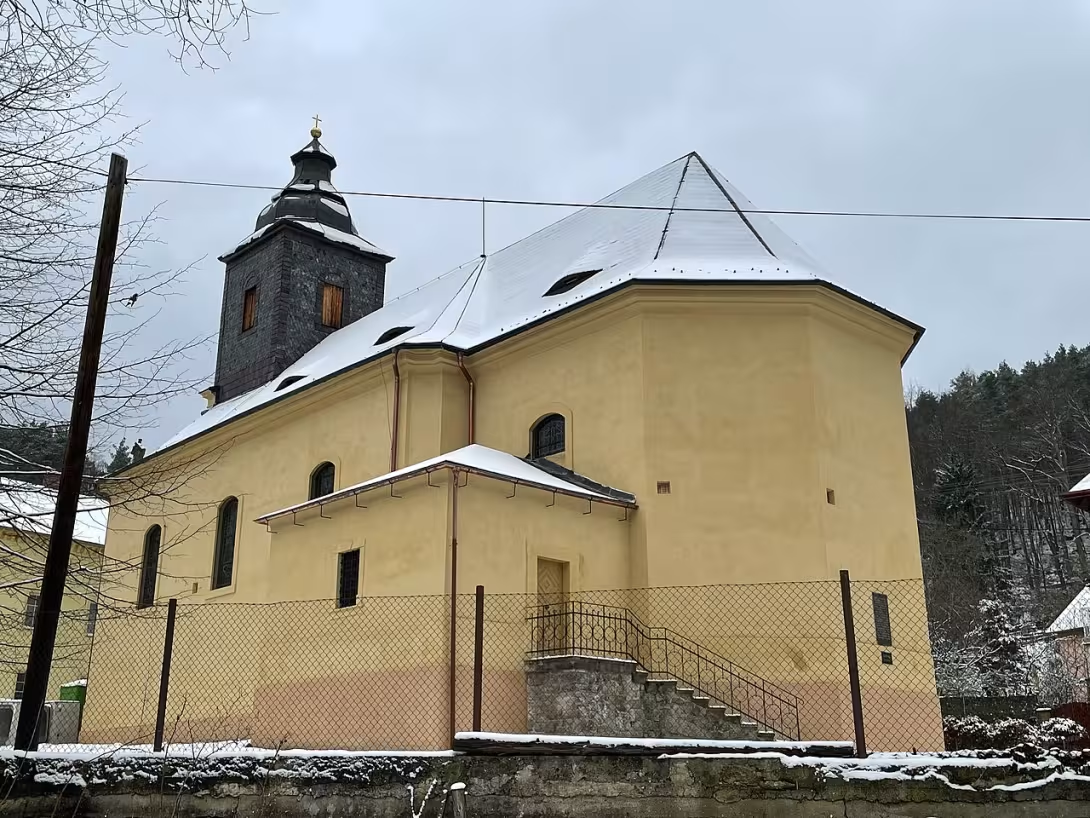

The historical appearance on the left is an AI-generated visualisation and serves as inspiration only.
Historical milestones
- 1787
- Completion of church construction
- 1792
- Installation of positive from Antonín Rutsch
- 1946
- The settlement of the last German vicar Ernst John
- 1960
- Restoring the church and repairing the tower
- 1993
- Transport of organ from St. Prokop church in Javory on the bark
Architectural development
The church is one-sided with three-sided conclusion and sacristy. The architecture combines late Baroque elements with classical decoration of Pilastres. In the 20th century, the roof and tower were repaired.
Historical events
The church was built in 1787-1788. In 1946, the last German priest Ernst John was displaced. In 1960-1961 the tower was repaired and the building was re-roofed.
Owners
Parish Děčín-Pokly (since 1946)
Points of interest
- Kostel svatého Františka Xaverského represents the late Baroque sacral architecture of northern Bohemia. - It originated between 1787 and 1788 at the site of the original chapel he replaced. - The construction was financed by a religious fund and implemented by North Bohemian builder Jan Václav Kosch. - After 1946, spiritual administration fell under the parish Děčín- They soiled after the displacement of the last German priest Ernst Johna. - An important repair took place in 1960 to 1961 when the tower was re-roofed and repaired.
Guide
This guide is narrated by a synthetic voice generated by artificial intelligence.
Show guide text
This text was created by artificial intelligence and has not been editorially reviewed. It may contain inaccuracies.
The Church of Saint Francis Xavier in Bělá u Děčína is a late Baroque building and the parish church of the Roman Catholic parish of Bělá u Děčína. It stands on the site of an original chapel. It was built in the years seventeen eighty-seven and seventeen eighty-eight by the North Bohemian builder Jan Václav Kosch and the money for the construction was provided by a religious fund.
After nineteen forty-six, when the last German priest Ernst John was expelled, the spiritual administration was taken over by the parish of Děčín-Pomokly. In the years nineteen sixty and nineteen sixty-one, the church received a new roof and the tower was repaired. The state paid the costs of one hundred thousand Czechoslovak crowns. The nave then served as a storage facility for equipment from other churches, for example from the Church of Saint Václav in Rozbělesích. Then came a period of decline. The roof began to leak, the vault of the nave was damaged and the coloured windows were broken. Significant renovation came only after the year two thousand. The church is protected as a cultural monument.
The building is single-nave and rectangular, with a narrower, tri-apsed closed presbytery and a low sacristy on the south side. Above the western façade rises a prismatic tower. In the superstructure of the rectangular portal is a Latin inscription with a chronogram, which conceals the date seventeen eighty-seven. Higher up is an oval window and on the gable stand statues of the Virgin Mary, Saint Florian and Saint Václav. The nave with rounded corners is covered by a flat reed vault with lunettes. The walls are articulated by pairs of pilasters and a surrounding cornice. The gallery rests on two pillars.
The furnishings are mostly Baroque, mainly from the eighteenth century. On the pseudo-Baroque main altar there was once a painting of Christ calming the storm on the lake by the painter Brendel from nineteen thirty. Today there hangs a painting of Saint Francis Xavier at baptism from two thousand and six. The pulpit is early Baroque.
Interesting are the fates of the organs here. The first small instrument from Litoměřice was sold to Saxony. In seventeen ninety-two, Antonín Rutsch brought a positive organ from Kostomlaty pod Milešovkou here. Originally it was part of an organ which the organ builder Standfuss built there in seventeen thirty-five, and a year later the Děčín carpenter Cajetan Windrich decorated and marbled it. In eighteen sixty-four the instrument was rebuilt by organ builder Müller. In December nineteen hundred and four the old organ was replaced by a new seven-stop instrument from the Prague workshop of Schiffner. Its façade pipes were confiscated in nineteen eighteen. During the communist totalitarianism, the organ was taken to Slovakia. From the old instrument only the Baroque case of the Standfuss positive organ remained in the gallery railing. In nineteen ninety-three, disassembled and already damaged organs from the Church of Saint Prokop in Javorech were brought here and stored, where there was a threat of the roof collapsing.
Tips for visitors
The best time to visit the church of St. Francis Xaversky is in the spring or autumn season when the weather is pleasant and the winter is not too cold. This time of year offers ideal lighting conditions for photography of the church with its Baroque architecture.
We recommend checking the current connection in the search engine.
When visiting the church, take a warm suit and goggles if you plan to take pictures. In addition, it is good to carry a map or GPS for easier orientation in the surroundings.
The photograph of St. Francis Xaversky church offers several attractive perspectives. The best light is usually in the early morning or late afternoon when the sun is not directly above the church and shading is ideal for highlighting architectural details.
In the vicinity of the church there is a visiting valuable place - the church of St. Wenceslas in Rozbělez. In addition, the city of Děčín offers various cultural and recreational activities that can be explored during the visit.
Frequently asked questions
Can the monument be visited?
Religious buildings are usually open mainly during services; at other times a visit is normally arranged with the parish or the operator. We have not verified specific times.
Where is the monument?
Location: Děčín X-Bělá, Ústecký kraj. The map on this page shows the exact spot.
Why is the monument protected?
It is listed in the Central List of Cultural Monuments of the Czech Republic as a cultural monument (register no. 25767/5-4104).
For kids
Imagine coming back 239 years and standing at a little place in Děčín X-Bělá. Where you now see the beautiful church of St. Francis Xaversky, there was once only a poor chapel. The church is like a book full of secrets and stories from the past.
When a new church was built in 1787, the locals were thrilled. It was like when they picked the best toy for the holiday. The chapel that stood there before served as a spiritual center for local families. People gathered here for prayers and celebrated their most important moments of life - from birthdays to weddings.
Businesses nearby
Do you run a restaurant, accommodation, shop, museum, rental, wellness or other visitor service near this monument? Show yourself directly to the people heading to it — this is how they will see you in the app and on the web:
Events nearby
Zdroj akcí: otevřená data měst a obcí ČR (Národní katalog otevřených dat) a kalendář akcí Národního památkového ústavu.
Nearby
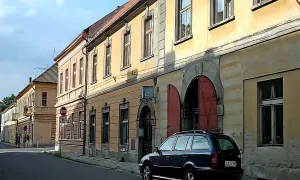
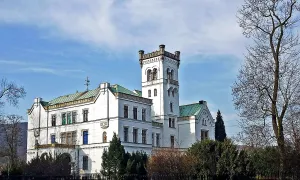
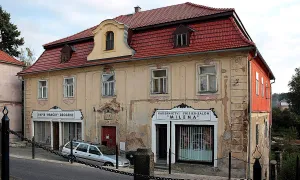
Church of St. Wenceslas in Rozbělez, city Děčín.
Accommodation nearby
Trips and activities nearby
Guided tours, tickets and activities nearby from GetYourGuide
Affiliate link: if you buy from the partner, we may receive a commission. The price for you does not change.
Search tours and activities →Themed route
1. city Děčín, city: Tour of local atmosphere and architecture. 2. Church of St. Wenceslas in Rozbělez, church: Historical monument offering a quiet environment. 3. Kostel svatého Františka Xaverského, Church: The main destination of the trip, which represents the most important sacral point of the route.
Seasonal recommendations
Spring brings new colors and freshness to the area around White. The lighting is fine, which highlights the details of architecture beautifully. Nature is awakening to life, creating an optimistic atmosphere. It is ideal to visit in the morning when the air is the cleanest. We recommend layered clothes because morning cold can still be felt.
In the summer months, it is often hot in this part of the Ústí Region and the sun shines intensively. Light in the morning creates sharp shadows, so it is best to come early in the morning or late in the afternoon when light is softer and temperatures are more pleasant. In the main summer season there may be more people near the monument. Dress lightly and don't forget to protect yourself from the sun.
Autumn is a period of fog that often stretches towards the river and creates a mysterious and melancholy mood around the church. The golden shades of leaves in the surroundings give the place a quiet character. It is advisable to take a waterproof jacket and warmer clothing because moisture increases the feeling of cold. The best time to observe color transformation is mid-afternoon.
Zimą makes the church very impressive and quiet atmosphere in the landscape, especially if everything is covered with snow. Days are short and light is weak, so it is best to plan a visit around noon to make enough daylight. Due to the cold and shorter opening times in advent time it is necessary to prepare very warm clothes.
Visualizations and artistic views


The visualisations are generated by artificial intelligence and serve as inspiration.
Photos from the area
Real photos taken near the monument


Zdroj a licence jsou uvedeny u každého snímku.
Tips from visitors
No tips yet. Be the first!
Log in and add your tip.
Sources and literature
Photos: Martin Davídek / CC BY-SA 4.0 — Wikimedia Commons. The author and licence also appear when you hover over the image.
Faktickým podkladem tohoto textu byl článek na Wikipedii, jehož autory jsou přispěvatelé Wikipedie. Článek je dostupný pod licencí CC BY-SA 4.0.
Location on the map

Příběhy a pověsti
Legendy, pověsti a příběhy spjaté s touto památkou
Fotografie návštěvníků
Zatím žádné fotografie. Buďte první, kdo přidá fotografii z návštěvy!
Log in a přidejte svou fotografii nebo hodnoťte.
Za ověřenou návštěvu v aplikaci získáte víc bodů — poznáme podle GPS, že jste na místě.
Reviews and comments