



Kostel svatého Františka z Assisi (Kamenice) Church
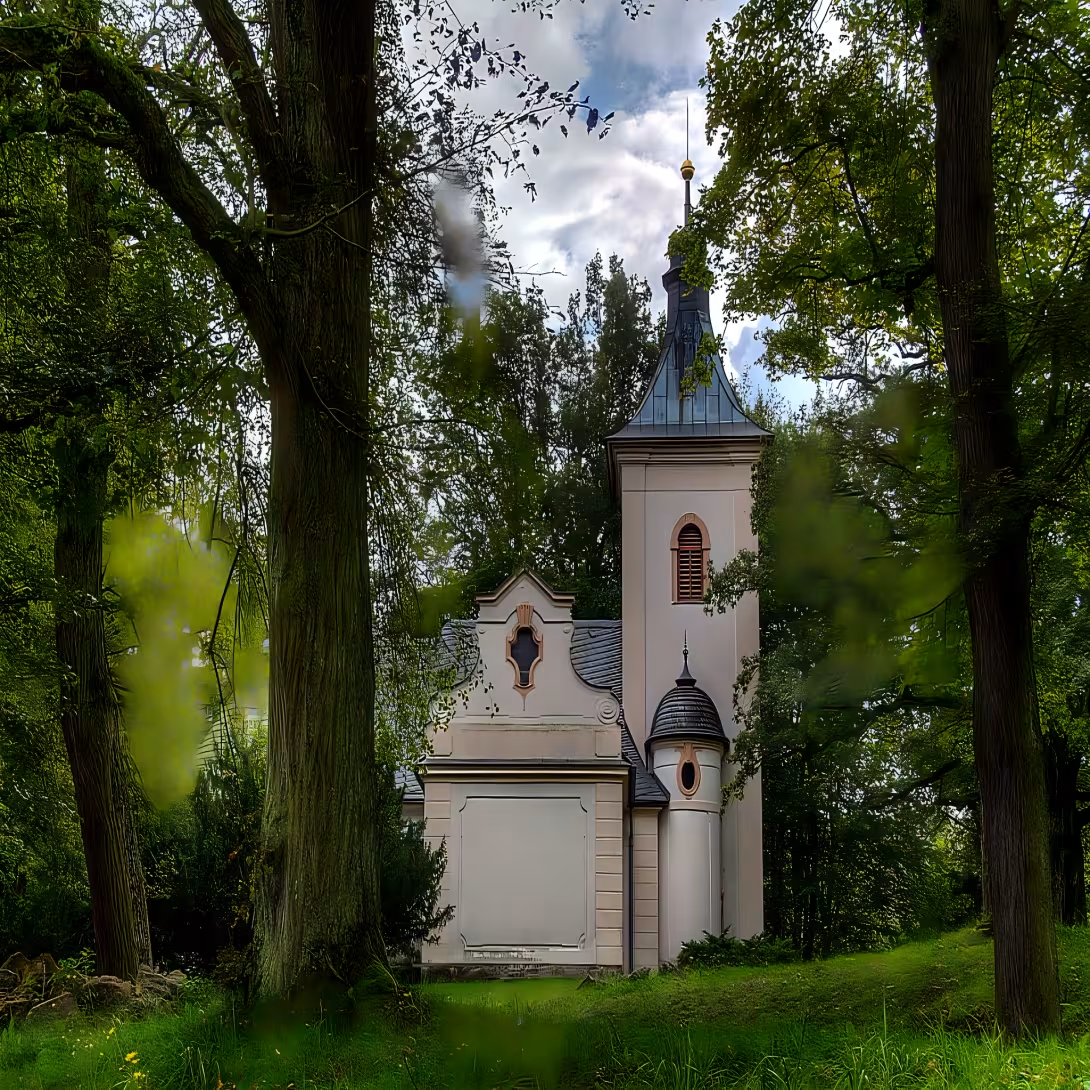
St. Francis Serafinski's church in Kamenice is located in the chateau park northwest of the chateau. The exact age of the temple is unknown; However, it is considered originally Romanesque or early Gothic based on the form of the priesthood that forms the apsida. However, the construction has undergone a number of major modifications, especially in the second half of the 18th century and at the end of the 19th century, which have printed today's appearance. Since 1966, the church and the chateau area have been protected as a cultural monument.
The first written mention of the church dates back to 1352 from the papal tithes register. In the 14th century, several plebans served here - the first documented was in 1364 Jiří, and later Havel of Ledč performed his activities until 1407. But the independent quarry of the stonemasons disappeared during the Hussite storms. The reconstruction of the parish was later recalled by the construction plans of 1702, preserved in the archive of Prague Archbishop. A member of the Jesuit Order Bohuslav Balbín z Vorličné was briefly present.
The decisive change came in 1763, when the stoneware estate became the property of the Prague Archbishop. Under Archbishop Wilhelm Florentine of Prince Salm-Salm, the church was rebuilt baroque in 1797 - the main boat was raised and the glass was raised, windows were extended and sacristy was added. The ceremonial consecration of the restored temple took place on 26 September 1797. The estate remained in the hands of the Archbishop until 1859, when Prague's Archbishop Bedřich of Schwarzenberg exchanged it with Baron Ringhoffer for the farm Hodkovice near Břežan. In 1898 the last major reconstruction was carried out by architect Jiří Stibral, who at the time also modified other Rinhoffer locks.
The architecture of the church reflects historical layers of development. The main ship is a vaulted vault with a section above the windows; The Hebrew name of Jehovah is painted in the vault in the sky with angels. The priestess shall carry a painting with the motif of Moses on Mount Sinai through the vault without ribs. The 18th-century Baroque altar combines the elements of the Empire and stands in the form of a tumba with hollow hips and the motive of a lamb. On the north side of the ship there is a Marian chapel with a square floor plan and a Baroque altar. The frescoes in the chapel were created by Belgian painter G. Doveria around 1750. Under the chapel lies a crypt with a monogram from 1753.
The two bells in the tower are interesting - the older one, the bell of the four evangelists, comes from the end of the 15th century. In the chapel stands the empir tombstone of Archbishop Wilhelm Florentine (1745-1810).
The church underwent reconstruction in 1938-1940 when repainted frescos were uncovered, and again in 2000- 2002. Today it is open to the public during services and within the Night of Churches, which provides an opportunity to become familiar with the rich history of the church, which in its example refers to centuries of Czech Religion and Architectural Creation.
Then and now
Drag the slider to compare how the landmark may have looked when it was built with the view today.
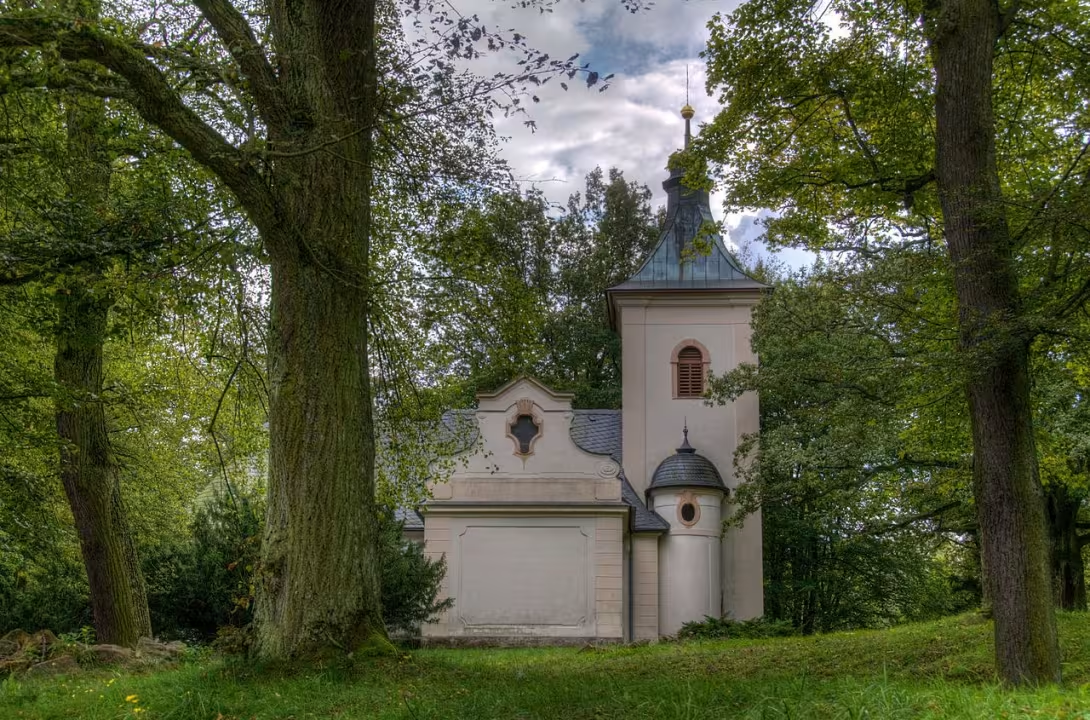
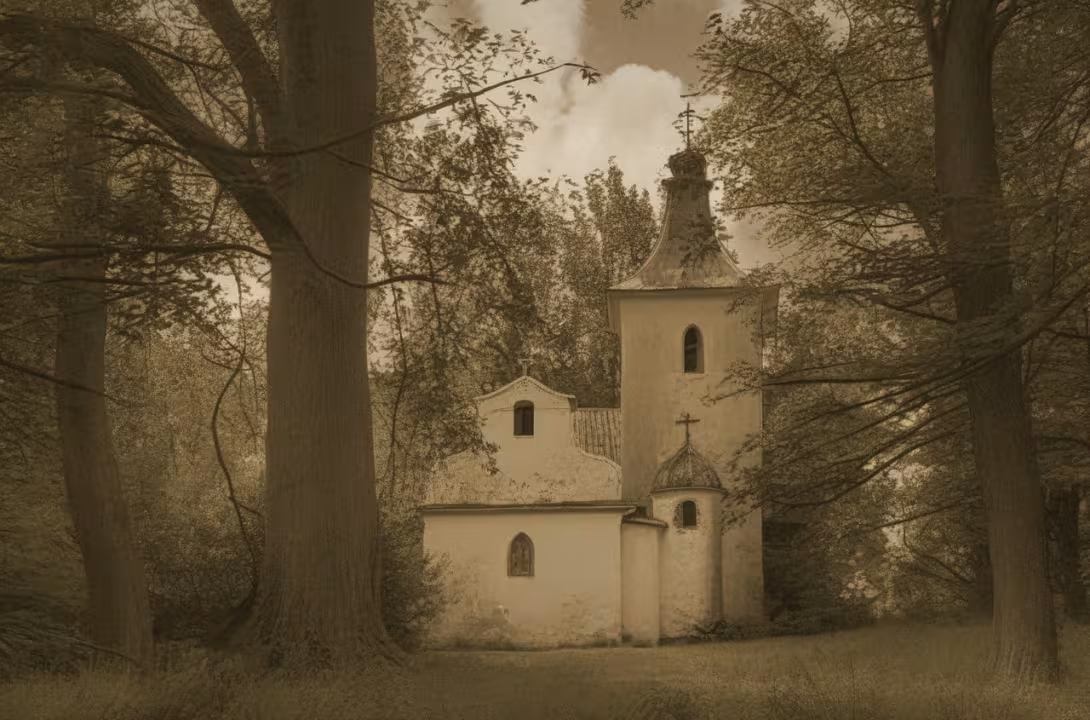
The historical appearance on the left is an AI-generated visualisation and serves as inspiration only.
Historical milestones
- 1352
- The first written mention of the church and the quarry.
- 1797
- Baroque reconstruction and consecration of the church under the leadership of Archbishop Salm-Salm.
- 1898
- The latest architectural reconstruction according to Jiří Stibral's design.
- 1966
- Writing the church into a list of cultural monuments.
Architectural development
The original church was probably Romanesque or early Gothic (supported by apsid). In the 18th century it underwent a Baroque reconstruction, including an increase in the ship, the expansion of windows and the addition of sacristy. In 1898 it was modified in Empire style, when frescoes from the 18th century were uncovered and restored. The priestess is arched by a vault, a ship filled with a vault with lunnets. The dominant is the prism tower with two bells.
Historical events
- 1352
- The first written mention of the church and the quarry in the papal tithes register.
- 1797
- Baroque reconstruction of the church for Archbishop Wilhelm Florentine prince of Salm-Salm, including consecration on September 26.
- 1898
- Last major reconstruction according to the design of architect Jiří Stibral.
- 1966
- Listed on the list of cultural monuments.
Owners
- parish plebans (e.g. Jiří, Havel from Ledče)
- Prague Archbishop
- Ringhoffer family
- State administration (after nationalisation)
Points of interest
The first written mention of the church dates back to 1352.
- The church was originally Romanesque or early Gothic, as indicated by the apsid of the priesthood.
- In the 14th century there were several plebans, the first of which was Jiří (evidenced by 1364), followed by Havel of Ledč (until 1407).
- The church passed through the Baroque reconstruction in 1797 under Archbishop Wilhelm Florentine of Prince Salm-Salm, when the ship was expanded and the sacristy was added.
- There's a bell in the tower of four evangelists from the late 15th century.
Guide
This guide is narrated by a synthetic voice generated by artificial intelligence.
Show guide text
This text was created by artificial intelligence and has not been editorially reviewed. It may contain inaccuracies.
The Church of Saint Francis of Assisi stands in the castle park in Kamenica, northwest of the castle. No one knows exactly how old it is. However, the semicircular apse of the chancel suggests that it originated as a Romanesque or early Gothic building. The church's original appearance was later completely changed by renovations.
The first written mention of the church and the Kamenica parish dates from 1352. The first documented vicar was George in 1364. After him, Havel from Ledč served there until 1407. The independent parish ceased to exist during the Hussite troubles. The Jesuit Bohuslav Balbín from Vorličná also stayed briefly in Kamenica.
In 1763, the Prague Archbishopric acquired the Kamenica estate. Under Archbishop William Florentin Prince Salm-Salm, the church underwent a Baroque renovation in 1797. The ceiling of the main nave was raised and vaulted, the windows were enlarged, and a sacristy was added. The renovated church was consecrated on September 26, 1797.
In 1859, Archbishop Frederick of Schwarzenberg exchanged the estate with Baron Ringhöffer. The last renovation took place in 1898 according to a design by architect George Stibral. He also adapted several castles for the Ringhöffers and built their family tomb. The church belonged to the Ringhöffers until the end of the Second World War. Between 1938 and 1940, frescoes that had been painted over in 1898 were uncovered again during reconstruction. Further restoration followed in 2000 to 2002. Since 1966, the church, together with the castle grounds, has been a cultural monument.
The main nave is covered with a barrel vault depicting Moses on Mount Sinai. On the chancel vault is the Hebrew name Jehovah in celestial rays surrounded by cherub heads. A Baroque altar from the eighteenth century with Empire elements is decorated with cartouches featuring a lamb and a tabernacle with a chalice. A more recent painting of Saint Francis hangs above the altar.
A square Marian chapel with a small Baroque altar adjoins the northern side of the nave. Its frescoes were painted around 1750 by the Belgian painter Doveri, who also worked on the decoration of the Marian chapel at Štiřín Castle. The chapel also contains an Empire-style tomb of Archbishop William Florentin Salm-Salm, who died in 1810. A crypt lies beneath the chapel. According to a monogram dated 1753 and a fragment of a coat of arms, it was prepared for Baron John Caspar Günter of Sternegk.
The western facade is dominated by a prismatic tower with two bells. The older one, dedicated to the four evangelists, dates from the end of the fifteenth century.
Tips for visitors
Best time to visit St. Francis's Church from Assisi is in the morning or at the end of the afternoon. In these times, the church is quiet and you can see its interior without crowds. If you are interested in history, in summer there are often short tours which reveal the attractions of early Gothic and Romanesque tracks in the church. Sunny days with mild weather are ideal for combining church visits with a walk around the chateau park.
The church is available by car, parking is possible near the chateau park, where the castle Kamenice is located. It is recommended to use public transport if you arrive from Prague. The location is well accessible by bus, specific connections and their times check out in the traffic search engine. If you arrive by car, make sure that there are limited parking areas around the church that are marked.
When visiting take comfortable clothes and shoes because the church and its surroundings offer walks along uneven terrain, especially in the chateau park. The interior of the church is cold, so bring a light sweater or sweater. It is advisable for children to take something to think about or to paint because the church offers a quiet environment for creative activities. Remember to also take a mobile phone with a good battery for shooting.
The best places for photography are the entrance portal of the church, a semi-circular end of the priesthood and an interior with Baroque elements. For quality images is ideal natural light in morning or afternoon hours. In the interior, avoid flashing of lightning to avoid damage to paintings and decorations. If you want to capture the surrounding landscape, go to the chateau park where there is a beautiful view of the church.
In the vicinity of the church it is worth visiting Castle Kamenice, located northwest of the church in the chateau park. This neo-Gothic chateau from 1875-1880 is built on the site of a medieval fortress and offers a beautiful environment for walks. Another interesting thing is Castle Štiøín, located about ten kilometers from Kamenice. This Baroque chateau with chapel is ideal for a half-hour drive or public transport.
For families with children, a visit to St. Francis's Church from Assisi is interesting thanks to its historic atmosphere and the opportunity to explore early Gothic and Romanesque elements. Children can look at the semi-circular end of the priesthood and talk about its history. In the chateau park there is enough room for children to run and play. It is interesting for older children to visit Castle Kamenice, where cultural events and tours are often held.
Frequently asked questions
Is Kostel svatého Františka z Assisi (Kamenice) open to the public?
Yes, the church is open to the public. The opening hours are 9:00 to 5:00.
How do I get to the place by car / public transport?
The nearest parking lot is in Castle Park, where the church is about 10 minutes' walk away. Public transport line 1 stops right in front of the church.
How much is the entrance fee and is it paid on the spot?
Payment is made at the register of the church.
Is the tour suitable for children and seniors?
Yes, a church tour is also suitable for families with children and seniors. The church has flat terrain and narrow pavements, which are also accessible for disabled people.
How long does the tour take?
The church tour takes approximately 30-45 minutes. More time can be spent if you want to look at the surroundings and relax.
What are the opening times and booking is required?
The church is open to the public from 9:00 to 17:00. Reservation is not necessary, but in case of group visits it is good to order it in advance.
What's interesting in the immediate vicinity?
In the immediate vicinity of the church is the Castle Park with a beautiful garden and views of the surrounding countryside. The Kamenice Chateau is about 10 minutes' walk away.
For kids
Imagine coming back 229 years, until Saint Francis of Assisi was still young and full of life in Kamenice. That was the time when there were many people who worked in the fields and in the woods.
The church stood in the middle of the village and was the heart of the village. People came here to pray and celebrate their anniversary. The church was small, but it had beautiful statues of St. Francis and his friends - cubs.
Businesses nearby
Do you run a restaurant, accommodation, shop, museum, rental, wellness or other visitor service near this monument? Show yourself directly to the people heading to it — this is how they will see you in the app and on the web:
Events nearby
Zdroj akcí: otevřená data měst a obcí ČR (Národní katalog otevřených dat) a kalendář akcí Národního památkového ústavu.
Accommodation nearby
Trips and activities nearby
Guided tours, tickets and activities nearby from GetYourGuide
Affiliate link: if you buy from the partner, we may receive a commission. The price for you does not change.
Search tours and activities →Themed route
Thematic cruise route: Baroque and Gothic in the surroundings of Kamenice
1.Kostel svatého Františka z Assisi (Kamenice) * Church * - Unique late Baroque building from 1730 with rich decoration, connecting spiritual peace and artistic value. The interior features frescos and sculptures that reflect the baroque championship.
2. Castle Kamenice * Chateau * - Neogotic pearl from 1875-1880, built on the site of medieval fortress, with picturesque park. Its architecture and history link the Middle Ages to the romantic revival.
3. Chateau park at castle Kamenice * Park * - Romantically modified spaces with alleys, ponds and grown trees, ideal for walking between historical monuments.
4. Chateau of Styrene * Chateau * - Baroque complex with Chapel of the Virgin Mary, where the painter Giovanni Doveri worked. Its interiors and surrounding park offer a rare view of Czech Baroque art.
* The route combines sacral architecture with representative locks and nature, always in logical proximity. *
Seasonal recommendations
Spring In the spring months, the church of Saint Francis of Assisi in Kamenice is surrounded by green clothes - the surrounding forests and vineyards flourish, while the sun rays penetrating through the stained glass walls create a game of colored glare on the stone walls. The atmosphere is calm, almost meditative, because the traffic is still mild and nature offers pleasant shadows under the trees. The waking singing of birds, which complements the peace of prayer, is also specific. It is recommended to visit the church early in the morning when the light is softer and the crowds are minimal. Clothes should be layered - spring weather changes rapidly, and even when the sun welcomes, evenings can be cold. The ideal time is between April and May, when apple trees bloom and the surrounding area smells fresh.
Summer In the summer months, the church becomes a living space where historical architecture meets the hot sun. The bright afternoon raises sharp shadows on the facade, while inside there is a pleasant semi-shade, ideal for rest. The surrounding area is full of green, but also insects, so the visit in the morning (10 hours ago) is the most pleasant - avoid crowds of tourists and heat. Light, breathable clothes, hat and sunglasses are recommended, as shadows in the church do not protect from direct sunlight. In the main summer season (July-August) it is worth checking the opening hours, since sometimes there are limited operating hours for maintenance.
Autumn Autumn brings golden tones to Kamenice - the forests turn red and yellow, while the church, illuminated by the sun inclined to the west, receives a warm, almost honey atmosphere. The evenings are cold, but the afternoon is still sunny, which creates a magical combination of light and shadows on stone walls. Visiting in September or October is ideal - nature is at the peak of color, but crowds are less than in summer. It is recommended that warmer clothes, especially for evening tours, and comfortable shoes, as the forest trails leading to the church can be wet. The best time is in the afternoon when light falls sideways and creates dramatic effects on the stained glass.
Winter The winter visit to the Church of Saint Francis of Assisi is like the entrance to the monastery peace - the snow cover dampens the sounds, while the white world around the church creates a sense of isolation from the excitement. The sun, when it rises, illuminates the church from the side, which gives its silhouette a mysterious, almore fairy tale character. The interior is warm and cozy, ideal for a short prayer or rest. In winter (November-February) it is necessary to dress in warm layers, gloves and hat - temperatures often fall below freezing. The opening hours are limited (usually only in the afternoon), which is why it is good to check out specific hours in advance. The best time is this afternoon, when the sun can illuminate the facade and the interior is already warm.
Visualizations and artistic views


The visualisations are generated by artificial intelligence and serve as inspiration.
Photos from the area
Real photos taken near the monument


Zdroj a licence jsou uvedeny u každého snímku.
Atmosphere of the place
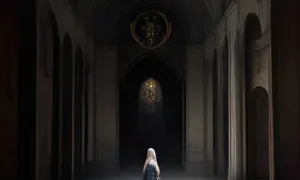
This atmospheric visualisation of the place and period was generated by artificial intelligence. It is not real footage of the location.
Tips from visitors
No tips yet. Be the first!
Log in and add your tip.
Sources and literature
Photos: Lukáš Kalista / CC BY-SA 4.0, rozlišení zvýšeno umělou inteligencí — Wikimedia Commons. The author and licence also appear when you hover over the image.
Faktickým podkladem tohoto textu byl článek na Wikipedii, jehož autory jsou přispěvatelé Wikipedie. Článek je dostupný pod licencí CC BY-SA 4.0.
Location on the map






Příběhy a pověsti
Legendy, pověsti a příběhy spjaté s touto památkou
Fotografie návštěvníků
Zatím žádné fotografie. Buďte první, kdo přidá fotografii z návštěvy!
Log in a přidejte svou fotografii nebo hodnoťte.
Za ověřenou návštěvu v aplikaci získáte víc bodů — poznáme podle GPS, že jste na místě.
Reviews and comments