



zámek Kamenice Chateau
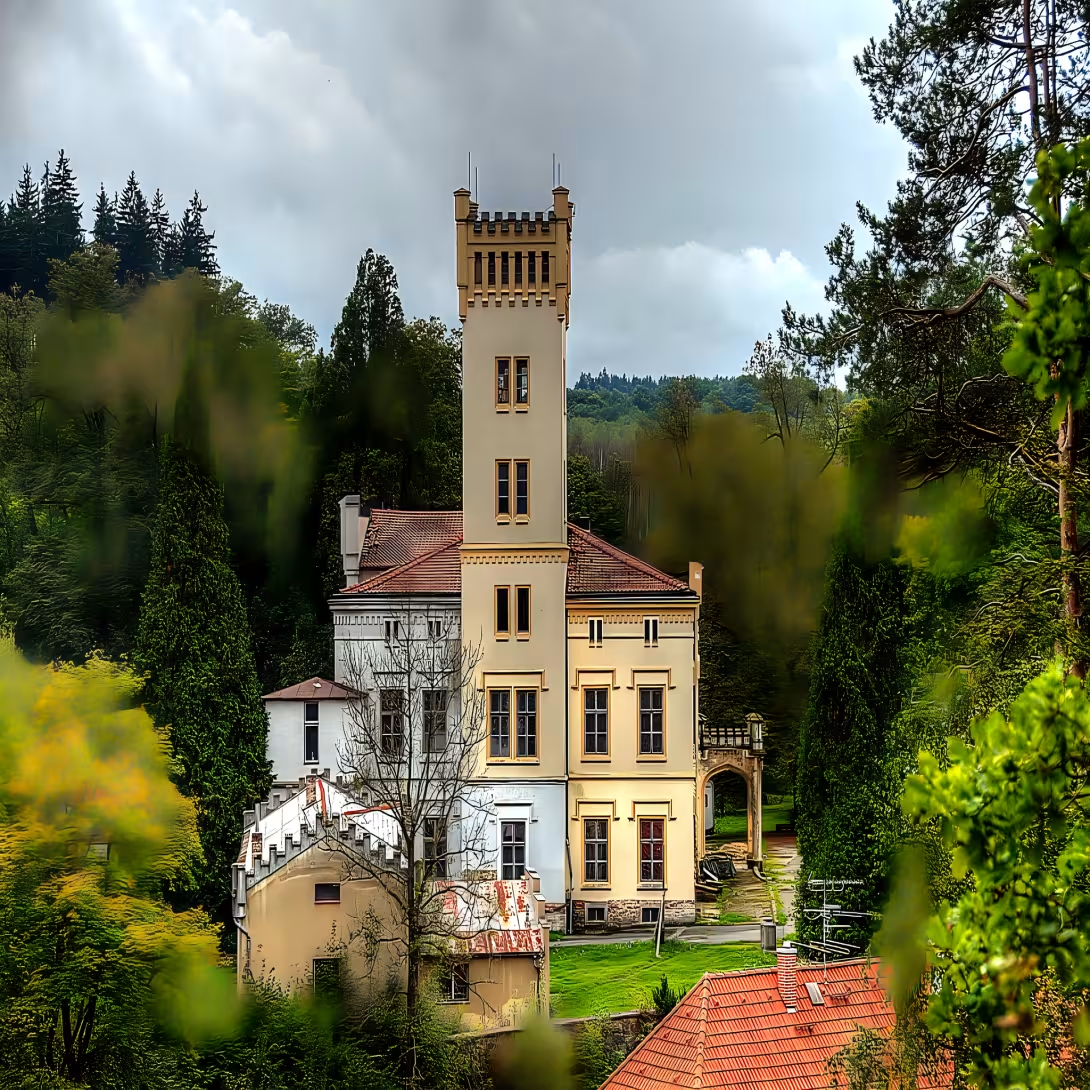
Chateau Kamenice is located in the village of the same name in the district of Praha-východ, protected as a cultural monument. The creation of the building dates back to the period when a medieval fortress stood in the same place. The first documented owner, the Ratmir of Kamenice, is mentioned in 1266. Over the following centuries, the fortress gradually acquired different families - belonged to the New Town of Prague, later won by Ferdinand I., and was then owned, for example, by Lobkovics, Pavel Michna of Vacín or the descendants of other noble families.
The year 1763 became the key периодом in the history of the building, when Kamenice became the summer residence of Prague Archbishops. During their nearly 100-year ownership, the fort was converted into a chateau. This conversion was completed in 1860 when the chateau was purchased by Prague industrialist František Ringhoffer II. His son, František Ringhoffer III, had the construction completely converted into a representative residence in 1875-1880. The reconstruction was led by architect Jiří Stibral and dedicated to the style of New English Gothic, with the chateau surrounded by a forest park.
The construction represents a one-storey rectangular building with eleven window axes on the main facade, decorated with champagne and mantelpiece. The facade divides the risality with double windows and battlements. The entrance porticus in the square plan consists of two columns. The eastern facade was equipped with a high prism tower and a smaller square corner tower. The interior contains valuable architectural elements - terrazzo, iron railing staircase, vaulted ceilings and original interior shutters.
1945 brought a major break. The property of the Ringhoffer was confiscated. In the next two years, the chateau became part of the so-called Action of the Chateau, when the educator Přemysl Pitter used it to save children from German concentration and Czech internment camps. German children were mainly housed in the chateau and 810 children were saved by means of projects on five locks. After the war, in 1949-1997, he served as a primary school. The municipality then sold it to a private owner - the Engineering Kamenice, who wants to build a teaching centre here.
The interior of the chateau has suffered considerable damage. During the twentieth and early twenty-first centuries, the original mobility was partly stolen, part transferred to local schools. The insensitive reconstruction of the Italian investor caused the most serious damage. Nevertheless, the architectural elements and the square entry porticus are preserved.
The chateau is surrounded by an English-style park on an area of four hectares, which in the nineteenth century passed smoothly into the surrounding countryside. A cross with the crucified from 1810, erected by Archbishop Wilhelm Salm, was preserved from the park decoration. In the park there is a neo-gothic garden pavilion with a bunk tower. After 1945 the park gradually faded - the fountain and the party disappeared. Near there is the church of St. Francis Serafinsky, an 11-blood early Gothic temple from the 14th century, rebuilt at the end of the nineteenth century also by Jiří Stibrál. The church is a protected cultural monument and remains in the property of the Catholic Church, which organizes Saturday services.
Then and now
Drag the slider to compare how the landmark may have looked when it was built with the view today.
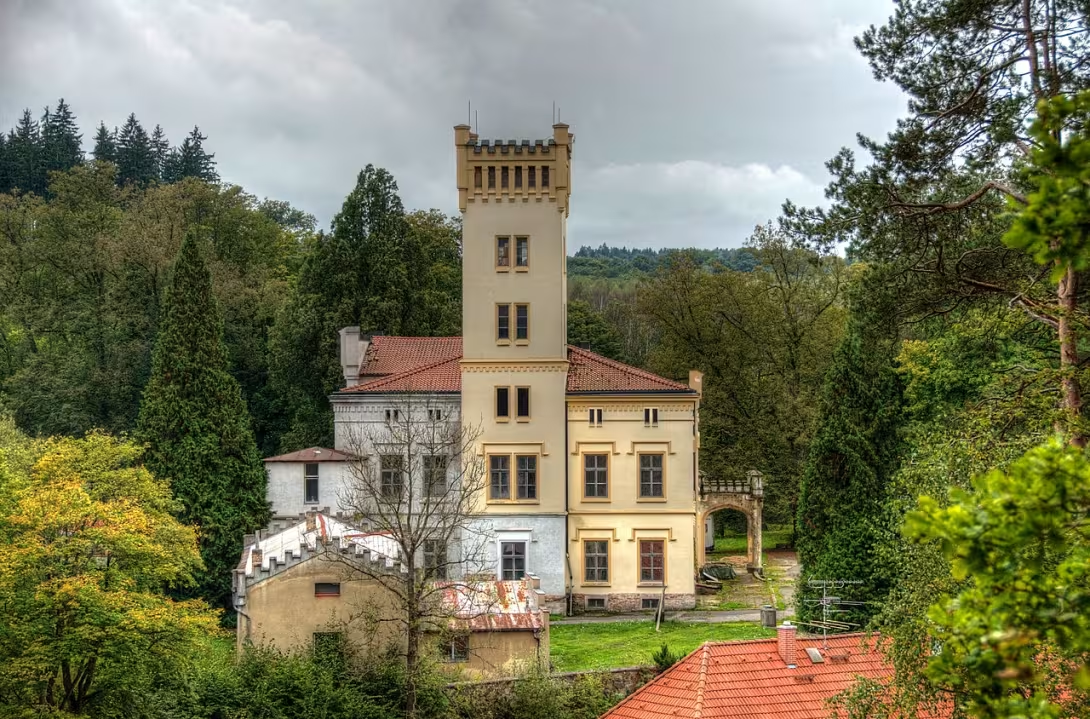

The historical appearance on the left is an AI-generated visualisation and serves as inspiration only.
Historical milestones
- 1875
- The beginning of the reconstruction of the chateau according to the design of Jiří Stibral.
- 1945
- Use of the lock within the Action Locks to save children from concentration camps.
Architectural development
The chateau was built on the site of the medieval fortress and rebuilt in a neo-gothic style. The original mobility and some architectural elements were damaged or lost during the 20th and 21st centuries.
Historical events
- 1875
- The beginning of the reconstruction of the chateau according to the design of Jiří Stibral.
- 1945
- Use of the lock within the Action Locks to save children from concentration camps.
Owners
In 1860 František Ringhoffer II bought the chateau, which had it rebuilt. After the confiscation of the property in 1945, the chateau was used for various purposes, including education and is also owned by the company Engineering Kamenice.
Points of interest
- Chateau Kamenice is protected as a cultural monument. - The first documented owner of the fort was the Ratmir of Kamenice, mentioned in 1266. - In 1763 Kamenice became the summer residence of the Archbishops of Prague and during their almost 100 years of ownership the fortress was converted to a chateau. - František Ringhoffer III had the construction rebuilt in 1875-1880 into a representative residence in the style of New England Gothic under the direction of architect Jiří Stibral. - 1945 brought a major break, when the property of the Ringhoffer was confiscated and the chateau became part of the Chateau for the Rescue of Children.
Guide
This guide is narrated by a synthetic voice generated by artificial intelligence.
Show guide text
This text was created by artificial intelligence and has not been editorially reviewed. It may contain inaccuracies.
Kamenice is a Neo-Gothic castle in the municipality of the same name in the Praha-východ district. It stands on the site of a medieval fortress and is protected as a cultural monument together with the neighbouring Church of Saint Francis Seraphinus.
Among the first owners, the nobleman Ratmír from Kamenice is mentioned in the year 1266. In the fifteenth century, the fortress belonged to Nové Město in Prague. However, after the rebellion of 1547, Ferdinand the First confiscated it from them and the estate was purchased by Jan Frejnar from Branov. The fortress then changed hands several times, including the Lobkowicz family, Pavel Michna from Vacínov, or Karel Arnošt from Valdštejn. From 1763 onwards, it served for almost a hundred years as the favorite summer residence of Prague archbishops, who had it rebuilt into a castle.
In 1860, the castle was purchased by the Prague industrialist František Ringhoffer the Second. His son František Ringhoffer the Third had it rebuilt between 1875 and 1880 according to the design of the architect Jiří Stibral. A representative residence was created in the style of Neo-English Gothic, surrounded by a forested park. It is a single-storey rectangular building. The main façade has eleven windows in a row. On both the northern and southern sides, sections with battlements project outward. The eastern side is complemented by a tall prismatic tower and a smaller corner tower.
After 1945, the Ringhoffer property was confiscated. Between 1945 and 1947, Přemysl Pitter used the castle for an action called Castles, which helped Jewish, Czech and German children from concentration and internment camps. A total of 810 children were saved thanks to it. Children from Germany were mainly accommodated in Kamenice.
From 1949 until 1997, the castle served as a primary school. Afterwards, the municipality sold it. Today it belongs to the company Strojmetal Kamenice, which wants to establish a vocational school in it. The interior was seriously damaged in the twentieth and early twenty-first century. Most of the furniture was lost and the greatest damage was caused by an insensitive reconstruction under an Italian investor. However, the vaulted ceilings, the staircase railings and the interior shutters were preserved.
The early Gothic Church of Saint Francis Seraphinus dates from the fourteenth century. At the end of the nineteenth century, it was also rebuilt by Jiří Stibral.
The castle park was approximately four hectares and in the nineteenth century it was laid out in the English style. A cross from 1810 was preserved in it, which was erected by Archbishop Vilém Salm-Salm in memory of the former cemetery near the church. There is also a Neo-Gothic garden pavilion with a story tower. It is mistakenly considered to be a remnant of the original fortress, but in fact it dates from the nineteenth century.
Tips for visitors
To visit the chateau Kamenice in the picturesque Central Bohemia region, choose ideal morning hours in sunny weather, when the sun best irradiates the neo-gothic facade built according to the design of architect Jiří Stibral. Transport to Kamenice is possible by car and public transport, and you can best verify the specific transport connections in the respective connection search engine. Take with you fixed shoes for travelling, because the area attracts to longer walks, as well as a bottle of drinking, as there may not be constantly open refreshments around the sights. For photography lovers, the best lighting conditions of the chateau park in English style, where you can capture picturesque scenery underlining the historical spirit of the place. In the immediate vicinity, within 30 minutes of the journey, you can visit the adjacent church of St. Francis Serafinski and explore the historical chateau park, which after 1945 gradually decayed, which today gives it a specific, melancholic atmosphere.
Frequently asked questions
Can the monument be visited?
Some buildings of this kind are open for guided tours, others serve another purpose or are privately owned. We have not verified whether and when this monument is open – please ask the operator.
What are the opening hours and admission?
We have not verified the opening hours or admission. Current information is published by the operator.
Where is the monument?
Location: Ringhofferova 62, Kamenice, Středočeský kraj. The map on this page shows the exact spot.
Why is the monument protected?
It is listed in the Central List of Cultural Monuments of the Czech Republic as a cultural monument (register no. 36188/2-2075).
For kids
Imagine going back to the past, when zámek Kamenice was still young and full of life. It was in the 17th century when the chateau was built as a refuge for noble families.
How did it look here? It was a big, beautiful garden with flowers and trees, where there were famous feasts and balls. The chateau stood in the middle of this garden, as crowned by the king. And who lived here? The nobility families who came to the area looking for Spanish gold coins.
Businesses nearby
Do you run a restaurant, accommodation, shop, museum, rental, wellness or other visitor service near this monument? Show yourself directly to the people heading to it — this is how they will see you in the app and on the web:
Events nearby
Zdroj akcí: otevřená data měst a obcí ČR (Národní katalog otevřených dat) a kalendář akcí Národního památkového ústavu.
Nearby
Near the chateau is the church of St. Francis Serafinsky.
Chateau park in English style, which gradually decayed after 1945.
Accommodation nearby
Trips and activities nearby
Guided tours, tickets and activities nearby from GetYourGuide
Affiliate link: if you buy from the partner, we may receive a commission. The price for you does not change.
Search tours and activities →Themed route
1. Chateau Kamenice (lock) This main objective is a historic building with a rich past, which is the natural center of the whole village. It offers a view of the architecture associated with the history of this region in the Central Bohemian Region.
2. Castle Park (park) In the immediate vicinity of the mansion is a large area in English style. Although this space gradually decayed after 1945, it still encourages walking around the main building.
3. Church of St. Francis Serafinski (church) This sacral monument lies in the immediate vicinity of the chateau. Her visit appropriately complements the tour of the historical core of the entire site.
Seasonal recommendations
Spring in the chateau in Kamenice brings awakening nature, when the chateau park blooms with thousands of onions and fresh green lawns attract to the first long walks. The dazzling spring sun pleasantly illuminates historic interiors with large windows, creating ideal lighting conditions for a detailed tour of chateau collections without summer herpes. During this period you will not find mass crowds of tourists, which guarantees a calm and chamber atmosphere. As a practical advice, we recommend choosing fixed and waterproof shoes, because chateau gardens can be muddy after spring thaw and rain, and don't forget layered clothing, as old chateau walls keep cold.
Summer in Kamenice opens the gates to a fully accessible area, where the main chateau building and adjacent courtyard live fully the main tourist season. The specifics of this period are the long sunny afternoon, which throws golden rays on the historical facade and encourages to rest in the shadow of centuries-old trees. Pack your sunglasses, headgear, plenty of fluids and light breathable shoes in your backpack, which will make you comfortable during the whole day's sightseeing.
Autumn turns the chateau park into a colorful palette of shades of yellow, orange and red, which together with the morning fog above the chateau pond creates an unrepeatable, slightly melancholic atmosphere. Interiors at this time are shrouded in a more attentive, natural light that underlines the historical spirit of the whole place. Visitors are failing significantly, so you can enjoy the tour almost alone. However, because the weather is changing rapidly, the basis of a successful expedition is a warm sweater, a waterproof jacket and umbrella, with the best time to arrive around noon, when the fog retreats and the sun is still warm.
Winter covers zámek Kamenice into a snow blanket and offers a unique peace and quiet, which you will not experience in another year. The atmosphere is very intimate, often underlined by the smoke rising from the historic chimneys and earlier twilight, which makes the inner lighting of the chateau halls dim. The tours take place in a limited mode and with shorter opening times, while the outdoor areas are empty. Here it is necessary to adapt the clothes to frosty weather - the necessary is a quality winter jacket, hats, gloves and warm shoes with anti-slip soles, as the chateau pavements and courtyard can be slippery and unfolded.
Visualizations and artistic views


The visualisations are generated by artificial intelligence and serve as inspiration.
Photos from the area
Real photos taken near the monument


Zdroj a licence jsou uvedeny u každého snímku.
Atmosphere of the place
This atmospheric visualisation of the place and period was generated by artificial intelligence. It is not real footage of the location.
Tips from visitors
No tips yet. Be the first!
Log in and add your tip.
Sources and literature
Photos: Lukáš Kalista / CC BY-SA 4.0, rozlišení zvýšeno umělou inteligencí — Wikimedia Commons. The author and licence also appear when you hover over the image.
Faktickým podkladem tohoto textu byl článek na Wikipedii, jehož autory jsou přispěvatelé Wikipedie. Článek je dostupný pod licencí CC BY-SA 4.0.
Location on the map





Příběhy a pověsti
Legendy, pověsti a příběhy spjaté s touto památkou

Fotografie návštěvníků
Zatím žádné fotografie. Buďte první, kdo přidá fotografii z návštěvy!
Log in a přidejte svou fotografii nebo hodnoťte.
Za ověřenou návštěvu v aplikaci získáte víc bodů — poznáme podle GPS, že jste na místě.
Reviews and comments