



Kostel svatého Františka z Assisi (Kněžmost) Church
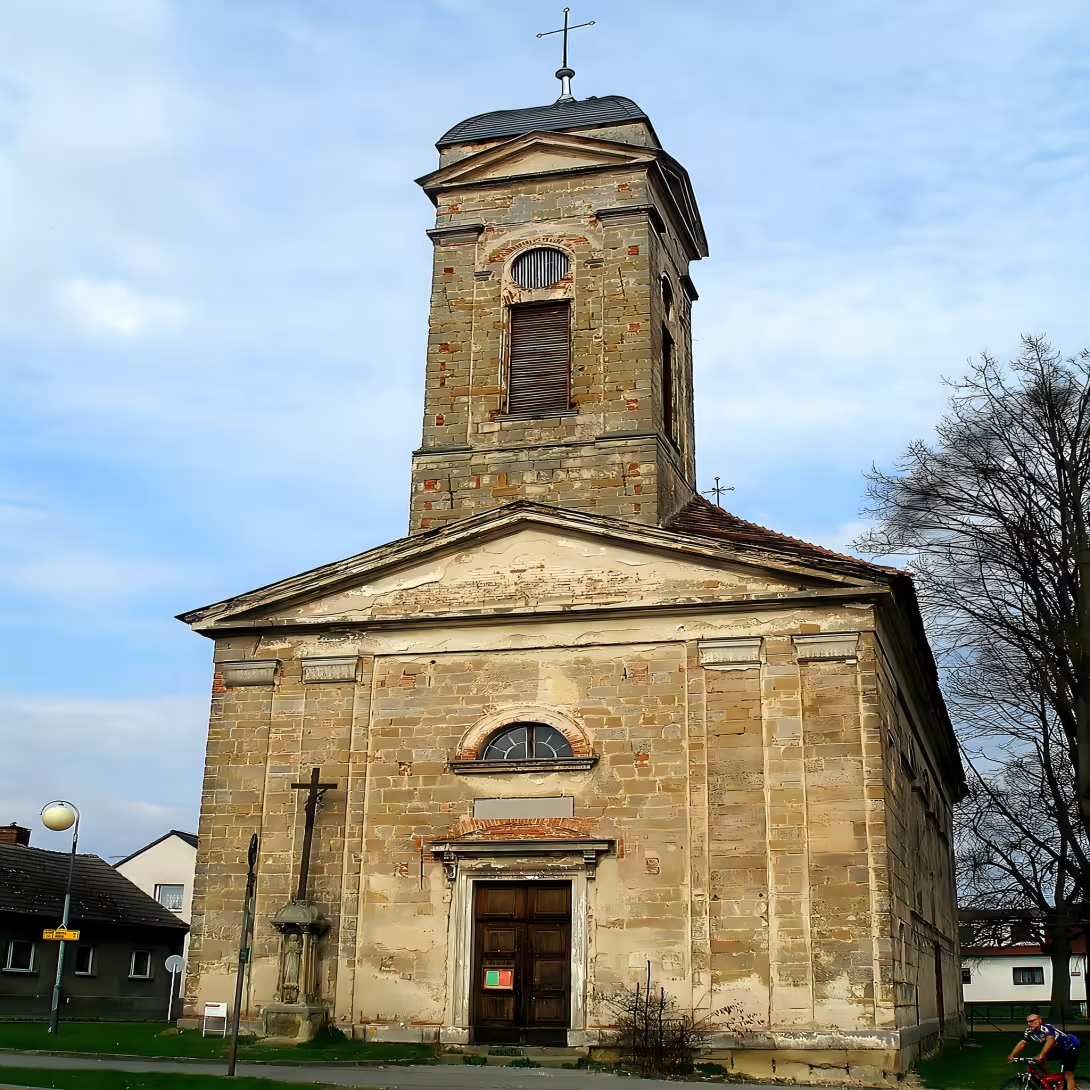
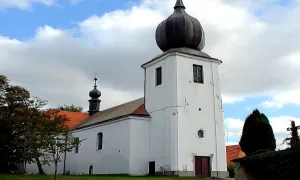
The church of St. Francis Serafinski in Kněžmost is an empirical sacral building which is protected as a cultural monument of the Czech Republic. The construction is due to its extraordinary importance to the elegant purity of the Empire style, which it maintains consistently from the foundation to the latest details of the equipment.
The temple was built between 1838 and 1841. The tower that dominates the appearance of the building was completed on 19 May 1841. The church's spiritual administration is provided by the Roman Catholic parish Kněžmost.
The construction has the character of rectangular, hall layout without marked presbytery. The architect has fitted it with a prism tower that dominates the entrance facade. The entrance to the church is highlighted by a portal with a characteristic volute console. The facade structures a pair of pilastes carrying a prism shield. Side walls are bared from plaster and broken through three high windows with semi-circular enchantments. The tower has corner pilasters that continuously evoke the main architectural motif of the building.
The interior is solved as a space divided into a boat and a narrower presbytery. There are sacristy and orator between the presbytery and the outer wall. The wall space is divided by pilasters, from which a flat ceiling grows. The crust is walled and straight, based on two Tuscan columns.
The interior equipment remained empirical, that is, at the same time as the church. The main altar from the carver P. Bushka from Sychrov dates back to 1843. Its dominant feature is the pillar arcade with the image of St. Francis's Death by Antonín Lhota. The two side altars are identical: the altar of the Virgin Mary from 1876 and the altar of St. John Nepomuk from 1875 with a painting by Josef Vojtěv Hellich.
The church also received unique equipment in the form of baroque organs from 1672. These were repaired in 1707 by the Franciscan of Turnov and were decorated with Boltz ornament. Originally, the three-tower organ was recently replaced by a remodeled organ from Germany, which is now installed in a new organ cabinet.
The church represents a whole house in which the architect, carver, painter and craftsman gathered in a uniform artistic vision. For the visitor, it is primarily a testament to the late 1830s and early 1840s, when empirical aesthetics remained faithful to their ideal of classical simplicity and proportionality.
Then and now
Drag the slider to compare how the landmark may have looked when it was built with the view today.
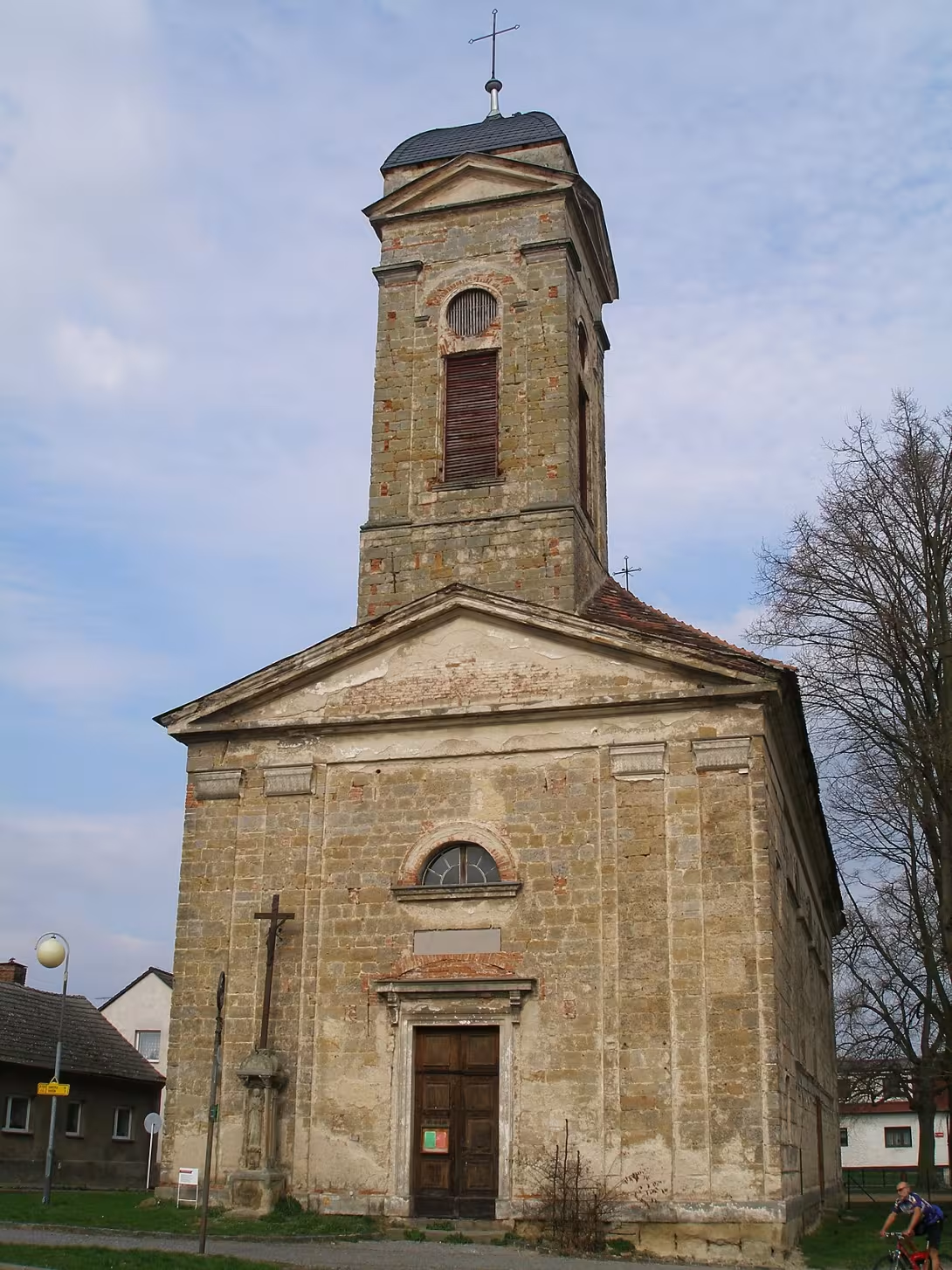

The historical appearance on the left is an AI-generated visualisation and serves as inspiration only.
Historical milestones
- 1838
- Opening of church construction.
- 1841
- Completion of the church tower on 19 May.
- 1843
- Installation of the main altar by the carver P. Bushka.
- 1875
- The foundation of St. John Nepomuk's altar.
Architectural development
The church is a rectangular hall building with a prism tower above the entrance front. The side walls are boarded and divided by high windows with semi-circular enchantments. The interior is divided into a boat and a narrower presbytery, the walls being decorated with pilasters carrying a flat ceiling.
Historical events
1838 start of church construction. 1841 The completion of the church tower. 1843 the completion of the main altar by the carver P. Bushek.
Points of interest
- The church is an empirical sacral building, which maintains its style purity from the foundation to the details of the equipment. - The church was built between 1838 and 1841, the tower was completed on 19 May 1841. - In the interior there is a walled and straight circle, which lies on two Tuscan columns. - The main altar of 1843 was created by the carver P. Bušek from Sychrova and its dominant is the painting of the Death of St. Francis by Antonín Lhota. - The church originally had Baroque organas from 1672, which were decorated with Boltz ornament.
Guide
This guide is narrated by a synthetic voice generated by artificial intelligence.
Show guide text
This text was created by artificial intelligence and has not been editorially reviewed. It may contain inaccuracies.
The Church of Saint Francis of Assisi in Kněžmostě is also called the Church of Saint Francis Seraphinus. It is an Empire block building, and its exceptional quality lies in how purely it adheres to a single architectural style. The church is protected as a cultural monument.
It was built between 1838 and 1841. The tower was completed on May 19th, 1841.
From the outside, the building is rectangular and hall-like, without a pronounced presbytery, that is without a distinctly separate space for the main altar. Above the entrance facade rises a prismatic tower. The facade is divided by two pairs of pilasters, which support a prismatic pediment. Between them is a portal emphasized by a cornice on scrolled consoles. The side walls have rusticated plaster and are pierced by three tall windows with semicircular tops. Pilasters are also at the corners of the tower.
Inside, the space is divided into a nave and a narrower presbytery. Between the presbytery and the outer walls of the church, on one side is squeezed in a sacristy and on the other an oratory. The walls are divided by pilasters, on which rests a flat ceiling. A brick flat gallery rests on two Tuscan columns.
The interior furnishings are also Empire style, thus dating from the time of the church's construction. The main altar was created in 1843 by the woodcarver Bušek from Sychrova. It takes the form of a pillar arcade and bears a painting of the Death of Saint Francis by Antonín Lhota. Two side altars are typologically identical. The Altar of the Virgin Mary dates from 1876. The Altar of Saint John of Nepomuk with a painting of the saint by Josef Vojtěch Hellich is from 1875.
Among the church's unique features were Baroque organs from 1672, which were repaired in 1707 by Franciscans from Turnov. They were three-towered and decorated with boltc ornaments. Today, repaired organs from Germany are installed on the gallery in a new organ case.
Tips for visitors
The best time to visit is in the morning during the working week or weekends when the village has a quieter atmosphere. Empir architecture excels especially in bright daylight, which highlights clean lines of construction.
If you use public transport, check out the current connection in the search engines before travelling.
For photography we recommend using the morning or late afternoon light, which creates interesting shadows on the facade of the church. The best shots are taken from the area in front of the main entrance, where the overall block layout of the building stands out.
In the surroundings of the village Kněžmost there are a number of historical settlements and natural monuments typical of the area of the Czech Paradise, which are ideal for hiking or cycling.
The location is suitable for families with children due to the peaceful environment and proximity of nature. We recommend that you take with you comfortable shoes for walks around the village and the surrounding area where you can discover local sights.
Frequently asked questions
Can the monument be visited?
Religious buildings are usually open mainly during services; at other times a visit is normally arranged with the parish or the operator. We have not verified specific times.
Where is the monument?
Location: Sobotecká, Kněžmost, Středočeský kraj. The map on this page shows the exact spot.
Why is the monument protected?
It is listed in the Central List of Cultural Monuments of the Czech Republic as a cultural monument (register no. 31019/2-1588).
For kids
Imagine going back 185 years to the picturesque village of Kněžmost, where the songs of birds and the rumble of the stream continue to spread. There, in the middle, is something wonderful - the church of St. Francis of Assisi! It's like magic came into the room: white and clean as snow, with a prism tower that rises to the sky like a shadow.
Businesses nearby
Do you run a restaurant, accommodation, shop, museum, rental, wellness or other visitor service near this monument? Show yourself directly to the people heading to it — this is how they will see you in the app and on the web:
Events nearby
Zdroj akcí: otevřená data měst a obcí ČR (Národní katalog otevřených dat) a kalendář akcí Národního památkového ústavu.
Nearby
The village Kněžmost is located near the Czech Paradise, in the surroundings there are a number of historical settlements and natural monuments typical of this area.
Accommodation nearby
Themed route
The theme cruise route around Kněžmost focuses on connecting the spiritual heritage with the natural beauties of the region. Due to the limited information in the assignment on specific other places, the route uses only the main objective and general characteristics of the surroundings listed in the description, i.e. the proximity of the Czech Paradise and historical mansions.
1. Church of St. Francis of Assisi (Church) This is the main point of your journey and dominant village Kněžmost. It is worth visiting for its architectural value and a calm atmosphere that attracts pilgrims and lovers of history. Here you can see the interior and appreciate the artistic details of this sacral building.
2. Ambient municipalities Kněžmost (natural and historical landscape) After visiting the church, take a walk around the village. This area offers views of the typical region of Central Bohemia with historical settlements, which are mentioned as part of the local heritage. It's an ideal place for short stops and local photography.
3. Close of the Czech Paradise (natural monuments) The route is logically directed to an area near the famous Czech Paradise. Although specific monuments are not specified in the entry, the presence of this area in the vicinity of Kněžmost ensures access to natural monuments typical of the region. Here you enjoy fresh air and natural beauty, which complement the cultural experience of visiting the church.
This route is designed to respect the restriction and focus on available information. You start at the main destination, continue in the immediate surroundings of the village and finish in the wider context of the nearby natural area. The whole trip is suitable for one day's stay, where you can explore the church in peace and then explore the surrounding countryside without having to visit other, unspecified places.
Seasonal recommendations
In spring the church surrounds a unique atmosphere of awakened nature, where the first spring flowers begin to bloom around it and the soft light of late morning hours puts warm golden tones into the interior. This season the attendance is still mild, so you can easily walk through the temple area without the rusha. We recommend lighter clothing in transition temperatures and solid shoes, because the path to the church can be uneven after rainy soil. The best time to visit is in the afternoon when the sun penetrates the interior and highlights architectural details.
In summer the church benefits from long bright days, when the afternoon sun intensively illuminates the stained glass and creates a bright atmosphere in the interior. In the main summer season more tourists come here, so it is advisable to come before the crowds fill up the temple ship. Warm weather recommends light, transparent clothes and plenty of drinking water, especially if you plan to combine a visit with a walk around. The best time is the early afternoon before the heat.
In the autumn, the church mirrors the atmosphere of a soothing period, when leaves fall around it, and the misty morning hours supply the temple with a mysterious, almost meditative nature. Less tourists means room for quiet thinking inside. It is suitable for warm, layered clothes adapted to cool weather and quality blanket shoes due to wet leaves on the way. The best time to visit is the second half of the morning when light passes through windows and creates dramatic shadows in the interior.
In winter, the church offers a specific advent atmosphere of short days and quiet winter calm, when the outside cold gives the interior special warmth. The opening times are shorter in winter, so the timetable must be checked in advance. Hot clothes, gloves and hats are essential, and because the visit is shorter, you just need to focus on the most important parts of the temple. The best time is noon, when sunlight penetrates the windows and warms the interior.
Visualizations and artistic views


The visualisations are generated by artificial intelligence and serve as inspiration.
Photos from the area
Real photos taken near the monument


Zdroj a licence jsou uvedeny u každého snímku.
Atmosphere of the place
This atmospheric visualisation of the place and period was generated by artificial intelligence. It is not real footage of the location.
Tips from visitors
No tips yet. Be the first!
Log in and add your tip.
Sources and literature
Photos: Jan Polák / CC BY-SA 3.0, rozlišení zvýšeno umělou inteligencí — Wikimedia Commons. The author and licence also appear when you hover over the image.
Faktickým podkladem tohoto textu byl článek na Wikipedii, jehož autory jsou přispěvatelé Wikipedie. Článek je dostupný pod licencí CC BY-SA 4.0.
Location on the map





Příběhy a pověsti
Legendy, pověsti a příběhy spjaté s touto památkou
Fotografie návštěvníků
Zatím žádné fotografie. Buďte první, kdo přidá fotografii z návštěvy!
Log in a přidejte svou fotografii nebo hodnoťte.
Za ověřenou návštěvu v aplikaci získáte víc bodů — poznáme podle GPS, že jste na místě.
Reviews and comments