



Kostel svatého Jakuba Většího (Kladruby) Church
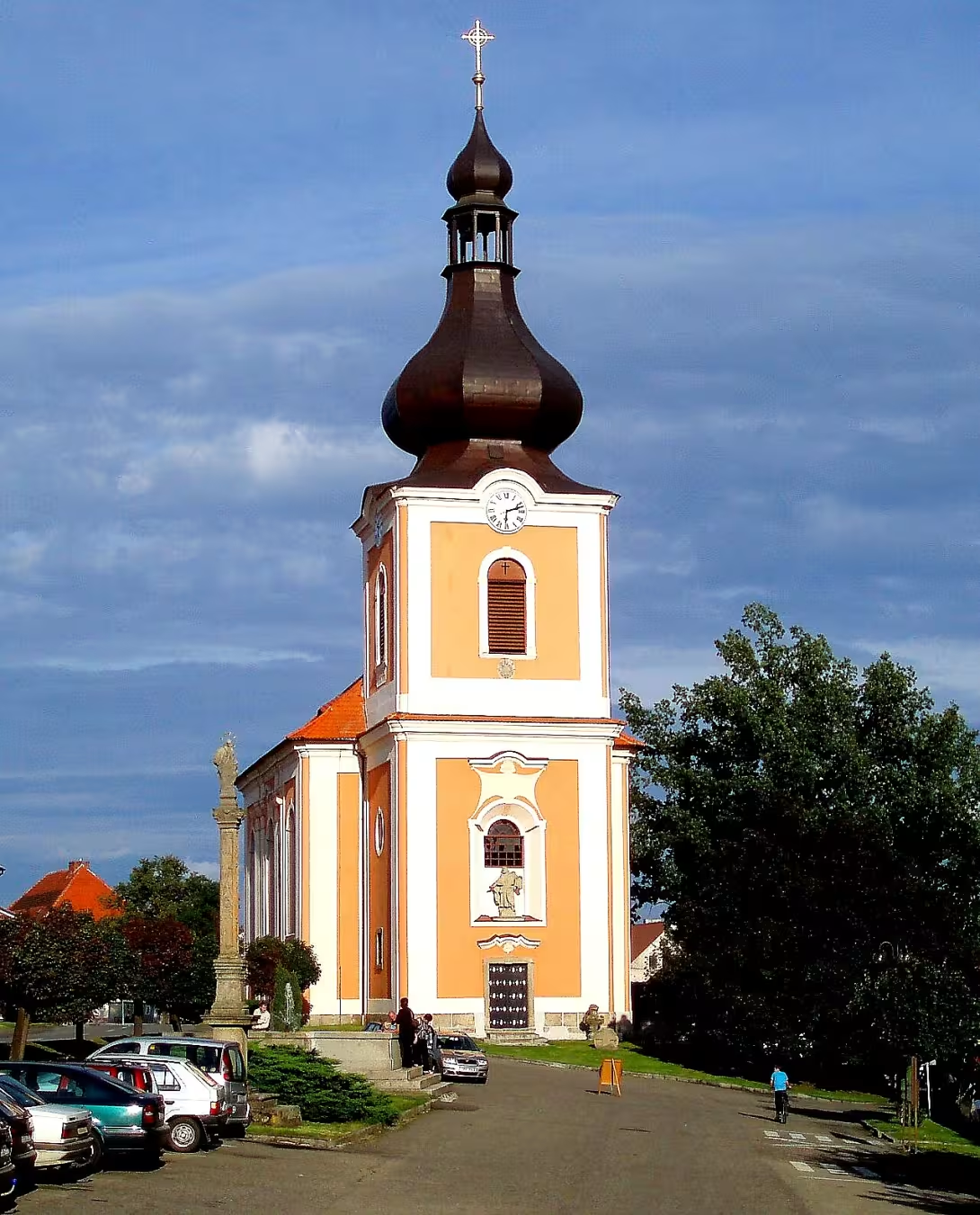
The Church of Saint James the Greater in Kladruby is among cultural monuments protected since 1958 and its history reflects the fates of sacred architecture in Central Bohemia. Kladruby originated as a settlement near an important trade route to Bavaria around 1230, with its church first mentioned in 1396 as a Gothic building. Over the centuries, it faced severe trials – devastation during the Hussite Wars and especially destructive fire in 1711, after which the church was only temporarily repaired.
A significant turning point came in 1772 when the roof of the half-century-old church collapsed. In the following seven years (1772–1779), a new church was built on the site of the original structure in Baroque style. The construction was financially supported by collections from local believers and subsidies from the nearby Kladruby Monastery, initiated by its last abbot, Amanda Streer. In 1792, the church was elevated to parish status and later also to deanery church, reflecting its growing importance.
Another trial came in 1843 when the church burned down again. The tower long managed with only a provisional low wooden shingle roof. It wasn't until 1908 that it was replaced by a large onion-shaped dome with a lantern, giving the church its current monumental appearance. In the 20th century, the church was maintained regularly; the roof was painted in 1974 and the façade repaired in phases during 1974 and 2000.
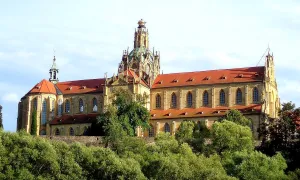
The building impresses with harmony through its simplicity and expressiveness. The nave with a rectangular floor plan closes on the east with a semicircular presbytery. Западní průčelí zdobí hranolová věž se zmíněnou cibulovitou bání, nad vchodem se vypíná socha patrona kostela. The façade is adorned with a pyramidal tower featuring the mentioned onion dome and above the entrance stands a statue of the church's patron. Decorative elements include two pairs of volute pilasters and white scrolls that emphasize the fluidity of lines. The interior is lit by windows partially glazed with historical lenses set in lead, while other windows are decorated with multicolored panes from 1911 and 1915.
The heart of the church is a Rococo main altar with a tabernacle and shrine surrounded by angel statues. Paintings and organs come from the monastery church of the Assumption of the Virgin Mary, transferred here after 1786 when the monastery was closed. The side altars are dedicated to Saint James and Saint Anne. A unique feature is the oak pulpit with a hanging sounding board adorned with inlaid panels and angel figurines holding an image of Christ. The baptismal font, carved from wood, dates back to the Baroque period.
Kladruby also has a long-standing pilgrimage tradition. In the Middle Ages, the so-called Nuremberg trade route passed through here, an important commercial corridor branching into Tachov and Přimda directions in Kladruby. Today, the church is located on the Saint James Pilgrimage Route leading to the tomb of Saint James in Santiago de Compostela. Some preserved medieval stone crosses that once lined the path are displayed in front of the church, reminding visitors of the depth of history of this village.
Then and now
Drag the slider to compare how the landmark may have looked when it was built with the view today.
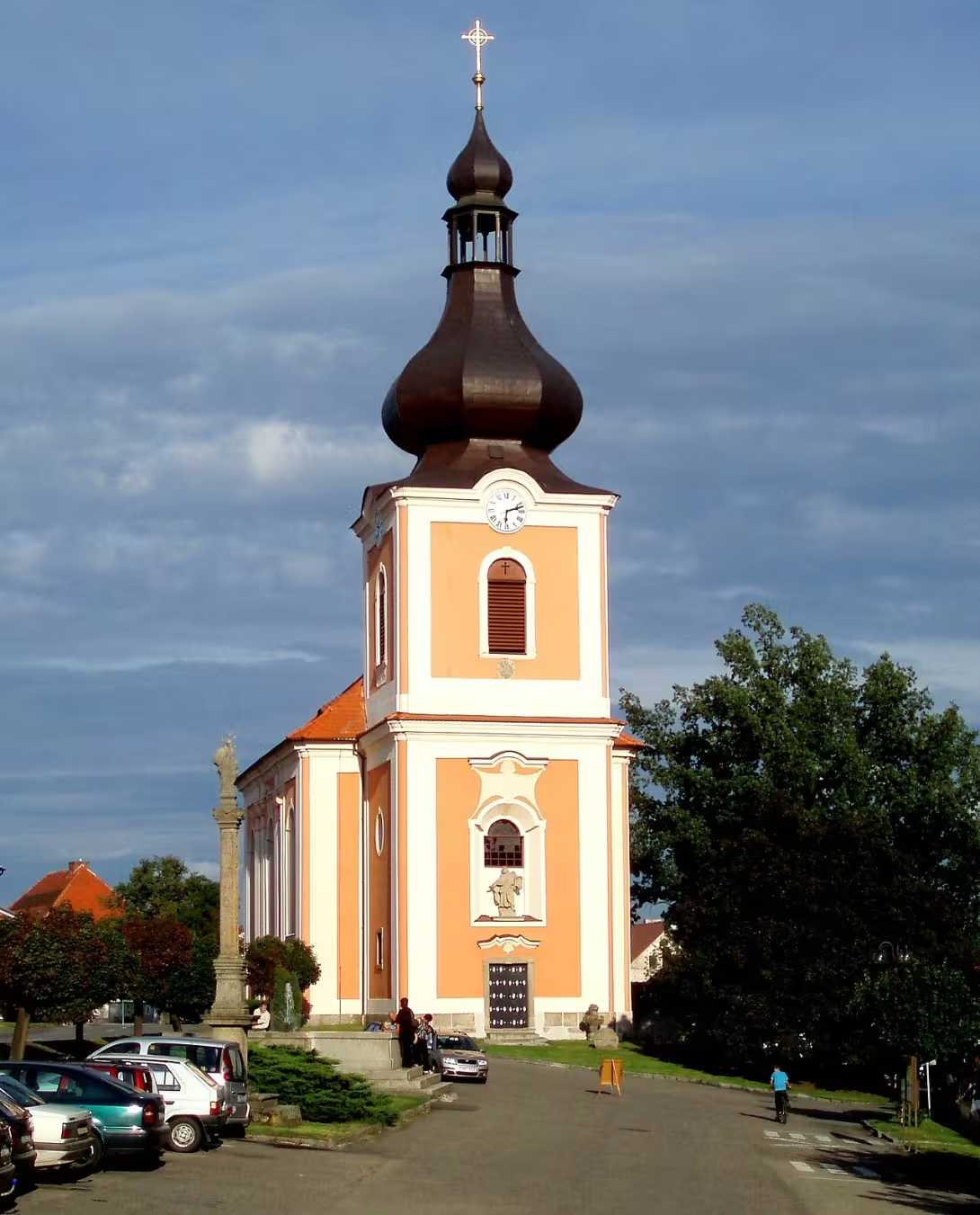

The historical appearance on the left is an AI-generated visualisation and serves as inspiration only.
Historical milestones
- 1396
- The original Gothic church is first mentioned as filial to the church of St. Peter.
- 1711
- The church is damaged by a fire and subsequently only provisionally repaired.
- 1779
- Completion of the new Baroque church on the site of the original sanctuary.
- 1843
- The church burns down again, leading to the loss of its tower dome until 1908.
- 1908
- A large onion dome is constructed to replace the previous provisional tower roof.
Architectural development
The church features a rectangular nave with a semicircular presbytery in the eastern part and a prismatic tower above the western facade. Architectural elements include a prominent onion dome with a lantern, white lisen frames, and a combination of a Czech plinth vault in the middle part and barrel vaults over the side spaces. A square sacristy adjoins the southern side of the presbytery, and stone crosses are displayed in front of the entrance.
Historical events
1396: First written mention of the original Gothic church. 1772-1779: Construction of the new Baroque church after the ceiling of the old building collapsed. 1843: The church suffered a fire and was left with a low wooden pyramidal roof until a new onion dome was built in 1908.
Owners
Kladrub Benedict Monastery
Points of interest
– The Church of St. James the Great in Kladruby has been protected as a cultural monument since 1958. – The church was first mentioned in 1396 as a Gothic building, having originated in an area where Kladruby was founded around 1230 along an important trade route to Bavaria. – Following a ceiling collapse in 1772, a new Baroque church was built on the original site between 1772 and 1779, financially supported by local believers and subsidies from the nearby Kladrubský klášter initiated by its last abbot, Amanda Streer. – The church suffered another fire in 1843, and its tower featured a provisional low wooden fir roof until a large onion-shaped dome with a lantern was added in 1908. – The interior features paintings and an organ transferred from the monastery church of the Assumption of the Virgin Mary after the monastery was closed in 1786.
Guide
This guide is narrated by a synthetic voice generated by artificial intelligence.
Show guide text
This text was created by artificial intelligence and has not been editorially reviewed. It may contain inaccuracies.
The Church of Saint James the Greater is a parish church on Republic Square in Kladruby near Stříbra. It has been a cultural monument since 1958.
Kladruby developed around 1230 along a trade route to Bavaria. In the Middle Ages, the Nuremberg territorial route passed through here, and it was precisely at this location that it branched into the Tachov and Přímda routes. The routes were lined with stone crosses, most commonly at junctions and crossroads. Several preserved and heritage-protected crosses are displayed today in front of the church entrance. The church also lies on the Saint James pilgrimage route, which leads to the tomb of Saint James the Greater in Santiago de Compostela.
The original Gothic church is first mentioned in 1396. At that time it belonged as a subsidiary to the Church of Saint Peter, which stood until the end of the 18th century where the cemetery is today. The church was damaged by the Hussite Wars and in 1711 by a fire, after which it was only temporarily repaired. When the ceiling collapsed in 1772, construction of a new Baroque church began, completed in 1779. Collections and subsidies from the nearby Kladruby Monastery helped, at the initiative of its last abbot Amanda Streer. In 1792 the church became a parish church and later also a deanery.
In 1843 the church burned down again. The vaults probably survived, but the roof had to be renewed. The tower then had only a low wooden pyramidal roof. It only received a large onion dome in 1908.
The rectangular nave ends to the east in a semicircular presbytery. Above the western façade rises a prismatic tower with a dome and lantern. In the niche above the entrance stands a statue of Saint James. White lisene frames and volute pilasters divide the structure. The center of the nave is covered by a Czech flat vault supported by two rows of pillars, while the side spaces have barrel vaulting.
Most of the furnishings date from the Baroque renovation. The dominant feature is a Rococo high altar with small angel statues. Some of the equipment came here from the monastery church of the Assumption of the Virgin Mary after the monastery was dissolved in 1786. A large painting above the altar and the organ were transferred in 1802 from the closed Church of the Holy Cross on Křížový vrch. The side altars are dedicated to Saint James and Saint Anne. An oak pulpit is decorated with a canopy with cherubs and a statue of Christ. The carved wooden baptismal font is also Baroque. Most of the windows are filled with colored glass with religious scenes from 1911 and 1915.
Tips for visitors
The best time to visit the Church of St. James the Greater in Kladruby is during the late morning or early afternoon when daylight beautifully illuminates Republic Square and highlights the historic architecture of the church and its surrounding area.
When visiting, be sure to bring comfortable walking shoes to explore the cobbled Republic Square and the historical terrain shaped by the medieval Nuremberg land route, along with a camera to capture the exterior details of the sanctuary standing on the site of an older Gothic structure first mentioned in 1396.
For photography, the best shots can be achieved from various angles across Republic Square, especially during the golden hour when the natural light accentuates the Roman Catholic parish church and its connection to the historic town layout.
If you are looking for what to see nearby within walking distance, you can easily explore the grounds of the former Kladruby Monastery located right in the area, offering a wonderful extension to your historical trip.
Frequently asked questions
Can the monument be visited?
Religious buildings are usually open mainly during services; at other times a visit is normally arranged with the parish or the operator. We have not verified specific times.
Where is the monument?
Location: náměstí Republiky, Kladruby, Plzeňský kraj. The map on this page shows the exact spot.
Why is the monument protected?
It is listed in the Central List of Cultural Monuments of the Czech Republic as a cultural monument (register no. 27029/4-1768).
For kids
More than 247 years ago, a story began in Kladrub that would become one of the most beautiful pilgrimage trips in the world. It was like playing in a great new park with many secrets and surprises. And so began to build the church of St. Jacob the Greater, which looks like you're painting the most beautiful painting, full of colors and secrets.
Businesses nearby
Do you run a restaurant, accommodation, shop, museum, rental, wellness or other visitor service near this monument? Show yourself directly to the people heading to it — this is how they will see you in the app and on the web:
Events nearby
Zdroj akcí: otevřená data měst a obcí ČR (Národní katalog otevřených dat) a kalendář akcí Národního památkového ústavu.
Nearby
The church is located on Republic Square in Kladruby u Stříbra, an area historically shaped by the medieval Nuremberg land route. Nearby features include the grounds of the former Kladruby Monastery.
Accommodation nearby
Trips and activities nearby
Guided tours, tickets and activities nearby from GetYourGuide
Affiliate link: if you buy from the partner, we may receive a commission. The price for you does not change.
Search tours and activities →Themed route
1. Republic Square in Kladruby Type: Square Why visit: Located in Kladruby u Stříbra, this public space was historically shaped by the medieval Nuremberg land route and offers a charming starting point for exploring the town.
2. Kostel svatého Jakuba Většího (Kladruby) Type: Church Why visit: Serving as the main destination on Republic Square, this historic church stands out as a significant architectural landmark of the area.
3. Grounds of the former Kladruby Monastery Type: Monastery grounds Why visit: Situated nearby, these extensive historical grounds provide a fascinating look into the region's rich monastic past and architectural heritage.
Seasonal recommendations
Spring at the Church of St. James the Greater in Kladruby brings a fresh, vibrant atmosphere as the surrounding nature awakens. The early daylight casts a gentle, clear glow over the historic stone architecture, contrasting beautifully with the budding greenery of the Plzeň Region. It is an ideal time to observe architectural details without harsh shadows, while the crisp morning air adds a refreshing feel to the visit. Practically speaking, visitor crowds are still quite manageable compared to the summer months, allowing for a peaceful exploration of the site. Since spring weather in the region can be notoriously changeable, it is wise to dress in layers and wear sturdy, comfortable footwear, as paths around the church might be damp from morning dew or recent spring showers. Late morning is generally the best time to arrive, catching the most pleasant temperatures of the day.
Summer transforms the Kladruby landscape into a lush, fully bloomed environment, where the bright sun highlights the impressive scale of the church. The high angle of the midday sun creates dramatic contrasts across the facade, while the dense foliage of the nearby trees provides welcome pockets of shade. The atmosphere is lively and warm, reflecting the peak tourist season in the Plzeň Region. Because this is the busiest time of the year, visitors should expect larger crowds and tour groups, making the early morning hours before ten o'clock the absolute best time for a tranquil experience. Practical advice for summer includes bringing adequate drinking water, wearing light and breathable clothing, and applying sun protection, as walking the open grounds around the landmark can expose you to strong midday rays.
Autumn at this historic monument in Kladruby offers a dramatic shift in mood, characterized by rich earthy tones and falling leaves. The low sun creates a golden, horizontal lighting effect that enhances the weathered texture of the stonework, producing phenomenal conditions for photography. The misty mornings and crisp breezes give the grounds a deeply contemplative and quiet atmosphere. Crowd levels drop significantly after the summer peak, making it one of the most relaxing times of the year to appreciate the heritage site at your own pace. For practical preparation, temperatures can plummet rapidly, so a warm windproof jacket, a scarf, and closed shoes are essential. Mid-afternoon is the prime window for your visit, allowing you to enjoy the warmest hours and the most picturesque autumn light before the sun dips below the horizon.
Winter envelops the Church of St. James the Greater in a serene, often snow-dusted silence that highlights its enduring strength. The stark winter light, combined with early sunsets and occasional frost on the old stones, creates a truly atmospheric and solemn mood. With very few tourists around, you will likely have the exterior surroundings almost entirely to yourself during the quiet winter weeks. Practical considerations are vital during this season: you must dress in heavy winter gear, including insulated coats, gloves, warm hats, and slip-resistant footwear to handle potentially icy paths around Kladruby. Because daylight hours are short and operating schedules for historical sites are typically restricted during the winter season, planning your arrival around noon ensures you make the most of the available daylight.
Visualizations and artistic views


The visualisations are generated by artificial intelligence and serve as inspiration.
Photos from the area
Real photos taken near the monument


Zdroj a licence jsou uvedeny u každého snímku.
Atmosphere of the place
This atmospheric visualisation of the place and period was generated by artificial intelligence. It is not real footage of the location.
Tips from visitors
No tips yet. Be the first!
Log in and add your tip.
Sources and literature
Photos: Orange.man / Public domain — Wikimedia Commons. The author and licence also appear when you hover over the image.
Faktickým podkladem tohoto textu byl článek na Wikipedii, jehož autory jsou přispěvatelé Wikipedie. Článek je dostupný pod licencí CC BY-SA 4.0.
Location on the map



Příběhy a pověsti
Legendy, pověsti a příběhy spjaté s touto památkou

Fotografie návštěvníků
Zatím žádné fotografie. Buďte první, kdo přidá fotografii z návštěvy!
Log in a přidejte svou fotografii nebo hodnoťte.
Za ověřenou návštěvu v aplikaci získáte víc bodů — poznáme podle GPS, že jste na místě.
Reviews and comments