



kostel svatého Jakuba Většího v Tečovicích Church
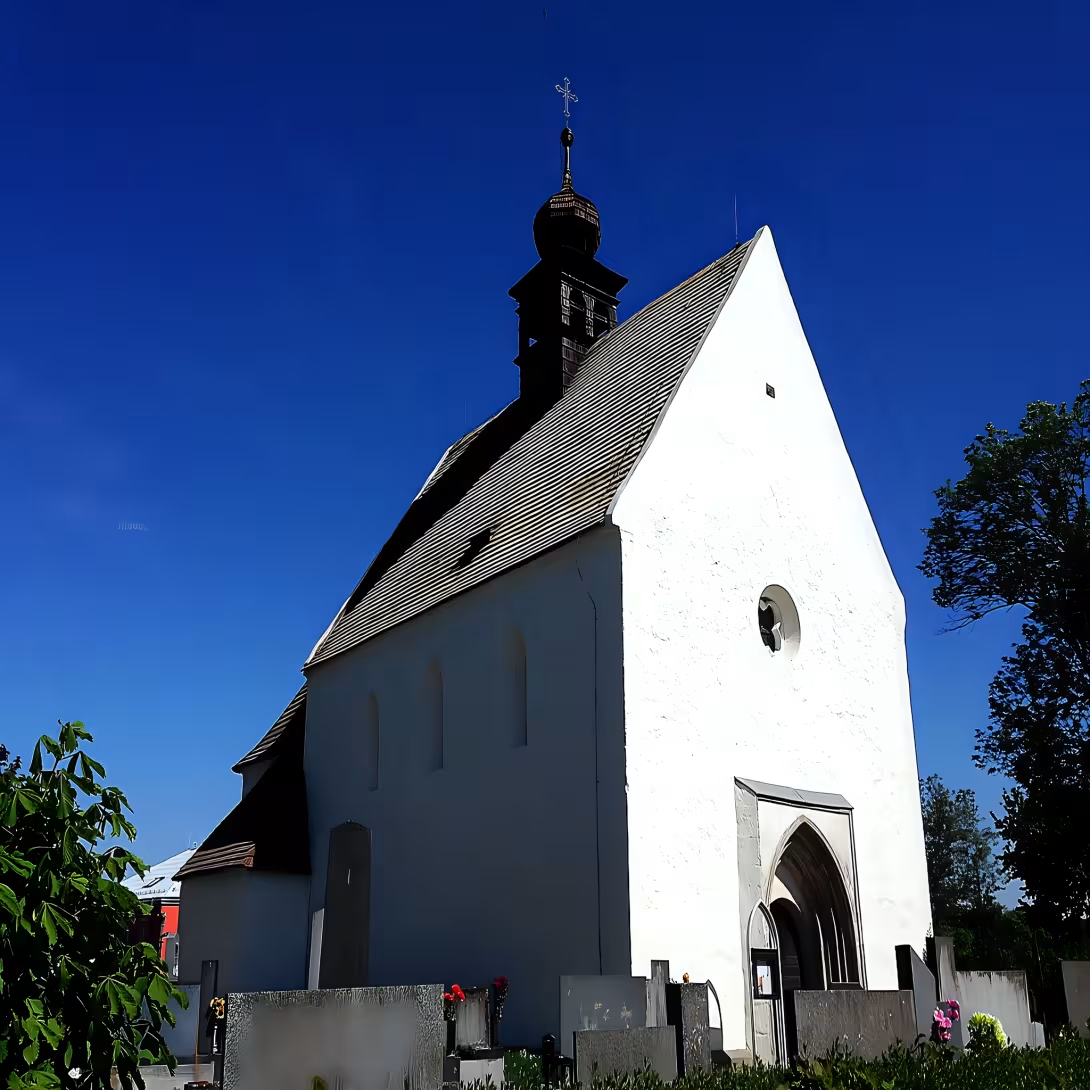
The church of St. Jacob the Elder is located on the north hill of the village Tečovice, on the elevated plateau at an altitude of 231 metres. It originated around 1260 and is thus one of the oldest buildings in the Zlín Region. In 1964 it was registered as a cultural monument.
The location of the church is not random - there was a former fortress on the same hill, which according to the survey arose at the time of construction of the church. It had a square floor plan of 25-30 metres and was surrounded by a three-metre deep moat, its centre being a wooden tower (12 × 12 meters). The fortress was destroyed by fire in the middle of the 14th century, but it was long adjacent to the temple.
The church was built in two stages. The basic floor plan and the ship with original windows were developed in the last third of the 13th century in late Romanesque style - as indicated by the thickness of the walls and the manner of the masonry. Posteriormente, in the third quarter of the 14th century, added the Gothic priesthood and sacristy with a concession portal. The construction is evidenced by various types of windows in the cubicle and also by the fact that the ship is older than presbyterium. The building is unglued, has a plinth, and the masonry forms a quarry stone - dark opka - with occasional bricks. The wall thickness is 1.2 meters.
Presbyterium and the ship are украшеna mural paintings from around 1350. During the Hussite wars, the church was burned, followed by two stages of its reconstruction. The Baroque link remained in the form of a bell lid with onions and poppy, which was inserted into the roof roof after it was finished. The Dendrochronological survey from 2024 revealed that this crov dates back to the first half of the 15th century.
The outer appearance is dominated by a Gothic portal - four meters high and three meters wide - which is considered an important example of the development of early Gothic portals in Moravia. The lining of the portal is not the classic rotation of rods, but the complex profiles of arches and three pear trees. There is a simple four-lobe slot above the entrance.
In the interior, the rectangular boat (13 × 8,5 meters) offers a wooden beam ceiling with a visible double cover of eight metres high. The presbyterium is separated from the ship by a triumphant arch six meters high. The entrance part of the ship contains a wooden bark, accessible by a spiral staircase. The church is surrounded by a cemetery with a stone wall, in its northeast corner lies the grave of Romanian soldiers who liberated the village on 3 May 1945.
The church presents a remarkable witness to medieval construction, when romance, goth and baroque met in one place, and where traces of the history of their landscape were preserved in architecture. / p >
Then and now
Drag the slider to compare how the landmark may have looked when it was built with the view today.
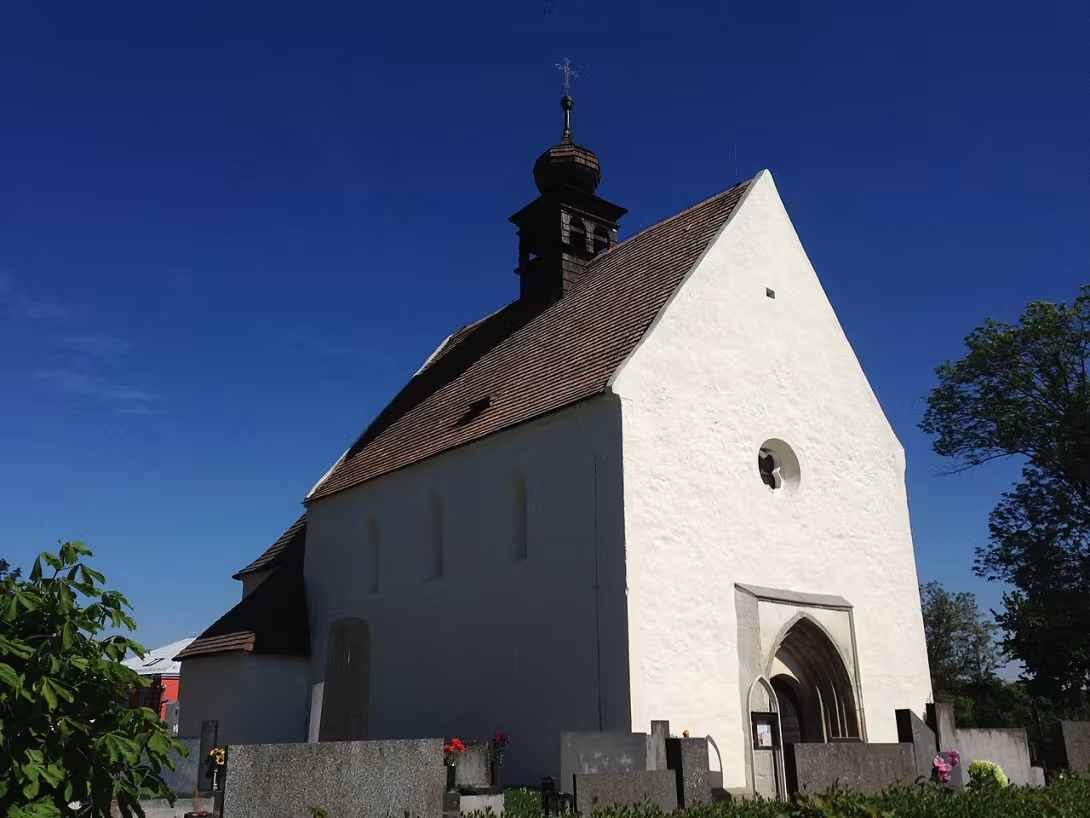

The historical appearance on the left is an AI-generated visualisation and serves as inspiration only.
Historical milestones
- 1350
- The wall paintings in the ship and the priesthood were created.
- 1945
- In the cemetery there is a grave of Romanian soldiers who liberated the village.
Architectural development
The construction of the church probably took place at two different times. The basic plan and the mass of the ship with windows is one of the early goths of the last third of the 13th century, while the concession portal and vaults point to the third quarter of the 14th century. The church was burned during the Hussite wars and subsequently reconstructed.
Historical events
- 1964
- The church was registered as a cultural monument.
- half of the 14th century
- The fortress next door to the church was destroyed by fire.
- husite wars
- The church was burned and subsequently reconstructed.
Points of interest
- The construction of Gothic churches in Bohemia and Moravia took place in the 14th century. At the time, the builders tried to create structures that would not only be functional but also aesthetically impressive.
- The church of St. Jacob the Greater was built on the site of an old Slavic sanctuary.
- It was built on the site of an old Slavic sanctuary and played an important role during the Hussite wars.
Guide
This guide is narrated by a synthetic voice generated by artificial intelligence.
Show guide text
This text was created by artificial intelligence and has not been editorially reviewed. It may contain inaccuracies.
The Church of Saint James the Greater, also called James the Elder, is one of the oldest architectural monuments in the Zlín Region. It was built around the year 1260 on a northern hill of the municipality, on an elevated plateau. Right beside it stood a fortress with a square ground plan, surrounded by a ditch three meters deep. Its core was a wooden tower. The fortress perished in a fire in the middle of the fourteenth century, but the church survived.
The building is originally late Romanesque, which is revealed by the thick walls and the appearance of windows in the nave. Later it was modified in the Gothic and Baroque styles. It was probably built in two periods. First the nave was created, only afterwards the choir and sacristy. The windows testify to this, as there are as many as four different types. The walls, one and two tenths of a meter thick, are made of rubble stone, dark limestone, supplemented in places with bricks. During the Hussite wars the church was burned and then it was restored in two stages.
The most valuable element of the exterior is the main entrance. It consists of a Gothic recessed portal with a pointed arch, four meters high and three meters wide. It was created by a sophisticated stonemason workshop and is very important for the development of early Gothic portals in Moravia. Its jamb is unusual, made up of profiles of two arches and three hood moldings. Above the door is a simple circular window with a quatrefoil motif. Behind the altar is a partially bricked-up window, from which only the top remains glazed in the shape of a trefoil. It illuminates the eye of God in the altar.
The hipped roof is covered with hand-split shingles. On the ridge sits a Baroque bell tower made of beech wood, topped with an onion dome and a finial. The bell in it is a replica of the original early Baroque bell. A tree ring analysis from 2024 showed that the roof structure dates from the first half of the fifteenth century. This finding will also help with dating the medieval paintings inside.
The nave and choir are decorated with wall paintings that were created around the year 1350. The nave has a wooden beam ceiling at a height of eight meters and in the entrance part a wooden gallery with a spiral staircase. They are separated from the choir by a six-meter-high chancel arch.
The church is surrounded by a cemetery with a stone wall. In its northeastern corner is a grave of Romanian soldiers who liberated the municipality on May third, nineteen forty-five. Just before that they managed to cross a bridge on the way from Malenice to Tečovice, which had been mined by German troops. The church has been a cultural monument since nineteen sixty-four.
Tips for visitors
The best time to visit the church of St. Jacob the Elder in Tečovice is the early spring or late autumn months. At that time the climatic conditions are favourable and the church presents itself in its most beautiful glow, without the heat of summer days and with bright colour contrasts on the leaves of trees. Moreover, there is a limited number of visitors in these months, which allows for more intimate experience of the historical site.
For those who prefer public transport, it is advisable to check the current connection using the search engine online. Traffic connections can be especially comfortable on Sundays and holiday days.
What to take with you: We recommend you bring your hat or sunglasses if you plan to visit during bright days. Thanks to the historical importance and architecture of the church, it is also advisable to bring a camera or mobile phone to capture beautiful details. In addition, it may be useful to bring a map or use GPS to help you navigate on the spot.
Photography: The best places for photography are the west side of the church and surrounding green areas. Eastern light in the morning or western evening provides ideal conditions for capturing architectural details in pleasant lighting. In addition, it is also recommended to photograph the interior of the church where there are rich historical elements.
What to visit in the surroundings: In the vicinity of Tečovice you can visit other historical and cultural monuments. For example, you can explore the chateau in Zlín, which is nearby and offers interesting exhibitions and architectural features. It is also suitable for nature lovers to walk along nearby forest trails or visit a local pond, which provides the possibility of relaxing and enjoying natural beauty.
Frequently asked questions
Can the monument be visited?
Religious buildings are usually open mainly during services; at other times a visit is normally arranged with the parish or the operator. We have not verified specific times.
Where is the monument?
Location: Tečovice, Zlínský kraj. The map on this page shows the exact spot.
Why is the monument protected?
It is listed in the Central List of Cultural Monuments of the Czech Republic as a cultural monument (register no. 14540/7-2092).
For kids
Imagine going back to the past. The place you're going is a small village church in Tečovice. From the outside, it looks pretty cool - just rough walls and a narrow window up. But when you sit on a bench inside, you show up in a beautiful Gothic church.
It was like entering a mysterious tomb. As soon as you fell from the sun outside, you realized you were somewhere deep underground and the light from the window is just a thin beam of candlestick. But when she looked around, she saw beautiful stone paintings on the walls and a beautiful altar.
Businesses nearby
Do you run a restaurant, accommodation, shop, museum, rental, wellness or other visitor service near this monument? Show yourself directly to the people heading to it — this is how they will see you in the app and on the web:
Nearby
The church is located in the village Tečovice, district Zlín.
Accommodation nearby
Trips and activities nearby
Guided tours, tickets and activities nearby from GetYourGuide
Affiliate link: if you buy from the partner, we may receive a commission. The price for you does not change.
Search tours and activities →Themed route
Thematic cruise route around the church of St. Jacob the Greater in Tečovice
1. St. Jacob's Church in Tečovice (Church) This Baroque temple is the most significant architectural work of the village Tečovice. Its rich history and beautiful interiors make a visit necessary for anyone interested in cultural monuments of the Zlín Region.
2. Nav v Tečovice (Public space) After visiting the church, we will relax to visit the village where local shops and restaurants are located. This central public area offers an opportunity to get to know everyday life in Tečovice and stop for afternoon coffee.
3. Zlín Museum in Zlín (Museum) If you have time, we recommend visiting the Zlín Museum, which is about 20 km from Tečovice. The museum offers fascinating exhibitions about the history and culture of the region, which perfectly complements your knowledge of the Zlín region.
4. Local Market (Public Event) Return to Tečovice will allow you to explore the local marketplace where you will encounter various products and traditions of the region. It is a great opportunity to see home-made food and products.
This route offers a view of the cultural wealth of Tečovice and the surrounding areas, while allowing to explore the everyday life and traditions of the local region.
Seasonal recommendations
Spring - In March and April, the first green buds and trees along the way to Tečovice are blooming around St. Jacob's Church. The light hits the Gothic towers with a soft, golden light, highlighting the stone details and stained glass. At this time visitors are still quite sporadic, so you can easily browse the interior and exterior without rush. We recommend to dress in a layer - light sweater or jacket against colder morning clocks and comfortable shoes, because around the church there are slippery stone paths after rain. It is best to arrive around noon when the sun lights up the main portal while avoiding morning fog.
Summer - In the summer months, the church turns into the center of the green park, where a flowering meadow is spread along the path and the trees cast a shadow on the stone wall. Sun rays at noon create dramatic contrasts between light windows and darker stone parts, which is ideal for photography. In the main summer season, however, the number of visitors increases, especially during weekends. We recommend to arrive early in the morning, preferably before eight o'clock, when the queues are smallest and the temperature is pleasant. Light clothing, sunglasses and sunscreen are essential; Remember also the comfortable sandals with a good heel, because the stone steps can be hot.
Autumn - In October and November, a golden and red palette of leaves spread around the church, which rustles under their feet and gives the place a nostalgic touch. The weaker autumn sun falls at an angle, creating soft shadows and underlining the texture of old walls. The number of tourists is falling, but there are sometimes groups of photographers looking for autumn scenery. It is convenient to dress in warmer layers - sweater, light jacket and firm shoes, because the leaves can be wet and slippery. The best time to visit is in the afternoon when the sun lights up the eastern facade while avoiding morning fog.
Winter - In December and January the church of St. James the Greater gains a quiet, almost mystical character; snow covers roofs and surrounding fields, and light in advent time reflects off white surfaces, creating a fine atmosphere. We recommend warm clothes - winter coat, hat, gloves and waterproof shoes because the path to the church can be icy. Come in the afternoon, when the sun still hits the west tower while avoiding the greatest burden of visitors during Christmas holidays.
Visualizations and artistic views


The visualisations are generated by artificial intelligence and serve as inspiration.
Photos from the area
Real photos taken near the monument


Zdroj a licence jsou uvedeny u každého snímku.
View from the area
This animation was generated by artificial intelligence from a real photograph of the surroundings. The motion and details are not real footage of the location.
Atmosphere of the place
This atmospheric visualisation of the place and period was generated by artificial intelligence. It is not real footage of the location.
Tips from visitors
No tips yet. Be the first!
Log in and add your tip.
Sources and literature
Photos: Kristýna.Vyslychová / CC BY-SA 4.0, rozlišení zvýšeno umělou inteligencí — Wikimedia Commons. The author and licence also appear when you hover over the image.
Faktickým podkladem tohoto textu byl článek na Wikipedii, jehož autory jsou přispěvatelé Wikipedie. Článek je dostupný pod licencí CC BY-SA 4.0.
Location on the map
Příběhy a pověsti
Legendy, pověsti a příběhy spjaté s touto památkou
Fotografie návštěvníků
Zatím žádné fotografie. Buďte první, kdo přidá fotografii z návštěvy!
Log in a přidejte svou fotografii nebo hodnoťte.
Za ověřenou návštěvu v aplikaci získáte víc bodů — poznáme podle GPS, že jste na místě.
Reviews and comments