



kostel svatého Jana Křtitele (Dolní Kralovice) Church
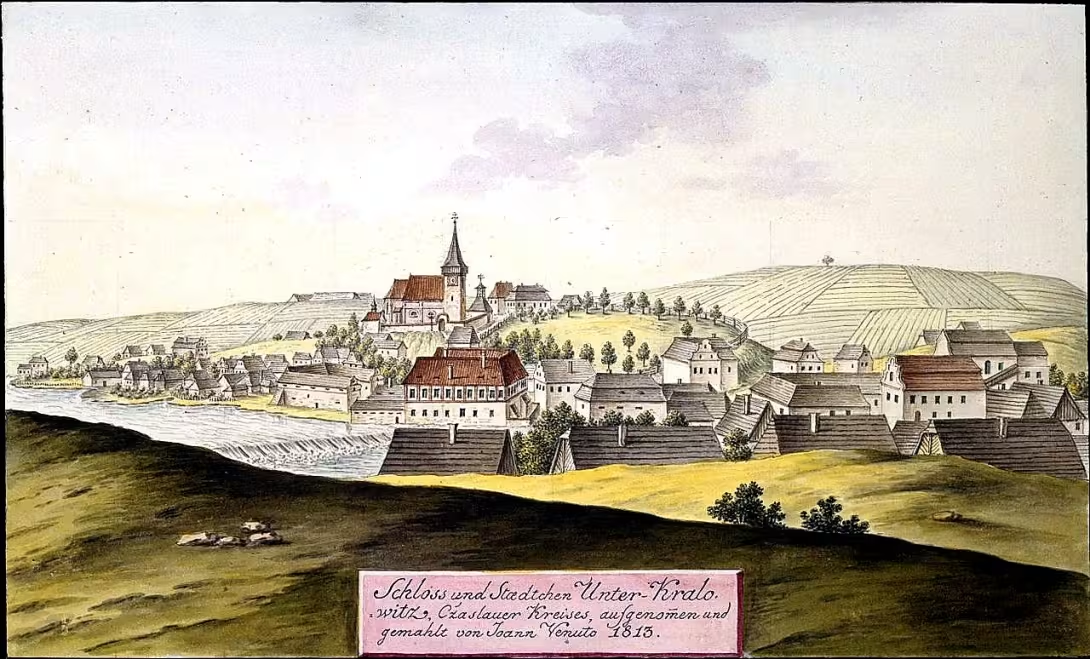
Objekt se nedochoval — na místě dnes nestojí. Následující text popisuje jeho historii, ne současnou návštěvu.
The Church of Saint John the Baptist in Dolní Kralovice was a Romanesque and Gothic church located in what is now a vanished village within the Benešov District. Constructed at the end of the 13th century, it transformed into the Gothic style by the mid-14th century. The church served as an important cultural monument until its demolition in 1975 for the Švihov Reservoir's construction. Despite its destruction, architectural elements and frescoes have been preserved and displayed elsewhere, marking its historical significance.
The origins of the Church of Saint John the Baptist trace back to the late 13th century when it was initially built in the Romanesque style. Historical records first mention the church in 1352. By the mid-14th century, it had transformed into Gothic architecture, featuring additions like a choir and sacristy. This period coincided with a flourishing of Gothic architecture across Europe.
Architecturally, the church began as a Romanesque structure but evolved significantly by adopting Gothic elements in the mid-14th century. The transformation included constructing a new Gothic choir and sacristy, replacing an earlier Romanesque apse. In the 18th century, it received Baroque furnishings: an organ in 1743, a bier in 1744, pews in 1758, and a redesigned main altar and pulpit by 1759. The church's exterior featured a single-nave design with a tower on its western façade and a five-sided apse with stepped buttresses capped by a gabled roof. Its windows were high-set without arches, framed by profiled eaves cornices.
Ownership and administration of the church fell under the Roman Catholic parish of Keblov until 1965 when it was listed as a cultural monument of the Czech Republic. However, two years later, plans for the Švihov Reservoir led to its removal from the list of protected monuments. The church's demolition began in 1968, with the reservoir's gradual filling starting in 1972 and culminating in the complete destruction of the village and church by 1975.
Key events associated with the church include its listing as a cultural monument in 1965 and subsequent demolition in 1975 due to the Švihov Reservoir construction. During preparations for demolition, frescoes from the 14th century were discovered beneath layers of paint. These frescoes were preserved by students from the School of Restoration and Conservation Techniques in Litomyšl in the late 1990s and are now displayed at Vodní Dům.
Today, while the physical structure no longer exists, its legacy endures through preserved architectural elements and frescoes. Key components such as two neo-Gothic side altars were transferred to the Church of the Assumption of the Virgin Mary in Číhošť; a Baroque main altar with an image of Saint John the Baptist and pulpit to the Church of Saint Bartholomew in Kondraci; and a Gothic statue of the Madonna to the Nativity of the Virgin Mary Church in Křivsoudov. Additionally, a bell from 1551 was moved to the Church of the Assumption of the Virgin Mary in Keblov.
The remnants of this once-prominent church serve as a testament to its historical and cultural significance. Visitors interested in Czech history can explore these preserved elements at various locations, gaining insight into the architectural evolution and artistic heritage that characterized Dolní Kralovice's Church of Saint John the Baptist. Its story invites reflection on modern development's impact on historical sites and underscores the importance of preserving cultural heritage for future generations.
Then and now
Drag the slider to compare how the landmark may have looked when it was built with the view today.
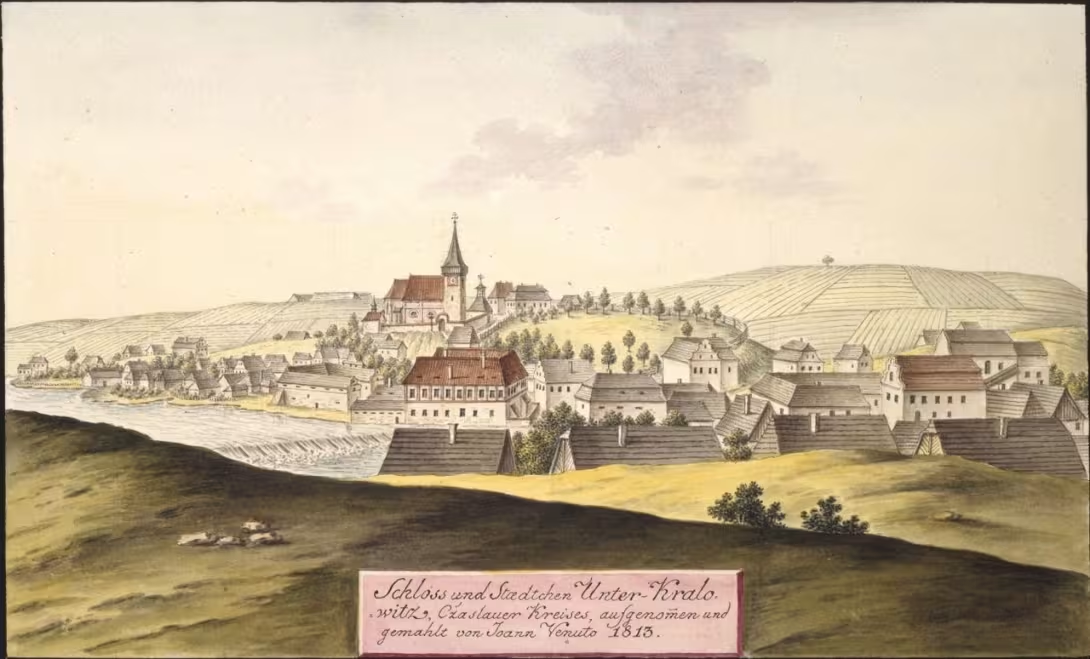

The historical appearance on the left is an AI-generated visualisation and serves as inspiration only.
Historical milestones
- end of the 13th century
- The Church of St. John the Baptist was built in Romanesque style.
- 1352
- First historical mention of the church.
- mid-14th century
- Transformation into Gothic style with the addition of a choir and sacristy.
- 1965
- The church was registered as a cultural monument of the Czech Republic.
- 1975
- Demolition of the church for the construction of Švihov Reservoir.
Architectural development
The Church of Saint John the Baptist began as a Romanesque structure at the end of the 13th century. By the mid-14th century, it was transformed into Gothic style with new additions such as a choir and sacristy. In the 18th century, it received Baroque furnishings including an organ and pulpit. The church underwent several renovations in the late 19th and early 20th centuries.
Historical events
The church was first mentioned in documents in 1352, indicating its existence by that time.
In the mid-14th century, it underwent a transformation into Gothic style with new architectural additions.
In 1965, the church was listed as a cultural monument of the Czech Republic.
It was demolished in 1975 due to the construction of the Švihov Reservoir.
Points of interest
- Despite its demolition for the Švihov Reservoir construction in 1975, the Church of Saint John the Baptist's legacy persists through preserved frescoes and architectural elements. These artifacts have been relocated to various churches across the region, allowing visitors to appreciate their historical significance.
- The church underwent a remarkable transformation from Romanesque to Gothic architecture by the mid-14th century, reflecting broader European trends in Gothic design during that era. This evolution highlights its role as an important cultural monument before its destruction.
- During preparations for demolition, 14th-century frescoes were discovered beneath layers of paint on the church walls. These frescoes were meticulously preserved and are now displayed at Vodní Dům, showcasing their historical value despite the church's physical absence.
- In a surprising turn of events, after being listed as a cultural monument in 1965, the Church of Saint John the Baptist was removed from this list just two years later due to plans for the Švihov Reservoir. This decision underscores the tension between development and heritage conservation that led to its eventual demolition.
- The church's Baroque furnishings, including an organ installed in 1743 and a redesigned main altar by 1759, reflect the stylistic changes it underwent over centuries, illustrating how it adapted to evolving artistic trends before its untimely destruction.
Guide
This guide is narrated by a synthetic voice generated by artificial intelligence.
Show guide text
This text was created by artificial intelligence and has not been editorially reviewed. It may contain inaccuracies.
The Church of Saint John the Baptist no longer stands today. It belonged to Dolní Kralovice in the Benešov district, a village that ceased to exist due to the construction of the Švihov water reservoir. It was demolished in nineteen seventy-five.
The parish church was built at the end of the thirteenth century in the late Romanesque style. A wooden church may have stood on this site as early as eleven eighty-seven. The first written mention dates from thirteen fifty-two. In the fourteenth century, it underwent Gothic reconstruction. A new nave from thirteen thirty was supplemented in the middle of the century by a presbytery, built in place of the Romanesque apse. A sacristy was added on the northern side, which served as a side chapel in the Middle Ages and was later heightened with an oratory.
In the eighteenth century, the church received new furnishings, including an organ, an oil lamp for the dying, pews, and a pulpit. In eighteen seventy-three, a lightning bolt damaged the tower and the tower was temporarily covered with a low tent roof. Around eighteen ninety-seven, another story was added to it with a neo-Gothic pyramidal roof covered with slate.
It was a single-naved brick structure with a prismatic tower in the western façade and a five-sided apse, which was reinforced by stepped buttresses.
The fate of the church was paradoxical. The decision to build the dam was made in nineteen sixty-three, and yet two years later the church was listed as a cultural monument. The protection lasted only ten years. The demolition of the village began in nineteen sixty-eight, and in nineteen seventy-two the reservoir began to be slowly filled. The church fell along with the railway station as the last buildings.
Part of the furnishings survived elsewhere. The neo-Gothic side altars were moved to Číhoště. The Baroque main altar with a picture of Saint John the Baptist and the pulpit are in Kondraci. A Gothic Madonna statue is in Křivsoudov and a bell from fifteen fifty-one is in Kebliv, under whose parish the church fell.
During the preparation for demolition, frescoes from the fourteenth century appeared beneath layers of paint. There was no time for careful examination, so they were fixed, removed from the wall, and stored in a depot. In the mid-nineteen-nineties, students of a restoration school in Litomyšl restored them over the course of two years. Since twenty sixteen, they have been displayed in the Water House.
Vault ribs, the western portal, and Gothic roof beams were transported to the Museum of Folk Architecture in Kouřim. The church was to rise again there. The regime of the time, however, was afraid that it would become a pilgrimage site for the faithful, and the reconstruction never took place.
Businesses nearby
Do you run a restaurant, accommodation, shop, museum, rental, wellness or other visitor service near this monument? Show yourself directly to the people heading to it — this is how they will see you in the app and on the web:
Visualizations and artistic views


The visualisations are generated by artificial intelligence and serve as inspiration.
Tips from visitors
No tips yet. Be the first!
Log in and add your tip.
Sources and literature
Photos: Joann Venuto (1746-1833) / Public domain — Wikimedia Commons. The author and licence also appear when you hover over the image.
Faktickým podkladem tohoto textu byl článek na Wikipedii, jehož autory jsou přispěvatelé Wikipedie. Článek je dostupný pod licencí CC BY-SA 4.0.
Location on the map





Příběhy a pověsti
Legendy, pověsti a příběhy spjaté s touto památkou
Fotografie návštěvníků
Zatím žádné fotografie. Buďte první, kdo přidá fotografii z návštěvy!
Log in a přidejte svou fotografii nebo hodnoťte.
Za ověřenou návštěvu v aplikaci získáte víc bodů — poznáme podle GPS, že jste na místě.
Reviews and comments