



Kostel svatého Jana Křtitele (Horní Habartice) Church
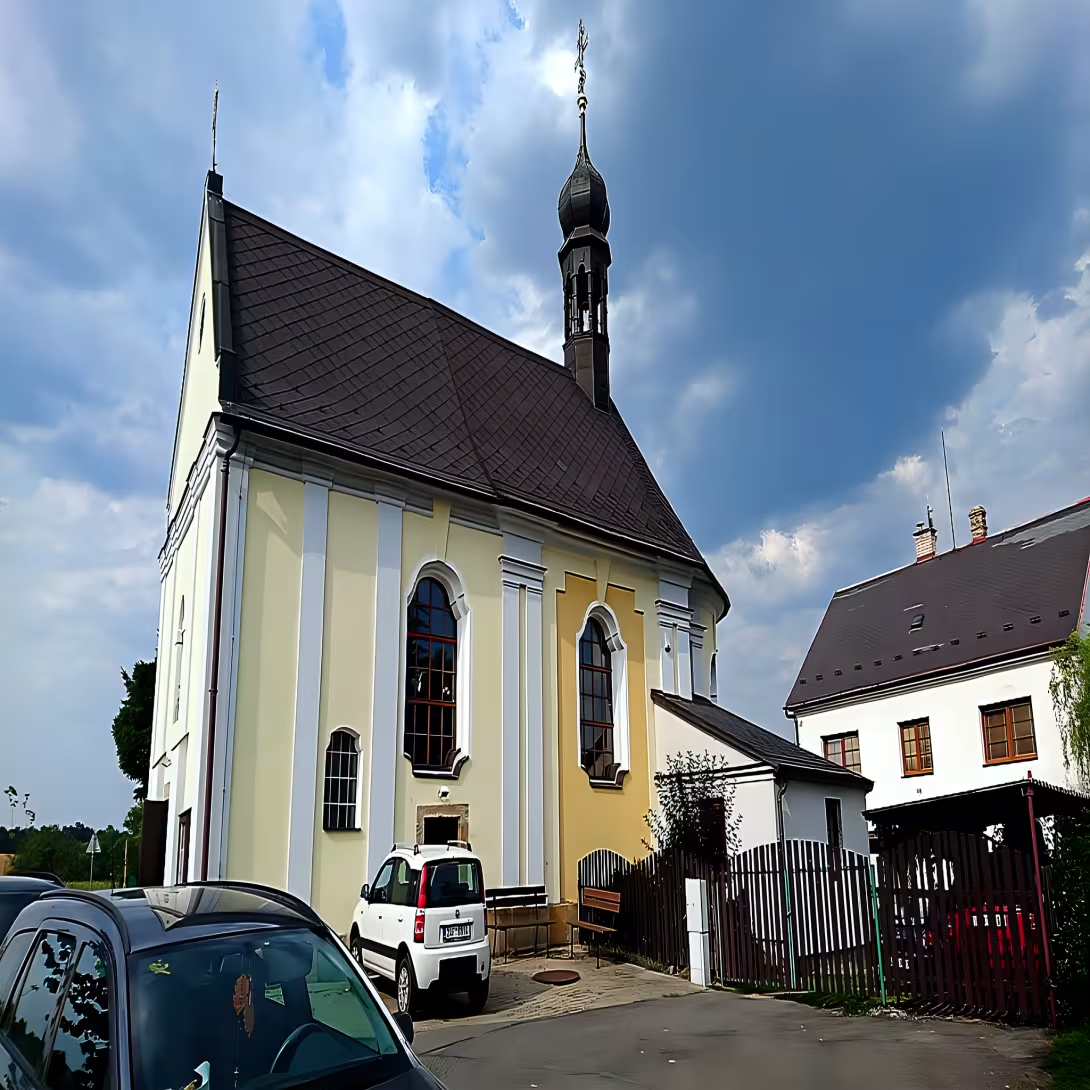
The church of St. John the Baptist in Horní Habartice stands on a long hill and together with the parish and school form an interesting building complex. It is a late Baroque sacral building, the creation of which is closely related to the distinctive story of the local mountain.
The story of the church has been unfolding since Jiří Hauptmann of Habartic brought a wooden statue of Savior from the Bavarian border. This is a sculpture that the locals liked to worship. With the permission of the authorities, Hauptmann then built a small chapel in 1745 to give the statue a dignified place. Soon, the skeleton became a target of interest for pilgrims from a wide area who flowed here in the process. When the chapel got too little space, the locals decided to build a new church. He was built in 1787 and gradually gained importance - in 1858 he became a parish church. After the introduction of the Yosephin reforms that banned pilgrims, worship of the statue was limited to local believers and neighborhoods of Habartic.
The architecture of the church speaks of several building stages. It is easy to see elements from different periods - the facade was created only in the 19th century when the original ship was extended. The construction is single and rectangular, with a presbytery semi-circular finish, which has a sacristy on the north side. The side facades and the ending are decoded by pairs of pilasters with casual windows. The facade is hard geometrical, divided by four pilasters and closed with a perfectly smooth triangular shield with a small circular window. There is a niche above the entrance with a statue of St. John the Baptist.
The interior shows a complex construction history. The presbytery is broken down by pilasters and has a valen of vaults with belts, which in the end turns into a lunettes. The rectangular ship, covered by the Fabion ceiling, has been extended in the past by niche with four windows, making it strangely proportional. In the middle part, the ship narrows down a pair of pilasters from which the belts converge from the ceiling. Krucht has a традičnou poprsni and the undercrop is covered by a ceiling with a band of compressed vaults.
The church's facilities reflect its pilgrim and parochial character. The main altar is dedicated to the Holy Heart of the Lord and has a pseudo-gothic style; The Baroque statues of St. Wenceslas and St. Prokop are part of it. The two side altars from the 19th century belong to St. John Nepomukki and the Virgin Mary and bear signs of historical style. The pulpit and the baptisms come from the late 18th century. The church also contains a Baroque statue of Christ in chains and other Baroque statues of saints.
The church was reconstructed in 2008 and returned to a dignified state. To date, it remains a place of interest for those interested in Baroque architecture and the history of pilgrimage places in the Czech-Moravian border. / p >
Then and now
Drag the slider to compare how the landmark may have looked when it was built with the view today.
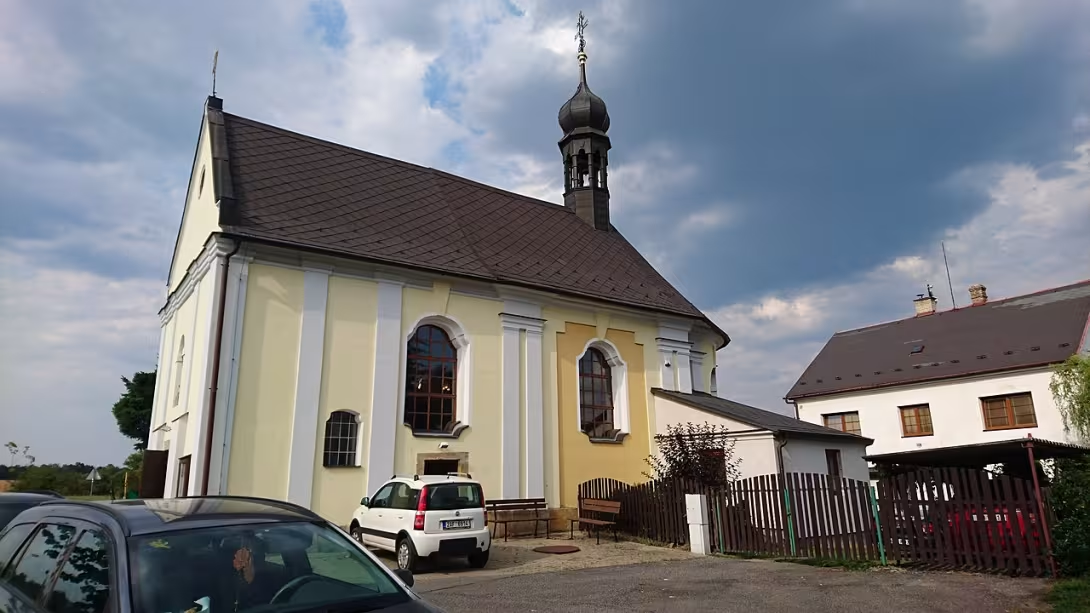
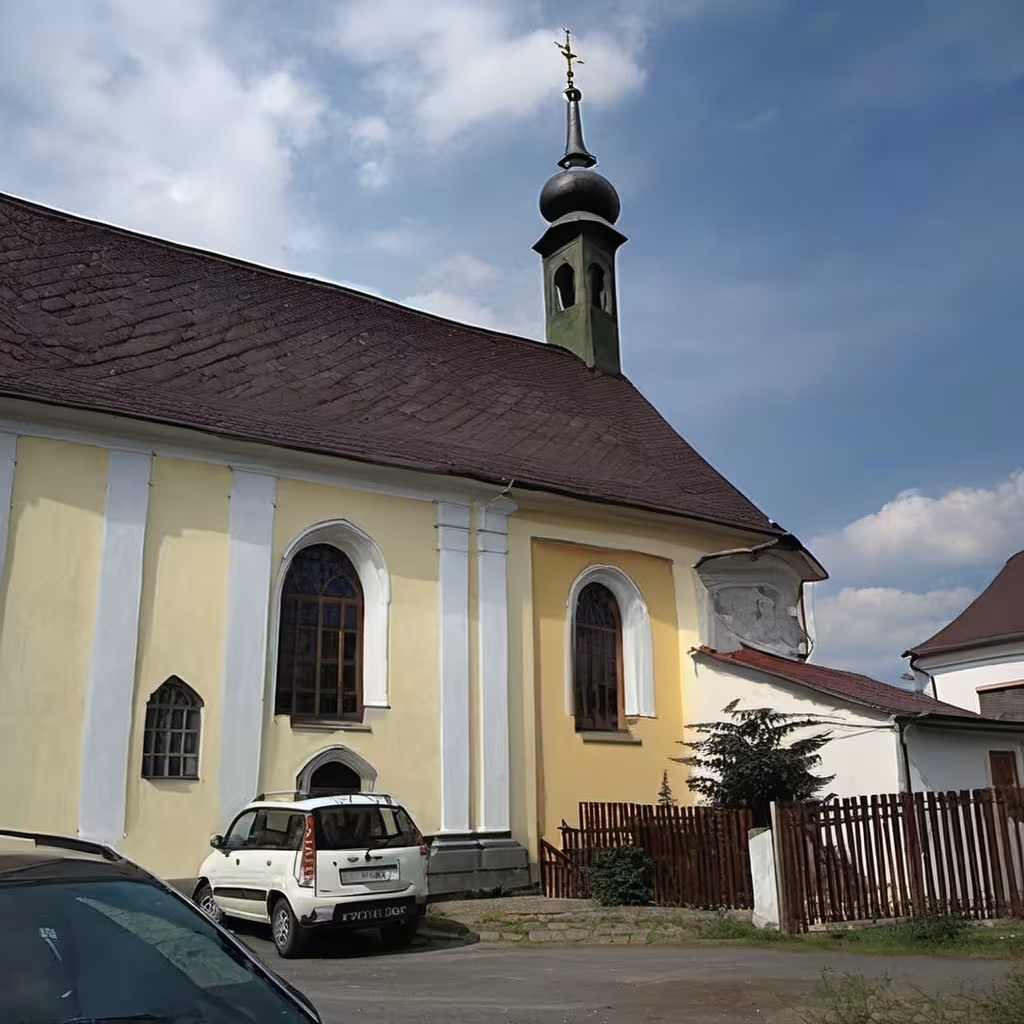
The historical appearance on the left is an AI-generated visualisation and serves as inspiration only.
Historical milestones
- 1745
- The creation of a small chapel to worship the Bavarian statue of the Savior at the impulse of Jiří Hauptmann
- 1787
- Status of the present pilgrimage church of the birth of St. John the Baptist
- 1858
- The church became parochial
- 2008
- Large reconstruction of the church
Architectural development
The church is a single boat with a rectangular presbytery ending with a half circle and sacristy on the north side. The exterior is divided by Pillasters and Casual Windows, the 19th-century facade has a triangular shield with nothing of the statue of St. John the Baptist. The interior combines the valentine vault of the presbytery with the flat ceiling of the boat and the round with the plank breast. The equipment includes a pseudo-gothic main altar and historizing side altars from the 19th century.
Historical events
In 1745, Jiří Hauptmann built a small chapel to worship Bavarian wooden statues of the Savior. In 1787 the chapel was replaced by the present church, which became parochial in 1858. There was an extension of the church in the 19th century and in 2008 there was extensive reconstruction.
Owners
The sequence of owners with years if available, otherwise zero.
Points of interest
- The church of St. John the Baptist was founded as a response to the worship of Bavarian wooden statue of Savior, brought here by the local mountain Jiří Hauptmann from Habartic.
- The chapel, built in 1745, soon became a destination for pilgrims from the surrounding area, leading to the construction of a new church in 1787.
The church became a parish church in 1858.
Josephine's reforms have limited the pilgrimage, so the worship of the statue has been limited to local believers and neighborhoods of Habartic.
- The interior of the church contains a Baroque statue of Christ in chains and other Baroque statues of saints.
Guide
This guide is narrated by a synthetic voice generated by artificial intelligence.
Show guide text
This text was created by artificial intelligence and has not been editorially reviewed. It may contain inaccuracies.
The pilgrimage church of the Nativity of Saint John the Baptist in Horní Habartice is a late Baroque structure. It stands on an extended hilltop and together with the rectory and school forms one complex of buildings.
Habartice became a pilgrimage site thanks to Jiří Hauptmann from house number twenty-three in Habartice. He brought a wooden statue of the Saviour on his own shoulders from the Bavarian borderland. The statue soon began to be venerated, and with the permission of the local authority, Hauptmann built a small chapel for it in seventeen forty-five. However, processions began to flow to the chapel from the wider surroundings, so the present church was built in its place in seventeen eighty-seven. It became a parish church in eighteen fifty-eight. In the nineteenth century it was extended and underwent reconstruction in two thousand and eight. The Josephine reforms banned pilgrimages. From that time on, the statue was venerated as a miraculous image only directly in Habartice and in its immediate vicinity.
The church has a single rectangular nave. It is followed by a rectangular presbytery, that is the space around the main altar, terminated by a semicircle. A sacristy adjoins it from the north side. The side walls and the end are divided by pairs of pilasters and windows in the shape of a chasuble, a priestly ornament. The façade was created only when the nave was extended in the nineteenth century. It is divided by four pilasters and at the top it is closed by a triangular, completely smooth pediment with a small circular window. On the axis of the façade is a rectangular portal and a niche with a statue of Saint John the Baptist.
Inside, the presbytery is divided by pilasters with sections of entablature and a pair of niches. It is vaulted with a barrel vault with bands, its semicircular end with a conch and lunettes. From the north wall a rectangular doorway leads to the sacristy with a flat ceiling. The nave is covered with a ceiling with a fabian, that is with a rounded transition to the walls. Originally it was apparently not so long. In its eastern part the nave is expanded by niches with windows. In the middle, on the other hand, the nave narrows slightly and is divided by a pair of pilasters, into which two bands from the ceiling converge. The gallery has a wooden balustrade and the space beneath it is covered by a ceiling and a band of compressed vault.
The main altar is dedicated to the Most Sacred Heart of Jesus and is pseudo-Gothic. Baroque statues of Saint Wenceslaus and Saint Procopius stand on it. Two side altars, of Saint John of Nepomuk and the Virgin Mary, are historicizing and date from the nineteenth century. The pulpit and baptismal font are from the end of the eighteenth century. In the church there is also a Baroque statue of Christ in chains and other statues of saints.
Tips for visitors
The best time to visit the church of St. John the Baptist is during spring and summer months when the outdoor environment is the most beautiful and sunlight creates ideal conditions for photography. The Baroque details of the facade and interior then radiate in full glory. In addition, there are often small cultural events or services that can enrich the visit in the summer.
It is recommended to arrive on your own vehicle because public transportation to Upper Habartic is not very common. Find out the current connection and departure times in the traffic search engine.
When visiting take comfortable shoes because the church stands on a slightly hilly terrain and the surrounding area offers an opportunity for short walks. It is often cold in the interior, so bring a light sweater or sweater. It is advisable for children to take something to think about or paint because the church offers a quiet environment for relaxation.
The best places for photography are the entrance portal with Baroque sculptures and windows of the interior that release light and create interesting shadows. It is recommended to photograph in the morning or afternoon light, when the rays of the sun highlight the details of the facade. In the interior it is advisable to avoid lightning to damage historical paintings.
The historical monuments are worth visiting the forts in Lower Habartice, which is only a few kilometres away. It is interesting for children to explore the surrounding forests and picturesque landscape of the Lusatian Mountains.
It is advisable for families with children to visit the church at a time when there is a service or a small cultural event, because children can listen to singing or hear stories about the history of the place. Around the church you can play on a small playground or talk while walking through the forest. Children can also see the old stone elements of the church and the chateaux that fascinate them.
Frequently asked questions
Can the monument be visited?
Religious buildings are usually open mainly during services; at other times a visit is normally arranged with the parish or the operator. We have not verified specific times.
Where is the monument?
Location: Horní Habartice, Ústecký kraj. The map on this page shows the exact spot.
For kids
Imagine going back to when the whole world was different. All people wore long coats and hats, and when they went to church, they prayed for their families and countries.
Horní Habartice was a small village where few people lived. But one church stood in the center of the village and was like the heart of the village. The church of St. John the Baptist was very beautiful and had a tall tower that was going to heaven.
Businesses nearby
Do you run a restaurant, accommodation, shop, museum, rental, wellness or other visitor service near this monument? Show yourself directly to the people heading to it — this is how they will see you in the app and on the web:
Events nearby
Zdroj akcí: otevřená data měst a obcí ČR (Národní katalog otevřených dat) a kalendář akcí Národního památkového ústavu.
Nearby
Within a 5 km radius there is a natural reserve Habartic surface and several historical fortresses such as the fort in Lower Habartice. The surrounding area is characterized by forests and picturesque landscape of the Lusatian Mountains.
Accommodation nearby
Trips and activities nearby
Guided tours, tickets and activities nearby from GetYourGuide
Affiliate link: if you buy from the partner, we may receive a commission. The price for you does not change.
Search tours and activities →Themed route
Thematic cruise route: Baroque and natural treasures Habartic
1.Kostel svatého Jana Křtitele (Horní Habartice) * Type: * Baroque sacral building from the 18th century. * Why visit? * A unique example of rural sacral architecture with rich decoration, typical of the Lusatian Mountains. The interior preserved valuable altars and statues that reflect local tradition.
2. Fortress in Lower Habartice * Type: * Renaissance fortress from the 16th century. Why visit? One of the best preserved chateaux in the region, hiding traces of medieval and early modern history. The area offers a view of the surrounding landscape and illustrates the importance of the village in the past.
3. Nature Reserve Habartic surface * Type: * Protected forest and rock areas. * Why visit? * The picturesque forests and rock source with rich flora and fauna, ideal for walking and observing nature. The reservation is part of the Lusatian Mountains and offers a quiet environment for relaxation.
* The route is designed as circular, beginning and ending in Upper Habartice, with an approximate length of 10 km. A combination of hiking and short stops is recommended. *
Seasonal recommendations
In spring, the church's surroundings awaken to life and fresh green vegetation creates a pleasant contrast to the historical state of the building. The light is soft and scattered during this period, allowing detailed observation of the facade without sharp shadows. We recommend choosing layered clothes because the morning air can still be cold. It is the perfect time for those who seek peace and want to avoid the greatest crowds of visitors.
In the summer months the surroundings are full of life and the strong sun clearly highlights the colors of the surrounding countryside. Due to the increased attendance in the main summer season, it is best to arrive at the monument early in the morning to enjoy a quieter atmosphere and avoid the greatest heat. Clothes should be light and comfortable, ideal for walking in summer weather.
Autumn brings to the Upper Habartic melancholic atmosphere, complemented by colorful leaves and occasional morning fog. The golden light of the autumn sun creates absolutely exceptional conditions for observing architecture. It is advisable to wear waterproof shoes and laminated clothing because temperatures are beginning to drop and moisture in the ground may be higher. The best time to visit is in the afternoon when the colors of nature are the most distinctive.
The winter season offers the greatest sense of peace and quiet, especially if the landscape is covered with snow. The lighting is silver at this time and the days are significantly shorter, creating a very specific, meditative charge. It is necessary to prepare for the frost and choose very warm and windproof clothes. When planning a visit in winter, consider the limited time for observations in natural light.
Visualizations and artistic views


The visualisations are generated by artificial intelligence and serve as inspiration.
Photos from the area
Real photos taken near the monument


Zdroj a licence jsou uvedeny u každého snímku.
View from the area
This animation was generated by artificial intelligence from a real photograph of the surroundings. The motion and details are not real footage of the location.
Atmosphere of the place
This atmospheric visualisation of the place and period was generated by artificial intelligence. It is not real footage of the location.
Tips from visitors
No tips yet. Be the first!
Log in and add your tip.
Sources and literature
Photos: IvanFrantišek / CC BY-SA 4.0, rozlišení zvýšeno umělou inteligencí — Wikimedia Commons. The author and licence also appear when you hover over the image.
Faktickým podkladem tohoto textu byl článek na Wikipedii, jehož autory jsou přispěvatelé Wikipedie. Článek je dostupný pod licencí CC BY-SA 4.0.
Location on the map
More monuments – Horní Habartice
Show all in the municipality
Příběhy a pověsti
Legendy, pověsti a příběhy spjaté s touto památkou
Fotografie návštěvníků
Zatím žádné fotografie. Buďte první, kdo přidá fotografii z návštěvy!
Log in a přidejte svou fotografii nebo hodnoťte.
Za ověřenou návštěvu v aplikaci získáte víc bodů — poznáme podle GPS, že jste na místě.
Reviews and comments