






kostel svatého Jana Nepomuckého (Starý Lískovec) Church
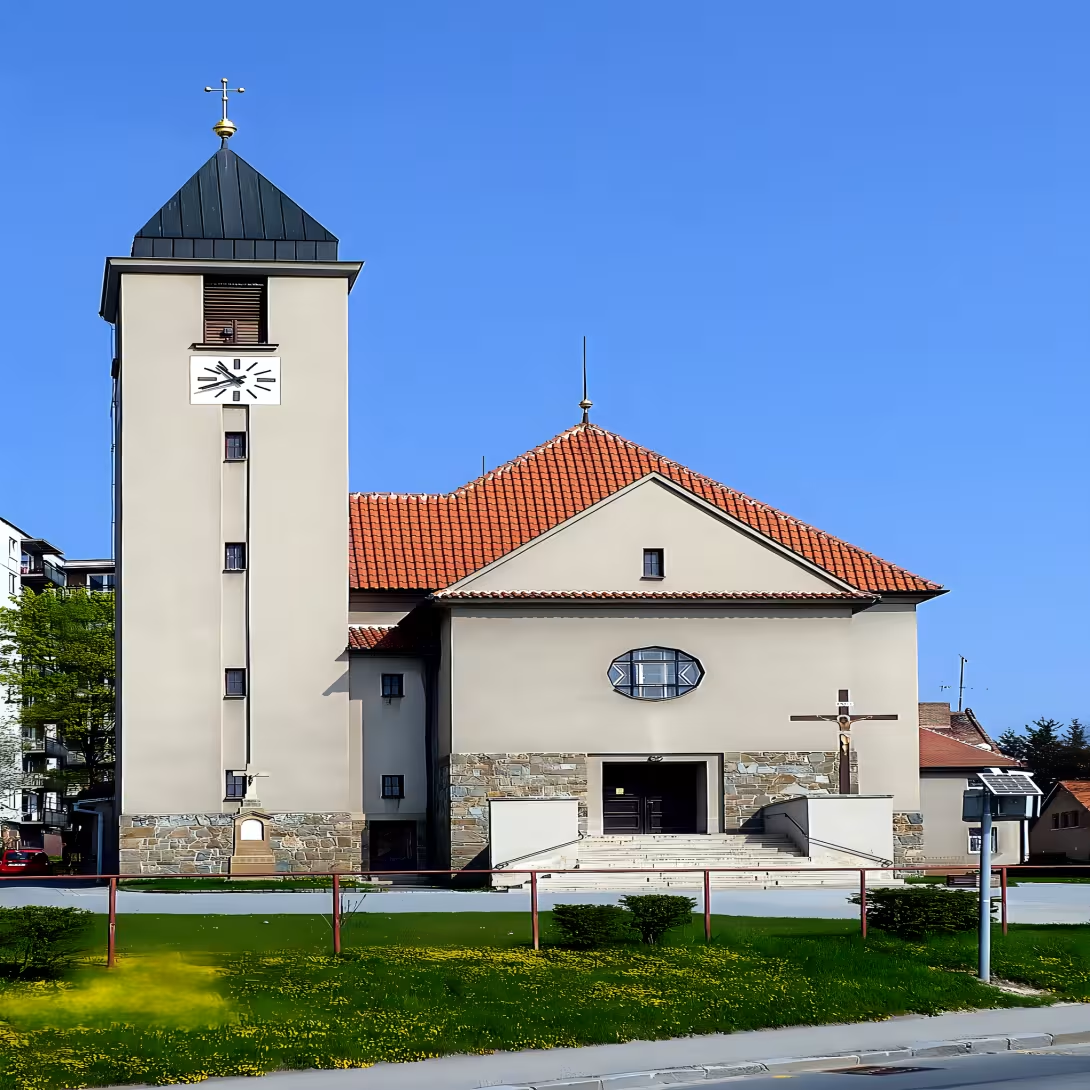
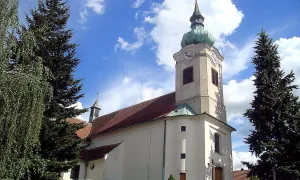
The church of St. John Nepomuk in Old Liskovec, located in the district of Brno-město, is a Roman Catholic parish church built in the years 1925-1926. Designed by architect Vladimir Fischer and built by Leopold Chupra, the temple boasts a simple modern style with a characteristic slender prism tower. It is an important religious and cultural centre for the inhabitants of Old Lískovka and the surrounding neighborhoods.
The preparatory work for the construction began in 1923, but the construction itself took place only two years later. At that time, Europe was undergoing reconstruction after the First World War, affecting the architecture of new buildings such as this church, which reflected modern trends. The consecration took place on 3 October 1926 by Bishop Kupkou of Brno, which meant its beginning as a religious centre for the local community.
The architecture of the church is a simple modern aesthetics with a distinctive slender prism tower that symbolizes the direction towards new architectural principles. The construction was completed in 1926 and has since served as a spiritual home for local residents.
In 1930 a separate parish was established, which included both Starý Lískovec and Bohunice. This move highlighted the importance of the church as a centre of religious life and community activity. Since then, he has become a key institution for the local Catholic community, providing various services and support.
Today, the church is an open religious centre that attracts not only local residents, but visitors from surrounding neighborhoods. Its simple modern style and historical importance make it an interesting destination for those interested in the architecture of the 20th century and the history of the local community. The visit offers an opportunity to explore its beautiful design and to understand its importance as a cultural and religious centre.
The church of St. John Nepomuk is not only a monument to architecture, but also a living proof of the history and traditions of the local community. Its existence resembles the period of recovery after the war and serves as a permanent religious centre for many generations. Exploring its interior and observing its unique design is a great opportunity to appreciate the history and modernity that intersect it.
Then and now
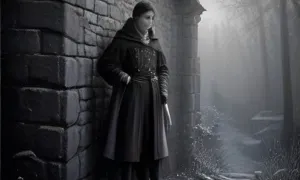
Drag the slider to compare how the landmark may have looked when it was built with the view today.
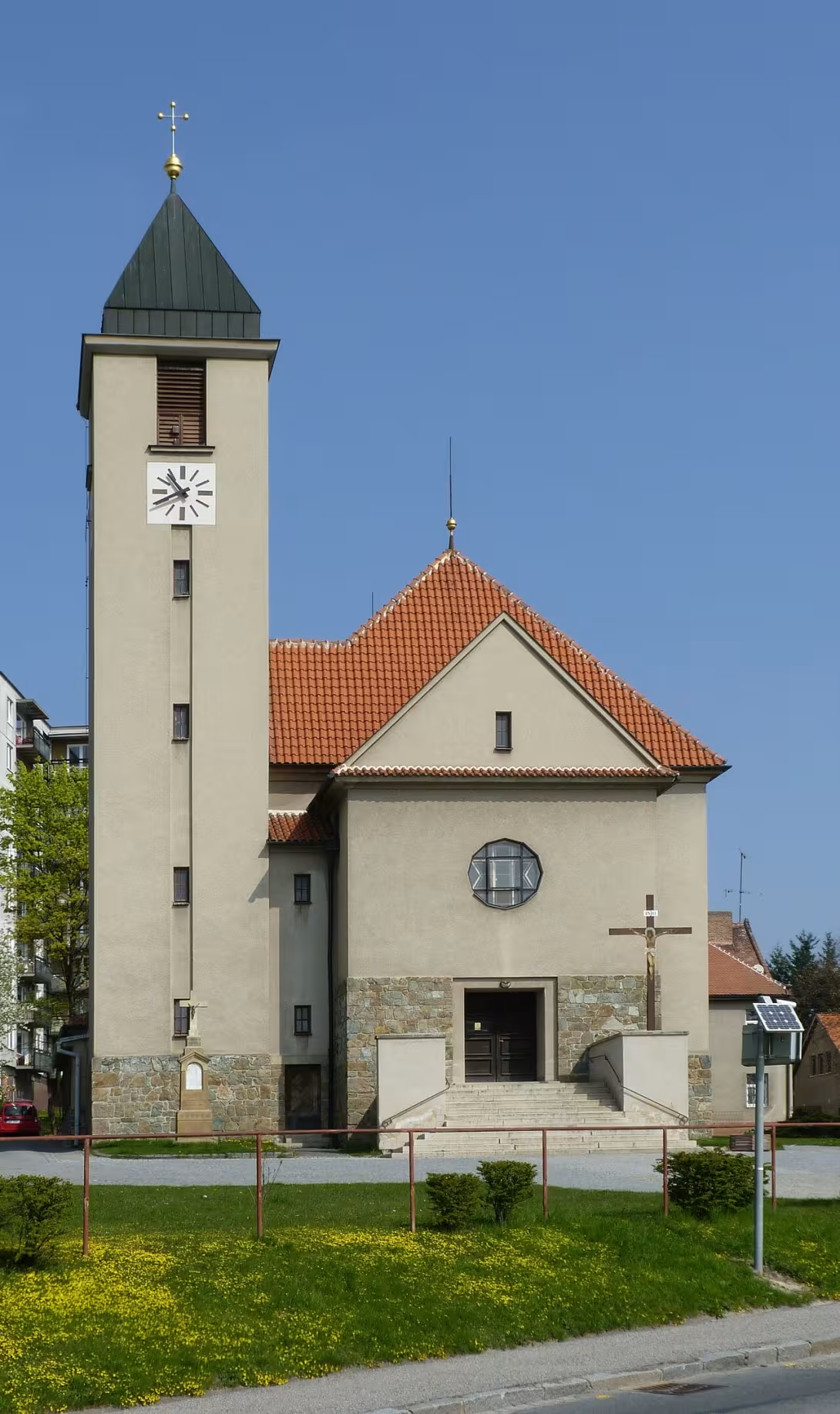
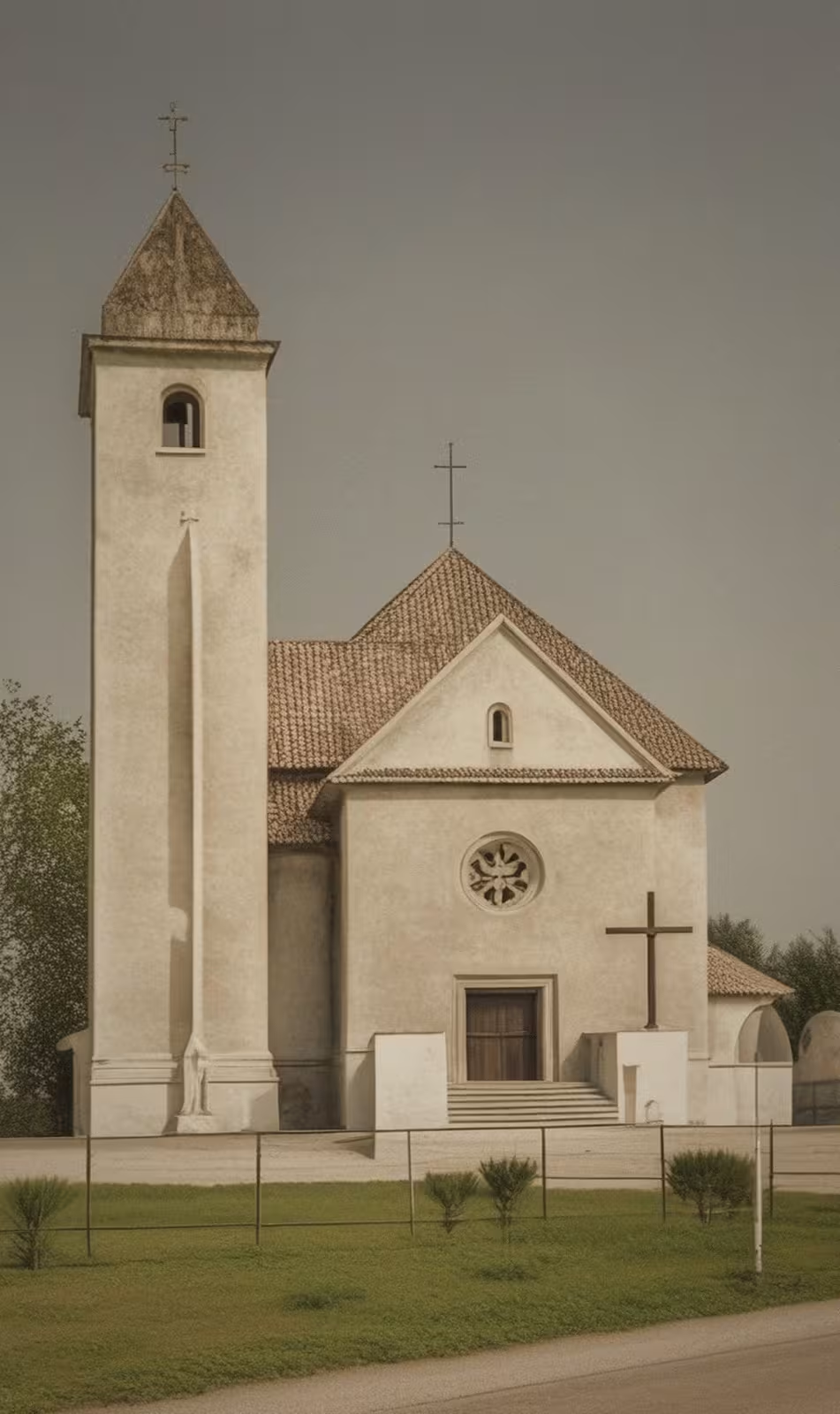
The historical appearance on the left is an AI-generated visualisation and serves as inspiration only.
Historical milestones
- 1923
- Start of preparatory work on church construction
- 1925
- Opening of the church construction itself
- 1926
- The ordination of the church by the Bishop of Brno
- 1926
- Completion of church construction
- 1930
- Establishment of a separate parish including Starý Lískovec and Bohunice
Architectural development
The church was built in 1925-1926. The preparatory work started in April 1923, but the construction began two years later. The church has a simple modern style with a characteristic slender prism tower.
Historical events
- 1926
- The church was consecrated by Bishop Coupka.
- 1930
- Establishment of a separate parish comprising Starý Lískovec and Bohunice.
Points of interest
- The church was designed by architect Vladimír Fischer and built by Leopold Čupra. - The construction has a simple modern style with a characteristic slender prism tower. - The consecration took place on 3 October 1926 by Bishop Kupkou of Brno. - In 1930 a separate parish was established including Starý Lískovec and Bohunice. The construction work began in 1923.
Guide
This guide is narrated by a synthetic voice generated by artificial intelligence.
Show guide text
This text was created by artificial intelligence and has not been editorially reviewed. It may contain inaccuracies.
Welcome to St. John Nepomuk's Church. Right now, when you're standing here in the heart of Old Hazelnut, you have a building in front of you that carries the incredible power of its time and its new, pure form. Before we go into deeper exploration, let us just stop for a moment, soak up the atmosphere of this place and observe how this building is raised above the surrounding landscape. Your first look is likely to slide to that distinctive, slender prism tower that sticks to the sky and dominates the whole area. Its direct lines and uncompromising shape remind you immediately that it is not an ancient, decorated temple from other centuries, but a work that carries the spirit of modern age.
Let us now return together in time and understand how this important point on the map of the village was even born. The whole story of this building began much before the first brick was laid. Already in 1923, the first preparatory work began to develop, which were to lay the foundations for a future spiritual centre. It was a time when the world and our country were changing, when people were looking in new values, and when space needed to be created to match this new era. The church itself was then built in 1925 and 1926. Imagine the enthusiasm at the time, the efforts of the local community who believed this place would serve generations. The whole process culminated in 1926 when the church was finally completed and ready for its believers.
Now pay attention to the architecture itself, which is so unusual and fascinating. If you look at the overall shape of the church, you will notice its simple modern style. This style was not random. The architect Vladimír Fischer, who designed this project, has decided on purity and clarity of shapes. Instead of complex ornaments and heavy decorative elements we know from the past, he chose a path that emphasizes structure and geometry. Notice how the building lines connect and how the entire composition acts harmoniously. It is an architecture that does not seem unnatural, but rather seeks order and peace. However, the builder Leopold Chupr was also responsible for the implementation of this visionary proposal. It was his work that allowed Fischer's vision to materialise in the matter and space that you are now seeing right in front of you. The slim prism tower I was talking about in the beginning is the most striking symbol of this connection between artistic intent and precise craft.
Now that you're looking at this church, you might think how important it was to people at the moment of its creation. Imagine that excited day, October 3rd, 1926. That was the day the church was officially consecrated. This important ceremonial event led by Bishop Kupka of Brno. It was the moment when this place officially became sacred and became a real home for prayer and meeting. Bishop Kupka confirmed with his presence the religious weight of this new place, which was supposed to be the heart not only for Starý Lískovec, but for the whole world around him.
But this church was not just a prayer building, it became a pillar of the entire community. It is important to remember how the importance of this place for local people changed over time. Although the church was built in the mid-1920s, its position within the church structure was further deepened. In 1930 there was a major milestone when a separate parish was established. This new parish did not only serve the inhabitants of Old Lískovka, but also included neighbouring Bohunice in its care. This move meant that the church had finally become a cultural and religious centre, connecting people from the surrounding neighborhoods and creating a sense of unity and common identity.
If you're looking for something that would really interest you at this point, think about how much this church is a symbol of transition. You're standing in front of a building that originated at a time when ancient traditions clashed with new, bold ideas. This is where the modern architecture of Vladimir Fischer met with deep faith and the need of the community to have its own independent centre. The simplicity that you perceive is not a lack, but an intention - an effort to be able to concentrate fully on the essential, without unnecessary interference with the details. It is a fascinating contrast to the richly decorated Baroque churches that you can find elsewhere, and in this contrast is its unique strength.
But now I will not take you too long from your observation. I suggest you take a slow walk around the entire facility. Feel its shapes from different angles, watch how the appearance of the tower changes depending on where you stand, and try to perceive the quiet dignity that this modern space radiates. St. John Nepomuk's church is more than a stone and walled building; It's a witness to history that still stands here to commemorate the human quest for beauty, order and spiritual home. Thank you for choosing to visit this area and devote your time to it. We wish you a beautiful and inspiring walk all around.
Tips for visitors
The best time to visit St. John Nepomuk's church is early morning during spring and autumn months, when the light is soft and fewer tourists. In these hours you can admire architectural details and enjoy the atmosphere of historical interior.
Parking is possible in a public parking lot near the church, which is free and easy to access. If you arrive by public transport, stop at the nearest stop in Old Liskovec and continue on foot; Check the current connection in timetables.
Take comfortable shoes, water and possibly an umbrella. For photography are the best places before the main entrance and in the back of the church where the afternoon sun hits and creates interesting shadows. Use the tripod to capture detailed interior images.
Families with children appreciate a short walk around the area where children can run freely on the lawn in front of the church. We recommend to prepare a simple story about St. Jan Nepomucký, who will involve the children in the tour, and after visiting to enjoy the refreshments together in the local cafe.
Frequently asked questions
Is kostel svatého Jana Nepomuckého (Starý Lískovec) open to the public?
Yes, the church is open to the public. Here you will find beautiful architectural details and rich history.
How do I get to the place by car / public transport?
The church is available by car and public transport. The nearest public transport stop is near the church.
How much is the entrance fee and is it paid on the spot?
Admission is paid on site, the current price list can be found on the official site of the sights.
Is the tour suitable for children and seniors?
Yes, it is advisable to visit the church with children or seniors. You can learn about history and architecture here.
How long does the tour take?
The tour takes approximately 30-60 minutes, depending on your interest and pace.
What are the opening times and booking is required?
The opening hours of the church vary depending on the season and events. You can find the closest information on the official site of the sights.
What's interesting in the immediate vicinity?
In the immediate vicinity of the church there is a park where you can relax or have fun with your family.
For kids
Good morning! Do you think St. John Nepomuk's church in Old Liskovec is just an ordinary church? Oh, no, this is a real adventure church!
101 years ago, in 1925, the church was built as one of the first Czech temples with modern architectural solutions. Architect Vladimír Fischer wanted to create something special and thus created a church with a unique design.
Businesses nearby
Do you run a restaurant, accommodation, shop, museum, rental, wellness or other visitor service near this monument? Show yourself directly to the people heading to it — this is how they will see you in the app and on the web:
Events nearby


Zdroj akcí: otevřená data měst a obcí ČR (Národní katalog otevřených dat) a kalendář akcí Národního památkového ústavu.
Nearby
ITEX Show interactive overview of the surroundings - restaurants, accommodation, rentals and other places within a 15 km radius.
Data: OpenStreetMap contributors, 15 km radius.
‡ Historical monuments
- sv Jan Nepomucký (2.8 km)
- Wild move 1945 (3.3 km)
- Mendel Museum (3.4 km)
- sv Florian (3.7 km)
- sv Jan Nepomucký (3.7 km)
- Casemates (3.9 km)
- Monument of peace (3.9 km)
- Monument of Italian carbonator (4.1 km)
Restaurant and catering
- Golden noodle (0.3 km)
- Moravian cottage (2.4 km - Křížkovsky 489 / 47a)
- Cukrlenka (2.7 km)
- U Soiko (3.1 km)
- Na Hristi (3.2 km)
- YELLOW FISH Billiard club & coctail bar (3.7 km - Vanhalova 587 / 2)
- Morgal (4.3 km - Husova 18)
- Location Gallery Glass meadow (4.6 km - Kounicova 276 / 23)
Accommodation
- On Air (2.1 km - Lip 340 / 16a)
- Quality Hotel Brno Exhibition Centre (2.3 km - Crožkovsky 496 / 20)
- Hotel Voro (2.4 km - Crožkovsky 488 / 49)
- Guesthouse Kovarna (3.1 km)
- Hotel Omega * * * (3.4 km - Wings 333 / 19b)
- Guesthouse Nikol (3.6 km - Infantry 363 / 6)
- Myslivna (4.2 km)
- R.C.P.R. - reality, s. r.o. (5.4 km - Cejl 469 / 71)
› Rental and sports
- ABC Cyclosport (0.6 km)
- Sokol (0.7 km - Edge 301 / 5)
- Kola Sírer (3.1 km)
- TETA drugerie (3.2 km)
- Army Store (3.3 km)
- Juventus (3.9 km)
- Club of tourists and skiers Brno (4.2 km)
- Spa Brna (4.5 km - Rashínová 643 / 12)
© Tourism and nature
- Stone top (2.1 km)
- Brno- Typists (public transport) (3.1 km)
- Kraví hora (4.5 km)
- Hradisk (4.9 km)
- White hora (7.4 km)
- Strane rock (8.4 km)
- Forms (10.0 km)
- Šlepanice (public transport) (11.5 km)
Accommodation nearby
Trips and activities nearby
Guided tours, tickets and activities nearby from GetYourGuide
Affiliate link: if you buy from the partner, we may receive a commission. The price for you does not change.
Search tours and activities →Themed route
Thematic cruise route: Spiritual tranquility and history of Old Liskova
This short but concise route focuses solely on the main objective and its immediate surroundings, as no other specific locations in the surrounding area are listed in the given base. The tour thus gains the character of an intimate experience focused on architecture, history and atmosphere of this particular area.
1. Church of St. John Nepomuk (Starý Lískovec) * Type: * Sacral monument, main destination route. * Why is it worth a visit: * This church is the heart of the village and its architecture departs from local historical development. Visitors can enjoy a quiet environment and admire the details of the construction that tell the story of the local community.
2. Tanks and entrance portal of the church * Type: * Part of the main monument area. * Why is it worth a visit: * The space in front of the church offers an ideal place for first introduction to the building from the outside. Here you can explore the stone elements, sculptures and overall composition of the entrance part, which is often neglected but visually rich aspect of sacral structures.
3. Interior of church and altar space * Type: * Internal spaces of the main monument. * Why is it worth visiting: * Inside the visitor can immerse himself in the atmosphere of the holy space. Attention should be paid to the altar, benches and possible remnants of historical paintings or mobiliaries that have been showing spiritual life in this location for centuries.
4. Bell and tower space (possibly accessible part) * Type: * Architectural element of the main monument. * Why is it worth a visit: * If the tower is accessible or the bells can be admired up close, it is an important accent of the route. The bells are a symbol of the connection with the community and their sound often defines the rhythm of the day in the village. Even a view of their location and the construction of the tower provides valuable context on the construction techniques of the time.
5. Ambient walls and cemetery space (if related to the premises) * Type: * Border zone of the main monument. * Why is it worth a visit: * Many old churches have a adjacent cemetery or fenced walls which form part of the total area. Walk this part allows you to reflect and provides a view of the historical development of funeral practices and maintenance of the grounds around the church.
This route is designed to respect the restriction of the assignment and concentrate on the in-depth examination of a single but significant monument. The visitor thus receives a comprehensive picture of St. John Nepomuk's church without the need to travel to more remote locations that are not specified in the background.
Seasonal recommendations
Spring: In the spring period, the church of St. John Nepomuk in Old Liskovec opens to new views when flowering shrubs and trees colour the surrounding landscape. Sunny days and mild temperatures offer ideal conditions for walking around the church. During this time it is recommended to visit in the early afternoon when there are fewer visitors and nature offers the most beautiful views. Due to the mild temperature, it is advisable to bring a light jacket for cooler afternoon hours.
Summer: Summer brings full sun and long days, which makes the visit of St. John Nepomuk's church in Old Liskovec an ideal experience. At high temperatures it is recommended to visit early morning or late evening to avoid heat and crowds. During the main summer season visitors can be more numerous, so it is advisable to prepare water and protective sun cream. Clothes should be light and light to provide sun protection.
Autumn: In autumn, the church of St. John Nepomuk in Old Liskovec offers a unique atmosphere with coloured leaves and temperate temperatures. This time of year is ideal for a peaceful visit when crowds are fed less. It is recommended to visit in the preceding hours in order to enjoy sunlight on leaves and trees. Clothes should be a little warmer to avoid cold winds.
Winter: The winter season brings the church of St. John Nepomuk in Old Liskovec a magical atmosphere with covered snow trees and freezing air. The opening hours may be limited, so it is advisable to inform yourself in advance of the visiting times. This time of year is ideal for a quiet and intimate tour without a large crowd. The important thing is to bring warm clothes, including jackets and gloves, so that you can enjoy the winter beauty without worrying about the cold.
Visualizations and artistic views


The visualisations are generated by artificial intelligence and serve as inspiration.
Photos from the area
Real photos taken near the monument


Zdroj a licence jsou uvedeny u každého snímku.
Tips from visitors
No tips yet. Be the first!
Log in and add your tip.
Sources and literature
Photos: Michal Klajban / CC BY-SA 3.0, rozlišení zvýšeno umělou inteligencí — Wikimedia Commons. The author and licence also appear when you hover over the image.
Faktickým podkladem tohoto textu byl článek na Wikipedii, jehož autory jsou přispěvatelé Wikipedie. Článek je dostupný pod licencí CC BY-SA 4.0.
Location on the map

Příběhy a pověsti
Legendy, pověsti a příběhy spjaté s touto památkou
Fotografie návštěvníků
Zatím žádné fotografie. Buďte první, kdo přidá fotografii z návštěvy!
Log in a přidejte svou fotografii nebo hodnoťte.
Za ověřenou návštěvu v aplikaci získáte víc bodů — poznáme podle GPS, že jste na místě.
Reviews and comments