



kostel svatého Klimenta (Dobřenice) Church
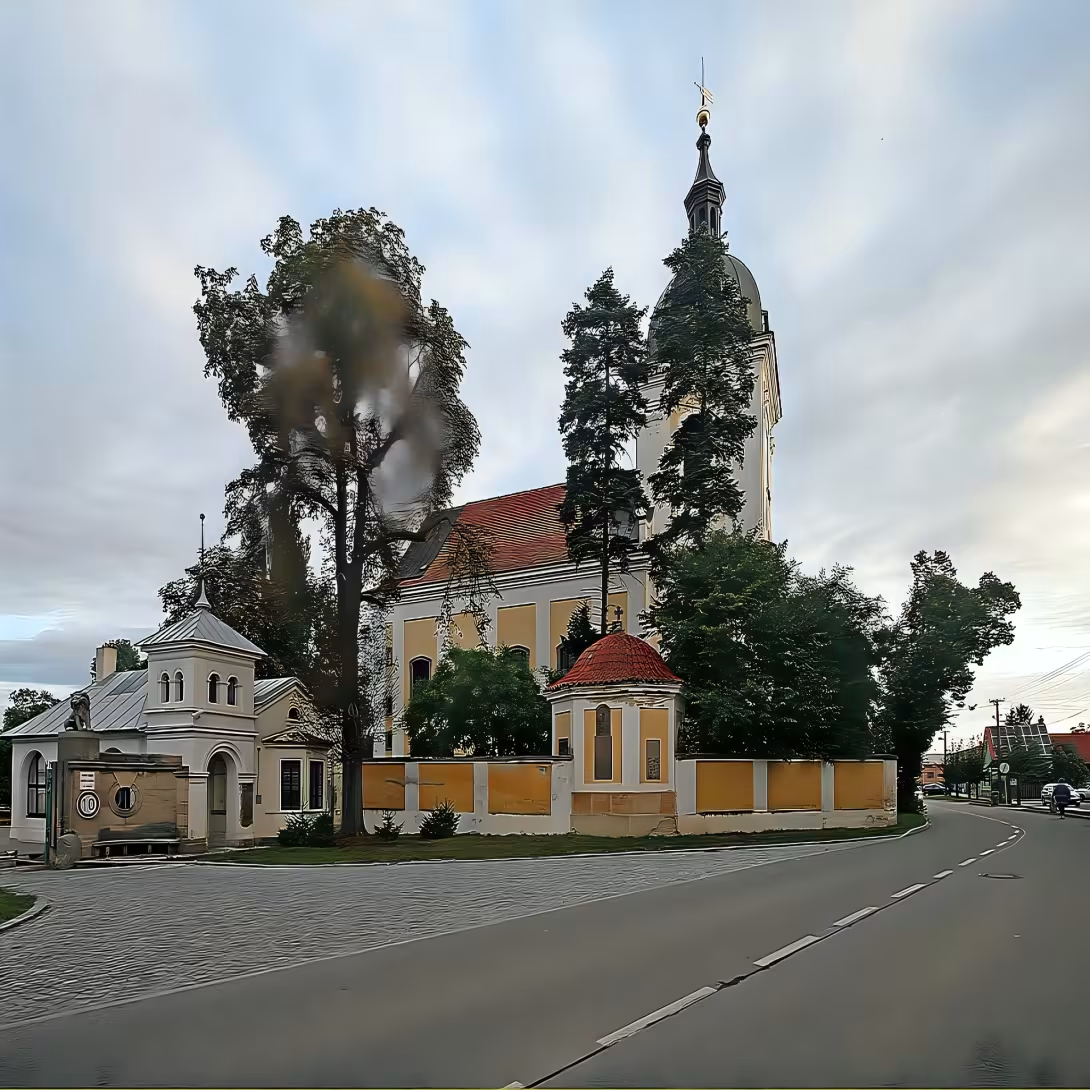
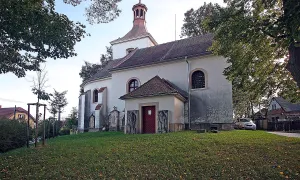
The Church of St. Kliment is located near Dobrenice Chateau in the village Dobřenice in the district of Hradec Králové, where it forms an important architectural dominant. The target area, including the stairs, the border wall and the Baroque morgue, is protected as a cultural monument of the Czech Republic under the register number ÚSKP 47234 / 6-596.
The present church grows in the place of its Gothic predecessor. The original building, which was partly wooden, dates back to the 13th century. During the demolition of the old temple in 1740 the builders discovered an authentic proof that the church stood here already in 1336. The new Baroque temple then completely replaced the older building.
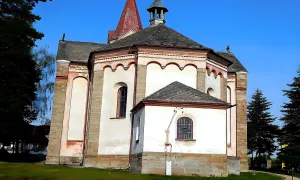
The architecture of the church corresponds to the baroque customs of its time. It is a one-boat rectangular construction with a characteristic prism tower 46 meters high located above a rectangular presbytery. On the sides of the presbytery are situated orator and sacristy. The western facade completes a shield with volutes, in which the locality is decorated with a statue of St. Kliment dating back to 1740. The interior of the church is decorated by rich stucco decoration covering the vaults of the ship.
The inventor of the temple reflects the extent of the investment in its equipment. The main Rococo altar of the Klimenta is from around 1740; The altar painting was painted by Jesuit painter Ignác Raab. The altar is lined with statues of St. Ivan and St. Vitus. Another altar dedicated to St. John of Nepomuk stands on the right under the triumphant arch, beside which there is a pulpit and confessional. The organ was manufactured in 1760 by the Kutnomountain organist Pavel František Horák. In the middle of the ship lies the tomb of the Dobřenský family. The temple includes a two-arm staircase with statues of St. Prokop and St. Ivan (around 1740) and a Baroque morgue near the border wall by the road.
The original cemetery around the church has been abolished. However, the tomb of the Löwenstein family from 1936 was preserved with an underground crypt. Renaissance tombstones are walled up in the church wall and 19th century tombstones in the wall of the former cemetery.
Then and now
Drag the slider to compare how the landmark may have looked when it was built with the view today.
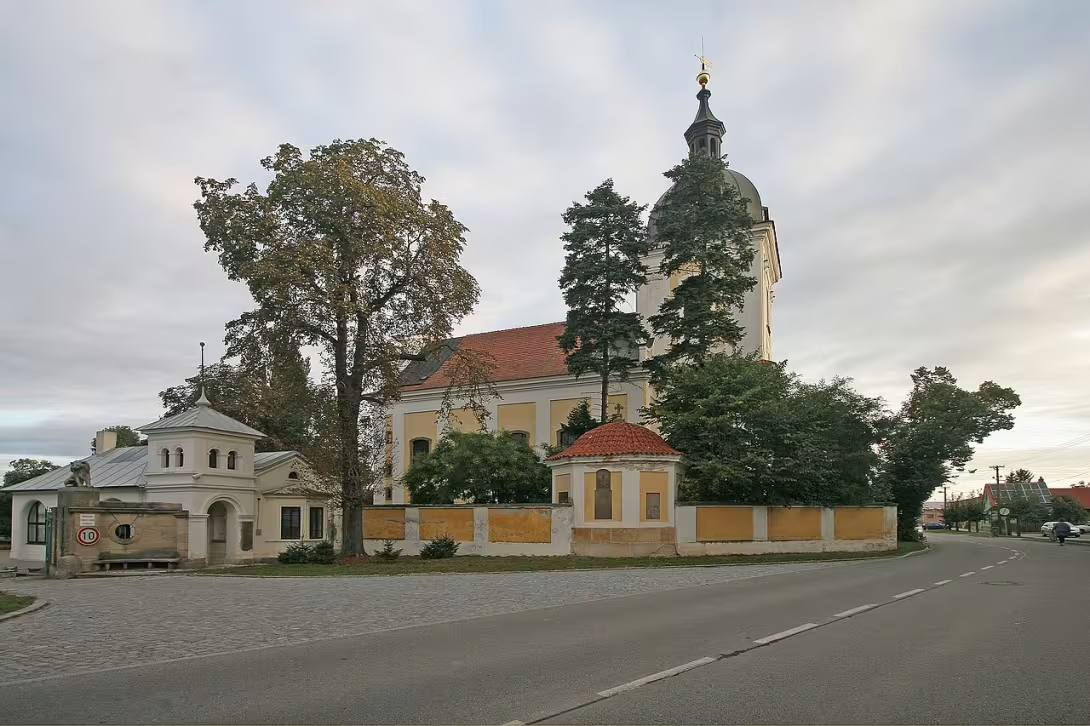
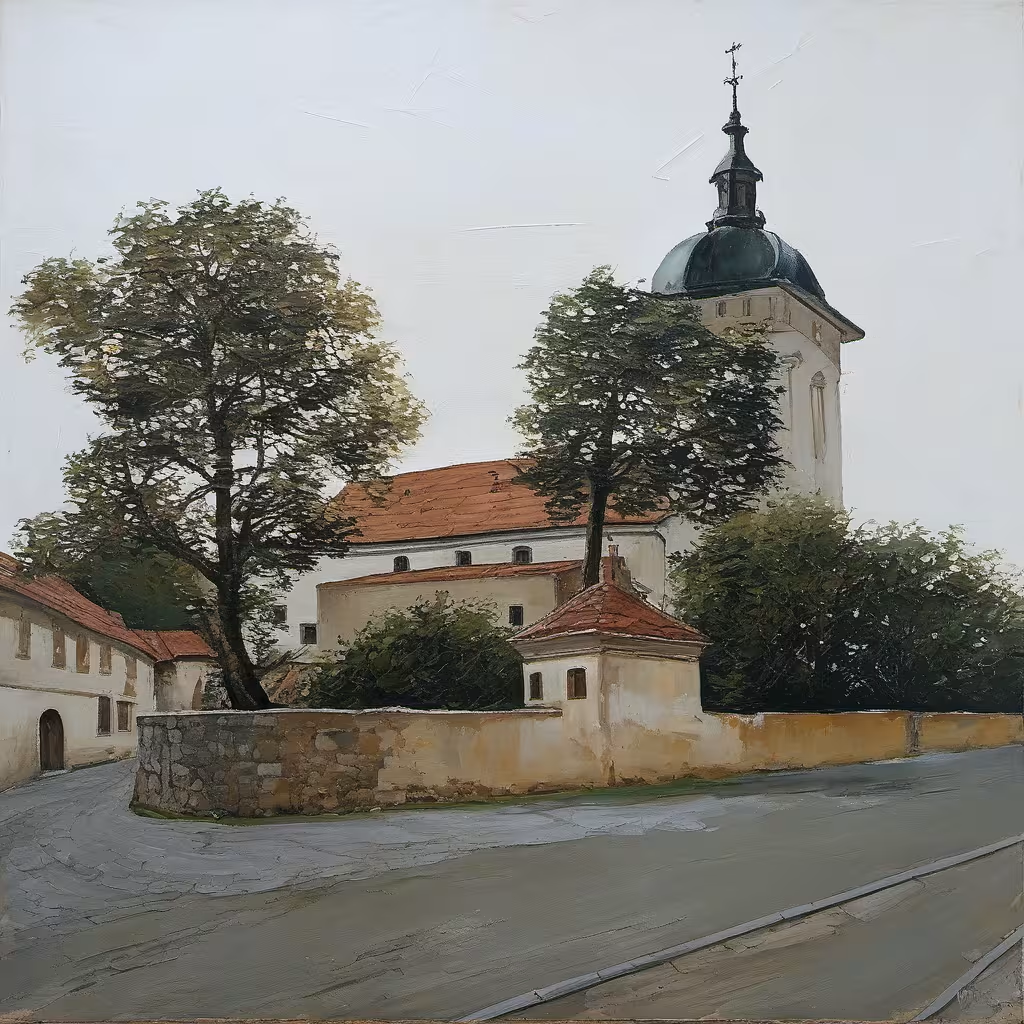
The historical appearance on the left is an AI-generated visualisation and serves as inspiration only.
Historical milestones
- 1336
- Proof of the existence of the church through authenticity.
- 1740
- The creation of the present Baroque church.
- 1760
- Production of organ by Pavel František Horák.
- 1936
- The creation of the Löwenstein tomb with underground crypt.
Architectural development
The original Gothic, partly wooden church from the 13th century was replaced by a baroque one-storey building with a prism tower. The building has presbytery, oratory and sacristy. There are also Renaissance tombstones hidden in the wall.
Historical events
1336: evidencing the existence of the church through authenticity, 1740: building the present Baroque church, 1760: making the Baroque organ by Pavel František Horák.
Points of interest
- The present church grows in the place of the Gothic predecessor, which was partly wooden and dates back to the 13th century. - During the demolition of the old temple in 1740, the builders discovered an authentic proof that the church had stood here in 1336. - The building has a prism tower 46 meters high and the interior is decorated by rich stucco decoration of the vault. - The main Rococo altar dates back to around 1740 and its painting was painted by Jesuit painter Ignác Raab. - In the middle of the ship lies the tomb of the Dobřín family and in the church wall are walled up Renaissance tombstones.
Guide
This guide is narrated by a synthetic voice generated by artificial intelligence.
Show guide text
This text was created by artificial intelligence and has not been editorially reviewed. It may contain inaccuracies.
The Church of Saint Clement in Dobřenice stands not far from the local castle and is a striking landmark for the village and the entire surrounding area. The Baroque church together with the staircase, boundary wall and charnel house is protected as a cultural monument.
On the site of today's building stood the original Gothic church, partially wooden, dating from around the thirteenth century. In the year 1740 it was replaced by the present Baroque church. When the old church was demolished, authentic materials were found that document its existence as early as 1336.
The church has a single nave of rectangular shape. Above the rectangular presbytery rises a prismatic tower forty-six meters high. On either side of the presbytery are an oratory and a sacristy. The western facade is crowned by a pediment with scrolls on either side. In the pediment is a niche with a statue of Saint Clement, which was created after 1740.
The vault of the nave is covered with rich stucco decoration. The Rococo high altar of Saint Clement dates from around 1740. The altar painting was painted by the Jesuit painter Ignác Raab and the altar is framed by statues of Saint Ivan and Saint Vitus. On either side of the triumphal arch stands on the right the altar of Saint John of Nepomuk and across from it the pulpit, under which is a confessional. The Baroque organ was built in 1760 by the Kutná Hora organ builder Pavel František Horák, who lived from 1727 to 1822. In the middle of the church is the tomb of the Dobřenský family.
From the castle side a two-armed staircase leads to the church with Baroque statues of Saint Prokop and Saint Ivan from around 1740. By the boundary wall at the road stands a Baroque charnel house.
Around the church there was formerly a cemetery. It was abolished and only the tomb of the Löwensteins from 1936 remains, with an underground crypt. In the church wall around it is built in a series of Renaissance tombstones. Younger tombstones from the nineteenth century are built into the cemetery wall.
Tips for visitors
The best time to visit St. Kliment's church is early spring or autumn, when there are fewer tourists and the light in the surroundings is soft, which allows for a peaceful tour and quality photography.
Take your comfortable shoes with you, because part of the journey leads on uneven terrain, as well as umbrella or raincoat in case of bad weather. We recommend having a water bottle, a map area and a mobile phone with a camera for quick capture of moments.
The most interesting places for photographers are the front Baroque facade with a tower, an interior with rich statues and altar paintings and western light falling on the church roof. It is ideal to photograph during the golden hour when the sun illuminates detailed stone ornaments.
The surrounding area is worth visiting Dobřenický chateau and its farm yard, where you can explore historical gardens and take advantage of the playground. For families with children it is advisable to plan a short walk around the chateau where information boards and interactive exhibitions are available suitable for younger visitors.
Frequently asked questions
Can the monument be visited?
Religious buildings are usually open mainly during services; at other times a visit is normally arranged with the parish or the operator. We have not verified specific times.
Where is the monument?
Location: Dobřenice, Královéhradecký kraj. The map on this page shows the exact spot.
Why is the monument protected?
It is listed in the Central List of Cultural Monuments of the Czech Republic as a cultural monument (register no. 47234/6-596).
For kids
Imagine being a little detective and discovering a mysterious church in the picturesque village of Dobřenice. It's a place full of stories from the past and magic. Whose roofs stretch under the blue sky like long, wide shelters that protect everything below.
Businesses nearby
Do you run a restaurant, accommodation, shop, museum, rental, wellness or other visitor service near this monument? Show yourself directly to the people heading to it — this is how they will see you in the app and on the web:
Events nearby


Zdroj akcí: otevřená data měst a obcí ČR (Národní katalog otevřených dat) a kalendář akcí Národního památkového ústavu.
Nearby
A godly chateau and its farm yard.
Accommodation nearby
Themed route
1. Dobřenice lock (Type: Chateau) - Historical building, which forms an important building element in the village. 2. Economic Court (Type: Economic area) - A tour of architecture connected with the former operation of the local estate. 3. St. Kliment Church (Type: Church) - The main destination of the trip, which represents the spiritual and cultural centre of the site.
Seasonal recommendations
In the spring, the church surrounds the awakening nature and fresh greenery, creating an optimistic atmosphere. The soft spring light highlights the details of Baroque architecture and surrounding landscape. We recommend to dress in layered clothes because the weather is usually unstable at this time, and visit the place in the morning when the air is the cleanest.
The summer season brings radiant sun and rich green trees that provide a pleasant shade around the temple. The atmosphere is full of energy and bright colors. In the main summer season it is advisable to come first thing in the morning to avoid the largest groups of visitors and the noon heat. Don't forget light, breathable clothes and sun protection.
The autumn landscape around Dobřenice is coloured in golden and red tones, which gives the memory a melancholy and peaceful touch. The morning fog in the valleys creates a mysterious scene that is very photogenic. Ideal is a visit in the afternoon, when the low sun falls beautifully on the facade. Due to cooling, a warm sweater or jacket is necessary.
In winter, the church of St. Kliment is very quiet, especially if the landscape is covered with snow. The contrast of white precipitation and architecture creates minimalist and clean aesthetics. The atmosphere is cosy in advent time, but it is necessary to count on shortened opening times. It is necessary to wear very warm and waterproof clothes and shoes.
Visualizations and artistic views


The visualisations are generated by artificial intelligence and serve as inspiration.
Photos from the area
Real photos taken near the monument


Zdroj a licence jsou uvedeny u každého snímku.
Atmosphere of the place
This atmospheric visualisation of the place and period was generated by artificial intelligence. It is not real footage of the location.
Tips from visitors
No tips yet. Be the first!
Log in and add your tip.
Sources and literature
Photos: Petr1888 / CC BY-SA 3.0, rozlišení zvýšeno umělou inteligencí — Wikimedia Commons. The author and licence also appear when you hover over the image.
Faktickým podkladem tohoto textu byl článek na Wikipedii, jehož autory jsou přispěvatelé Wikipedie. Článek je dostupný pod licencí CC BY-SA 4.0.
Location on the map
Příběhy a pověsti
Legendy, pověsti a příběhy spjaté s touto památkou
Fotografie návštěvníků
Zatím žádné fotografie. Buďte první, kdo přidá fotografii z návštěvy!
Log in a přidejte svou fotografii nebo hodnoťte.
Za ověřenou návštěvu v aplikaci získáte víc bodů — poznáme podle GPS, že jste na místě.
Reviews and comments