



Kostel svatého Martina (Mlékojedy) Church
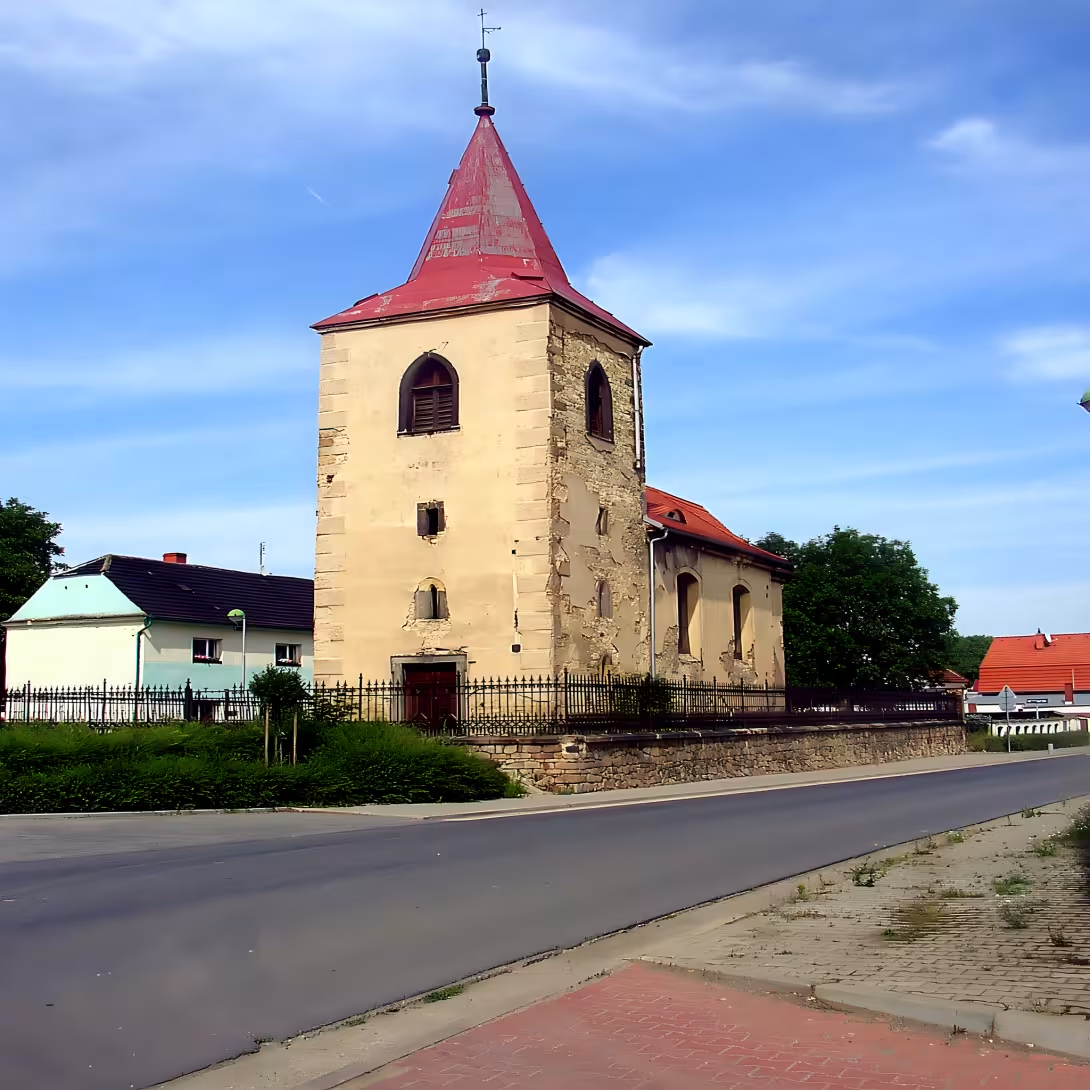
The church of St. Martin grew in the heart of the village Mlékojedy on a rectangle, on the elevated terrace of the former cemetery. It surrounds a cast iron fence with gotifying shapes from 1885. It's been protected as a cultural monument since 1964.
The building has Gothic roots from the 14th century. For the first time, it is remembered as a parish church in 1384. Like many Czech sacral structures, it was damaged during the Hussite wars, yet it remained Catholic in 1465. In 1592 he was hit by a fire, after which the tower was restored and received the last floor with grafted plaster. The most serious change was the year 1776 when the radical reconstruction took place in the late Baroque form - the construction was demolished up to the tower, but the new object held the same dimensions. The following centuries brought floods (1845, 1890, 2002). After 1945 the building gradually faded, but since the second decade of the twenty-first century it has been gradually reconstructed.
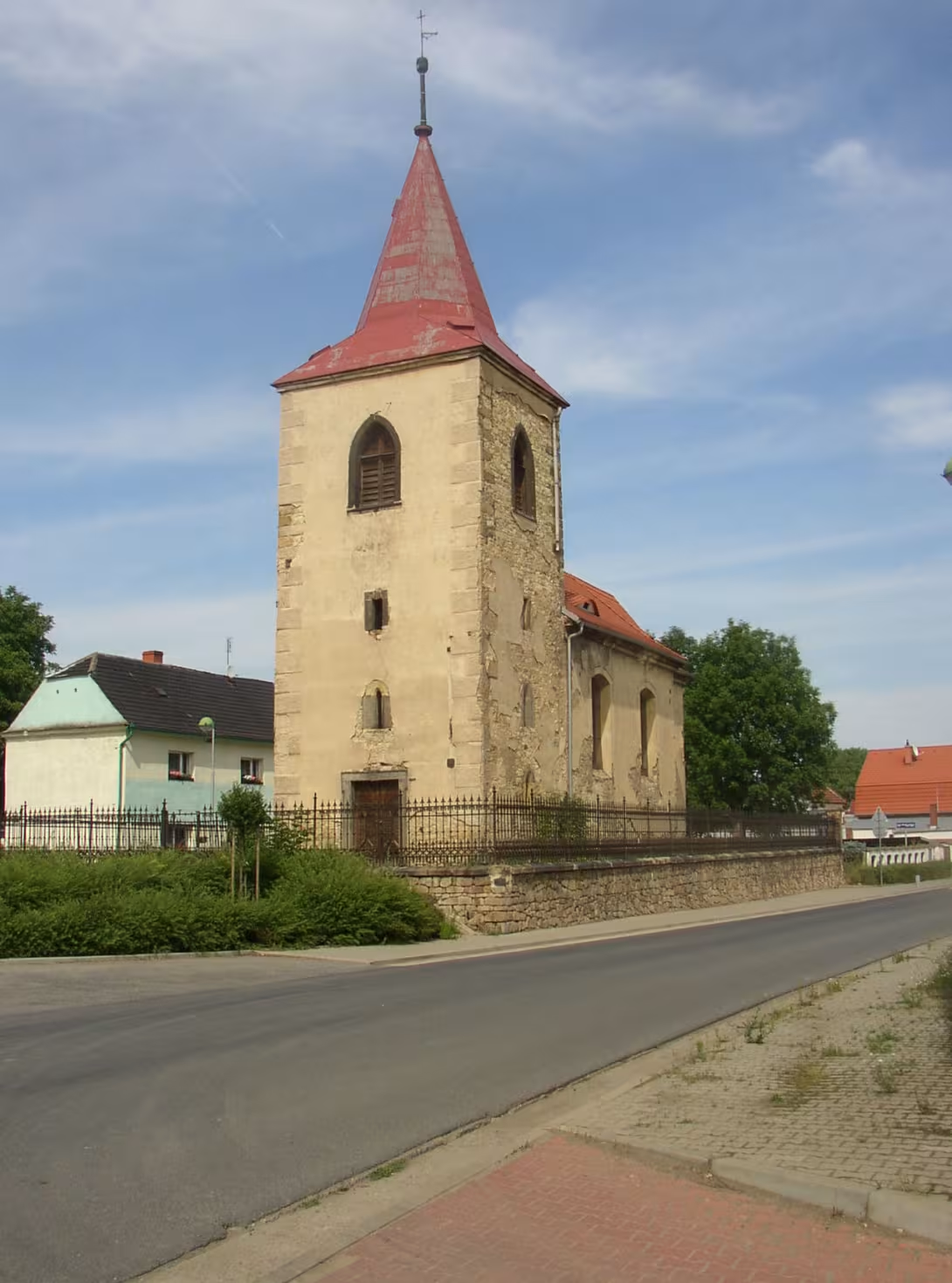
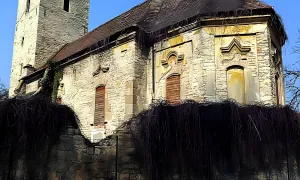
It is an architectural construction with a semi-circular presbytery from 1776 and a small sacristy on the north side. The dominant element - the massive prism tower in the western facade - comes from the Gothic era. After the fire in 1592 it was restored and retains Renaissance sgraffiti quads. The lower floors of the tower are opened by a rectangular portal and slot windows, the upper bell floor has four large sound windows. The roof of the tower is closed with a boulder with the year 1595. There are pilaster bundles with rocai heads and flat vaults in the ship; The large late Baroque windows are mainly located on the south side.
The interior equipment bears clear signs of Rococo. The main altar from 1776, made of artificial marble by M. Hennevogel, has a richly cut and gilded Baroque frame from the beginning of the eighteenth century. The side altar of the Burying of Christ is late Renaissance, wooden, with four statues and the original plate picture of the same motif from around 1600. The equipment includes a pulpit, a painting of St. John the Baptist, a statue of Jesus and an organ - all works of Rococo shapes from the end of the eighteenth century. The reconstruction work has moved this facility to the depositary.
There are several other sacral elements around the church. The Baroque statue of St. Florian from 1707 is preserved on the pillar of No. 77. At the west end of the village there is an iron baroque cross from the time around 1680 with a richly heated lattice; In 1839 it was transferred from the repealed church of St. Michael in Litomerice. On the east side of the village there is a simple cross on the base.
Then and now
Drag the slider to compare how the landmark may have looked when it was built with the view today.

The historical appearance on the left is an AI-generated visualisation and serves as inspiration only.
Historical milestones
- 1592
- After the fire, the tower was rebuilt and received its present form.
- 1776
- The church was rebuilt into a late Baroque form.
Architectural development
Originally a Gothic building from the 14th century underwent several phases of reconstruction, including damage during Hussite wars and fires in 1592. In 1776, the church was demolished with the exception of the tower and replaced by a new object in the late Baroque style, which brought about a change in its architectural form.
Historical events
- 1384
- The church is first mentioned as a parish church.
- 1592
- After the fire, the tower was rebuilt and received its present form.
- 1776
- The church was rebuilt into a late Baroque form when it was demolished except the tower.
Points of interest
- St. Martin's Church has Gothic roots from the 14th century and is first mentioned as a parish church in 1384. - He was damaged during the Hussite wars, but in 1465 he remained a Catholic church. - The year 1776 brought a radical reconstruction to the late Baroque form - the building was demolished up to the tower, but the new object held the same dimensions. - The massive prism tower with renaissance sgraffiti suit dates back to the Gothic era and was restored after the fire in 1592. - The interior equipment bears clear signs of Rococo, including the main altar of 1776 by M. Hennevogel and the late Renaissance side altar of Burying Christ with the original plate picture from around 1600.
Guide
This guide is narrated by a synthetic voice generated by artificial intelligence.
Show guide text
This text was created by artificial intelligence and has not been editorially reviewed. It may contain inaccuracies.
The Church of Saint Martin in Mlékojedech stands on an elevated terrace of a small former cemetery, in the middle of a rectangular square. The cemetery is enclosed by a cast iron fence with Gothic-inspired shapes from the year 1885. Some of the gravestones have been preserved and lie to the north of the church. Since 1964, the church has been protected as a cultural monument.
The core of the building is Gothic from the 14th century. In the year 1384, the church is mentioned as a parish church. During the Hussite Wars, it was damaged, yet in 1465 it remained Catholic, even though the surrounding area had turned to Utraquism. In 1592, a fire struck the church. The tower then received its present final story, which had previously perhaps been timber-framed or boarded, and also sgraffito plaster. On its top is a weathervane with the date 1595, when the church was repaired after the fire.
A fundamental transformation came in the year 1776. Except for the tower, the church was practically completely demolished and replaced with a new late Baroque building of essentially the same dimensions. Later it was affected by floods in the years 1845, 1890, and 2002. After 1945, it began to deteriorate. In the second decade of the 21st century, its gradual restoration began, initially with the renewal of the roof covering.
It is a longitudinal single-nave building with a recessed, semicircularly closed presbytery and a small sacristy on the north side. On the west side rises a prismatic tower of Gothic origin, for the proportions of the church quite massive, with remains of Renaissance sgraffito ashlar work. In the lower stories, it has a rectangular portal with stone framing and slot windows. The bell story is pierced by four large sound windows. The tower is covered by a pointed pyramidal roof. The nave is vaulted with flat barrel vaults and is divided by pilaster bundles with rocaille capitals. Large late Baroque windows are only on the south side.
The Rococo main altar made of artificial marble dates from the year 1776 and was created by M. Hennevogel. The newer title painting is set in a gilded acanthus frame from the beginning of the 18th century. A wooden side altar of late Renaissance type is decorated with gilded columns and four statues. It bears an original panel painting of the Burial of Christ from around the year 1600. The pulpit, a painting of Saint John the Baptist, a statue of the Infant Jesus, and the organ date from the end of the 18th century. Due to restoration, the furnishings are stored in a depository.
In the village there is also a Baroque statue of Saint Florian from the year 1707. On the western edge stands an iron double cross from around the year 1680 with richly wrought lattice work. It was moved to Mlékojedech in 1839 from a decommissioned Church of Saint Michael at the Dominican monastery in Litoměřice.
Tips for visitors
For the visit of St. Martin's Church in Milky Jed, it is best to choose the morning hours in sunny weather, when the sun illuminates the raised terrace on which this historic sacral building stands. Thanks to this they stand out Gothic roots dating back to the 14th century and the late Baroque form from 1776.
You can use car transport or local public transport on your way to Milkojej in the Ústí Region; The best way to verify a specific transport connection is in the online connection search engine.
Take with you fixed shoes for the journey, because the surrounding terrain on the elevated terrace and in the village can be uneven, as well as drinking water, as there are no commercial services available directly on the church premises. Don't forget the camera to document this valuable memory from the outside.
The view from the base of the raised terrace is best used for photography, where you can capture the total silhouette of the church, and the best light for the pictures is in the morning or during the late afternoon. In the immediate vicinity of the church in Milky Jedna, the Baroque statue of St. Florian from 1707, located on the pillar next to the house number descriptive seventy-seven and an iron double baroque cross with a richly wrought lattice, which was transferred here in 1839.
A trip to Milkojej is also suitable for families with children who appreciate a quiet rural environment and a short walk associated with discovering local historical attractions. However, due to the ongoing reconstruction, caution should be exercised and only at a safe distance from the construction works.
Frequently asked questions
Can the monument be visited?
Religious buildings are usually open mainly during services; at other times a visit is normally arranged with the parish or the operator. We have not verified specific times. According to the heritage register restoration is under way, so access may be restricted.
Where is the monument?
Location: Mlékojedy, Ústecký kraj. The map on this page shows the exact spot.
Why is the monument protected?
It is listed in the Central List of Cultural Monuments of the Czech Republic as a cultural monument (register no. 34187/5-2179).
For kids
Imagine going back to the past to the small village Mlékojedy and seeing the ancient church of St. Martin standing on the elevated terrace. It's like entering a book full of adventure where every loophole has its own mysterious story.
When the church was built in the 14th century, the village Mlékojedy spread around it like a small heart. People here smoked wood over fires and went to church to pray. It was a meeting place where everyone knew all the stories about the secrets that the ancient temple could hide.
Businesses nearby
Do you run a restaurant, accommodation, shop, museum, rental, wellness or other visitor service near this monument? Show yourself directly to the people heading to it — this is how they will see you in the app and on the web:
Events nearby


Zdroj akcí: otevřená data měst a obcí ČR (Národní katalog otevřených dat) a kalendář akcí Národního památkového ústavu.
Nearby
The Baroque statue of St. Florian from 1707 is located on the pillar at No. 77.
The iron double baroque cross with a richly wrought lattice, originally from the abolished church of St. Michael in Litoměřice, was transferred to the Milkøe in 1839.
Accommodation nearby
Trips and activities nearby
Guided tours, tickets and activities nearby from GetYourGuide
Affiliate link: if you buy from the partner, we may receive a commission. The price for you does not change.
Search tours and activities →Themed route
1.Kostel svatého Martina (Mlékojedy) Type: Sacral construction This church is the main dominance of the village and represents the central historical point of the entire route. Visitors can perceive the peaceful atmosphere of an ancient place, which serves as a natural center for exploring local sights.
2. Iron Double Baroque Cross Type: Art-craft monument This rare object with a richly wrought lattice was transferred to the village in 1839 from the abolished Litomeric Church of St. Michael. This is an exceptional example of baroque blacksmith art, which complements the collection of sacral monuments in the village.
3. Baroque Statue of St. Florian Type: Sculpture The 1707 monument stands on a stone pillar at a house with a descriptive number of seventy-seven. The statue depicts a traditional fireman's patron and is a valuable proof of baroque folk godliness, which completes the historical character of the village.
Seasonal recommendations
Spring: In the youth of the year, the Church of St. Martin in the Milky Jedges is transformed into a living image when flowering gardens and trees come to life. The sun's rays illuminate the reconstructed shards of architecture, giving the impression of a new beginning. In this period, the atmosphere is full of hope and quiet murmur of leaves. It is recommended to visit in the early afternoon when the temperature is pleasant and the crowds are less. Wear comfortable shoes for walking on a flowering lawn and don't forget your sunglasses.
Summer: The Church of St. Martin becomes a popular destination for tourists when the warm sun illuminates its architectural elements in a special way. The atmosphere is full of life and energy, with loud birds and flowering fields around the monument. In the main summer season it is recommended to come early in the morning or evening to avoid strong crowds. Don't forget the sun cream and water-filled bucket because the temperature can be very high.
Autumn: In autumn the Church of St. Martin becomes melancholic charm when the golden leaves and trees are empty. Sun rays penetrate the pale sky, highlighting the details of the reconstruction. The atmosphere is calm and resembles a time for reflection. Visit the memory in late afternoon, when the temperature is most suitable for walking. Put on the heat on your feet and don't forget the umbrella, because autumn can bring sudden precipitation.
Winter: The Winter Church of St. Martin is surrounded by snow, creating a magical atmosphere. Sun rays are reflected on ice and the church roof is staring through a striped pattern. The atmosphere is calm and quiet, with freezing air, which gives the impression of a remote place. Wear warm and dry clothes, remember gloves and shoes with good groove for snow ground.
Visualizations and artistic views


The visualisations are generated by artificial intelligence and serve as inspiration.
Photos from the area
Real photos taken near the monument


Zdroj a licence jsou uvedeny u každého snímku.
Atmosphere of the place
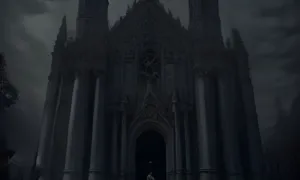
This atmospheric visualisation of the place and period was generated by artificial intelligence. It is not real footage of the location.
Tips from visitors
No tips yet. Be the first!
Log in and add your tip.
Sources and literature
Photos: Michielverbeek / CC BY-SA 4.0, rozlišení zvýšeno umělou inteligencí — Wikimedia Commons. The author and licence also appear when you hover over the image.
Faktickým podkladem tohoto textu byl článek na Wikipedii, jehož autory jsou přispěvatelé Wikipedie. Článek je dostupný pod licencí CC BY-SA 4.0.
Location on the map
Příběhy a pověsti
Legendy, pověsti a příběhy spjaté s touto památkou
Fotografie návštěvníků
Zatím žádné fotografie. Buďte první, kdo přidá fotografii z návštěvy!
Log in a přidejte svou fotografii nebo hodnoťte.
Za ověřenou návštěvu v aplikaci získáte víc bodů — poznáme podle GPS, že jste na místě.
Reviews and comments