



Kostel svatého Mikuláše (Lomnice nad Popelkou) Church
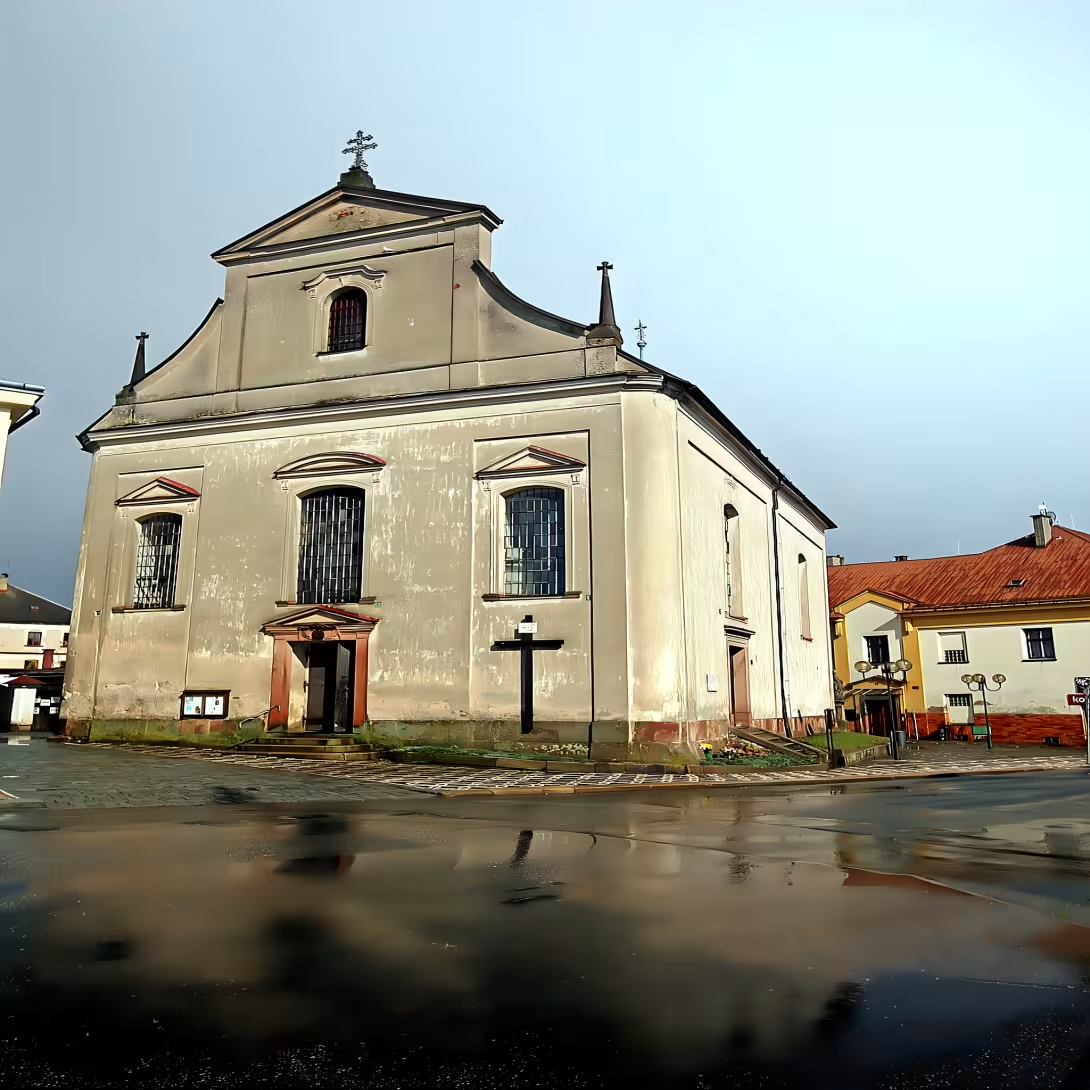
The Church of Saint Nicholas in Lomnice nad Popelkou is a prominent late Baroque single-nave church situated at the lower part of the town square. This cultural monument stands out for its historical significance and architectural beauty, dominating the town's historic core. Originally built on the site of an older church that had been rebuilt multiple times before being destroyed by fire in 1590, it was reconstructed after a devastating fire in 1781. Designed by Anton Teimer, the current structure reflects significant Baroque influences and has undergone several restoration efforts to preserve its historical integrity.
The origins of the Church of Saint Nicholas trace back to an earlier church mentioned as early as 1354, with subsequent reconstructions occurring over the centuries. By 1505, a new version had been built, only to be destroyed by fire in 1590. A stone church with a wooden bell tower was constructed by 1592 but burned down again in 1781. The current church was then erected following plans by Anton Teimer after the previous structure was demolished. This period marked significant cultural development in Bohemia under Habsburg rule, influenced by the ornate Baroque architectural style of the Enlightenment.
Architecturally, the Church of Saint Nicholas is a single-nave building with an oblong base and a gabled roof featuring an oblong presbytery with a segmental closure. The structure includes a bell tower topped by a slender spire, housing a bell originally cast in 1591 but recast in 1756. Notable artistic elements within the church include woodcarvings by Jan Hájek from Kosmonosy, such as altars, a pulpit, and a baptismal font. The main entrance is adorned with the coat of arms of the Rohan family, who were donors for the church's construction.
Throughout its history, the church has seen various owners and administrators. Václav Hegler, the parish priest in 1767, initially proposed building the church under the current parish house but eventually agreed to construct it on the town square as desired by the public and council. Kamil Rohan, a later patron, contributed financially to its restoration after a significant fire in 1849 that damaged much of the structure. The church was reconsecrated following major restorations completed in 2002.
Key events in the church's history include its reconstruction after fires in both 1590 and 1781, with the latter leading to its current form under Anton Teimer's design. Another pivotal moment occurred in 1849 when a large fire caused extensive damage, necessitating restoration efforts that focused on structural repairs rather than full aesthetic restoration.
Today, the Church of Saint Nicholas remains an accessible cultural monument open for regular services and visits. Its rich history, combined with its architectural beauty and artistic elements, make it a worthwhile destination for those interested in exploring Bohemian heritage. Visitors are invited to appreciate this historical gem and reflect on its enduring significance within Lomnice nad Popelkou's historic landscape.
Then and now
Drag the slider to compare how the landmark may have looked when it was built with the view today.
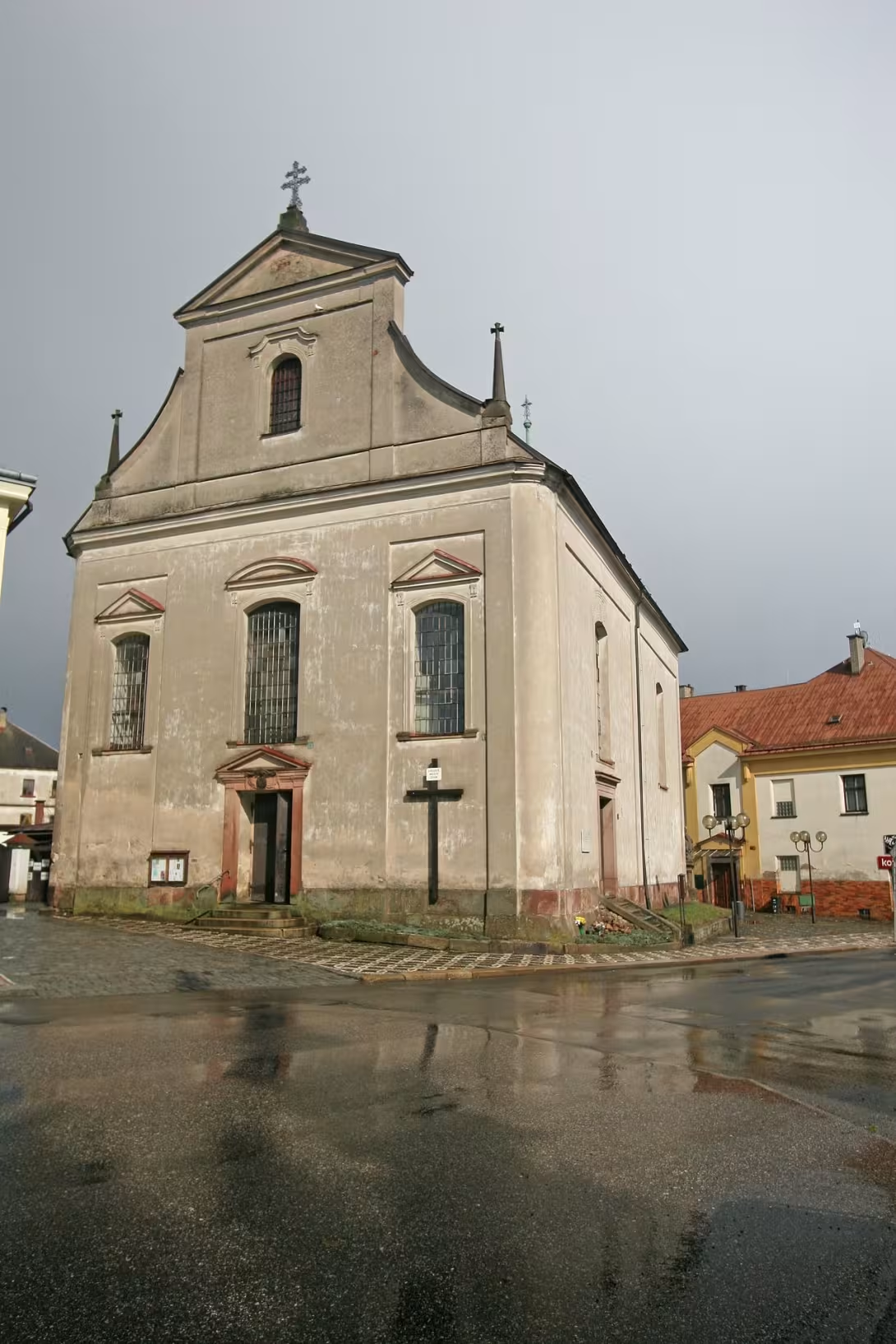

The historical appearance on the left is an AI-generated visualisation and serves as inspiration only.
Historical milestones
- 1781
- The foundation stone of the new church was laid.
- 1782
- Construction began on altars, windows, and the pulpit.
- 1783
- Completion of altar carvings and marble work on the pulpit.
- 2002
- The church underwent significant restoration and was reconsecrated.
Architectural development
The Church of Saint Nicholas underwent several phases of construction and restoration. Initially, it replaced an older church that had been rebuilt multiple times before being destroyed by fire. The current structure, designed by Anton Teimer, was completed in the late 18th century with significant Baroque influences. Restoration efforts followed a major fire in 1849, focusing on structural repairs rather than full aesthetic restoration.
Historical events
The original church was rebuilt in 1505, but burned down during a city fire in 1590.
A new stone church with a wooden bell tower was constructed by 1592.
In 1781, the current church was built following plans by Anton Teimer after the previous structure was demolished.
The church suffered significant damage from a large fire in 1849 but was restored three years later.
Points of interest
- The Church of Saint Nicholas has a history of resilience against fire, having been rebuilt after being destroyed in 1590 and again in 1781. Its repeated reconstructions highlight the community's dedication to preserving their place of worship.
- An intriguing aspect of the church is its bell, originally cast in 1591 but recast in 1756. This continuity of tradition reflects both historical craftsmanship and the importance of the bell in local religious life.
- The artistic contributions by Jan Hájek from Kosmonosy are less widely known yet significant; his woodcarvings include altars, a pulpit, and a baptismal font, adding to the church's Baroque aesthetic and cultural value.
- Kamil Rohan's role as a patron who financially supported restoration after the 1849 fire is an interesting historical detail. His involvement underscores the influence of local nobility in maintaining religious and cultural sites during that era.
- The decision-making process surrounding the church’s location involved Václav Hegler, the parish priest in 1767, who initially proposed a different site but eventually agreed to build on the town square due to public and council preference. This reflects early community engagement in architectural decisions.
Guide
This guide is narrated by a synthetic voice generated by artificial intelligence.
Show guide text
This text was created by artificial intelligence and has not been editorially reviewed. It may contain inaccuracies.
The Church of Saint Nicholas, often referred to as the Church of Saint Nicholas of Bari, is a Roman Catholic parish church in Lomnice nad Popelkou. This well-preserved late Baroque structure stands in the lower part of the town square and prominently dominates the historic center of the town. It is protected as a cultural monument.
The parish church at this location is first mentioned in the year thirteen fifty-four. In fifteen oh five it was rebuilt, and in fifteen ninety it burned down during a city fire. Two years later a stone church with a wooden bell tower was erected here. In seventeen sixty-seven, Reverend Václav Hegler wanted to build a new church below the rectory, but the public and town councillors wished for it to remain on the square. The reverend gave in, and so the new structure was built on the site of the old one.
The old church was demolished in seventeen eighty-one. From it only a crypt and two marble tombstones were preserved, belonging to the owners of Lomnice, Václav Štěpanický z Valdštejna and his wife Eliška z Martinic. The cornerstone of the new church was laid on June thirteenth, seventeen eighty-one, and it was built according to a design by Anton Teimer. The very next year, on the feast of Saint Václav, the church was consecrated by the bishop of Hradec Králové, Jan Leopold Hay. By the year seventeen eighty-five the decoration was completed and organs were brought into the church.
A heavy blow came in the year eighteen forty-nine. A great fire struck the church and part of the town. Only the outer walls remained, part of the vault collapsed, and the interior furnishings were destroyed. The repairs were financed by the estate owner Kamil Rohan and the work lasted until eighteen fifty-two. The collapsed main facade never regained its original appearance. The interior paintings were restored only in the year eighteen ninety-seven. The last major restoration took place in two thousand and two, after which the church was reconsecrated.
It is a single-nave structure on a rectangular floor plan. To the east it is closed by a narrowed chancel with a two-story sacristy. Above the chancel rises a slender sanctus bell tower with a bell from fifteen ninety-one, which was recast in seventeen fifty-six. Above the main entrance is an iron coat of arms of the Rohans, donors of the church and the last owners of the Lomnice estate.
Inside, the woodcarving works of Jan Hájek z Kosmonos stand out, particularly the altars, pulpit, and baptismal font. Hájek also decorated the facade. The decoration was also influenced by Prague painter Fidelius Weibel. The Baroque organ was destroyed by fire and in eighteen eighty-two it was replaced by an instrument by Joseph Kobrle, a Lomnice organ builder.
Around the church there was a cemetery until the year sixteen fifty-two. After Swedish plundering and plague it was no longer sufficient, so a new one was established outside the town. By the church today stands a cross from a folk mission from the year two thousand and four, and there is also a memorial plaque to composer František Doubravský, who worked here as a choir director and organist.
Tips for visitors
The best time to visit the Church of Saint Nicholas is during late spring or early autumn when the weather is pleasant, allowing you to comfortably explore both the church and its surroundings. This period also offers softer natural light for photography, enhancing the beauty of the Baroque architecture. Additionally, visiting outside peak tourist seasons can provide a more serene experience.
It's advisable to check current schedules online or at local information centers.
When visiting, consider bringing comfortable walking shoes as you may want to explore beyond the church grounds. A camera is recommended for capturing the architectural details and surrounding art pieces like the cross from a 2004 folk mission and the baroque statue of Saint John Nepomucene. Additionally, carrying a small umbrella or raincoat can be useful in case of unexpected weather changes.
Photography enthusiasts will find several spots around the church ideal for capturing its beauty. The best light is usually during the golden hours—shortly after sunrise or before sunset—when the sunlight softly illuminates the façade and highlights the intricate details. The lower part of the town square provides a scenic backdrop, enhancing your photos.
Nearby attractions within 30 minutes include the surrounding natural landscapes perfect for short hikes or walks. These areas offer beautiful views and are ideal for families looking to spend time outdoors after visiting the church. Exploring these spots can be a delightful way to extend your visit.
Frequently asked questions
Can the monument be visited?
Religious buildings are usually open mainly during services; at other times a visit is normally arranged with the parish or the operator. We have not verified specific times.
Where is the monument?
Location: Husovo náměstí, Lomnice nad Popelkou, Liberecký kraj. The map on this page shows the exact spot.
Why is the monument protected?
It is listed in the Central List of Cultural Monuments of the Czech Republic as a cultural monument (register no. 36802/6-2661).
Businesses nearby
Do you run a restaurant, accommodation, shop, museum, rental, wellness or other visitor service near this monument? Show yourself directly to the people heading to it — this is how they will see you in the app and on the web:
Nearby
Surrounding the church is a cross from a 2004 folk mission and a baroque statue of Saint John Nepomucene relocated in 1739. A memorial plaque honors František Doubravský, a local composer who served as choirmaster and organist.
Accommodation nearby
Themed route
Tematická výletní trasa: Kostel svatého Mikuláše a jeho okolí
1. Kostel svatého Mikuláše (Lomnice nad Popelkou) - Typ: Náboženská památka - Proč stojí za návštěvu: Kostel svatého Mikuláše je centrem historie a kultury v Lomnici nad Popelkou. Jeho architektura přitahuje návštěvníky zájmem o barokní prvky a bohatou historii, která se odrazí ve výzdobě interiéru.
2. Kříž z lidové mise 2004 - Typ: Historický prvek - Proč stojí za návštěvu: Kříž, který obklopuje kostel, je symbolickým připomenutím lidové mise z roku 2004. Je to památník duchovního oživení a komunitních snah v této části regionu.
3. Barokní socha svatého Jana Nepomuckého - Typ: Umělecký prvek - Proč stojí za návštěvu: Socha svatého Jana Nepomuckého, která byla přemístěna v roce 1739, je představitelem barokní sochařské umění. Její historický a estetický význam nabízí návštěvníkům pohled do minulosti a uměleckých tradic té doby.
4. Pamětní deska Františku Doubravskému - Typ: Památní prvek - Proč stojí za návštěvu: Pamětní deska uctívá památku Františka Doubravského, místního skladatele a kapelníka. Je to připomínka významné osobnosti pro kulturní dědictví Lomnice nad Popelkou a jejího hudebního života.
Tato trasa nabízí návštěvníkům pohled na bohatou historii a kulturu obce Lomnice nad Popelkou, zaměřenou především kolem kostela svatého Mikuláše.
Seasonal recommendations
Spring: Visiting the Church of St. Nicholas during spring offers a unique experience as nature awakens around Lomnice nad Popelkou. The surrounding landscape is adorned with blooming flowers and fresh greenery, creating an idyllic backdrop for exploring this historic site. As daylight extends into the evening, visitors can enjoy the soft natural light that enhances the church's architectural details. It's advisable to dress in layers as temperatures can vary, and early arrival is recommended to avoid larger crowds during peak visiting hours.
Summer: Summer at the Church of St. Nicholas is characterized by vibrant greenery and warm weather, making it an ideal time for outdoor exploration. The lush surroundings are perfect for a leisurely stroll before or after your visit. However, this season also attracts more visitors, so arriving early in the day can help avoid long lines and ensure a more peaceful experience. Comfortable walking shoes and light clothing are recommended to stay cool during the warmer months.
Autumn: Autumn provides a spectacular display of colors as the leaves around Lomnice nad Popelkou transform into shades of red, orange, and gold. This picturesque setting creates a serene atmosphere for visiting the Church of St. Nicholas. The cooler temperatures make it comfortable to explore both indoors and outdoors. It's wise to bring a light jacket or sweater, as evenings can be chilly. Visiting during weekdays might offer a quieter experience compared to weekends.
Winter: Winter envelops the Church of St. Nicholas in a magical atmosphere with snow-covered landscapes that highlight its historic charm. The shorter days mean visiting earlier is beneficial to make the most of daylight hours, while the cooler temperatures necessitate warm clothing and possibly gloves or scarves.
Visualizations and artistic views


The visualisations are generated by artificial intelligence and serve as inspiration.
Photos from the area
Real photos taken near the monument


Zdroj a licence jsou uvedeny u každého snímku.
Atmosphere of the place
This atmospheric visualisation of the place and period was generated by artificial intelligence. It is not real footage of the location.
Tips from visitors
No tips yet. Be the first!
Log in and add your tip.
Sources and literature
Photos: Petr1888 / CC BY-SA 3.0, rozlišení zvýšeno umělou inteligencí — Wikimedia Commons. The author and licence also appear when you hover over the image.
Faktickým podkladem tohoto textu byl článek na Wikipedii, jehož autory jsou přispěvatelé Wikipedie. Článek je dostupný pod licencí CC BY-SA 4.0.
Location on the map



Příběhy a pověsti
Legendy, pověsti a příběhy spjaté s touto památkou
Fotografie návštěvníků
Zatím žádné fotografie. Buďte první, kdo přidá fotografii z návštěvy!
Log in a přidejte svou fotografii nebo hodnoťte.
Za ověřenou návštěvu v aplikaci získáte víc bodů — poznáme podle GPS, že jste na místě.
Reviews and comments