



Kostel svatého Stanislava (Pitín) Church
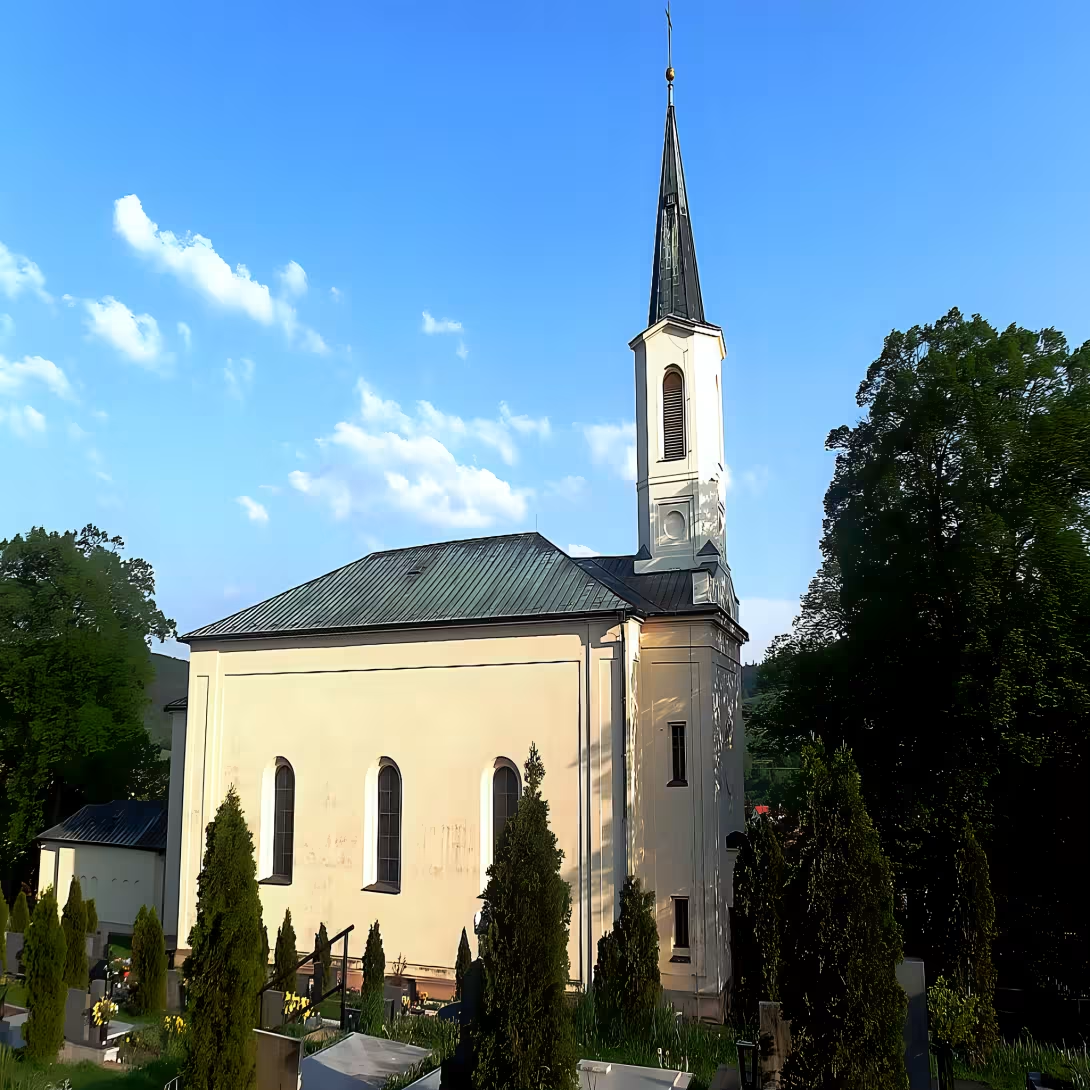
The Church of St. Stanislav in Pitín is one of interesting examples of the way in Czech churches are reflected in centuries of архitonic and artistic changes. The single-boat oriented building with polygonal closure of the priestry and the four-sided tower at the entrance grew gradually, forming its form of renewal and reconstruction in several key periods.
The original church was built in 1585 by the brothers Václav and Wilhelm Tetouro. During the 18th century, namely from 1758 to 1773, the construction was extended by presbytery and sacristy. But the most fundamental change came in the middle of the 19th century, when the church was created in 1851 to 1855 as a new building by rebuilding the original church. This reconstruction gave him a new face, which we will recognize today.
In the 20th century, the church faced serious problems. Due to considerable damage, he underwent extensive reconstruction between 1950 and 1951, during which the vault was removed and the entire interior was modernized. The architect Jaroslav Čermák (1901- 1990), who invited the painter Miloslav Troup to work with him (1917- 1993), developed plans for this reconstruction. Their cooperation has become crucial to the creation of the present form of the church. The repaired church was consecrated on November 25, 1951 by Archbishop Josef Karel Matoch, native from Pitína. Since 1968, the church has been carrying the status of a cultural monument.
The most valuable feature of the decoration was the cross road consisting of 14 stops located around the perimeter of the church. The painter Miloslav Troup created it with a characteristic technique: the black distinctive linear drawing is supplemented by bright surfaces of bright colours. The first ten stops with bright colors, while the last four images (Napping Christ on the Cross, Crucifixion, Pieta and Asking to the Grave) turn dark in colour, creating a symbolic prognosis of credibility.
In the presbytery you will find four coloured-glazed windows with irregular fields that illuminate the priesthood with various tones. Among them is a large wall image of Miloslav Troup (600 × 190 cm) whose central motive is a stylized bishop's crutches with thorns and blood drops, resembling Christ's crown of thorns. This painting refers to Archbishop Matocho.
The centre of the church is a marble menza with a copper shrine with a canopy for a wooden altar cross. The shrine is decorated with a gold decoration resembling the sun and on the canopy is an engraved symbol of the victim's smoke. Twelve copper candlesticks and semi-precious stones on triangulas of metal wings complement this artistic composition.
Visiting the church means meeting with an example of the 20th century Czech temple decoration, when modern artists dared to portray traditional sacral topics with no cliché. There is also a stone cross which complements the atmosphere of this place.
Then and now
Drag the slider to compare how the landmark may have looked when it was built with the view today.
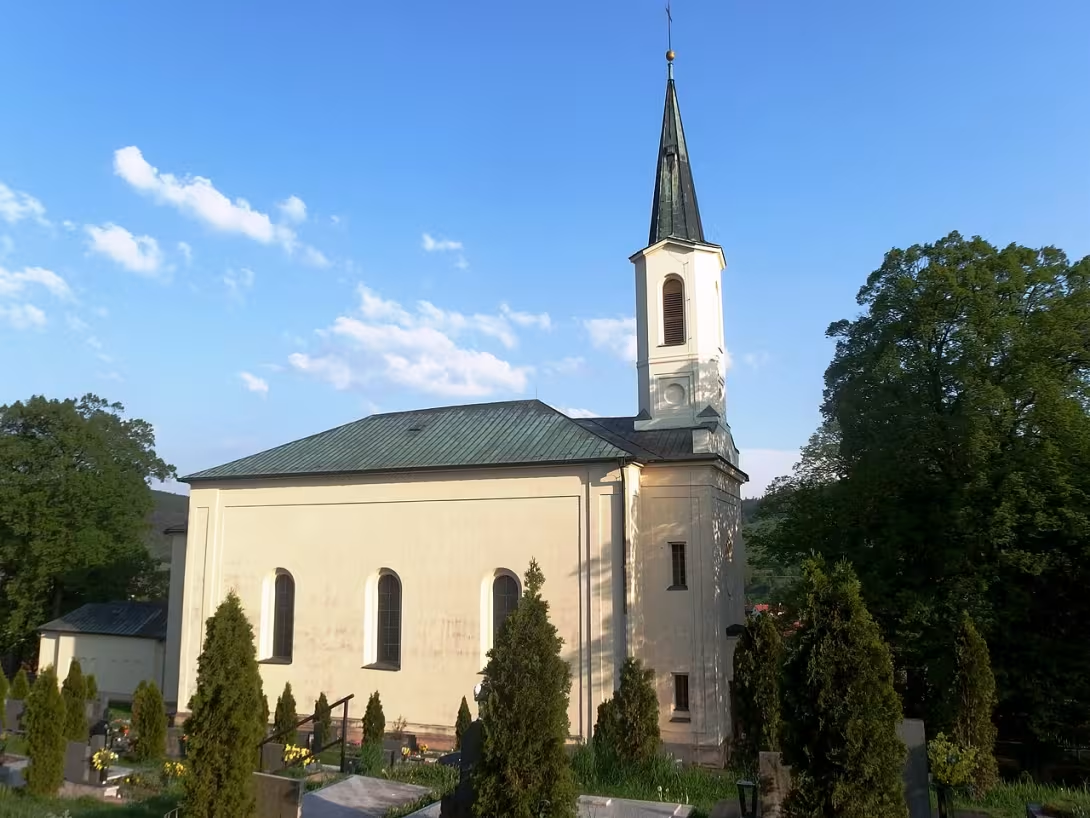

The historical appearance on the left is an AI-generated visualisation and serves as inspiration only.
Historical milestones
- 1585
- The status of the original church of the brothers Václav and Wilhelm Tetouro.
- 1758
- The beginning of the church expansion of presbytery and sacristy.
- 1851
- The beginning of the construction of the church in its current form as a new building.
- 1951
- The sanctification of the repaired church by Archbishop Joseph Karl Matochou.
- 1968
- Writing the church into a list of cultural monuments.
Architectural development
The original construction from the end of the 16th century was expanded in the 18th century and was replaced in the middle of the 19th century by a new construction in classical style. After extensive reconstruction in the 1950s, the vault was removed and the interior was modernized.
Historical events
1585: Status of the original church by the Tetours brothers. 1758-1773: Expansion of the church by presbytery and sacristy. 1851-1855: The creation of the church in its current form as a new building. 1950-1951: Extensive reconstruction and modernization of the interior.
Owners
Parish Pitín
Points of interest
- St. Stanislav Church in Pitín is an example of the way in which centuries of architectural and artistic changes are reflected in Czech churches. - The original church was built in 1585 by the brothers Václav and Wilhelm Tetour. - The most fundamental change came in the middle of the 19th century, when the church was created in 1851 to 1855 as a new building by rebuilding the original church. - In the 20th century the church faced serious problems and underwent extensive reconstruction between 1950 and 1951, during which the vault was removed and the whole interior was modernized. - The most valuable element of decoration is the cross road consisting of 14 stops located on the perimeter of the church, created by the painter Miloslav Troupe.
Guide
This guide is narrated by a synthetic voice generated by artificial intelligence.
Show guide text
This text was created by artificial intelligence and has not been editorially reviewed. It may contain inaccuracies.
The Church of Saint Stanislav in Pitín in the Uherskohradišťsko region is a single-nave oriented building with a polygonal choir and a four-sided tower at the entrance. It was built in the year 1585 by brothers Václav and Vilém Tetourové. Between 1758 and 1773 it was extended with a presbytery and a sacristy. The parish church acquired its present appearance between 1851 and 1855, when the original small church was replaced by a new building.
The church was later seriously damaged. Therefore, between 1950 and 1951, it underwent extensive reconstruction, during which the vault was removed and the entire interior was given a modern appearance. The plans were drawn up by architect Jaroslav Čermák and he invited painter Miloslav Troup to collaborate. During the nineteen-fifties, Troup created a Stations of the Cross and wall painting for the clean classicist space. He also designed four stained-glass windows, the decoration of the tabernacle, and twelve candlesticks. The restored church was consecrated on November 25, 1951 by Archbishop Josef Karel Matocha, a native of Pitín.
The Stations of the Cross has fourteen stops arranged around the perimeter of the nave. They are made up of painted glass. A striking black drawing is complemented by glowing areas of bright colours, and the glass panes are backed with gold foil, which shines through where colour is missing. The golden background refers to Gothic panel paintings. The colours also have symbolic meaning. The first ten stops glow with light colours. The last four are noticeably darker, depicting the Nailing of Christ to the Cross, the Crucifixion, the Pietà, and the Entombment.
The choir is lit by four windows made up of irregular multicoloured fields. Between them, on the front wall, there is a large mural painting measuring 600 by 190 centimetres. Its central motif is a stylized bishop's crosier with thorns and drops of blood, which recall Christ's crown of thorns. The crosier refers to Archbishop Matocha himself. The painting was originally complemented by painting of the surrounding plaster by the same artist, but this was lost during later alterations.
In the centre of the church is the main altar with a marble mensa. On it stands a copper tabernacle with a baldachin for a wooden altar cross. On the baldachin, according to Troup's design, the symbol of sacrificial smoke is engraved. The tabernacle doors are decorated with gold ornament similar to a radiant sun. The triangular metal wings on either side of the tabernacle are adorned with semi-precious stones, as are the twelve copper candlesticks on the mensa.
Since 1968 the church has been a cultural monument. Its grounds also include a stone cross.
Tips for visitors
The best time to visit the church of St. Stanislav in Pitín is autumn or spring when it is quieter and nature offers beautiful colors. This period also offers ideal lighting conditions for photography, especially at noon, when the sun illuminates the church from the side.
For those travelling by public transport, Pitín is well connected to the surrounding municipalities and cities, making it an easy place for tourists. Check the current connection before travelling.
When planning a visit, take a hat or a parasol with you, especially in the summer months to ensure sun protection. In addition, we recommend comfortable shoes for walking on a possibly uneven surface around the church.
For photography is the best place at the entrance tower where you can get a general view of the church and its architectural details. The morning light offers soft shadows that highlight the historical beauty of the building.
Around the church there is a stone cross which is an interesting detail for those who want to expand their knowledge of local monuments. For families with children Pitín is a suitable place for a short walk and exploring history.
Frequently asked questions
Can the monument be visited?
Religious buildings are usually open mainly during services; at other times a visit is normally arranged with the parish or the operator. We have not verified specific times.
Where is the monument?
Location: Pitín, Zlínský kraj. The map on this page shows the exact spot.
Why is the monument protected?
It is listed in the Central List of Cultural Monuments of the Czech Republic as a cultural monument (register no. 20868/7-3410).
For kids
About 331 years ago, a magnificent building was built in Pitín, which became one of the most beautiful jewels on the Moravian-Slovak border. The Church of St. Stanislav is like a magnificent heritage, full of secrets and stories from the past. When we get to it, we feel like we've gotten to a time when people wore long dresses and believed in the power of the saints.
Businesses nearby
Do you run a restaurant, accommodation, shop, museum, rental, wellness or other visitor service near this monument? Show yourself directly to the people heading to it — this is how they will see you in the app and on the web:
Nearby
A stone cross is part of the complex.
Accommodation nearby
Themed route
Thematic cruise route around St. Stanislav Church (Pitín)
1. Church of St. Stanislav * Type: Religious landmark * This church is one of the oldest sacral buildings in the area and represents the architectural treasure of goth. Its history dates back to the 13th century, making it an ideal place to know the history of the region.
2. Stone Cross * Type: Memorial * On the grounds of the church there is a significant stone cross, which resembles historical events and personalities associated with this place. It is not only a symbol of religious importance, but also a monument to the history of the village.
3. Church tank * Type: Historical courtyard * Walk through the courtyard allows users to view the architectural structure while enjoying the quiet moments. Here it is also possible to observe detailed elements of the construction, which are only visible from close range.
4. Church Tower * Type: Architectural height * The climb to the tower offers a unique view of the surrounding landscape and Pitín itself. It is an ideal place for photographs and for reflection on the history and the present position of the village.
5. Exposure in church * Type: Historical exposure * The inner space of the church hosts a small but interesting exhibition which focuses on the history and cultural heritage of the village. It is a great way to better understand the local traditions and influence of the church on the life of Pitín.
This route offers a comprehensive view of the history and culture of the village Pitín through its most distinctive monument building.
Seasonal recommendations
Spring awakens the surrounding nature of the Vizovic hills to a new life and opens the gates for the first discoverers of monuments. In this period there is a calm atmosphere where the sun's rays pleasantly illuminate the surrounding greenery and the waking trees create picturesque sets for the photography of sacral architecture. For the spring visit, it is worth choosing fixed shoes because the field roads in the surrounding area can be muddy after the rain, as well as layered clothes, as spring weather is usually variable. You will meet only a minimum of tourists here, which guarantees an undisturbed atmosphere, while the ideal time for the tour of the exteriors is in the morning, when the morning herpes is slowly receding.
Summer brings sunny days full of bright light, which contrasts sharply with the white walls of the building and thus creates ideal lighting conditions for detailed façade images. Nature around the village is in full bloom and offers great conditions for longer trips associated with visiting this dominant. Since the main holiday is taking place, it is a little more lively here, so it is best to come early in the morning or late in the afternoon when you avoid the biggest summer heat and possible groups of tours. Don't forget to pack enough fluids, headgear and light breathable clothing, because you won't find much shade near the building.
Autumn turns the landscape into a colourful palette of shades from yellow to brown, which gives the place a melancholy character and a deeper spiritual dimension. The low sun creates long shadows and a magical game of light and shadow on historical walls, which will be appreciated by all lovers of aesthetic shots. During this period, the crowds of visitors have fallen completely, so you can enjoy complete silence and contemplation. The practical board includes the need for warm and wind-resistant clothing, because autumn winds on the top may be cold, as well as monitoring the current forecast, as the days are shortening and fog may limit the view.
Winter covers Pitín and its surroundings into snow whiteness and during the period around Christmas offers an unrepeatable atmosphere of silence, tranquility and snow romance. The early dimming and the light of the snow sheets give the whole place a mysterious feel, which excels especially during the holiday evenings. For this visit, unconditionally wear high-quality winter shoes with anti-slip soles, a warm jacket, a hat and gloves, as the temperatures on the hill fall rapidly. Due to the shorter daylight, it is best to plan your arrival for morning or around noon so that you can enjoy natural daylight and avoid icy journeys after dark.
Visualizations and artistic views


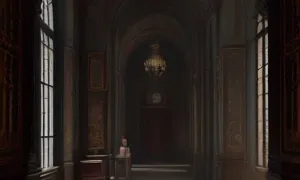
The visualisations are generated by artificial intelligence and serve as inspiration.
Photos from the area
Real photos taken near the monument


Zdroj a licence jsou uvedeny u každého snímku.
View from the area
This animation was generated by artificial intelligence from a real photograph of the surroundings. The motion and details are not real footage of the location.
Atmosphere of the place
This atmospheric visualisation of the place and period was generated by artificial intelligence. It is not real footage of the location.
Tips from visitors
No tips yet. Be the first!
Log in and add your tip.
Sources and literature
Photos: Palickap / CC BY-SA 4.0, rozlišení zvýšeno umělou inteligencí — Wikimedia Commons. The author and licence also appear when you hover over the image.
Faktickým podkladem tohoto textu byl článek na Wikipedii, jehož autory jsou přispěvatelé Wikipedie. Článek je dostupný pod licencí CC BY-SA 4.0.
Location on the map
Příběhy a pověsti
Legendy, pověsti a příběhy spjaté s touto památkou
Fotografie návštěvníků
Zatím žádné fotografie. Buďte první, kdo přidá fotografii z návštěvy!
Log in a přidejte svou fotografii nebo hodnoťte.
Za ověřenou návštěvu v aplikaci získáte víc bodů — poznáme podle GPS, že jste na místě.
Reviews and comments