



kostel svatého Václava (Bukovník) Church
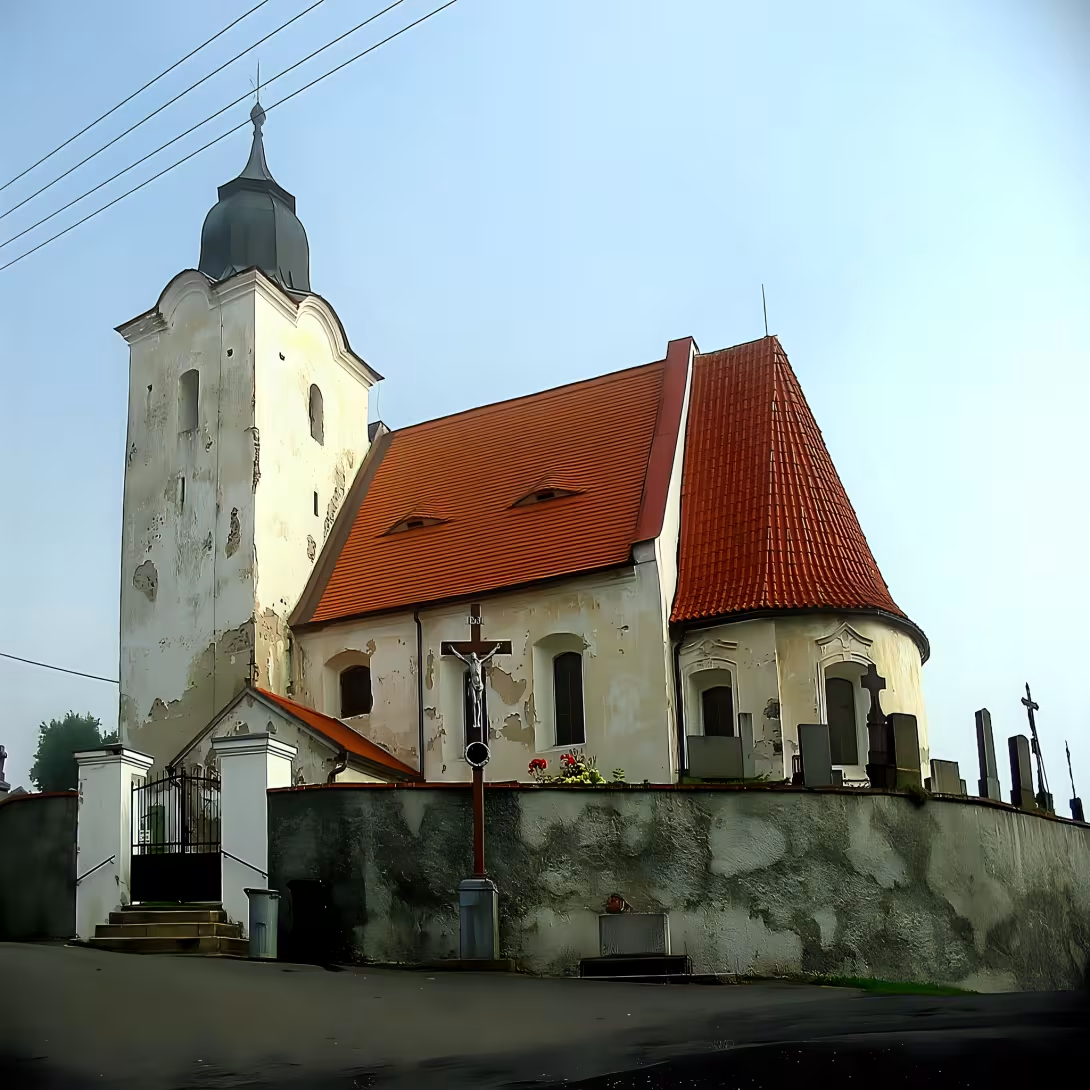
St. Wenceslas Church in Bukovník is among the oldest preserved buildings of Šumava foothills. This late Romanesque church stands at an altitude of 615 metres in the village Bukovník, located east of Susice in Klatov district. For the first time in historical sources - according to the memorial book of the village - is mentioned in 1240, which makes it among the early medieval buildings.
The church was built by Dobeczem (also known as Dobiah or Tobias) from Bukovníka, whose name is erschvílna in the list Přemysla Otakar II from 1251. At the same time, Vladyka built his seat at the church - a fortress - which he connected with the tower of the church with a balcony. This solution made the brick church a refuge for the inhabitants of the wooden fortress in case of threat. In the course of the following century, the skeleton gained an important role: in 1360 it became a parish church.
Over the centuries, the church went through a number of building changes. The choir was built around 1300, in the first half of the 14th century the building was expanded. During the Gothic reconstruction he obtained a presbytery with ribs arches, gothic sanctuaries and sedile. In 1690 it was modified in the Baroque style and extended with a new presbytery and chapel originally dedicated to Saint Joseph, which was later changed into the chapel of the Virgin Mary. Other modifications followed in the 18th century, when baroque windows, organ circle and south hall were added. In 1722 he went through another reconstruction, in 1855 he was restored from the outside and before World War I he received a new interior painting.
It is an architecturally oriented church with a massive square tower in the southwest corner. The construction was originally built from a quarry stone as a building of almost square shape with a rectangular presbytery and a detached apside. The oldest parts - the original Romanesque origin - are reminiscent of a well-designed southern portal with massive granite lining. The interior has a cassette ceiling with ornamental painting and a wooden circle in the western part. The chorus opens a winning arch with a broken archivolta, the chorus is encircled by a cross vault with pear ribs. Sakristia has a valentine tunnel vault with lunnets.
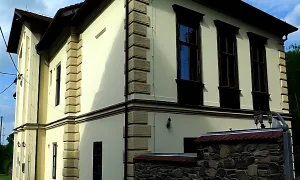
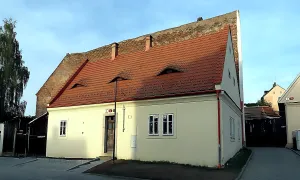
Today the church is surrounded by a cemetery and located at the north edge of the village. The area is surrounded by a wall with access from the main road and side roads. Access to the church is casual. East of it is a former rectory in late Baroque form, which is privately owned. For those who are interested in medieval architecture and the history of local foreplay administrators, the church offers a fascinating view of the transformation of construction from the early Middle Ages to the modern era.
Then and now
Drag the slider to compare how the landmark may have looked when it was built with the view today.
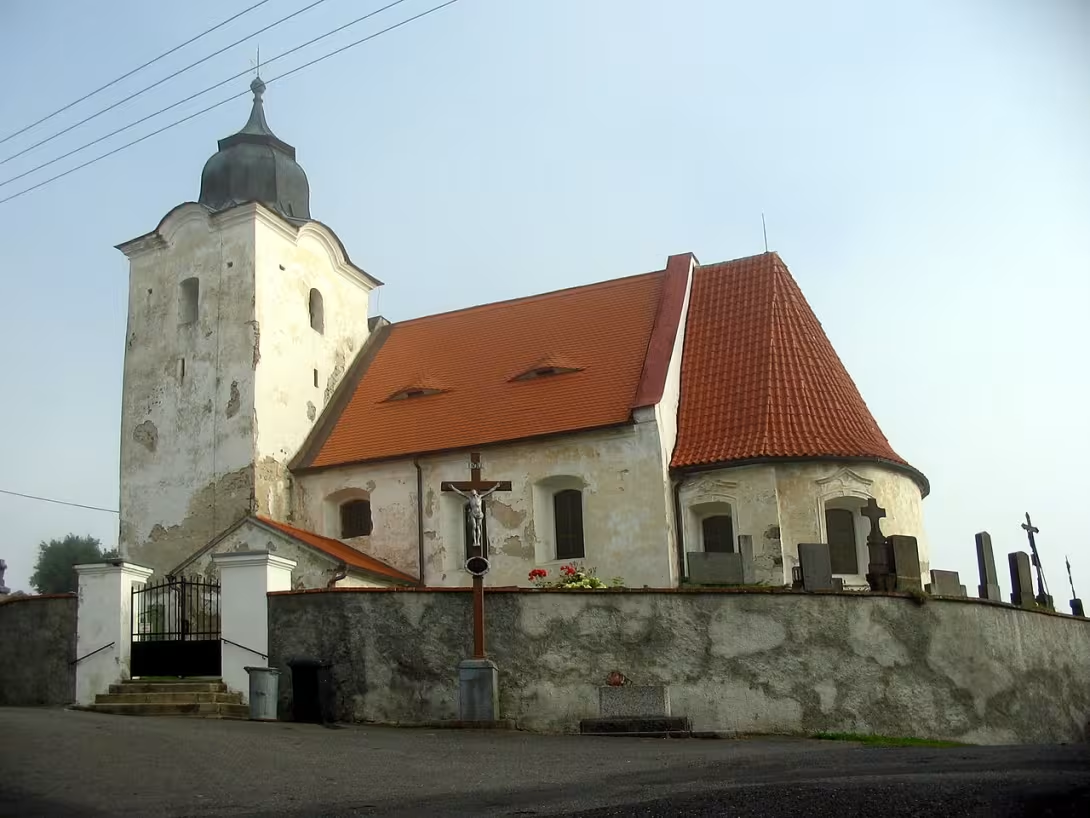

The historical appearance on the left is an AI-generated visualisation and serves as inspiration only.
Historical milestones
- 1240
- The first written mention of the church, founded by Dobčem of Bukovníka.
- 1251
- The mention of Dobce from Bukovníka in the charter of Rehysl Otakar II, joining the church with the fortress.
- 1300
- Adjust the choir.
- 1360
- The church became parochial.
- 1690
- Baroque adjustments, extension of the chapel of St. Joseph (later the Virgin Mary).
- 1722
- Baroque interior restoration.
Architectural development
The original Romanesque one-boat building with a semi-circular apside and a massive tower was gradually expanded. The Gothic reconstruction brought a presbytery with a cross vault and sacristy. In the 17th century there was a Baroque enlargement (a new presbytery, a chapel of the Virgin Mary) and in the 18th century there were internal modifications. From the original Romanesque, the southern portal and the apsid survived.
Historical events
- 1360
- The church became parochial.
- 1722
- Baroque interior and exterior modifications.
Points of interest
- The church of St. Wenceslas in Bukovník is one of the oldest preserved buildings in Šumava's foothills and is first mentioned in 1240.
- It was built by Dobeczem (also known as Dobiah or Tobias) from Bukovníka, whose name appears in the Mohysl Otakar II list of 1251.
- The church was originally connected to the steeple's fortress on the bleachers, thereby serving as a refuge for the inhabitants of the wooden fort in the event of a threat.
- In 1360 he became a parish church and during the centuries he underwent several building modifications, including the addition of the choir around 1300.
- The church interior retains the original Romanesque portal with a massive granite lining and later Baroque elements such as the organ ring and the chapel of the Virgin Mary.
Guide
This guide is narrated by a synthetic voice generated by artificial intelligence.
Show guide text
This text was created by artificial intelligence and has not been editorially reviewed. It may contain inaccuracies.
The Church of Saint Václav in Bukovník belongs to the late Romanesque buildings on the foothills of the Šumava region. The village lies east of Sušice in the Klatovy district. The church stands on its northern edge at an altitude of 615 meters. According to the parish record book, it is first mentioned in the year 1240.
It was built by the nobleman Dobecz of Bukovník, also called Dobiáš or Tobiáš. He is named in a charter of Přemysl Otakar the Second from the year 1251. Beside the church, the nobleman built a wooden fortress and connected it to the church tower with a wooden gallery that led to the choir loft. The stone church could thus serve the inhabitants of the fortress as a refuge in times of danger.
The original building was made of quarried stone. It consisted of an almost square nave to which was attached a rectangular presbytery and an offset apse. From the oldest period, a southern entrance portal with massive sandstone framing has been preserved, a semicircular apse with a conch and a double window on the northern side. The nave is separated from the presbytery by a wide triumphal arch.
Around the year 1300, a choir was added. It became a parish church in the year 1360. In the first half of the fourteenth century, a Gothic reconstruction enlarged the church by adding a presbytery with ribbed vaults. From the Gothic period, the sanctuary and the sedile, that is a niche with a seat in the wall, have survived to this day. The choir is vaulted with a cross vault with pear-shaped ribs and the pointed windows have retained their original tracery.
In the year 1690, the church was converted in the Baroque style and enlarged with a chapel. This chapel was dedicated first to Saint Joseph, later to the Virgin Mary. Further alterations came in the year 1722 and during the eighteenth century, when Baroque windows were added to the nave, the organ loft and a southern vestibule. The majority of the interior furnishings date from that period. From the outside, the church was renovated in the year 1855 and shortly before the First World War it received new paintings. The nave today is covered with a coffered ceiling with ornamental paintings. In its western part stands a wooden choir loft supported by columns.
The church is surrounded by a cemetery enclosed by a wall. The cemetery was originally in a field outside the village, but was later founded at the church and the remains of the deceased were transferred here. East of the church stands a former late Baroque rectory with outbuildings. Today it is in private ownership.
Tips for visitors
Best time to visit the church of St. Wenceslas in Bukovník is in spring or autumn when the weather is pleasant and surrounding nature is in full glory. In summer it can be quite busy here, especially during summer holidays, while in winter the visit is quieter, but some parts of the area may be difficult to access due to snow or ice. The Romanesque architecture of the church is best visible in sunny weather, where details of stone walls and window openings are displayed.
The church is available by car, parking is possible in a nearby parking lot or in free places around the village. If you arrive by public transport, it is recommended to check the current connection to Bukovník in the search engine. Admission is paid on site, the current price list can be found on the official site of the sights. It is recommended to arrive on time, especially in the summer months when there may be a crowd outside the church.
When visiting, wear comfortable shoes because the terrain around the church is partially uneven and covered with forest roads. It is also appropriate to take a map or navigation with you if you want to take a walk around. Bring warmer clothes in winter, because it can be cold even in sunny weather at an altitude of 615 meters. If you plan to stay longer, you will also bring water and refreshments.
The Church of St. Wenceslas offers several interesting places for photography. It is best photographed here in the morning or afternoon light, when the light falls sideways and highlights the details of Romanesque architecture. The most prominent places are the entrance portal, window openings and interior with original fresco. In the vicinity of the church there is also a beautiful view of the forest, which can be captured while walking along nearby roads.
In the vicinity of the church is worth visiting a former rectory located approximately 50 meters east of the church. This late Baroque rectory with economic facilities is now privately owned and offers an interesting view of historical architecture. For families with children, it is advisable to visit the surrounding forests of Šumava foothills where children can discover nature and walk through forest paths. There are also other historical and natural attractions within a 30-minute drive.
For families with children, a visit to St. Wenceslas' church is interesting because of its historical importance and pleasant environment. Children can look at ancient stone details and hear stories about the history of the church. It is possible to play in the surrounding area or to take a walk in the forest. It is also recommended to visit the former rectory, which can impress children with its appearance and the possibility of exploring the surrounding environment. It is also advisable for children to bring a laptop or drawing items to draw interesting details that they see.
Frequently asked questions
Is kostel svatého Václava (Bukovník) open to the public?
Yes, the church is generally open to the public. We recommend checking the current opening hours on the official site of the sights.
How do I get to the place by car / public transport?
The location is accessible both by car and by public transport. For accurate information about connections, we recommend using online search engines or contact details of the local transport company.
How much is the entrance fee and is it paid on the spot?
Admission fees are usually paid on the spot. Current prices can be found on the official site of the sights or contact the administration.
Is the tour suitable for children and seniors?
The tour is also accessible to children and seniors, but given the historical nature, it may be difficult for some people to walk the stairs. A performance about history and architecture is suitable for families with small children.
How long does the tour take?
A tour of the church can take from 30 minutes to an hour, depending on how much time you want to devote to detailed examination and photography.
What are the opening times and booking is required?
Opening hours may vary according to the period of the year. Reservation is often not necessary, but we recommend checking the current information on the official website or in the case of a telephone question.
What's interesting in the immediate vicinity?
Around the church there is a Šumava foothills offering beautiful walks and opportunities to observe local fauna and flora. In addition, it is possible to visit other historical places around Bukovníka.
For kids
More than 786 years ago, when everything was moving slower and the world was full of secrets, a strange building was created on a hill above the Šumava forests. It was like someone imagining a beautiful fairy tale and starting to pick it out of a time closet. St. Wenceslas Church in Bukovník seemed to be several thousand years older, but it was only built around 1240.
Businesses nearby
Do you run a restaurant, accommodation, shop, museum, rental, wellness or other visitor service near this monument? Show yourself directly to the people heading to it — this is how they will see you in the app and on the web:
Events nearby
Zdroj akcí: otevřená data měst a obcí ČR (Národní katalog otevřených dat) a kalendář akcí Národního památkového ústavu.
Accommodation nearby
Themed route
Thematic cruise route: St. Wenceslas Church (Bukovník) and surroundings
1. Church of St. Wenceslas (Bukovník) * Type: * Religious landmark * Why is it worth a visit: * This Baroque church, built in the 18th century, is not only the spiritual centre of Bukovník, but also architectural pearls with rich history and artistic elements. Its interior offers a view of beautiful altars and frescoes.
2. Former rectory * Type: * Historical building * Why is it worth visiting: * Situated just 50 metres from the church, the former rectory presents a late Baroque architecture with economic background. Today, privately owned, it is worth exploring its historical and architectural value.
3. Bohemian foothills * Type: * Natural area * Why is it worth a visit: * The church is located at an altitude of 615 meters, on the edge of a forested area with typical Šumava landscape beauty. This area offers opportunities to relax and explore the original vegetation and perhaps even the observations of wild animals.
4. Drying * Type: * City with historical core * Why is it worth a visit: * About 15 km west of Bukovník is located Susice, a city famous for its rich history and architectural monuments. It is an ideal place to explore historic streets, visit museums or stop in one of the local restaurants.
This route offers a combination of cultural and natural travel, ideal for those who like history and beautiful landscapes.
Seasonal recommendations
Spring During the spring, the church of St. Wenceslas in Bukovník is surrounded by a green coat of nature - surrounding forests and meadows flourish, while the sun's rays penetrate through bright trees and create a light game on stone walls. The morning fog often covers the surrounding hills, which gives the visit a mysterious atmosphere, especially during morning tours. The sound background is also specific - the singing of birds and the noise of the wind in the trees' crowns complements the calm of the church, which is even more intimate at this time of the year. It is practically appropriate to visit the memory early in the morning or in the afternoon when you avoid the main tourist flows to Pilsen. Clothes should be layered - spring weather is variable, and even when the sun welcomes, evenings can be cold. Comfortable shoes are also recommended, as the path to the church leads partly to forest paths.
Summer In summer the church of St. Wenceslas offers not only an historic atmosphere, but also an opportunity for walking around where warm sun days give off a pleasant summer mood. The surrounding landscape is dry and golden, the forests turn into green shadows that provide refreshments during walks. The evenings are quiet, and the church in the warm light of sunset is almost fabulous. In the main summer season, however, you can expect a higher interest for tourists, especially on Saturdays and Sundays. It is recommended to come early in the morning to enjoy a quiet environment and avoid crowds. Clothes should be easy, but with the possibility of covering up while visiting the interior, where it can be colder. Don't forget the sunglasses and hat - the sun in the summer months is intense.
Autumn Autumn brings to Bukovníka golden and red shades of leaves that create contrast with the dark walls of the church. At this time of year the surrounding nature is the most beautiful but also the most variable - the morning can be cold, while the noon brings warmer air. The atmosphere is calm and nostalgic, especially in November, when the forests begin to undress and the church stands as a symbol of endurance. In addition, small meetings or concerts often take place in the surrounding area in advent time, which provide a special charm. Practically it is advisable to visit the church in the morning when light is softer and nature still retains its autumn colors. Clothes should be warm, but not too heavy - autumn weather changes rapidly, and even when the sun shines, evenings are cold. Solid footwear is also recommended as wet leaves on the road can be slippery.
Winter Winter visit to St. Wenceslas Church is an experience for those who appreciate the peace and quiet that comes with the first snow. The church appears picturesque and mysterious in a white snow coat, while the surrounding forests turn into a winter fairy tale. The light of the winter sun, which falls through bright trees, creates interesting shadows on the stones of the church and gives the interior a special atmosphere. In winter, the church is less visited, which allows a quiet tour. However, opening times are shorter, and in some months the monument can only be accessible in limited hours. It is recommended to visit the church in the afternoon when the light is the most intense and the snow surfaces shine. Clothes should be warm and waterproof - winter weather in Pilsen region can be sudden and wet. Remember warm gloves and tight shoes, as the roads can be frozen or snowy.
Visualizations and artistic views


The visualisations are generated by artificial intelligence and serve as inspiration.
Photos from the area
Real photos taken near the monument


Zdroj a licence jsou uvedeny u každého snímku.
Tips from visitors
No tips yet. Be the first!
Log in and add your tip.
Sources and literature
Photos: Nissan0 / CC BY-SA 3.0, rozlišení zvýšeno umělou inteligencí — Wikimedia Commons. The author and licence also appear when you hover over the image.
Faktickým podkladem tohoto textu byl článek na Wikipedii, jehož autory jsou přispěvatelé Wikipedie. Článek je dostupný pod licencí CC BY-SA 4.0.
Location on the map
More monuments – Bukovník
Show all in the municipality

Příběhy a pověsti
Legendy, pověsti a příběhy spjaté s touto památkou
Fotografie návštěvníků
Zatím žádné fotografie. Buďte první, kdo přidá fotografii z návštěvy!
Log in a přidejte svou fotografii nebo hodnoťte.
Za ověřenou návštěvu v aplikaci získáte víc bodů — poznáme podle GPS, že jste na místě.
Reviews and comments