






kostel svatého Václava (Hrusice) Church
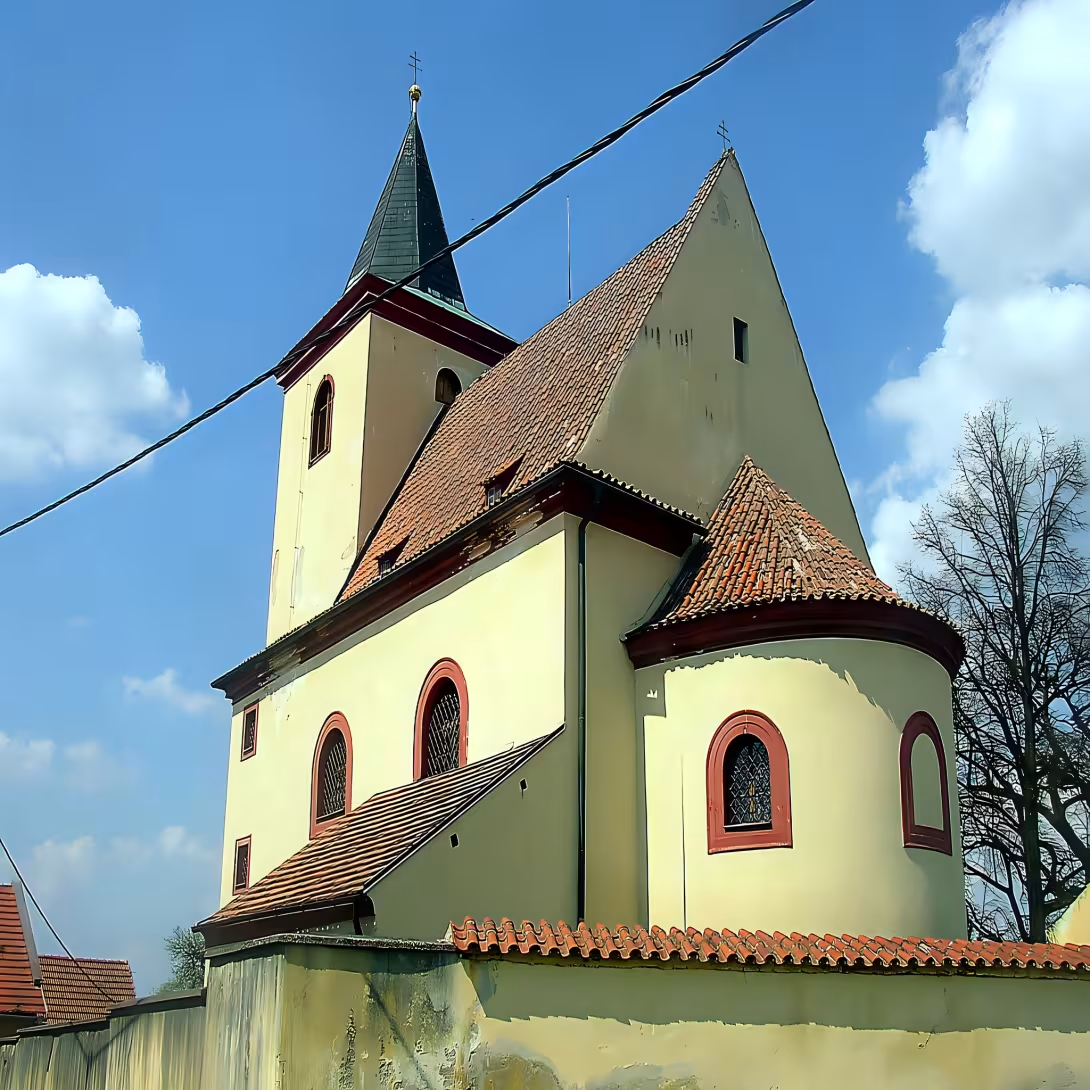
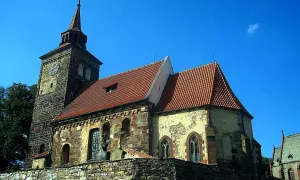
The Church of Saint Wenceslas in Hrusice is a captivating historical monument located on the village square. This Romanesque structure, enhanced with Baroque elements, is preserved as a cultural monument of the Czech Republic due to its architectural significance and rich history. It features an exquisite portal that provides insights into medieval craftsmanship and religious heritage.
The church's origins date back to 1225-1250, built in honor of Saint Wenceslas. Prior to this period, a chapel dedicated to Saint Vojtech existed nearby. By 1359, it was documented as a parish church, highlighting its community importance. Over time, the church experienced several ecclesiastical changes; notably, in 1624, Hrusice's parish was annexed to Mnichovice. However, by 1785, when Hrusice's parish became an independent locality, the church regained its dedication to Saint Wenceslas. In 1856, an independent parish was restored, reinforcing its role in local religious life.
Architecturally, the Church of Saint Wenceslas is fundamentally Romanesque with a single nave and semi-circular apse, complemented by a spire. Baroque renovations introduced significant modifications: the western portal of the tower was opened, a portico and sacristy were added, and the flat ceiling of the nave was vaulted with new windows. The original northern portal in the nave, previously bricked up, was accidentally discovered in 1853 when lightning struck the church’s tower.
The most valuable architectural feature is its Romanesque portal, renowned for stylized plant ornamentation and primitive figures on the tympanum. These figures are believed to represent either Saints Cyril and Methodius or Saints Wenceslas and Vojtech. The craftsmanship of the portal is attributed to Benedictine monks from Sázava Monastery, highlighting monastic artistry's influence in the region.
Throughout its history, the church has seen various changes in administration and ownership. After being annexed to Mnichovice's parish in 1624, it regained its status as a dedicated site for Saint Wenceslas by 1785. The restoration of an independent parish in 1856 marked another significant chapter in its ecclesiastical journey.
Today, the Church of Saint Wenceslas remains a testament to the region’s rich religious and architectural history. Visitors can explore its interior, featuring Baroque elements such as a main altar from the late 18th century with sculptures of the Virgin Mary, Saint Vojtech, and Saint Prokopius. Additionally, there are pseudoromantic side altars, pulpit, and images of the Stations of the Cross by Florian Mašek from the end of the 19th century. The church also houses two bells; while one was requisitioned during World War I, another dates back to 1579, crafted by renowned Prague bell-founder Brikcí z Cimperka.
The church's enduring legacy is celebrated through its depiction in various artworks and a miniature replica that stands in Boheminium Park in Mariánské Lázně since 2018. This monument serves as both a place of worship and a cultural beacon, inviting visitors to explore the historical narratives it embodies.
The Church of Saint Wenceslas is more than an architectural marvel; it is a living chronicle of Hrusice's spiritual and communal evolution. Its preservation allows appreciation of the intricate blend of Romanesque and Baroque styles that define its structure. For those interested in history, architecture, or religious heritage, this church offers a unique glimpse into the past and remains an essential destination for anyone visiting the region.
Then and now
Drag the slider to compare how the landmark may have looked when it was built with the view today.
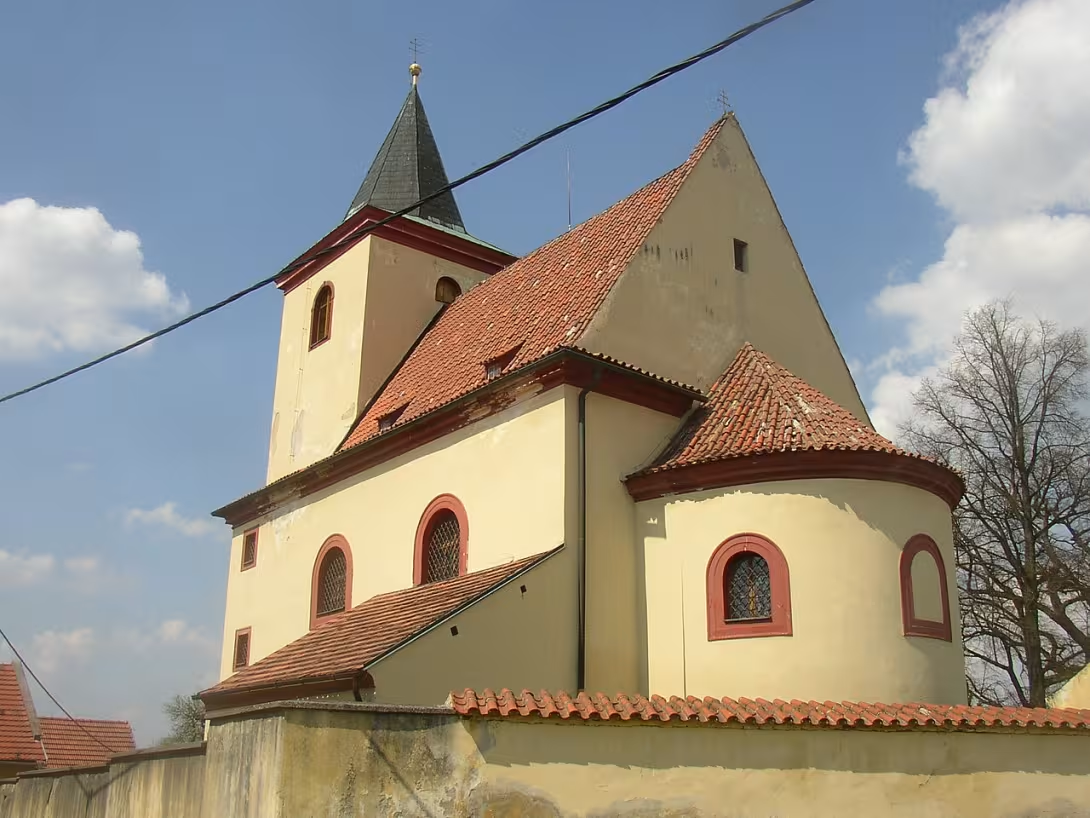

The historical appearance on the left is an AI-generated visualisation and serves as inspiration only.
Historical milestones
- 1225
- A chapel dedicated to Saint Vojtech existed earlier in Hrusice.
- 1359
- The church was documented as a parish church.
- 1624
- Hrusice's parish was annexed to the parish in Mnichovice.
- 1785
- The church regained its dedication to Saint Wenceslas when Hrusice's parish was elevated to a locality.
- 1856
- An independent parish was restored.
Architectural development
The church is fundamentally Romanesque with a single nave and semi-circular apse, featuring a spire. During Baroque renovations, the western portal of the tower was opened, a portico and sacristy were added, and the nave's flat ceiling was vaulted with new windows introduced. The original northern portal in the nave was bricked up until its accidental discovery in 1853.
Historical events
The church was originally dedicated to Saint Wenceslas and documented as a parish church by 1359.
In 1624, Hrusice's parish was annexed to the parish in Mnichovice.
By 1785, when Hrusice's parish was elevated to a locality, it regained its dedication to Saint Wenceslas.
In 1856, an independent parish was restored.
Points of interest
- The Church of Saint Wenceslas features a Romanesque portal with stylized plant ornamentation and primitive figures on the tympanum, believed to represent either Saints Cyril and Methodius or Saints Wenceslas and Vojtech. This artistic element reflects the influence of Benedictine monks from Sázava Monastery, showcasing monastic artistry in the region.
- In 1853, a lightning strike revealed an original northern portal in the nave that had been bricked up for years. This accidental discovery highlighted the church's layered architectural history and the changes it underwent over centuries.
- The church’s spire was significantly altered during Baroque renovations, which included opening the western portal of the tower. These modifications were part of a broader trend to infuse Romanesque structures with Baroque aesthetics, reflecting evolving artistic preferences in ecclesiastical architecture.
- One of the church's bells, dating back to 1579, was crafted by renowned Prague bell-founder Brikcí z Cimperka. This historical artifact survived through turbulent times, although another bell was requisitioned during World War I, indicating the church’s resilience and continuity amidst global conflicts.
- A miniature replica of the Church of Saint Wenceslas stands in Boheminium Park in Mariánské Lázně since 2018, celebrating its architectural and cultural significance. This replica allows visitors to appreciate the church's design on a smaller scale while highlighting its importance as part of Czech heritage.
Guide
This guide is narrated by a synthetic voice generated by artificial intelligence.
Show guide text
This text was created by artificial intelligence and has not been editorially reviewed. It may contain inaccuracies.
The Church of Saint Wenceslaus stands in the upper part of the village square in Hrusice. At its core, it is a Romanesque building that was later modified in the Baroque style. It was previously surrounded by a cemetery, from which a boundary wall with a gate remains. The entire complex is a cultural monument.
The church was founded no later than between 1225 and 1250. However, a chapel dedicated to Saint Adalbert had already stood in the vicinity of Hrusice earlier. The church is documented as a parish church from the year 1359. In the sixteenth century, it was rededicated to Saint Nicholas, and its dedication to Saint Wenceslaus was restored in 1785. The independent parish, which had been under Mnichovice for years, was re-established in 1856. After 1953, there has been no resident priest here, and services are conducted by a chaplain from Mnichovice.
It is a single-nave church with a semicircular apse and a prismatic tower. During the Baroque modifications, a portal was added on the western side of the tower, a portico, and a sacristy. The nave, which originally had a flat ceiling, received a vault and new windows. The original entrance in the northern wall was bricked up. It appeared again by chance in 1853 when lightning struck the tower and a crack appeared in the church wall.
This Romanesque recessed portal made of red sandstone is the most valuable part of the building. It was probably created by Benedictine monks from the Sázava Monastery. The capitals of the columns are decorated with stylized plant ornament. In the tympanum are two rather simply conceived figures on either side of a cross, raised on the back of a dragon. They may represent Saints Cyril and Methodius, or Saint Wenceslaus and Saint Adalbert. The sign above the portal is sometimes mistakenly considered to be the mark of Abbot Reginhard. However, it lacks a shield, and moreover, the portal did not arise during the abbot's lifetime. It is a purely Christological sign with a cross and lilies.
The Baroque main altar from the second third of the eighteenth century was transferred here from some Prague church. It is supported by statues of the Virgin Mary, Saint Adalbert, and Saint Prokop, with a statue of Saint Wenceslaus added at the top in 1809. A large painting of Saint Wenceslaus dates from 1619. The side altars, pulpit, and Stations of the Cross by Florian Mašek date from the end of the nineteenth century, and the organ from 1902. Two bells hang in the tower. A third, larger bell was requisitioned during the First World War. The smaller bell is from the fifteenth century, and the larger one was cast in 1579 by the Prague bellmaker Brikcí from Cimperka.
The church appears in various forms in many paintings by the local native son Josef Lada. Since 2018, a miniature of it has also stood in the Boheminium park in Mariánské Lázně.
Tips for visitors
The best time to visit the Church of Saint Wenceslas in Hrusice is during late spring or early autumn when the weather is pleasant, allowing you to comfortably explore both the interior and exterior of this historical site. These seasons offer a balance between avoiding the peak tourist crowds of summer and the potential for inclement weather in winter. The natural lighting during these times also enhances the beauty of the church's architecture and its exquisite portal.
For visitors preferring public transport, it is advisable to check current routes and schedules as they can vary. Both methods offer a convenient way to reach Hrusice and enjoy the serene surroundings of this historical site without the stress of navigating unfamiliar roads.
When planning your visit, consider bringing comfortable walking shoes for exploring the church grounds and its vicinity. A camera or smartphone is recommended to capture the stunning architectural details and the tranquil landscape around the church. Additionally, carrying a light jacket can be beneficial as temperatures may vary throughout the day, especially in spring and autumn.
Photography enthusiasts will find several spots within and around the Church of Saint Wenceslas that offer unique perspectives. The best natural lighting for photography is usually during the golden hours—shortly after sunrise or before sunset—when the light casts a warm glow on the church's facade and its surroundings. Experimenting with different angles can also reveal captivating views of the medieval portal and the blend of Romanesque and Baroque elements.
For families visiting with children, there are several engaging activities to enjoy within a 30-minute radius of Hrusice. Exploring nearby natural landscapes offers opportunities for outdoor fun, such as picnicking or short hikes suitable for all ages. These areas provide a peaceful setting for family bonding while appreciating the beauty and history of the region.
Frequently asked questions
Can the monument be visited?
Religious buildings are usually open mainly during services; at other times a visit is normally arranged with the parish or the operator. We have not verified specific times.
Where is the monument?
Location: Hrusice, Středočeský kraj. The map on this page shows the exact spot.
Why is the monument protected?
It is listed in the Central List of Cultural Monuments of the Czech Republic as a cultural monument (register no. 15233/2-2070).
Businesses nearby
Do you run a restaurant, accommodation, shop, museum, rental, wellness or other visitor service near this monument? Show yourself directly to the people heading to it — this is how they will see you in the app and on the web:
Events nearby
Zdroj akcí: otevřená data měst a obcí ČR (Národní katalog otevřených dat) a kalendář akcí Národního památkového ústavu.
Accommodation nearby
Themed route
Tematická výletní trasa z Hrusic
1. Kostel svatého Václava (Hrusice)
Typ: Historická památka
Tento barokní kostel je hlavním cílem vaší návštěvy a slouží jako významný kulturní bod ve Středočeském kraji. Jeho architektura a historie přitahují mnoho návštěvníků, kteří se zajímají o duchovní i umělecké dědictví regionu.
2. Obecní úřad Hrusice
Typ: Historický stavební objekt
Přibližně 200 metrů od kostela se nachází obecní úřad, který je umístěn v historickém budově. Je to skvělá příležitost prozkoumat místní správu a pochopit dnešní život ve vesnici Hrusice.
3. Mikulášský sloup
Typ: Historická památka
Tento sloup, nacházející se v centru obce, je další historicky zajímavou památkou. Je spojen s místními tradicemi a poskytuje vhled do minulosti Hrusic, kde byl kdysi místo pro modlitby a svátky.
4. Kaple Panny Marie
Typ: Religiozní památka
Kaple je umístěna blízko kostela svatého Václava, což z ní činí snadný přídavek k vaší trase. Je známá pro svou malost a intimní atmosféru, která nabízí klidné okamžiky meditace.
Tato trasa vás provede skrze historické a kulturní centrum Hrusic, přičemž každý bod poskytuje jedinečný pohled na místní dědictví.
Seasonal recommendations
Spring: Visiting the Church of Saint Wenceslas during spring offers a unique experience as nature begins to awaken, with blooming flowers and lush greenery enhancing the serene atmosphere around Hrusice. The soft light filtering through budding leaves creates a gentle illumination that beautifully highlights the church's architectural details. This period often sees fewer visitors compared to summer, making it an ideal time for those seeking tranquility. It is advisable to wear layers as temperatures can vary; mornings and evenings might be cool while afternoons become pleasantly warm. Arriving early in the day allows you to enjoy the site with minimal crowds.
Summer: Summer at the Church of Saint Wenceslas is characterized by vibrant sunshine that accentuates the church’s stonework, providing a picturesque setting for visitors. The long daylight hours offer ample time to explore and appreciate the historical details of this landmark. However, this season also attracts larger crowds, especially during peak tourist times in July and August. To avoid the busiest periods, consider visiting early in the morning or later in the afternoon. Comfortable walking shoes and light clothing are recommended due to warmer temperatures, along with sun protection like hats and sunscreen.
Autumn: Autumn brings a stunning transformation as the surrounding landscape of Hrusice is painted in rich hues of red, orange, and gold. The changing leaves create a warm, inviting atmosphere that complements the historical charm of the Church of Saint Wenceslas. This season tends to be less crowded than summer, offering a more relaxed visit. As temperatures begin to cool, it's wise to wear layers and bring a light jacket for the crisp air. Early morning visits can provide optimal lighting conditions for photography and a quieter experience.
Winter: The winter months envelop the Church of Saint Wenceslas in a quiet, almost magical atmosphere as snow blankets the landscape around Hrusice. This season offers a unique opportunity to see the church against a backdrop of pristine white, with its architectural details standing out sharply. It's essential to dress warmly in layers and wear sturdy boots or shoes suitable for snow. Visiting during weekdays can help avoid any increased weekend crowds that might gather despite the cold.
Visualizations and artistic views


The visualisations are generated by artificial intelligence and serve as inspiration.
Photos from the area
Real photos taken near the monument


Zdroj a licence jsou uvedeny u každého snímku.
Tips from visitors
No tips yet. Be the first!
Log in and add your tip.
Sources and literature
Photos: User:Miaow Miaow / Public domain, rozlišení zvýšeno umělou inteligencí — Wikimedia Commons. The author and licence also appear when you hover over the image.
Faktickým podkladem tohoto textu byl článek na Wikipedii, jehož autory jsou přispěvatelé Wikipedie. Článek je dostupný pod licencí CC BY-SA 4.0.
Location on the map

Příběhy a pověsti
Legendy, pověsti a příběhy spjaté s touto památkou
Fotografie návštěvníků
Zatím žádné fotografie. Buďte první, kdo přidá fotografii z návštěvy!
Log in a přidejte svou fotografii nebo hodnoťte.
Za ověřenou návštěvu v aplikaci získáte víc bodů — poznáme podle GPS, že jste na místě.
Reviews and comments